

 Français
 Sole trader tax return: the complete guide
Master your sole trader tax return with our practical guide. Proven strategies and expert advice to optimize your tax situation.

The fundamentals to master before you start

Before filing your tax return as a sole trader (micro-entrepreneur), a solid understanding of the basics is essential. Mastering the tax calendar, the dedicated platforms and the consequences of a late filing will ensure smooth, stress-free administration.
The tax calendar and platforms to use
Sole traders need to become familiar with the tax calendar specific to their scheme. This calendar sets out the deadlines for filing and paying taxes and social contributions. Two platforms are essential: the impots.gouv.fr website for the income tax return, and the autoentrepreneur.urssaf.fr portal for declaring and paying social contributions. Both platforms offer simplified interfaces to make things easier.
For effective management, it’s important to clearly distinguish tax obligations, relating to income tax, from social obligations, linked to social security and pension contributions.
The consequences of a late filing
Filing your taxes after the deadline can result in financial penalties, usually in the form of surcharges on the amounts owed. Meeting deadlines and organizing ahead of time are therefore essential to avoid these sanctions. Staying informed about changes to the tax regime and related regulations, such as the pest-control obligation in co-ownership properties, also matters.
Preparing documents and key thresholds
Preparing your return in advance by gathering the necessary documents, such as invoices, bank statements and expense receipts, will save you time and reduce errors.
In 2025, the maximum turnover threshold for the micro-entreprise scheme will be €77,700 for services. This threshold is decisive for your eligibility. Note that even with zero turnover, filing remains mandatory — you must indicate “nil” on the URSSAF website.
The flat-rate final withholding (versement libératoire), which lets you pay income tax at the same time as your social contributions, can be an advantageous option. The request must be made before September 30 of the previous year, or within three months of setting up your business. For more details on the topic, see the official documentation on thresholds and the flat-rate withholding option. You can also read this article: How to become a sole trader.
Mastering these fundamentals will let you approach your sole trader tax return with confidence and efficiency.
Choosing the tax option that fits your situation
Choosing the most advantageous tax scheme for your sole proprietorship is an important decision. Two main options are available: the standard scheme, with its progressive tax bands, and the flat-rate final withholding, which is simpler and more predictable. It’s essential to understand the specifics of each scheme in order to make the choice best suited to your situation.
The standard scheme: progressive taxation
The standard scheme applies the progressive income tax bands. This means the tax rate increases with your income. Advantageous for lower incomes, this system lets you benefit from the reduced-rate bands. It is also applied by default, simplifying your administrative steps.
The flat-rate final withholding: simplicity and predictability
The flat-rate final withholding, on the other hand, involves paying a fixed tax, calculated as a percentage of turnover, at the same time as your social contributions. This percentage varies depending on your activity (sales, services, etc.). Its main advantage? Simple calculation and predictable tax charges. However, it may be less attractive for sole traders with a large number of tax shares or low income.
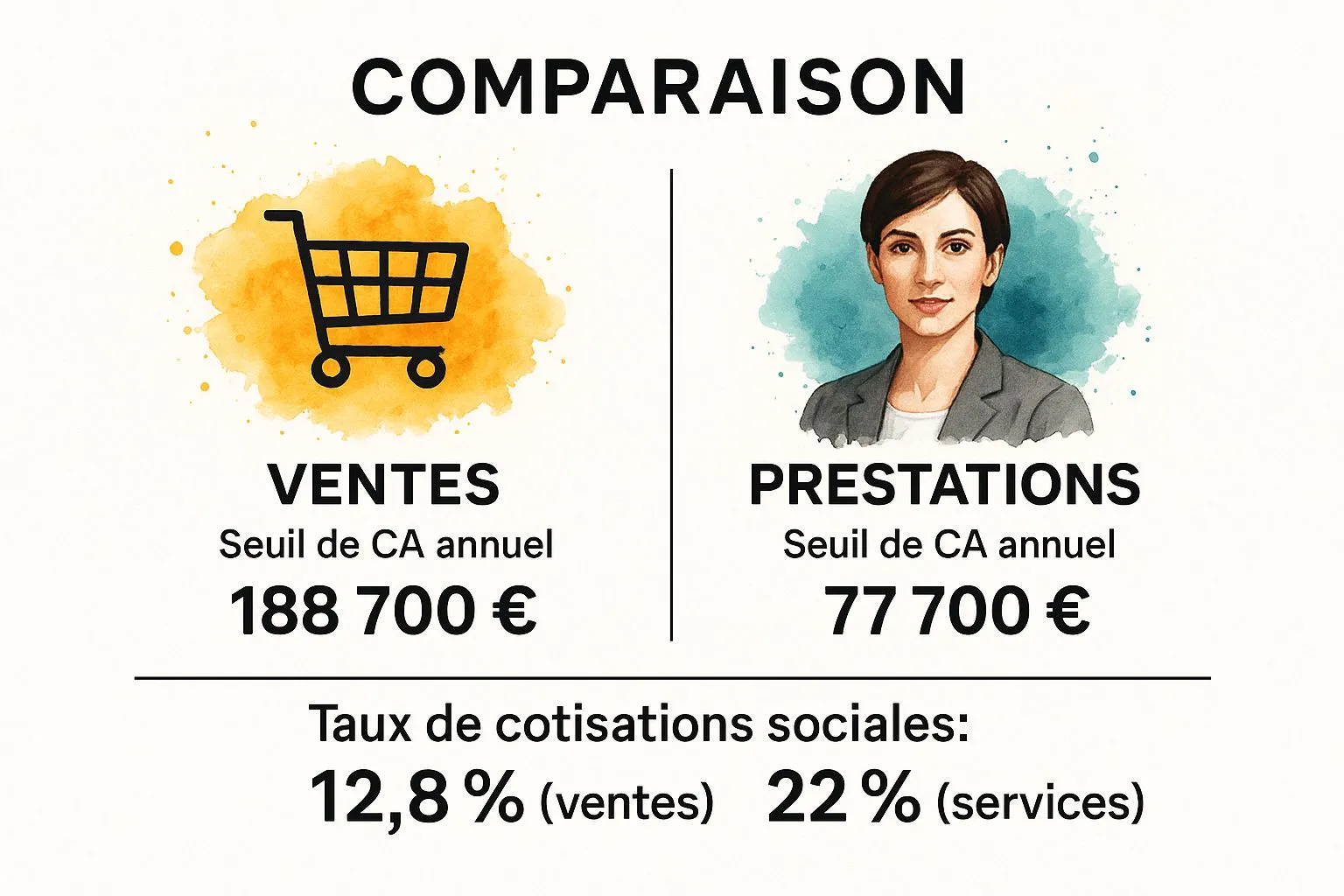
The infographic above illustrates the turnover thresholds and social contribution rates for sales and service activities. This data is essential for comparing the two tax schemes and making an informed decision.
To help you see things more clearly, here’s a comparison table of the two options:
The two tax options side by side
A detailed comparison of the advantages and drawbacks of each tax option to help you make the decision best suited to your specific situation
| Feature | Standard scheme | Flat-rate final withholding |
|---|---|---|
| Tax calculation | Progressive income tax bands | Fixed percentage of turnover |
| Advantage | More advantageous for lower incomes | Simplicity and predictability of charges |
| Drawback | Complexity of calculation | Can be less advantageous with more tax shares or low income |
| Steps | Applied by default | Requires a request |
This table summarizes the key points of each scheme and highlights their differences. Feel free to use a simulator to estimate your tax under each option.
Eligibility conditions and steps for the flat-rate final withholding
The flat-rate final withholding is subject to eligibility conditions, notably a turnover cap. The request must be made before September 30 for the following year, or within three months of setting up your sole proprietorship. The choice of scheme depends on several factors, such as your personal situation, your projected turnover and your risk tolerance.
The standard scheme, meanwhile, uses flat-rate allowances on turnover to determine taxable income. These allowances are 71% for buy-resell activities, 50% for services (BIC) and 34% for liberal professions (BNC).
Adapting your choice over time
Your situation and income can change. It’s therefore important to reassess your tax choice every year. Switching schemes can prove beneficial and let you optimize your tax charges. Don’t hesitate to run simulations regularly to check which scheme remains the most advantageous for you.
Calculating your taxable income without errors
Calculating your taxable income as a sole trader can seem complicated. However, with a simple method and concrete examples, it becomes much clearer. Let’s look at how flat-rate allowances work and how they apply.
Understanding the role of allowances is essential. The flat-rate allowance is a percentage applied to your turnover to determine your taxable income. This percentage, which simplifies your tax return, varies according to your activity and represents your expenses without the need for supporting documents.
Take the example of a sole trader providing services with €20,000 in turnover. With a 50% allowance, their taxable income is €10,000.
To help you see things more clearly, here’s a summary table:
Tax allowances by activity type
Discover how allowances apply to your turnover depending on your business sector, with concrete examples to clarify your specific situation
| Activity type | Allowance rate | Example for €10,000 turnover |
|---|---|---|
| Buy-resell activities | 71% | €2,900 |
| Services (BIC) | 50% | €5,000 |
| Liberal professions (BNC) | 34% | €6,600 |
This table shows the impact of your activity on the calculation of your taxable income. The allowance rate directly influences the final amount.
Applying the allowance and filing
After applying the allowance, you obtain your taxable income, which is the basis for calculating your income tax. This amount must be reported on your income tax return (form 2042-C-PRO). Choose the box corresponding to your activity (BIC or BNC).
Multiple activities: a special case
If you have another activity (such as employment), you must add up the taxable income from each activity to obtain your overall taxable income. Each activity is treated individually with its own allowance. For example, if you earn €15,000 as an employee and €10,000 in buy-resell activity (after a 71% allowance), your overall taxable income will be €15,000 + €2,900 = €17,900.
The importance of precision
An accurate calculation of your taxable income is crucial. An error can lead to a tax reassessment. Online tools, such as Bizyness, can help you automate these calculations and minimize errors. This lets you stay compliant while legally optimizing your taxation. If in doubt, don’t hesitate to consult a chartered accountant.
Managing your tax return with mixed activities
Being a sole trader offers welcome flexibility, allowing many people to combine it with employment or another form of self-employment. This multi-activity situation, a source of opportunity, makes the tax return more complex. It’s therefore essential to understand the specifics of this situation for optimal management of your tax obligations.
Combining employment and a sole proprietorship
Combining employment with a sole proprietorship is a common practice. You must declare income from both activities. Employment income is declared via your payslip, while sole trader income is declared via form 2042-C-PRO. The flat-rate allowance still applies to your sole trader turnover.
For example, for €10,000 in turnover from services, your taxable income will be €5,000 after the 50% allowance. This amount is added to your employment income for the calculation of your overall income tax.
Running several self-employed activities
Running several self-employed activities under the sole trader scheme means considering each activity separately. The allowance corresponding to each activity must be applied.
If you offer services and sell products, you’ll apply a 50% allowance to the turnover from services and 71% to that from sales. The taxable income from each activity is then added together to determine your overall taxable income.
Impact on contributions and thresholds
Multiple activities also affect your social contributions. The turnover thresholds for staying in the micro-entreprise scheme apply to each activity. Exceeding the threshold for one activity triggers a switch to the standard tax regime for that activity only.
In 2023, the micro-entreprise scheme retained its appeal thanks to its simplified management. To learn more about how sole-trader status has evolved. Tracking turnover for each activity is therefore crucial to respect the caps.
Choosing between tax options
The tax option (standard scheme or flat-rate final withholding) must be considered in the case of multiple activities. The optimal choice depends on your overall situation, including all your income. Simulating both options helps identify the more advantageous one. The flat-rate final withholding can be worthwhile if your sole trader income is low, even with a higher salary.
The importance of organization
Managing mixed activities requires rigorous organization. Keeping separate accounts for each activity and holding onto all supporting documents is essential. This makes filing your income easier and avoids errors. Tools like Bizyness can automate part of your bookkeeping. By mastering these aspects, you’ll fully benefit from the advantages of multiple activities while meeting your tax obligations.
Avoiding costly pitfalls for entrepreneurs
Filing your taxes as a sole trader requires particular care. Some mistakes, though common, can have significant financial consequences. This guide will help you identify the most frequent pitfalls and put in place solutions for a stress-free sole trader tax return.
Confusing receipts and invoicing
A classic mistake is confusing receipts with invoicing. Invoiced turnover, not money received, is the basis of your return. For example, a service invoiced in December but paid by the client in January must be declared in December. This principle is essential for a compliant sole trader tax return.
Errors in applying allowances
Applying flat-rate allowances is another common source of problems. Applying the correct percentage for your activity is crucial. Using a 71% allowance for services, when the rate is actually 50%, can trigger a tax reassessment. Carefully check the rate that applies to your activity for your sole trader tax return.
Missed filings and their consequences
Forgetting to file, even with zero turnover, is a mistake to avoid. Declaring “nil” is mandatory. Any omission can result in penalties. Likewise, failing to declare income received after ceasing activity, even if deferred, will have tax consequences. This income must be declared as part of your sole trader tax return.
Preventive solutions and correcting errors
Simple solutions can help you avoid these pitfalls:
- Keep rigorous records: Record every invoice with its amount, regardless of when payment is received.
- Check the allowance rate: Make sure you apply the correct percentage for your activity.
- Use accounting software: Bizyness, for example, automates certain tasks and reduces errors.
- Consult a chartered accountant: A professional can help you if in doubt.
If, despite these precautions, an error creeps into your return, correction procedures exist. Contact your local tax office (Centre de Finances Publiques) to find out the process. A quickly corrected sole trader tax return minimizes the risk of penalties. Anticipation and organization are the keys to a successful sole trader tax return.
Legal and effective tax optimization strategies
Filing your taxes as a sole trader is an obligation, certainly. But it’s also an opportunity — a chance to optimize your taxation in a legal and effective way. Turning this process into a real asset for your business is possible thanks to simple, proven strategies.
Planning investments and invoicing
The end of the fiscal year is a key moment to optimize your taxation. Anticipating purchases of equipment needed for your business can help reduce your taxable base. Similarly, managing your invoicing intelligently — for example by grouping certain invoices before the year-end close — can positively influence your taxable income.
Take a concrete example: investing in equipment before the end of the year can reduce your taxable profit and therefore the amount of tax due. This kind of planning is a major asset for the good management of your sole proprietorship.
Changing schemes: an opportunity worth considering?
The micro-entreprise scheme is often popular when starting a business, thanks to its simplicity. However, as your turnover grows, it can become less advantageous. Regularly hitting the turnover thresholds is a signal not to ignore. Switching schemes, for example to the simplified standard regime, can then become more relevant in the long run.
This new scheme lets you deduct all your actual expenses, unlike the micro-entreprise scheme, which applies a flat-rate allowance. An important point to keep in mind.
Setting up a company: an option to consider
For some sole traders, setting up a company (EURL, SASU) can prove to be an interesting option above a certain income level. This transformation significantly impacts your taxation and your social status.
It’s therefore essential to analyze your current income, your growth projections and your social protection needs before making a decision. Don’t hesitate to consult a chartered accountant to weigh the pros and cons of each option.
The importance of staying informed
Tax legislation is constantly evolving. Staying up to date with changes and new opportunities is therefore crucial to optimizing your tax situation. Resources such as the official tax website or specialized blogs, like that of Bizyness, can provide valuable information. You can, for example, read this article: Tax optimization for sole traders.
In conclusion, tax optimization is an ongoing process that requires regular attention. By taking a proactive approach and keeping up with changes, you can turn your tax return into a real management tool for your sole proprietorship. Support from a professional can also help you put in place a strategy tailored to your specific needs.
Adapting to changes in the tax regime
The tax regime for sole traders is a constantly evolving field. Anticipating these changes is essential to stay compliant and optimize your management. This article analyzes recent changes and their impact, and offers you strategies to adapt and navigate this landscape with confidence.
Impact of changes on your business
Legislative changes affect various aspects of the micro-entreprise scheme, notably the turnover thresholds. An increase in these thresholds can be a development opportunity for your business. Conversely, a decrease may require you to adapt your commercial strategy. Social contribution rates can also fluctuate, directly affecting your profitability. Finally, filing obligations are sometimes changed, requiring you to update your practices.
For example, an increase in the turnover threshold for services would let you invoice more while still benefiting from the simplified micro-entreprise scheme. Conversely, a decrease in this threshold could lead you to consider switching to the standard regime.
Strategies for adapting to change
To take advantage of these changes and turn them into opportunities, here are a few pointers:
- Regulatory monitoring: Stay informed of legislative changes. Regularly check reliable sources such as the official tax website (impots.gouv.fr) or specialized blogs such as the Bizyness blog. For example, you could read this article: Our article on VAT for sole traders.
- Adapting your business model: If turnover thresholds change, adjust your pricing strategy or offerings to stay competitive.
- Optimizing your expenses: If social contributions change, look into legal ways to optimize them and preserve your profitability.
- Anticipating new obligations: Prepare ahead of time for changes to filing requirements to avoid errors and potential penalties.
Resources to stay informed
Various resources let you keep track of how the scheme evolves:
- The official sole trader portal: This is the official, reliable and regularly updated source of information.
- Specialized newsletters: Subscribe to newsletters from organizations or specialized websites to receive information directly by email.
- Chartered accountants: Personalized support can help you understand how changes affect your specific situation.
- Accounting software: Some tools, like Bizyness, generally incorporate the latest regulatory updates.
Making regulatory monitoring part of your routine
Making regulatory monitoring part of your routine as an entrepreneur shouldn’t be a burden. Set aside a regular time slot, for example one hour a month, to stay on top of the latest news. Set up tracking tools, such as Google Alerts or RSS feeds, to be notified of important changes. Finally, don’t hesitate to talk with other sole traders or experts to exchange information and best practices.
By adapting your practices and staying informed, you’ll be able to turn changes in the tax regime into opportunities for your business. Take control of your management with Bizyness, a tool that simplifies your accounting and lets you focus on growing your business.