

 Français
Tax return for sole traders made simple and fast
The guide to your sole trader tax return. Master the process, choose the right tax regime and avoid common mistakes.

The income tax return for a sole trader (micro-entrepreneur) is that unavoidable yearly appointment, even when you already pay your URSSAF contributions every month or every quarter. It’s the final step where you report your gross revenue for the past year on the supplementary 2042-C PRO form. And yes, it’s mandatory, even if you opted for the flat-rate withholding (versement libératoire).
Demystifying your first tax return

Tackling your first tax return as a sole trader can feel daunting. You hear about different forms, different tax regimes… it’s easy to feel overwhelmed. But don’t panic! Once you’ve grasped a few basic concepts, the path becomes much clearer.
The first thing to do is clearly distinguish your URSSAF declarations from your annual income tax return. These are two completely different processes, even though they’re linked.
-
URSSAF declarations: You know these well — your monthly or quarterly appointments. This is where you declare the revenue (turnover) you’ve just collected in order to pay your social contributions. If you chose this option, it’s also how you pay your income tax, via the flat-rate withholding.
-
The annual income tax return: This happens in spring. It’s used to present the tax authorities with a summary of all your income from the previous year (N-1). This is when you’ll need to fill out the well-known 2042-C PRO form.
Understanding the two tax options available to you
How you fill out your return depends directly on the tax regime you chose at the outset. As a micro-entrepreneur, you have two options: the standard regime (also called micro-fiscal) or the flat-rate withholding (versement libératoire). If you’re on the standard regime, it’s simple: the tax authorities themselves apply a flat-rate allowance to your turnover to determine your taxable income.
The golden rule: Never calculate or deduct this allowance yourself. Your only job is to declare your gross turnover, exactly as you collected it. The tax authorities handle the rest.
Choosing between these two regimes isn’t trivial — it’s a strategic decision that directly affects the amount of tax you pay. It all depends on your personal situation and your reference tax income. To avoid headaches, tools like Bizyness prove invaluable. They track your turnover down to the cent, making it much simpler and more reliable to report the right figures when the time comes.
It’s also essential to keep an eye on regulatory changes. For example, for 2025 income, the turnover threshold for liberal professions was adjusted to €15,000, which calls for extra vigilance over the revenue declared to URSSAF. To dig deeper, feel free to check the official fact sheets on entreprendre.service-public.fr.
Choosing the right tax regime: the key to a healthy micro-business
Choosing your tax regime is probably the most decisive decision you’ll make for the financial health of your micro-business. It’s what determines how — and how much — tax you’ll pay. In practice, you have two main options: the flat-rate withholding (versement libératoire) or the standard micro-fiscal regime.
Taking the time to properly understand their differences is crucial to optimizing your taxes and avoiding unpleasant surprises when it’s time for your sole trader tax return.
Flat-rate withholding: simplicity above all
The flat-rate withholding (VFL) is often the favorite among sole traders, and for good reason: its simplicity. The principle is straightforward. You pay your income tax at the same time as your social contributions, whether monthly or quarterly, directly to URSSAF.
A fixed, final percentage is applied to your turnover:
- 1% for the sale of goods (BIC).
- 1.7% for commercial or craft services (BIC).
- 2.2% for liberal professions and services (BNC).
This option can be a real advantage if your household isn’t taxable or falls into the lowest tax brackets. You pay a low tax on your business income, and that’s it. No adjustment the following year, no complex calculations.
When is flat-rate withholding a good deal? Take the example of a single graphic designer whose household isn’t taxable. They generate €25,000 in annual turnover. With the VFL, their tax will be €25,000 x 2.2% = €550. Without this option, their taxable income after the 34% allowance would be €16,500. They would fall into the 11% bracket, resulting in a much higher tax bill.
Be careful — to be eligible, there’s an income condition. Your reference tax income (RFR) for year N-2 must not exceed a certain cap (for example, €27,478 for a single person for 2024 income). Be sure to check this figure every year!
This infographic will help you visualize the pace of your declarations, a rhythm that has a direct impact on the VFL.
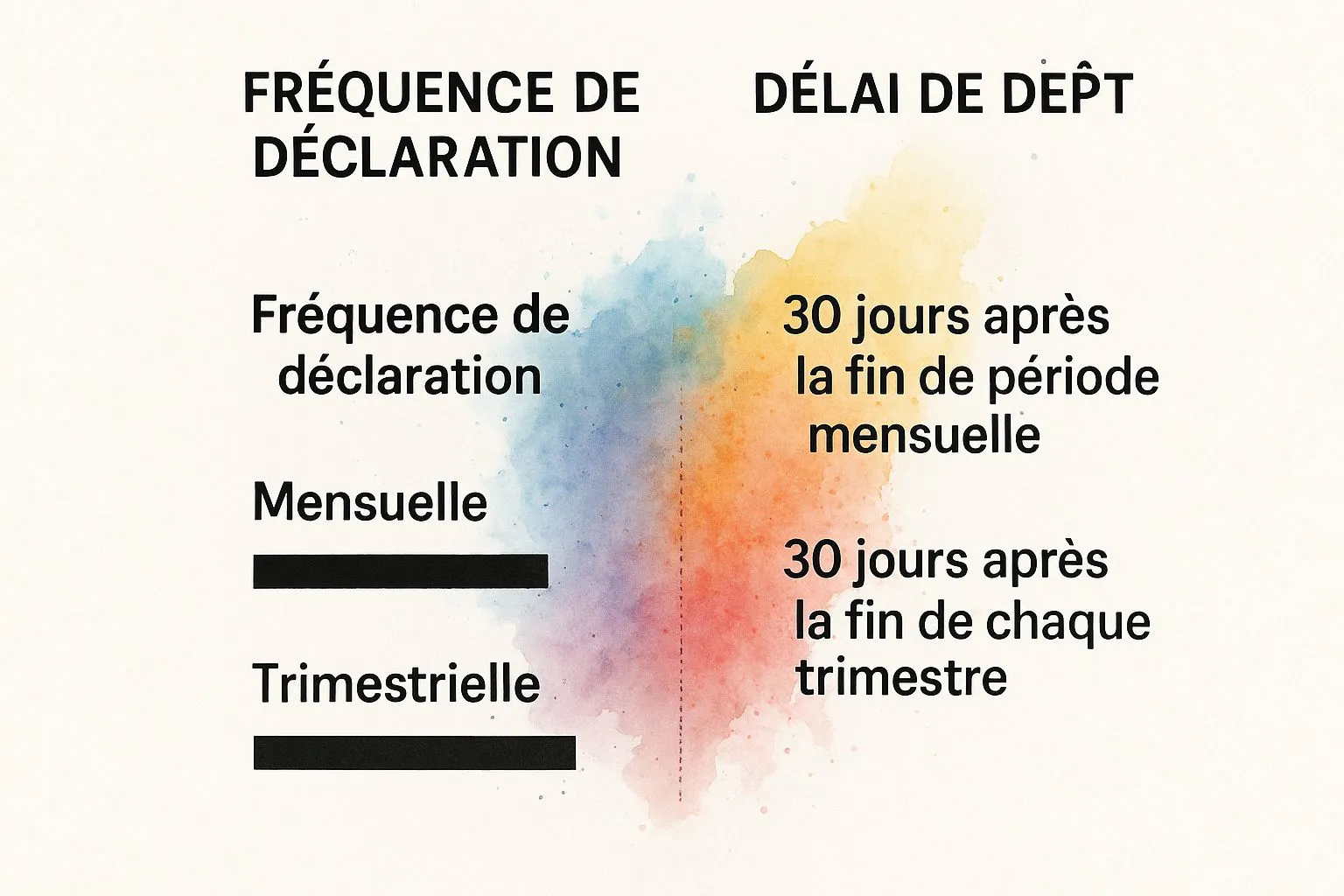
The image clearly highlights the regularity required, whether you’ve chosen a monthly or quarterly pace. This discipline is essential when tax is withheld at the same time as your contributions.
The micro-fiscal regime: the allowance as your ally
If you don’t opt for the VFL (or simply aren’t eligible), you fall by default under the micro-fiscal regime. The logic is different: here, you pay no tax to URSSAF as you go. Your only obligation is to declare your gross annual turnover on the supplementary 2042-C PRO form.
From this amount, the tax authorities apply a flat-rate allowance for business expenses before calculating your tax:
- 71% for buying and reselling goods.
- 50% for BIC services.
- 34% for BNC services and liberal professions.
The remaining income is then added to the rest of your household’s income, and the total is subject to the progressive income tax scale. This regime becomes more attractive if you’re already in a high tax bracket, or if your actual expenses are well below the flat-rate allowance. The allowance then becomes more advantageous than the VFL’s fixed rate.
Comparing tax regimes for sole traders
To make things clearer, here’s a table summarizing the key points of each option. It will help you weigh the pros and cons based on your personal situation.
| Criterion | Flat-rate withholding (VFL) | Micro-fiscal regime (standard) |
|---|---|---|
| Tax payment | Monthly or quarterly, with social contributions | Annual, after the income tax return |
| Calculation basis | Gross turnover (no allowance) | Gross turnover minus flat-rate allowance |
| Tax rate | Fixed (1%, 1.7% or 2.2% depending on activity) | Progressive income tax scale |
| Eligibility condition | Yes, based on reference tax income from year N-2 | None (default regime) |
| Ideal for… | Households with little or no tax liability | Households already in high tax brackets |
The choice therefore depends entirely on your profile. Simplicity and immediate visibility with the VFL, or optimization through a potentially generous allowance with the standard regime.
To help you make the right decision, don’t hesitate to run some simulations. You can use the calculation tools provided by URSSAF, which are very well designed for this purpose.
Filling out your tax return step by step

Theory is one thing, but let’s get down to business now: practice. Filling out your sole trader tax return can quickly feel like an obstacle course. Yet, with the right guidance, it’s nothing more than an administrative formality. I’ll walk you through the impots.gouv.fr interface so you know exactly where to click and what to fill in, without the headache.
The heart of the matter is the 2042-C PRO supplementary form. This is the additional document dedicated to income from self-employed professions. This is where you’ll declare the fruits of your work from the past year.
Watch out — here’s a crucial point that’s a very common source of error: you must always declare your gross annual turnover. This is the total amount your clients paid you, before any deduction whatsoever. It’s the tax authorities, and only them, who will apply the flat-rate allowance that corresponds to your activity. Never do it yourself.
The golden rule to remember: Always declare the turnover collected, not the turnover invoiced. In practice, if an invoice issued in December is paid by your client in January, that income must be declared for the following year.
To avoid any mistakes, your best ally is the annual tax certificate that URSSAF makes available to you. It summarizes the exact amounts you declared each month or quarter. Trust these figures — they’re your guarantee of a perfectly accurate return.
The right boxes if you opted for flat-rate withholding
If you chose the flat-rate withholding (VFL), good news: you’ve already paid your tax throughout the year. The return is still mandatory, though. It’s used to inform the authorities of your income and to calculate your reference tax income, a figure that matters for many other administrative steps.
On your 2042-C PRO form, look for the section titled “Micro-Entrepreneur (auto-entrepreneur) ayant opté pour le versement libératoire de l’impôt sur le revenu” (having opted for flat-rate income tax withholding).
Here’s where to enter your gross annual turnover:
- Box 5TA: For the sale of goods (BIC).
- Box 5TB: For commercial or craft services (BIC).
- Box 5TC: For liberal professions (BNC).
It’s as simple as that. Once these boxes are filled in, you’re done declaring your sole trader income.
The boxes to check for the standard regime (micro-fiscal)
If you don’t have the flat-rate withholding, you’re therefore under the standard micro-fiscal regime. The logic is a bit different. Your turnover will be added to the rest of your household’s income and subjected to the progressive tax scale, but only after the tax authorities have applied their allowance.
You’ll need to declare your income in the following sections of the 2042-C PRO form:
For BIC activities (trade, craft):
- Box 5KO: For the sale of goods.
- Box 5KP: For commercial services.
For BNC activities (liberal professions):
- Box 5HQ: For services and liberal professions.
Let’s take a concrete example. A freelance graphic designer (a liberal activity, so BNC) collected €30,000 in 2024. They log into impots.gouv.fr, open their return and check the “Revenus non commerciaux professionnels” (professional non-commercial income) box. The 2042-C PRO form appears. All they need to do is enter 30,000 in box 5HQ. That’s it.
Another example: an e-commerce seller (a commercial activity, so BIC) sold €50,000 worth of products. They’ll check the “Revenus industriels et commerciaux professionnels” (professional industrial and commercial income) box and report the amount of 50,000 in box 5KO.
The key to approaching this period with peace of mind? Rigorous tracking of your collections throughout the year. To dig deeper into the topic and master your cash flow, check out our tips on how to do your own bookkeeping as a freelancer.
Managing other taxes: keeping an eye on VAT and the CFE
Your income tax return is a key step, but a sole trader’s tax life doesn’t stop there. Two other taxes deserve your full attention, as they can seriously impact your cash flow if you don’t plan for them: VAT and the Cotisation Foncière des Entreprises (CFE, a local business property tax).
Even though they don’t appear on your 2042-C PRO form, keeping them in mind is crucial for smoothly managing your business.
Navigating VAT
As a sole trader, you start by default with a major advantage: the VAT exemption threshold (franchise en base de TVA). In practice, this means you don’t charge VAT to your clients. The trade-off is that you also can’t reclaim it on your business purchases. This system greatly simplifies day-to-day invoicing.
But be careful, this regime is conditional on staying under certain turnover thresholds. Watch out, as they’re not the same as the general micro-business caps.
- For commercial activities (buying and reselling): €91,900 in turnover.
- For services and liberal professions: €36,800 in turnover.
There are also tolerance thresholds (€101,000 and €39,100 respectively). If you exceed the first threshold in one year but stay below the second, you keep the benefit of the exemption. However, if you exceed the tolerance threshold, or the first threshold two years in a row, you automatically switch to the standard VAT regime.
The habit to adopt: As long as you’re under the exemption, the mention “TVA non applicable, art. 293 B du CGI” (VAT not applicable) must appear on all your invoices. This is a legal requirement — don’t forget it!
Moving to VAT isn’t a punishment — it’s often a sign that your business is growing. It simply requires more administrative rigor. Fortunately, a tool like Bizyness is there to help you automate your VAT returns and simplify your life. To dig deeper, feel free to check out our complete guide to VAT for sole traders.
Planning ahead for the CFE (business property tax)
Ah, the CFE… This is the local tax that many new entrepreneurs forget about, until they receive the tax notice at the end of the year. It’s owed by nearly all businesses, including micro-businesses, and is based on the municipality where your business is registered.
The good news? You get a full exemption for your first calendar year of activity. For example, if you set up your business in March 2024, you won’t pay the CFE until the end of 2025. It’s a real boost to help you get started.
For this exemption to be properly applied, you need to take action. You must fill out the Initial CFE Declaration (form 1447-C-SD) and send it back before December 31 of the year you set up your business. This document is what triggers your right to the exemption. Don’t miss it!
Its amount then varies depending on your turnover and the rate set by your municipality. Even though it’s only due once a year, this tax isn’t negligible and should be planned for in your financial management.
A few tips to optimize your taxes and avoid common mistakes
Filling out your sole trader tax return is good. But knowing how to play your cards right to ease the tax burden is even better. Smart tax management isn’t just about staying compliant with the authorities; it’s also about making sure you keep as much as possible of what you’ve earned.
Sometimes, the most profitable strategy isn’t the most obvious one. Take the flat-rate withholding, for example. On paper, this option seems simple and appealing, but it isn’t always the most cost-effective, even when you’re eligible for it.
Imagine a freelance graphic designer, married with two children. Their reference tax income makes them eligible for the flat-rate withholding. Yet, it might actually be smarter to opt out. By staying on the standard regime, their turnover is added to the rest of the household’s income, and tax is then calculated based on their family quotient shares. The benefit provided by the children’s shares can largely offset, and even exceed, the savings promised by the low flat-rate withholding rate.
Fine-tune your turnover with precision
Another technique, particularly useful at year-end, is to keep a close eye on your turnover so you don’t unintentionally change tax regime. If you’re getting close to the VAT exemption threshold (€36,800 for services), it can be smart to delay collecting on one or two invoices until the following January.
This simple move lets you remain exempt from VAT for the current year. This buys you time to calmly prepare your transition to VAT the following year, without stress or rushing. Of course, this requires meticulous tracking, greatly simplified by tools like Bizyness, which give you a clear, real-time view of your collections.
Expert advice: Anticipation really is the key word. By staying on top of your collections, you remain in control of your tax status, whether for VAT or to avoid exceeding the micro-business caps. This proactive management makes all the difference.
Good management also means knowing which mistakes to avoid at all costs. Unfortunately, the same ones tend to come up again and again, and they can be very costly. If you want to dig deeper into the topic, check out our complete guide on tax optimization for sole traders, which explores other strategies.
Classic mistakes to avoid at all costs
Steering clear of the most common pitfalls will save you a lot of trouble with the tax authorities. Here are three of the most frequent ones, along with practical tips to avoid falling into them.
-
Forgetting to file a zero-turnover declaration. Even if your turnover was zero over a given period, you must still file your declaration (whether with URSSAF or the tax authorities). Forgetting to do so can lead to penalties, or even an automatic flat-rate tax assessment. The solution? Set reminders in your calendar for each deadline. Simple, but remarkably effective.
-
Confusing turnover with profit. A beginner’s mistake, but one that happens more often than you’d think. You should never deduct your business expenses yourself. Always declare the gross amount of turnover you collected. The tax authorities are then the ones who apply the flat-rate allowance corresponding to your expenses. The solution? To avoid mistakes, simply copy the amounts shown on your annual URSSAF tax certificate.
-
Neglecting your professional account on impots.gouv.fr. This account is entirely separate from your personal account, and it’s essential for anything related to the CFE (business property tax). If you don’t create it, you risk missing the payment notice and being hit with late-payment surcharges. The solution? Make it a habit to create your professional account as soon as you launch your business. You’ll then be ready for all your obligations.
Questions you might still have about sole trader taxes
Even with the best guide, a few grey areas often remain. That’s perfectly normal — tax law has its subtleties! Let’s go over the most frequently asked questions so you can approach your tax return with peace of mind.
What if I file my return late?
It happens. The most important thing is to act quickly. Missing the deadline for your tax return exposes you to a penalty. It’s 10% of your tax if you take the initiative and correct the situation before receiving a formal notice.
However, if you wait for the tax authorities to contact you, the bill gets heavier. The surcharge rises to 20% if you file within 30 days of the formal notice, and can climb to as much as 40% after that period. My advice: as soon as you realize you’ve missed it, contact your local tax office. Explaining the situation shows good faith and can help limit the damage.
How do I correct a return that’s already been submitted?
You just clicked “Validate” and spotted a mistake? Don’t panic. As long as the online filing service is still open (generally until the end of June), you can log back into your account on impots.gouv.fr. You can modify your return as many times as you like. It’s always the last saved version that counts.
Once the filing period is over, all is not lost. An online correction service opens from early August to mid-December. It’s the simplest way to adjust a figure or check the right box after the fact.
Do I need to declare the ACRE on my taxes?
No, the ACRE (Aide à la Création ou à la Reprise d’une Entreprise, a start-up support scheme) is not considered income. You therefore don’t need to include it on your tax return. It’s actually a social-contribution exemption, managed directly by URSSAF. It reduces your costs but has no bearing on the turnover figures you report on your 2042-C PRO form.
Can I deduct my business expenses?
This is a crucial question that gets to the heart of how the micro-business regime works. The answer is simple: no. The micro-fiscal regime doesn’t allow you to deduct your actual expenses, whether that’s equipment, rent, software subscriptions, or travel costs.
Instead, the tax authorities automatically apply a flat-rate allowance to your declared turnover. This allowance (71%, 50% or 34% depending on your activity) is meant to cover all your expenses. This is why it’s essential to always declare your gross turnover, without deducting anything beforehand.
Imagine bookkeeping so simple that your next tax return becomes a mere formality. With Bizyness, your figures are always clear and up to date. Reporting the right amounts in the right place becomes child’s play. Discover how Bizyness can lighten your administrative load and give you back time for what really matters.
