

 Français
Understanding the CFE, the French Business Property Tax
Every business is liable for the CFE. Discover how this Cotisation Foncière des Entreprises is calculated and who can benefit from exemptions.

The CFE (Cotisation Foncière des Entreprises) is a local tax that must be paid by self-employed professionals carrying out a habitual, non-salaried activity as of January 1 of the tax year. In this article, we explain how the CFE is calculated, why it can vary from one year to the next, and what the exemption conditions are.
Don’t confuse CFE for Cotisation Foncière des Entreprises with CFE for Centre de Formalités des Entreprises
The acronym CFE refers to two entirely distinct concepts, both nonetheless related to business. This article covers the Cotisation Foncière des Entreprises (business property tax). The other meaning is: Centre de Formalités des Entreprises, a one-stop shop set up for all companies, regardless of their legal form (sole proprietorship, micro-entrepreneur, or company) and field of activity (craft, commercial, professional, or agricultural). It is a single digital portal through which you carry out all your business formalities: registration, takeover, various administrative formalities, company changes, change of legal status, cessation of activity, business transfer, etc.
What is the CFE?
The CFE is one of the two components of the CET, the Contribution Économique Territoriale (territorial economic contribution). Since 2010, this contribution has replaced the TP (Taxe Professionnelle) on equipment and movable property, which used to apply to businesses and individuals or legal entities carrying out a non-salaried professional activity. The other component of the CET is the CVAE (Cotisation sur la Valeur Ajoutée des Entreprises, or value-added contribution).
The CFE is itself increased by an additional tax that funds the CCIs (Chambers of Commerce and Industry). All businesses liable for the CFE, with a few exceptions, are subject to this additional CFE tax.
Which businesses must pay the CFE?
All businesses, as well as individuals carrying out a non-salaried professional activity in France on a habitual basis as of January 1 of the tax year, are liable for the CFE. The tax is due regardless of your legal status, your activity, or your tax regime.
However, if your revenue does not exceed €5,000, you are entitled to a CFE exemption.
Who else benefits from a CFE exemption?
In addition to the minimum revenue threshold, the CFE exemption is granted to all businesses for their year of creation, regardless of the date they were created or started operating.
The CFE exemption — temporary or permanent — is also granted in certain special cases. To find out if you qualify, refer to articles 1449 to 1466F of the French General Tax Code.
By what date must the CFE be paid?
CFE payment is due by December 15 if the amount owed is less than €3,000. If it is higher, you must pay 50% of your CFE before June 15 and the balance before December 15 of the same year.
If you have signed up for direct debit for your CFE payment, the amount(s) are debited in the days following the payment deadline, with no action required on your part. In all cases, the amount must be paid using a digital payment method, whether at the due date or through monthly direct debit.
To manage your CFE, you must create a business account on the tax authority’s website. You will then receive a letter by post containing a confidential code that allows you to activate your account. This is also how you receive your CFE tax notice, along with a link to make the payment.
How is the CFE calculated?
To calculate the CFE, you must rely on the rental value of the real estate used by your business during year N-2. For example, the CFE due for 2023 is calculated based on the premises you used in 2021.
Certain criteria allow you to reduce your CFE tax base:
- 30% if you operate your business in an industrial facility;
- 25%, 50%, or 75% (depending on the number of employees) for craftspeople employing up to 3 employees;
- proportionally to periods of inactivity for seasonal activities;
- 25% for a location in Corsica.
If the rental value of your business premises is very low, your CFE is set based on a minimum flat-rate contribution. The amount is then set by the municipality or by the EPCI (Public Establishment for Inter-Municipal Cooperation), taking into account your revenue for year N-2. This flat-rate contribution scale is revised every year.
The minimum CFE base scale
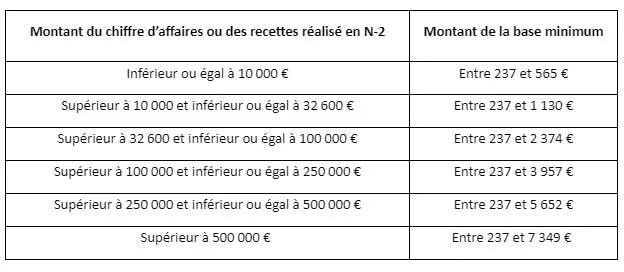
Each municipality decides on its tax rate every year in the municipal council. This rate is multiplied by the tax base to calculate the CFE. The tax can therefore change from one year to the next depending on the national scale as well as the rate set by the municipality.
The rate of the additional CFE tax, based on the CFE tax base, is voted on each year by the regional CCI.
Calculating the CFE for micro-entrepreneurs
Since all businesses are subject to the CFE, micro-entrepreneurs are no exception, even if you have no business premises and work from home (or from anywhere thanks to digital tools) or directly at your clients’ premises.
Micro-entrepreneurs exempt from CFE are:
- craftspeople;
- farmers;
- VDIs (Independent Home Sellers);
- fishers;
- athletes;
- artists: painters, sculptors, engravers, illustrators, author-photographers, authors, composers, and opera and dramatic performers;
- owners renting out a furnished part of their home;
- micro-entrepreneurs whose annual revenue remains below €5,000.
In addition, micro-entrepreneurs benefit from a 50% reduction in their CFE tax base in the year following the year of creation, i.e. the first year of taxation.
The CFE for a micro-entrepreneur with business premises or land is calculated the same way as for other businesses, based on the rental value of their real estate — subject to property tax — used for the professional activity during year N-2. It must be paid before December 15 each year. If the rental value is too low, a flat rate applies.
Calculating the CFE for a micro-entrepreneur working from home or at clients’ premises
In this case, your CFE amount is based on your revenue for year N-2.
Filing the CFE return
The CFE return must be filed before January 1 of the year following your business’s creation, using a form available on the tax authority’s website. As long as you do not change premises, you will not need to file a new return afterward. However, you must notify the tax authorities if you change premises or modify the surface area you occupy.
If you cease your activity, you must notify the tax authorities before the second business day following May 1.
