

 Français
Unpaid Invoice Follow-Up: The Guide to Getting Paid on Time
Master unpaid invoice follow-up. Discover our tips and templates to secure your cash flow and speed up collection of what you're owed.
In practical terms, a follow-up on an unpaid invoice is the message, often an email or letter, that you send to a client when their invoice’s due date has passed. The idea is to gently remind them of their debt to get paid as quickly as possible, without damaging your business relationship. It’s a crucial step to protect your company’s financial health.
The real impact of unpaid invoices on your cash flow
An invoice awaiting payment isn’t just a line in a spreadsheet. It’s a genuine hole in your cash flow. Every euro that doesn’t come in on time weighs directly on your ability to pay your own suppliers, salaries, or even invest. It’s a subtle risk at first, but one that can become a major problem, especially for small and medium-sized businesses with less room to maneuver.

And this isn’t a trivial concern. In France, late payments are a plague on the economy. On average, invoices are settled 12 days later than the agreed deadline. The situation is so serious that it’s a factor in nearly 50,000 business failures every year. You can dig deeper into the topic by consulting this detailed analysis of the costs linked to unpaid invoices.
But why do clients pay late in the first place?
Before launching an unpaid invoice follow-up procedure, it’s essential to understand what’s happening on the other side. The reasons for a delay are varied and, most of the time, there’s no bad intention involved.
- Simple forgetfulness: This is the most common reason. Swamped by other urgent matters, your invoice simply slipped through the cracks. A small friendly reminder is usually enough to unblock the situation.
- Endless internal approval processes: In larger companies, your invoice sometimes has to pass through several departments before being approved. Your contact is acting in good faith, but the process is out of their hands.
- A hidden dispute: Sometimes, silence hides dissatisfaction. The client isn’t happy with the service or product and uses non-payment as leverage, without ever expressing it clearly.
- Genuine cash flow difficulties: Your client may themselves be struggling and juggling their own bills to pay.
Keep this in mind: an unpaid invoice isn’t necessarily an act of bad faith. Above all, it’s a signal that should prompt you to communicate clearly and in a structured way.
Consequences that go beyond cash flow
The financial impact is the first thing that comes to mind, but late payments create cascading problems. The time you spend chasing payments, tracking them, and, in extreme cases, launching legal procedures is time you’re not spending on your core business. It’s an enormous mental and administrative burden.
Worse still, working capital needs that balloon because of outstanding receivables can put a sudden brake on your growth. You might be forced to turn down promising projects simply because you don’t have the cash to cover upfront costs. Putting an effective follow-up process in place isn’t just an administrative formality, then. It’s a strategic pillar for ensuring the long-term survival and growth of your business.
Building solid foundations before your first follow-up
A follow-up on unpaid invoices strategy that really works doesn’t start on the day payment is late. No, it starts well before that, sometimes even before you draft your quote. By preparing the ground intelligently, what’s often a source of stress becomes a simple formality. Laying healthy, clear foundations from the outset drastically reduces the risk of unpaid invoices.

The first reflex is to bulletproof your documents. I’m talking here about your terms and conditions of sale. Precise terms that your clients systematically accept are your best insurance. They must unambiguously state your payment deadlines and the late-payment penalties that apply.
Think of your terms and conditions not as an administrative burden, but rather as the instruction manual for your collaboration. The clearer they are, the less room there is for misunderstandings or risky interpretations.
Next, take the time to know who you’re dealing with. Before committing to a new partner, a quick check of their creditworthiness can save you a lot of headaches. It’s not about playing private detective, just making sure the company is serious, especially when the contract represents a significant amount.
Creating the perfect invoice
An impeccable invoice is one that gives no grounds for a dispute over its form. All the legally required information must appear on it, and be accurate. A small error, like an incorrect VAT number or a missing date, can become an easy excuse for a client acting in bad faith to delay payment.
To make sure everything is in order, check that every invoice includes:
- Your full contact details and those of your client.
- A unique invoice number, following a logical sequence.
- The issue date and the payment due date.
- Precise details of the services or products sold, with quantities and unit prices.
- The amounts excluding VAT, the VAT rate and amount, and of course, the total amount including VAT.
A tool like Bizyness can make your life easier by ensuring all your invoices are compliant and professional, automating the addition of this crucial information.
Finally, one last tip: build prevention into your communication. A few days before the due date, a brief courtesy email can make all the difference. It’s not yet a follow-up, just a friendly reminder to check that everything is in order for payment. This proactive approach shows how serious you are and often resolves simple oversights before they turn into genuine unpaid invoices. These foundations are the key to more peaceful cash flow management.
Managing the amicable follow-up process with tact
Once your foundations are solid, it’s time to put them into practice. Unpaid invoice follow-up isn’t a fight, but rather a well-orchestrated dance between diplomacy and firmness. The idea is simple: get your money back, without sacrificing what’s often most precious, a good client relationship.
The biggest mistake I see? Waiting too long. A late payment isn’t necessarily a disaster, but it should never be left unaddressed. A progressive, systematic approach is the key. It quickly helps you tell the difference between a simple oversight and a more serious problem.
Setting up a smart follow-up schedule
Each contact with your client should be adapted to the time elapsed since the due date. By following a clear rhythm, you stay in control and demonstrate your professionalism. Good timing is what makes your approach effective without harassing your client.
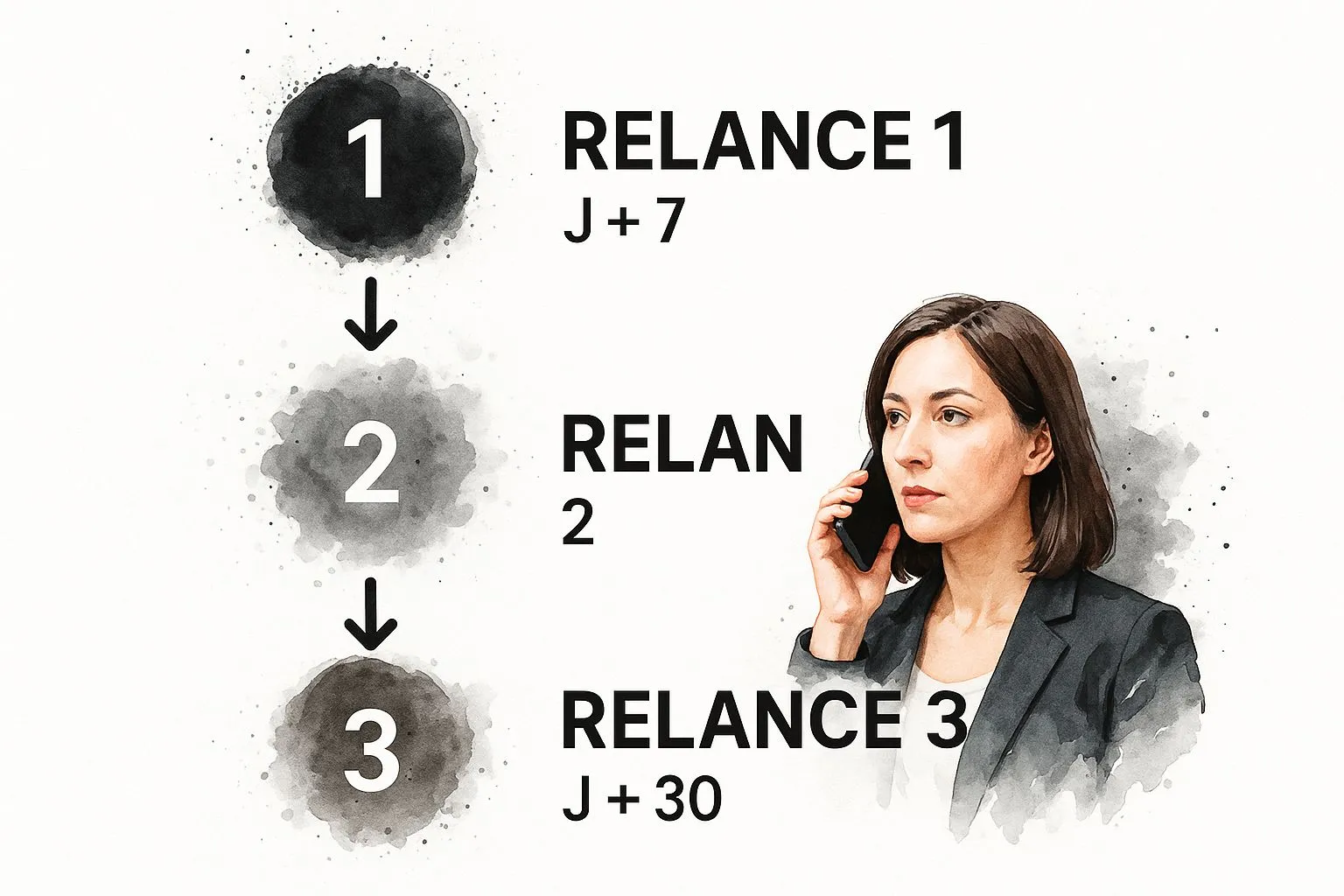
To help you visualize this process, I’ve put together a sample schedule. It structures the actions to take progressively, from a simple alert to a formal notice.
Sample amicable follow-up schedule
| Step | Timing | Communication channel | Main objective |
|---|---|---|---|
| Preventive notification | 2-3 days before the due date | Remind them of the upcoming due date to avoid any oversight. | |
| First follow-up | 7 days after the due date | Point out the delay courteously, assuming it was an oversight. | |
| Second follow-up | 15 days after the due date | Phone call + Email | Get a payment date and understand the reason for the delay. |
| Final amicable follow-up | 30 days after the due date | Registered letter with acknowledgment of receipt | Signal a firmer tone and warn of the next step (formal notice). |
This table is of course just a template. What matters most is adapting it to your business and your relationship with each client, while remaining consistent and organized in your approach.
The first follow-up, one week after the deadline
The first contact, about seven days after the due date, should be light and friendly. At this stage, you always assume the client simply forgot. You don’t want to accuse them, just gently remind them that the invoice exists.
An email is perfect for this. It’s less formal than a letter, but it leaves a written record. Always remember to attach the invoice, it makes things easier for everyone.
Here are the ingredients of a good first follow-up email:
- A clear, simple subject line: “Quick reminder regarding invoice No. [Invoice number]” works very well.
- A friendly tone: Phrases like “I hope you’re doing well” or “Unless we’re mistaken” defuse any tension.
- The essential information: Mention the invoice number, its amount, and the due date.
This simple, non-aggressive approach is enough to resolve more than 80% of situations. To go further, feel free to check out our complete guide on writing a courteous follow-up letter, you’ll find excellent examples there.
Stepping it up after 15 days of delay
If your first email went unanswered and the invoice is still unpaid after two weeks, it’s time to shift gears. Your client’s silence might be hiding something more than a simple oversight.
At this stage, a phone call can work wonders. Direct contact creates a dialogue, helps you understand what’s causing the holdup and, often, allows you to find a solution together, such as a payment plan, for example.
A phone call humanizes the process. It’s much harder to ignore a real person on the phone than yet another email lost in an overflowing inbox. Your goal: come away with a specific payment date.
If you get voicemail, follow up with a second follow-up email. The tone should be a bit firmer, but still professional. Mention that you tried to reach them and ask them to get back to you to sort out the situation. Persistence, when applied in the right measure, is your best ally for a successful unpaid invoice follow-up.
Escalating: the formal notice
Despite your follow-ups, your client remains silent? If the conversation isn’t going anywhere and your amicable reminders go unanswered, it’s time to step things up. This is where the formal notice comes in, a tool that takes your unpaid invoice follow-up into much more formal territory.
Some see it as an aggressive move, but it should rather be seen as an essential legal lever. It’s the official step that precedes any potential legal action.

Make no mistake, a formal notice is much more than a simple reminder. It’s a legal act that officially records the late payment. Concretely, it demands that your debtor settle their debt within a specific deadline. Sending it also triggers the calculation of statutory late-payment interest, even if this wasn’t stipulated in your terms and conditions of sale. It’s a clear way of signaling that your patience has run out and that you’re ready to assert your rights.
The details you must not forget for a solid formal notice
For your formal notice to carry real legal weight, it must absolutely include certain information. A single omission could see it ruled invalid, weakening your entire case should things go further. This is really not a document to take lightly.
Think of this letter as a kind of checklist: for it to be legally airtight, every element must be present. The idea is to leave no room for doubt, neither about the substance of your claim, nor about the consequences you’ll pursue if payment is still not made.
Here’s what your letter must absolutely contain:
- The heading “Formal Notice” (mise en demeure) must appear clearly, ideally in the subject line.
- A summary of the facts: the invoice number in question, its issue date, and its total amount.
- A firm, reasonable payment deadline (generally, between 8 and 15 days).
- A clear statement that, in the absence of payment within this deadline, you will pursue legal proceedings.
A well-crafted formal notice isn’t a declaration of war. Above all, it’s proof of your seriousness and determination. Very often, it’s the wake-up call needed to unblock a situation without having to go to court.
Why sending it by registered letter with acknowledgment of receipt is non-negotiable
And how should you send it? Forget email or a simple letter. The formal notice must be sent by registered letter with acknowledgment of receipt. This is the only way to obtain undeniable proof that your debtor actually received it.
This signed acknowledgment of receipt becomes a key piece of evidence in your file. It proves that your client was formally informed of their obligation and the deadline set. Without this proof, it would be too easy for them to claim they never received anything, rendering your efforts pointless.
This step is also a mandatory legal prerequisite before taking a case to court. If you get to that point, the judge will systematically check whether you attempted an amicable resolution. The formal notice and its acknowledgment of receipt are irrefutable proof of that. To master all the finer points, you can check out our complete guide on following up on invoice payment. Using this tool properly gives you the confidence you need to defend your interests and recover what you’re owed.
Exploring judicial collection options
When the formal notice goes unanswered and the invoice keeps dragging on, it’s sometimes necessary to step things up further. Stepping into the legal sphere can be intimidating, I understand, but it’s often the only option left to assert your rights and recover the money you’re owed.
Fortunately, this doesn’t necessarily mean an endless court case. There are procedures of varying speed and cost, designed for different situations. The goal isn’t to charge in head first, but to choose the smartest legal tool for your case. The end goal is simple: obtain an enforceable title (titre exécutoire). This is the official key that gives you the power to force your debtor to pay, for example by instructing a bailiff to seize assets.
The payment order: the fast track for simple cases
The payment order (injonction de payer) is very often the first avenue to explore when your unpaid invoice follow-up efforts have gone nowhere. Why? Because it’s the fastest and cheapest procedure. It’s known as “non-adversarial,” meaning the judge makes their decision based solely on the documents you provide, without your debtor even being summoned.
It’s ideal if:
- Your claim comes from a clear contract (an invoice, a signed purchase order…).
- The amount is precise and not open to dispute.
- You’re nearly certain your client won’t contest the debt.
Its simplicity makes it the preferred option for business owners dealing with claims no one is disputing.
Since everything is decided on the file alone, the quality and clarity of the documents you provide to the court are crucial. A well-detailed invoice, a signed quote, proof that the formal notice was sent… every element matters in tipping the decision in your favor.
The provisional payment order (référé-provision): acting fast when there’s urgency
The référé-provision is another expedited procedure, ideal when the debt is “not seriously disputable.” Its huge advantage is that it lets you quickly obtain an advance on the amount owed, a sort of down payment (“provision”), while waiting for the substance of the case to be judged if the dispute is more complex.
It’s a card worth playing if you sense your client might be organizing their own insolvency. Once you have the court order in hand, you can act without delay and secure part of what you’re owed. For this to work, you need two things: urgency and an obvious debt.
The summons for payment: the standard lawsuit for complex disputes
Now, if the case is thornier, if your client disputes the quality of your work or the very validity of the invoice, a summons for payment (assignation en paiement) becomes unavoidable. Here, you’re entering a full-blown lawsuit. Each party presents its arguments before a judge, during a hearing.
This is a much longer and more expensive procedure, that’s true. It’s generally reserved for significant claims or when all other attempts have failed. But it’s essential for settling a substantive disagreement once and for all.
Don’t forget that time works against you. A late payment that drags on dramatically increases the risk of never seeing your money again. In fact, studies show that in France, the probability of a client’s business failing is multiplied by six once the payment delay exceeds 30 days.
Each option has its own rules and advantages. To make the right choice, take the time to analyze your situation. And if needed, seek advice. For a broader view of the different strategies, our complete guide on collecting outstanding customer debts can help you see things more clearly.
Automating so you never have to chase payments manually again
Spending hours chasing late invoices is a bit of every entrepreneur’s nightmare. Between hunting down information, manual reminders, and tracking due dates, you burn out fast. Not to mention the risk of oversights or human error that can be costly.
Fortunately, there are now solutions to turn this chore into a smooth, near-automatic, and above all much more professional process. The idea isn’t to bombard your clients with impersonal messages, but to set up a rigorous, intelligent follow-up system.
Imagine a system that watches your due dates for you. A tireless assistant that makes sure no invoice slips through the cracks. That’s exactly what modern invoicing and cash flow tracking software offers. It lets you structure your approach, adapting the tone and frequency of follow-ups based on the client’s profile: more lenient with a long-standing partner, firmer with a new client or a known bad payer.
Setting up smart follow-up sequences
The real strength of automation is personalization. You’re no longer stuck with a single standard email sent to everyone. You create genuine follow-up sequences, “workflows,” that trigger based on rules you set yourself.
Concretely, an effective follow-up sequence might look like this:
- 3 days before the due date: A courteous reminder email is sent automatically. Just a friendly little “heads up.”
- 7 days after the due date: The system sends a first follow-up, still with a conciliatory tone, attaching the invoice again.
- 15 days after the due date: The tone becomes a bit more direct. A second follow-up email is sent, suggesting a phone call to sort things out.
- 30 days after the due date: You receive an internal notification. This is the signal that it’s time to take over manually, likely to send a formal notice.
These tools give you a clear, instant view of your outstanding receivables. At a glance, you know where you stand on every invoice and can identify the clients who might put your cash flow at risk.
The goal isn’t to dehumanize the relationship, quite the opposite. By handing off repetitive tasks to software, you free up time to personally handle the trickiest cases. That’s where your human touch really adds value.
Saving time and securing your cash flow
The first benefit, obviously, is time saved. Those hours spent on low-value administrative tasks can be reinvested where it really matters: growing your business, innovating, or simply serving your clients better.
This rigor is all the more essential given how fragile the economic context remains. The number of business failures in France remains high, with 17,845 formal insolvency proceedings recorded in a single recent quarter. Even though late payments seem to be stabilizing, they continue to weigh heavily on the financial health of many small and medium-sized businesses. To dig deeper into the topic, you can find detailed analyses on the evolution of business failures on leanpay.io.
Ultimately, automating your unpaid invoice follow-ups isn’t a gimmick. It’s a strategic choice that gives you impeccable tracking, better visibility into your cash flow and, above all, more peace of mind so you can focus on growing your business.
Take control of your invoicing and follow-ups effortlessly. With Bizyness, automate your payment reminders and spend your time on your core business instead. Discover how Bizyness can simplify your management today.
