

 Français
Unpaid Invoice Follow-Up: An Effective Guide to Getting Paid
Discover our tips for effective unpaid invoice follow-up. Templates and strategies to optimize your collections and secure your cash flow.
The best way to deal with an unpaid invoice is still to never have one in the first place. A well-designed framework, with clear payment terms and impeccable invoicing, changes everything. It limits the risk, and if an unpaid invoice follow-up does become necessary, the conversation is much simpler. Anticipation is really the secret to protecting your cash flow.
Setting up an effective anti-non-payment framework

Acting upstream always pays off more than chasing your money afterward. Rather than treating unpaid invoice follow-up as an inevitability, you should see it as the last step of a system designed, precisely, so you never have to use it. Everything is decided well before the invoice is even issued.
This approach rests on solid foundations, laid from the very first contact with a client. Including clear, precise terms and conditions of sale in your quotes isn’t just an administrative formality; it’s your first line of defense.
Formalize your payment terms
Well-drafted terms and conditions set the rules of the game and leave no room for doubt. They are non-negotiable and must include:
- The payment deadline (for example, net 30 days upon receipt of invoice). This is the baseline.
- The late payment penalties applicable from the first day of delay.
- The flat-rate compensation for collection costs, whose legal amount is set at €40.
These three points have a genuinely deterrent effect. Above all, they give you an immediate legal lever if something goes wrong. A client who signs a quote containing these clauses commits, in writing, to respecting them.
Assess your clients’ financial health
Before diving headfirst into a major project, taking a few minutes to check your prospect’s solvency can spare you a lot of headaches. Online services let you get a quick look at a company’s financial health. For significant contracts, this should be second nature.
One in every two companies in France experiences late payments. Making sure a client is on solid financial footing isn’t distrust — it’s simply good management.
Aim for flawless invoicing
The smallest error on an invoice is an open door to every excuse a client acting in bad faith might need. Your invoicing must be impeccable. Make sure every invoice is complete, accurate, and sent immediately after the service or delivery.
To really optimize this process, using an invoicing platform is a major asset. These tools automate a good part of the work, from creation to sending, while ensuring everything is compliant and on time. It’s an excellent way to anticipate and reduce the risk of non-payment.
The economic context behind late payments

Before diving headfirst into your follow-ups, it’s worth stepping back a little. Do you feel like late payments are becoming more frequent? It’s not just an impression. The current economic climate is straining the cash flow of many companies, including your clients’.
A late payment isn’t always an act of bad faith or simple negligence. It’s often the symptom of cascading difficulties rippling from one economic player to another. Keeping this in mind will let you adjust your communication to make it far more effective.
The domino effect of business failures
The context is tense. The end of post-pandemic government support, combined with a difficult economic climate, is putting many companies under pressure. The result? A marked rise in business failures, a phenomenon that spreads directly along payment chains.
And this isn’t anecdotal. The numbers speak for themselves and paint a clear trend. In France, this rise in business failures is directly fueling the problem of unpaid invoices. In the first quarter, their number climbed 2% compared to the previous year. The projection for the full year is even nearing a historic record, potentially reaching 68,000 cases. To dig deeper into the topic, Allianz Trade’s full analysis of business failures is very illuminating.
Very concretely, when one of your clients has to manage their own unpaid invoices, their ability to pay you on time is compromised. This is where the domino effect begins. Your business can then get caught up in this chain reaction, which threatens everyone’s cash flow.
How should you adapt your follow-up strategy?
So, what should you do? This observation should certainly not discourage you from claiming what you’re owed. On the contrary, it should push you to refine your approach.
An unpaid invoice follow-up that shows you understand your client’s potential situation has a much better chance of succeeding. The idea isn’t to pass judgment, but to find a solution to recover your money while trying to preserve the business relationship.
Adopting a more human approach doesn’t mean being lax. It’s about finding the right balance between firmness and empathy.
- Be factual and professional. Simply restate the facts: invoice number, amount, due date. No need to come across as aggressive.
- Open the door to dialogue. A simple question like “Are you facing temporary difficulties?” can unlock a situation and lead to a constructive discussion.
- Be proactive with solutions. If it makes sense for you, offering a payment schedule can be a win-win solution.
By approaching things this way, a potentially conflictual situation is often turned into an amicable resolution. You position yourself as a business partner who is both rigorous and understanding, which strengthens your credibility and, ultimately, makes collection much easier.
Setting up a structured follow-up schedule
Managing unpaid invoice follow-up without a clear plan is a bit like navigating blind in a storm. To be effective, you need method and responsiveness. Believe me, a well-structured, progressive approach doesn’t just maximize your chances of getting paid; it also helps you preserve a healthy relationship with your client.
The idea isn’t to wait for the delay to settle in comfortably. A good follow-up strategy is, above all, about anticipation. By acting proactively, with a precise timeline in mind, you stay in control of the situation and reinforce your image as an organized professional.
The preventive approach: acting before the due date even arrives
The secret to avoiding most late payments? A simple preventive reminder. A courteous email, sent one or two days before the due date, can make all the difference. Note that this isn’t yet a follow-up reminder — it’s more like attentive customer service.
The assumption here is that most delays are due to an oversight or a simple administrative slip-up, not bad faith. A short message is enough: “Just a friendly reminder that our invoice #XXXX is due tomorrow. Feel free to reach out if you have any questions.”
This is a tried-and-tested trick: this simple action alone can prevent up to 80% of non-payment situations. The effort is minimal, but the time and peace of mind saved are enormous.
The first follow-up, a few days later
The due date has passed by a few days and still nothing? It’s time to send the first unpaid invoice follow-up. The ideal timing is around one week after the deadline.
The tone should remain cordial and professional. At this stage, email is the perfect channel. The goal is simple: remind them the invoice is outstanding, while still assuming it’s an oversight. Always remember to include:
- The invoice number in question
- The exact amount
- The original due date
- And, above all, a copy of the invoice attached to make things easier for them.
The process is gradual, as this visual clearly shows. You start softly before ramping up communication.
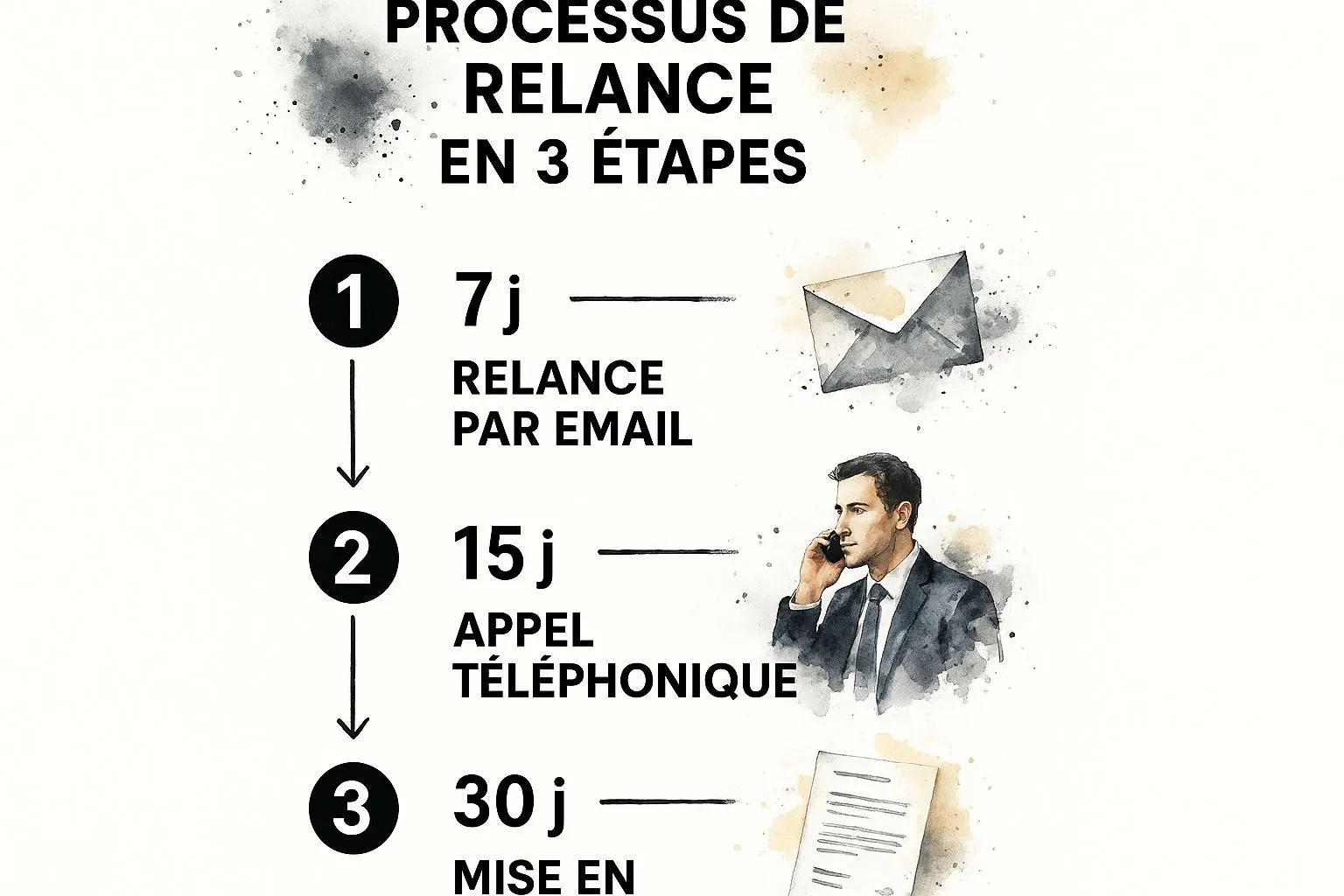
This diagram perfectly illustrates this controlled escalation: from a simple email reminder to more direct communication, before even considering formal notice.
The second follow-up and the phone call
A week has passed since your first follow-up and it’s still radio silence? Time to step it up. The second follow-up, sent around 15 days after the due date, should be a bit firmer, without tipping into aggressiveness.
This is also the perfect time to pick up the phone. A call is often far more effective than yet another email that risks getting lost. The approach is direct: introduce yourself, restate the context of the unpaid invoice, and simply ask where things stand with payment.
This human exchange lets you understand the reason for the delay (a cash flow issue, a misplaced invoice, a dispute?) and, where relevant, find a solution together, such as a payment schedule. My advice: always note the date of the call and what was said. If no one answers, leave a clear voicemail and send a follow-up email right after to confirm your attempt to reach them.
Chronological action plan for invoice follow-up
To help you visualize this process, I’ve summarized the key steps in a table. It’s an excellent cheat sheet for knowing when, how, and with what tone to act.
This table summarizes the key steps, timing, communication channel, and tone to adopt for a structured, effective follow-up process.
| Step | Timing (relative to due date) | Main channel | Tone of message |
|---|---|---|---|
| Preventive reminder | D-2 | Friendly, helpful | |
| Follow-up 1 | D+7 | Cordial but factual | |
| Follow-up 2 + Call | D+15 | Phone + Email | Firm and direct |
| Formal notice | D+30 | Registered letter with acknowledgment of receipt | Formal, legal |
Following this plan will give you a solid foundation for managing unpaid invoices professionally and effectively, progressively increasing pressure while keeping the door open for dialogue.
How to write follow-up messages that finally get a response
Having a good follow-up schedule is great. But if your messages end up in the trash unread, it doesn’t do you much good. The goal isn’t to bombard your client with reminders, but to write messages that push them to act. Drop the impersonal, off-the-shelf templates everyone uses. An unpaid invoice follow-up that works is above all clear, personalized, and thoroughly professional.
Every word matters. You need to find that delicate balance between the firmness needed to demand payment and the courtesy needed to avoid blowing up a business relationship you’ve spent time building. It all comes down to the details: an eye-catching email subject line, the essential information visible at a glance, and a tone that adjusts at each stage.
The art of the email subject line: the first impression
Before anything else, your message needs to be opened. Faced with an overflowing inbox, your email subject line is your one and only chance to stand out. It should be direct, informative, without sounding like an attack.
A few examples that work well in practice:
- For a gentle reminder: “Quick reminder about our invoice #[Invoice number]”
- For a first official follow-up: “Follow-up on invoice #[Invoice number]”
- When the tone needs to rise a notch: “URGENT: Invoice #[Invoice number] unpaid - 2nd follow-up”
The secret? Always, always include the invoice number. It’s a simple habit that makes life easier for your client (they find the document in two seconds) and shows that your tracking is airtight.
Structuring a clear, effective message
Once the email is opened, the information should jump out immediately. No one wants to play detective to figure out what you expect. Your message should therefore be short, concise, and get straight to the point.
Here’s a framework that has proven itself in the field:
- A personalized greeting: A simple “Hello [Contact name],” is the bare minimum.
- The context, from the very first sentence: Immediately state which invoice this is about.
- The key info, clearly visible: Clearly list the invoice number, its amount, and the due date, which has now passed.
- A clear call to action: State precisely what you expect. A payment? A simple reply to keep you posted?
- The attachment: NEVER forget to attach a copy of the invoice. This is the number-one mistake that wastes everyone’s time.
A good follow-up message leaves no room for doubt. Your client should understand in under 10 seconds which invoice this is, how much they owe, and how they can pay you. It’s that simple.
To help you get started, we’ve prepared unpaid invoice follow-up letter templates that you can adapt. It’s an excellent starting point.
Knowing how to adapt tone and content
The tone of your messages should evolve at the same pace as your follow-up schedule. A first friendly reminder obviously won’t have the same flavor as a final warning before a formal notice.
- Follow-up 1 (D+7): Stay very cordial. Always assume it’s a simple oversight — it happens to the best of us. A phrase like “Unless we’re mistaken, it appears the invoice…” works very well to keep things light.
- Follow-up 2 (D+15): Be more direct, but stay professional. “We are writing to follow up regarding our invoice #… which, to date, remains unpaid.”
- Follow-up 3 (just before the formal notice): Here, the tone becomes firmer and more factual. This is the moment to mention the applicable late payment penalties and clearly state the next step if no payment is received shortly.
To make your follow-ups effective while staying impeccable, it can be very useful to improve your professional writing. Polished communication strengthens your credibility and proves you’re handling the situation with rigor. By personalizing each message and showing that your tracking is meticulous, you dramatically increase your chances of getting paid quickly.
Moving on to collection procedures
Despite your follow-ups, cordial at first and then firmer, nothing works. Payment still hasn’t arrived. Your emails and calls go unanswered. It’s a frustrating situation, no doubt, but it simply means it’s time to change tactics. Amicable collection has reached its limits; it’s now time to move to a more formal approach.
This transition isn’t a failure on your part. On the contrary, it’s the logical next step in a well-structured collection process. The goal now is to formalize your approach so the debtor understands that you’re determined to recover your money, even if it means using the legal means at your disposal.
The formal notice: the step that changes everything
Sending a formal notice letter marks a real turning point. It isn’t just another follow-up reminder. It’s an act with legal weight that, for example, officially starts the calculation of late payment penalties. More importantly, it’s an essential prerequisite before you can initiate legal action.
For this reason, it’s always sent by registered letter with acknowledgment of receipt. Its psychological and legal weight is considerable.
To be valid, your letter must contain very specific information:
- The clear, explicit mention: “formal notice”.
- The date of drafting.
- Your full contact details and those of your debtor client.
- A summary of the facts (invoice number, amount owed, service rendered).
- A new deadline for payment (generally, 8 days is sufficient at this stage).
- The consequences of non-payment (recourse to legal proceedings).
The goal is twofold: to offer the client one last chance to settle their debt without going to court, while also building solid evidence for your case should you need to go further.
Unfortunately, this escalation is sometimes unavoidable, especially in the current economic climate. Unpaid invoices are an increasingly heavy reality for French businesses. A recent study showed that 62.6% of them have experienced unpaid invoices, a figure that jumped by 11.6%. The most worrying part? Nearly half of payments now exceed 45 days late, putting enormous pressure on cash flow. To get a sense of the scale of the problem, find out more about client risk in France.
Which collection procedure should you choose?
If even the formal notice goes unanswered, you have several options. Your choice will depend on the amount of the invoice, the complexity of your situation, and the strength of the evidence you have.
The court order for payment (“injonction de payer”) is often the most direct and effective solution. It’s a fast, inexpensive judicial procedure. It’s described as “non-adversarial,” meaning the judge makes a decision based on the documents you provide, without your client being summoned to a hearing. If the judge finds your claim legitimate, they issue an “order for payment.”
You can also turn to professionals to handle the rest:
- A collection agency: It takes over and manages the entire process for you. In exchange, it takes a commission on the amounts it manages to recover.
- A bailiff (now called a “commissaire de justice”): Their involvement has a very deterrent effect. They also become essential for enforcing a court decision if you win your case.
Each solution has its own advantages. To make sure you don’t overlook anything and fully understand the different options, our complete guide to unpaid invoice follow-up is here to help. Choosing the right strategy at this stage is absolutely crucial to maximizing your chances of recovering your money without incurring excessive costs.
Frequently asked questions about invoice follow-up

Managing unpaid invoices is a bit of an obstacle course for many entrepreneurs. You have a thousand questions, worry about getting it wrong, breaking the law, or upsetting a client. That’s completely normal.
The goal here is to answer the most common questions head-on. My aim? To give you clear, practical information so you can handle these situations with confidence and professionalism.
What should you do if a client disputes an invoice?
A client disputes an invoice? First reflex: hit “pause.” No point continuing to send automatic follow-ups — that would only inflame the situation. The urgent thing is to understand why.
Take the time to really listen. Is it a quality issue with a product? A service that doesn’t match their expectations? Or maybe a simple error on our part on the invoice? Ask them to put their complaint in writing so you have a clear record.
- If their complaint is justified, be accommodating. Quickly offer a credit note or issue a new corrected invoice. It’s the best way to preserve the relationship.
- If you believe the dispute is unfounded, don’t let yourself be rattled. Respond point by point, relying on tangible evidence: the signed quote, the countersigned delivery note, the email exchanges… Then firmly maintain your request for payment.
Can you always charge late payment penalties?
The answer is yes, the law allows it. But be careful — there’s one essential condition: the late payment penalties, as well as the flat-rate €40 compensation for collection costs, must be explicitly stated in your terms and conditions of sale.
And, of course, your client must have accepted these terms (for example, by signing a quote that references them). If that’s not the case, you have no legal grounds to claim anything. Think about it in advance: it’s an excellent deterrent and proof of how seriously you take your business.
Applying penalties is a right, not an obligation. Faced with a loyal client who’s had a simple oversight, making a commercial gesture and not claiming them can prove far more worthwhile in the long run. It’s up to you to judge.
Payment behavior in France is, in fact, improving slightly. A recent Ellisphere analysis showed that average delays have dropped to 16.48 days. Good news, even though the situation varies enormously from one sector to another. You can check out Ellisphere’s study on payment behavior for more details.
What is the statute of limitations for an invoice?
The statute of limitations is essentially the expiration date on your right to claim payment. Once this period has passed, it’s too late — your claim is legally “extinguished.” This period isn’t the same for everyone:
- Between businesses (B2B): You have 5 years to act.
- With a private individual (B2C): The period is much shorter, only 2 years.
One crucial thing to know: sending a formal notice by registered letter or a debt acknowledgment signed by your client can interrupt this period and reset it to zero. This is strategic information worth keeping in mind.
Mastering these aspects is the foundation of sound management. To take things a step further, don’t hesitate to explore other strategies and tools for truly effective customer debt collection.
Radically simplify your invoice management and follow-ups with Bizyness. Our tool is designed for freelancers and small businesses that want to automate their invoicing, track payments in real time, and send effective reminders without spending hours on it. Take back control of your cash flow and focus on what really matters. Discover Bizyness today.
