

 Français
 Unpaid Invoice Payment Reminder Letter: Complete Guide & Tips
Learn how to write an effective payment reminder letter for an unpaid invoice. Tips and templates to recover your payments quickly and easily.
An unpaid invoice that lingers is never just an administrative oversight. It’s a direct hole in your cash register, a threat to your cash flow. That’s why knowing how to write a payment reminder letter that hits the mark isn’t optional — it’s a key skill for any entrepreneur who wants to stay in control of their finances and client relationships. It’s truly your first lever for turning a late payment around.
Why chasing an unpaid invoice is a serious matter
Don’t fall into the trap of treating unpaid invoice management as a chore. Every invoice left pending is money missing from your working capital — the capital that lets you pay salaries, suppliers, and simply keep the business running day to day.
Picture this: one of your best clients forgets to pay an invoice for €3,000. That money was already mentally earmarked for your own expenses or for buying raw materials. A single unpaid invoice can quickly trigger a domino effect. You fall behind on your own payments, which risks upsetting your suppliers and damaging your reputation.
The concrete impact on your growth
Beyond the daily headache, late payments are a genuine brake on your development. Money sitting with your clients is capital you can’t reinvest. Think about everything you could do with it:
- Launch that marketing campaign you’ve had your eye on.
- Acquire more modern, more efficient equipment.
- Bring in a freelancer to delegate and focus on your core business.
And no, this isn’t an isolated worst-case scenario. It’s a very real reality in France. A recent study showed that in the second quarter, French companies paid their invoices with an average delay of 19 days — a record in several years! Clear proof that the problem is real and widespread.
A payment reminder letter is not an admission of weakness — quite the opposite. It’s a sign of sound, rigorous management. You’re showing that you keep a close eye on your accounts and that your cash flow is a priority. It’s a clear, professional message sent to your business partners.
Preserving the client relationship is entirely possible
Following up with a client doesn’t mean starting a conflict. With the right approach, you can fully recover what you’re owed while preserving a good business relationship. After all, a simple oversight happens even to the best clients. A well-written payment reminder letter for an unpaid invoice, both courteous and firm, is enough to resolve 90% of situations without a hitch. It puts the discussion back on professional ground and reminds the client of their commitments. To keep your business financially stable, understanding invoice payment terms and mastering the reminder process is simply essential.
Faced with an unpaid invoice, the worst mistake would be to bring out the heavy artillery on the very first day of delay. You’d risk alienating a client acting in good faith and sabotaging a business relationship over what is, very often, a simple oversight.
To handle the situation with tact and effectiveness, the ideal approach is a progressive one. The idea is simple: escalate the tone step by step, always leaving room for dialogue. This method preserves the client relationship while maximizing your chances of getting paid.
Concretely, this strategy unfolds in three key stages, each with a specific message and channel.
The courtesy reminder: assuming it’s an oversight
A few days after the due date, the first action is a simple friendly reminder. Email is the easiest option. Here, the goal is absolutely not to accuse, but rather to assume it’s a simple slip. The tone should be light, almost helpful.
A short message like: “Hello, unless I’m mistaken, invoice no. XXX appears to be past due. Was this a simple oversight?” does the job perfectly. It’s a very gentle way to open the conversation without the slightest aggressiveness.
The formal reminder: stepping it up a notch
If your friendly reminder goes unanswered after a week, it’s time to be a bit more formal. This is the moment to send the first real payment reminder letter for an unpaid invoice. Whether by email or standard mail, the tone becomes more direct and the payment request explicit.
This is also the stage where it’s relevant to subtly mention the late-payment penalties provided for in your terms and conditions of sale. This adds extra weight to your request and can encourage your client to settle the matter to avoid additional fees.
The secret to successful collection comes down to two words: persistence and documentation. Keep track of everything. Every email, every call, every letter should be dated and archived. This traceability will become your best ally if things get complicated.
To help you visualize the process, here’s an illustration of the recommended steps for effective follow-up.
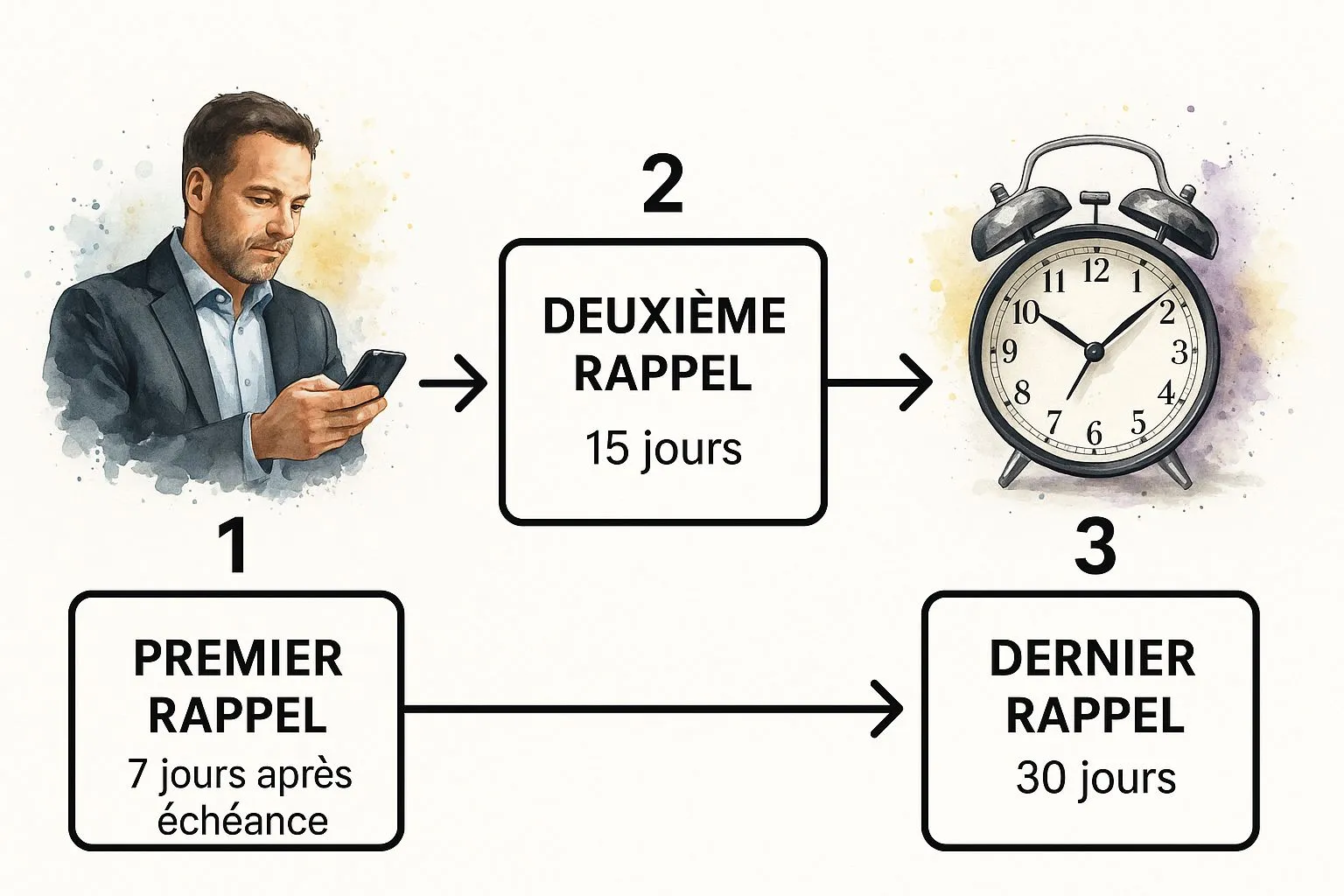
As you can see, having a clear, progressive timeline is key to structuring your approach and demonstrating you mean business without appearing aggressive.
The formal notice: the last warning before the storm
The formal notice (mise en demeure) is the last rampart before considering legal action. It’s no longer a simple reminder but a formal legal act. It must be sent by registered mail with acknowledgment of receipt to have legal value. The tone changes radically: it is firm, factual, and unambiguous.
This letter must include specific mentions to be valid:
- A clear, visible heading: “Formal Notice to Pay”.
- A precise recap of the facts (invoice number, due date, amount owed).
- A final payment deadline, which must be precise and reasonable (generally 8 days).
- An explicit warning that legal proceedings will be initiated if payment is not made within the given deadline.
Never underestimate the effectiveness of this graduated approach. Handled well, it pays off. It’s estimated that well-structured reminder processes recover up to 70% of receivables before even needing to think about a lawyer. To learn more, feel free to check out the details on managing unpaid invoices provided by industry professionals. It’s clear proof that a well-thought-out reminder process is the best tool for protecting your cash flow.
Comparison of the 3 levels of payment reminder letters
To help you find your way around easily, this table summarizes the key characteristics of each type of reminder letter. It’s a handy cheat sheet for choosing the right approach at the right time.
| Reminder level | Main objective | Tone to adopt | Sending timeframe (after due date) | Key elements to include |
|---|---|---|---|---|
| 1. Courtesy reminder | Flag a possible simple oversight | Friendly, courteous, helpful | 2 to 5 days | Invoice no., amount, due date, payment link if possible |
| 2. Formal reminder | Officially request payment | Direct, firm but professional | 10 to 15 days | Recap of the invoice, mention of late-payment penalties, clear call to action |
| 3. Formal notice (mise en demeure) | Warn before legal action | Legal, factual, unambiguous | 30 days and beyond | Mention of “formal notice,” mandatory payment deadline (8 days), threat of legal proceedings |
Keeping this structure in mind will let you respond proportionately and professionally, while optimizing your chances of payment at every stage.
Anatomy of a payment reminder letter that works
For a reminder about an unpaid invoice to succeed, it needs to be much more than a simple note slipped into an inbox. It’s a document that must be carefully crafted, where every word and every piece of information matters. It’s about finding the right balance between clarity, firmness, and professionalism to inform, persuade, and above all, prompt your client to act.
Too often, out of fear of being pushy or lack of time, people send vague letters that end up lost in the noise. To avoid this pitfall, every element of your letter should be deliberate and optimized. Think of it as a targeted message: every detail counts.
A subject line that grabs attention immediately
The first thing your client will read is the subject line. It must be clear, direct, and unambiguous. Forget generic phrases like “Invoice follow-up” that say nothing. Be precise.
A punchy reminder-letter subject line always contains two key pieces of information:
- The reason: “Reminder regarding your invoice” or “Follow-up for invoice No. XXX.”
- The invoice number: This is the essential reference. It lets your client — or their accounting department — find the document in a second.
For example, a subject line like “Reminder – Invoice No. F2024-087 Past Due” is perfect. It’s clear, professional, and leaves no doubt about the content of the message.
The legal mentions that establish your credibility
A well-structured letter body is what gives weight to your request. Your credibility and the seriousness of your approach rest on the accuracy of the information you provide. Keep in mind: your letter must include the following elements, without exception.
These aren’t mere formalities. They form the legal basis of your claim and prove you’re not being approximate.
An effective reminder letter is above all factual. It recalls a contractual obligation, nothing more. By sticking to the facts and avoiding any emotional charge, you keep the discussion on a professional level. It’s the best way to get paid quickly without damaging the relationship.
Make sure to clearly include:
- Your full contact details (company name, address, business registration number)
- Your client’s contact details
- The date the letter is sent
- A precise recap of the invoice (its number, issue date, total amount including VAT)
- The original due date, the one that has now passed.
With these elements, your message goes from a simple “friendly reminder” to an official document. This is what underscores the seriousness of your approach.
Wording that persuades without being aggressive
The tone of your letter is key. The goal is simple: stay firm on the need for payment, but always respectful. Personalization, even minimal, makes all the difference. A “Hello Ms. Durand” will always be more effective than an impersonal “Dear customer.” You’re showing that you’re addressing a person, not a file number.
Here are a few wording tips that have proven effective:
- Use an active, more direct voice: “We kindly ask you to settle…” is more engaging than “The invoice must be paid…”.
- Be precise in your call to action: Instead of a vague “Please do the needful,” prefer: “Please arrange payment of [Amount] € as soon as possible.”
- Always leave the door open for dialogue: “If you’re experiencing any difficulty, or if you have already made the payment, please don’t hesitate to contact us.” This simple sentence can defuse a lot of tension and resolve simple misunderstandings.
Finally, always close with a professional sign-off, such as “Yours sincerely” or “Best regards.” This keeps a formal, respectful framework, even in a situation that can be delicate. By combining these elements, your payment reminder letter for an unpaid invoice becomes a genuine strategic tool for protecting your cash flow.
Ready-to-use, annotated payment reminder letter templates

Theory is good, but practice is better — especially when it comes to managing an unpaid invoice. To help you take action, here are three concrete reminder letter templates, designed for each stage of your process.
Don’t just copy and paste. I’ve broken down each template so you understand the logic behind every word. You’ll see which elements to personalize so your message has maximum impact.
These examples have proven themselves in the field. Consider them a solid foundation for building your own communications. They’ll help you make sure you don’t forget anything essential in finally getting paid what you’re owed.
Level 1: The friendly, courteous reminder
Always start gently. This first reminder assumes your client simply forgot. An email sent a few days after the due date is perfect for this. The tone should stay light, helpful, never accusatory. The idea is to flag the delay politely, without damaging your good business relationship.
Example of a first reminder
Subject: Quick reminder regarding our invoice no. [Invoice number]
Hello [Contact name],
I hope all is well with you.
I’m reaching out regarding our invoice no. [Invoice number] for [Amount] €. Unless I’m mistaken, it was due on [Due date] and still appears to be pending payment.
For your convenience, I’ve attached it again.
Could you let me know the status of the payment? If this is simply an oversight, feel free to disregard this message.
Please don’t hesitate to reach out if you have any questions.
Best regards,
[Your Name/Your Company Name]
This message works because it’s short, direct, and assumes the client’s good faith. To refine your approach further, check out our full guide on the friendly payment reminder letter.
Level 2: The formal, factual reminder
If your first reminder goes unanswered after a week or ten days, it’s time to change your tone. Move to more formal communication. The tone hardens slightly, but stays professional. This payment reminder letter for an unpaid invoice can be sent by email or standard mail. The goal is to clearly restate the payment obligation.
Example of a second reminder
Subject: Reminder No. 2 – Unpaid invoice no. [Invoice number]
Dear Sir or Madam,
Despite our previous reminder, we note that invoice no. [Invoice number] dated [Invoice date], for an amount of [Amount] €, remains unpaid.
We hereby ask you to kindly settle this matter as soon as possible.
As a reminder, our terms and conditions of sale provide for late-payment penalties. We sincerely hope not to have to apply them.
If your payment has been made in the meantime, please disregard this letter.
Sincerely,
[Your Name/Your Company Name]
Level 3: The formal notice before legal action
At this point, it’s no laughing matter. This final step is a legally binding act. Sending it by registered mail with acknowledgment of receipt is therefore mandatory. The tone becomes firm and non-negotiable.
Example of a formal notice
Subject: FORMAL NOTICE TO PAY – Invoice no. [Invoice number]
Dear Sir or Madam,
Despite our successive reminders, invoice no. [Invoice number] dated [Invoice date], for an amount of [Amount] €, remains unpaid to this day.
By this letter, we hereby give you formal notice to pay the full amount owed within 8 days of receipt of this letter.
Should payment not be made within this period, we will be forced to initiate judicial debt-collection proceedings against you, with all the legal and financial consequences that entails.
Yours sincerely,
[Your Name/Your Company Name]
This escalation shows that receivables management is a major issue, one that goes well beyond a simple commercial matter. To give you an idea, unpaid energy bills in France led to more than 1.2 million interventions in one year, a 24% increase. These figures illustrate the very real, human, and economic impact of unpaid invoices.
Building an effective reminder system and optimizing it
Having a good payment reminder letter for an unpaid invoice template on hand is good. But to truly regain control of your cash flow, a letter alone isn’t enough. The idea is to integrate it into a comprehensive, well-thought-out, coherent collection process. You move from a mindset of enduring delays to a proactive approach that saves you precious time.
Technology is here to help. Most modern invoicing software, Bizyness among them, includes features to automate reminders. In just a few clicks, you can schedule the sending of a first friendly reminder email right after the due date, followed by a second, more formal one 10 days later, without lifting a finger.
Don’t underestimate the phone call
Even in the all-digital era, the phone remains a formidable tool, especially if your first email reminder went unanswered. A short, professional call can often unlock a situation that’s been dragging on for days.
The goal isn’t to apply pressure, but simply to establish human contact in order to:
- Understand the source of the problem: a simple oversight, a technical issue, or a disagreement over the invoice?
- Make sure your communications were actually received.
- Get a payment commitment with a clear date.
This simple phone call personalizes the approach and shows your client that you’re closely tracking your accounts. It’s often far more effective than yet another email that might end up ignored. To go further, you can explore how to automate your administrative tasks and free up time for this kind of high-value action.
What if discussion no longer works?
Sometimes, despite all your goodwill, the invoice remains unpaid. If even your formal notice provoked no reaction, it’s time to move up a gear to recover what you’re owed.
A word of experience: never let a receivable linger. The more weeks that pass, the more your chances of recovering the amount shrink. You need to act fast as soon as the amicable route has failed.
Two main paths are available to you:
- A debt collection agency: These specialized agencies take over and manage the entire process for you. They’re paid via a commission on the amounts recovered. It’s a good option if you’re short on time or not comfortable handling these matters yourself.
- A court order to pay (injonction de payer): This is a relatively simple, inexpensive legal procedure. It aims to obtain a “titre exécutoire” (writ of execution) from the court, an official document that then lets you instruct a judicial officer (commissaire de justice, formerly huissier) to seize the amounts owed.
These solutions are, of course, a last resort. But knowing they exist and knowing when to use them is part of good management. Having a complete system, from automatic reminders all the way to legal options, is the best way to secure your cash flow and let you focus on your core business.
Frequently asked questions about unpaid invoices
Even with the best templates on hand, you often end up with very specific questions when facing an unpaid invoice. That’s completely normal. I’ve gathered here the questions that come up most often among entrepreneurs, with direct answers, to help you see things clearly without wasting time.
The idea is to give you reliable guideposts. You’ll know exactly when and how to send each payment reminder letter to maximize your chances of success.
When should I send the very first reminder?
Timing is crucial. You need to act quickly, but without rushing either. Ideally, you should reach out as soon as you notice the delay, while still giving the client a little leeway, since they may have simply forgotten.
A good, tried-and-tested practice is to send a first friendly reminder between 2 and 7 days after the due date. This timeframe shows you’re diligent in your follow-up, without appearing aggressive. If you wait too long, your client might think the payment isn’t that urgent to you.
Is registered mail really mandatory every time?
No, and this is a fairly persistent misconception! For the first reminders, sending by registered mail with acknowledgment of receipt is completely unnecessary. A simple, courteous, clear email does the job perfectly.
Registered mail with acknowledgment of receipt has its place at only one specific stage: the formal notice. This is the letter that gives your approach legal value and constitutes formal proof that you warned your client before going further.
Reaching for registered mail too soon risks not only alienating your client but also costing you money for nothing.
Can I charge late-payment penalties from day one?
Legally speaking, the answer is yes. You can apply penalties from the very first day of delay, on one condition: that they are clearly stated on the invoice and in your terms and conditions of sale.
That said, from a business standpoint, it’s more delicate. In your first payment reminder letter, it’s far wiser to simply mention that they exist. If you apply them right away, you risk straining the relationship with a client who may be acting in good faith. Save this card for the second reminder, if payment still hasn’t arrived.
What if my client disputes the invoice after my reminder?
If that happens, there’s only one thing to do: pause the collection process. Continuing to send reminders would be completely counterproductive and would only make things worse.
Here’s the step-by-step approach:
- Call your client. Try to calmly and precisely understand what’s wrong.
- Ask them to formalize their dispute in writing. A simple email is enough, but it gives you a clear record of the issue.
- Take the time to analyze the situation. Is it an error on your part? A misunderstanding about the service?
- Find a solution. Once you agree, you can issue a credit note or a new invoice. A new payment deadline will then begin.
So you never have to ask yourself these questions again, Bizyness can automate your unpaid invoice reminders for you. You save precious time, secure your cash flow, and can finally focus on your core business. Discover how to simplify your life on the Bizyness website.
