

 Français
 Unpaid Invoice Reminder Letter: Guide & Effective Templates
Learn how to write an effective unpaid invoice reminder letter with our practical strategies and templates to speed up payments quickly.

Dealing with an unpaid invoice is rarely a pleasure, but with the right method it can become a simple, well-oiled formality. Your best ally? A well-crafted unpaid invoice reminder letter that turns a potential source of tension into a straightforward professional exchange. The key is to be proactive and crystal clear in your communication.
Building a reminder strategy that works
Chasing a client should never feel like a hostile act. Think of it instead as the logical extension of your business relationship. A well-thought-out strategy is what lets you preserve that valuable relationship while protecting your cash flow.
The goal is to systematize your approach. As soon as an invoice reaches its due date, every day counts. A structured process avoids oversights and ensures consistent, professional handling of every late payment. Most businesses start with a friendly reminder, which in most cases is enough to resolve simple oversights without any friction.
Why being proactive matters so much
Waiting too long before sending your first reminder can send the wrong signal, as if your payment terms were negotiable. Acting quickly, on the other hand, shows seriousness and professionalism. In France, this is far from a minor issue: nearly 20% of SMEs face payment delays of more than 60 days, sometimes with serious consequences for their cash position.
To make this clearer, here is a visual representation of the process to follow for each overdue invoice.
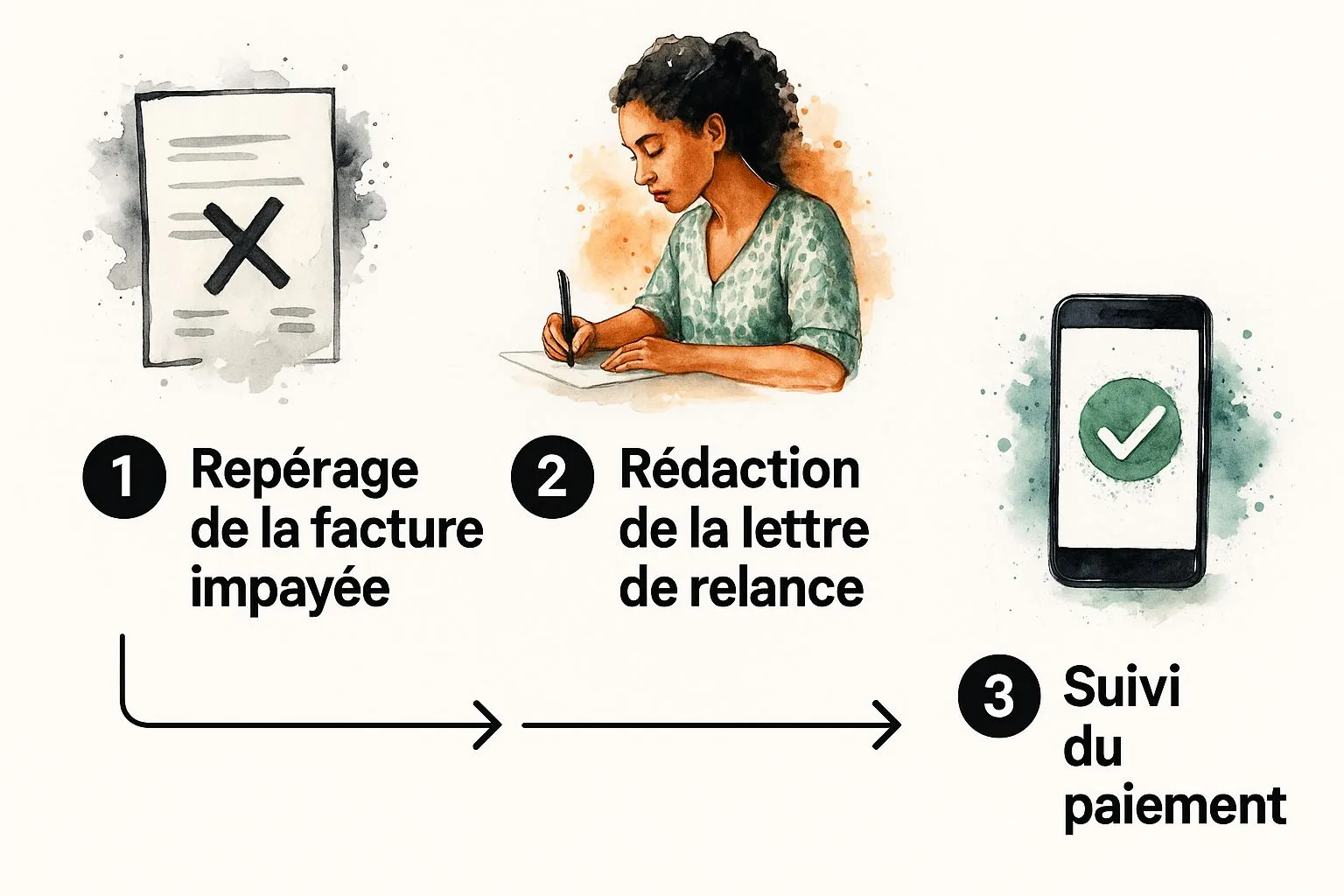
This diagram illustrates that chasing payment isn’t a one-off action but a progressive journey that requires rigorous follow-up to pay off.
To help you visualize the different steps, here is a table summarizing the reminder process, from a simple first contact to formal notice.
The steps of the reminder process
This table compares the different phases of the unpaid invoice reminder process, from a simple friendly nudge to formal notice.
| Reminder phase | Main objective | Tone of communication | Recommended channel |
|---|---|---|---|
| Friendly reminder | Resolve oversights and maintain a good relationship | Courteous, friendly, informal | Email, phone call |
| Reminder #1 | Formally flag the delay and request payment | Professional, firm but polite | Formal email |
| Reminder #2 | Increase pressure and recall the terms of sale | Direct, more insistent | Registered letter with acknowledgment of receipt |
| Formal notice | Legal warning before starting proceedings | Formal, legal, threatening legal action | Registered letter with acknowledgment of receipt |
As you can see, each step has a very specific objective and tone. Adapting your communication is the key to staying effective while controlling the escalation.
Well-managed unpaid invoice handling is an excellent indicator of a company’s rigor and good health. It reassures your partners and clients about your ability to run your business in a structured way.
Ultimately, a solid reminder strategy goes well beyond simply recovering funds. It’s an opportunity to reaffirm the clarity of your commercial terms. By turning this administrative chore into a controlled process, you secure your cash flow and build lasting client relationships.
The key elements of a bulletproof reminder letter
For a reminder to be effective, it needs to be flawless. The goal is simple: leave no room for doubt or dispute. Your payment request must be clear, factual, and indisputable.
Think of your letter as a building: if the foundations are weak, the whole thing collapses. Every piece of information you include is a brick. Forgetting even one could not only delay payment but also weaken your entire case if you need to escalate.
What absolutely must appear in your letter
Start with the basics: your full contact details and your client’s. Company name, registered address, a direct contact if possible… that’s the bare minimum. Then move on to the heart of the matter: the details of the unpaid invoice.
To make sure you don’t forget anything, here is the list of essentials:
- The invoice number, so the client can identify it at a glance.
- Its issue date, to put things in context.
- The total amount due, including VAT.
- The original due date, which has now passed.
This rigor isn’t just a matter of formality. It’s grounded in a well-defined legal framework, notably since the 2008 law on the modernization of the economy (LME), which brought order to payment terms between businesses. That’s what gives your request its weight. For more details on the regulatory context, the government website offers useful resources.
The tip that makes all the difference: always attach a copy of the original invoice to your reminder. It’s simple, but remarkably effective at countering the classic “I never received the invoice” excuse.
By following this structure, your unpaid invoice reminder letter changes status. It’s no longer just a friendly nudge, but a formal document. It’s the essential first step toward smooth debt collection, while solidly laying the groundwork for what comes next if payment is still delayed.
Knowing how to adapt your tone at each stage of the reminder process

Recovering an unpaid invoice is a bit like a dance. You need to guide your partner with tact and firmness, without ever stepping on their toes. A single, blunt approach is often counterproductive. The secret is to gradually increase the pressure, always starting from the assumption that your client simply forgot. This is the best way to preserve a good business relationship.
Your very first unpaid invoice reminder letter should therefore be as cordial as possible. Think of it less as a complaint and more as a friendly reminder, a service you’re doing your client to help them meet their deadlines. This gentle approach is enough to resolve the situation without friction in most cases. For concrete examples, feel free to check out our dedicated article on the courteous reminder letter.
Don’t underestimate the power of this first step. The numbers speak for themselves: 68% of businesses consider written reminders their number one tool for getting paid. And it works! Nearly 54% of overdue invoices are settled within 15 days of this first reminder.
When the tone needs to get firmer, while staying professional
Despite your first courteous reminder, payment still hasn’t arrived? It’s time to change your tone. The second reminder should be more direct, firmer, while remaining impeccably professional.
Here are the key points to include to make your point:
- Reference your first message: Clearly mention that your previous communication went unanswered.
- Recall the rules of the game: Cite the terms of the contract or your general terms of sale that apply.
- Mention the consequences: This is the right time to bring up late payment penalties, even if you choose not to apply them immediately.
The idea isn’t to wave a threat around, but to make it clear that the matter is shifting from a simple oversight to a contractual breach. You’re moving out of customer service and into the formal framework of the business relationship.
The formal notice: the last warning before the storm
If, after all this, silence persists, you have one last card to play before considering legal action: the formal notice (mise en demeure). Be aware, this is not a letter like any other. It is an act with real legal weight.
The tone must be formal, precise, with no room for interpretation. Use clear wording such as “formal notice to pay within eight days” and specify that “failing payment, we will refer the matter to the competent court.” This is the strongest signal you can send. Your client will understand that the time for discussion is over.
Our reminder letter templates to help you take action
Now that we’ve covered the theory, it’s time to put it into practice. To help you avoid staring at a blank page, I’ve prepared a few concrete templates. Treat them as a solid starting point, to be adapted to your situation and your company’s tone.
Each template corresponds to a specific moment in the collection process, from the simple friendly nudge to the more formal warning. The idea is to give you the keys to clear, professional communication, much like a dedicated management tool such as Bizyness would, while staying within legal bounds.
Level 1: The friendly, courteous reminder
Always assume it’s a simple oversight. Your client is probably acting in good faith, just overwhelmed. The approach should therefore be helpful, not accusatory. The goal is to gently jog their memory.
-
Subject: Quick reminder regarding invoice #[Invoice number]
-
Email body:
Hello [Client’s first name],
I hope you’re doing well.
Unless I’m mistaken, it looks like invoice #[Invoice number] for [Amount] €, due on [Due date], is still awaiting payment.
I’ve attached it again for your convenience. If this was simply an oversight, no worries at all!
Please don’t hesitate to reach out with any questions.
Have a great day,[Your first name]
Level 2: The firm but professional reminder
Your first email went unanswered. An oversight is less likely, so it’s time to step things up. The tone becomes more formal, while remaining controlled. This second unpaid invoice reminder letter should make it clear that the matter requires prompt action.
-
Subject: Reminder #2 – Unpaid invoice #[Invoice number]
-
Email body:
Dear Sir or Madam,
Despite our previous email dated [Date of first reminder], we have not yet received payment for invoice #[Invoice number], due on [Due date].
We ask that you settle this as soon as possible. As a reminder, in accordance with our general terms of sale, late payment penalties are now applicable.
Without payment on your part within 48 hours, we will be forced to move to the next step of the collection process.
Best regards,[Your name/Company name]
Level 3: Formal notice before legal action
At this stage, it’s no longer a laughing matter. This is your final warning before initiating legal proceedings. This letter carries real legal weight and must be sent by registered mail with acknowledgment of receipt. The tone is direct, factual, and to the point.
-
Subject: FORMAL NOTICE TO PAY – Invoice #[Invoice number]
-
Letter body:
Dear Sir or Madam,
Despite our reminders dated [Reminder 1 date] and [Reminder 2 date], invoice #[Invoice number] for [Amount] €, due since [Due date], remains unpaid to this day.
By this letter, we hereby give you formal notice to pay the full amount owed within eight days of receipt of this letter.
Should full payment not be received within this strict deadline, we will, without further notice, refer the matter to the competent court to obtain forced recovery of our claim.
Yours sincerely,[Your name/Company name]
Best practices and mistakes to avoid

Knowing how to write the perfect reminder letter is one thing. Managing the entire collection process is another. For it to work, it’s all about balance: finding the right timing, choosing the right communication channel, and above all, maintaining rock-solid follow-up.
Timing really is key. A first reminder sent about 5 days after the due date shows you’re attentive, without applying pressure right off the bat. For this first step, email is perfect. It’s fast, effective, and leaves an easily searchable written record.
On the other hand, once you reach the formal notice stage, registered mail with acknowledgment of receipt is no longer optional — it’s mandatory. This is what gives your action real legal standing and provides proof that your client actually received the letter.
To stay on top of things, methodical tracking is your best ally. Every unpaid invoice reminder letter should be meticulously logged, for example in a simple tracking spreadsheet. Note the date sent, the communication method used, and set yourself a date for the next action. It’s the only way to make sure nothing falls through the cracks. If you want to dig deeper into this topic, our complete guide to customer debt collection offers even more advanced strategies.
Mistakes that can ruin everything
Sometimes a single small misstep is enough to undo all your efforts. Here are the classic mistakes I see far too often, and that you absolutely must avoid if you want your process to be effective.
Pitfalls to avoid:
- Adopting an aggressive tone: Even if the delay drags on and your patience is running thin, staying professional is non-negotiable. Aggressiveness shuts down any discussion and can seriously damage your reputation. You can be firm without being threatening.
- Forgetting the required details: A letter missing crucial information (invoice number, due date, amount owed…) opens the door to disputes. Rigor is essential.
- Failing to follow up: Sending a reminder and then nothing… That’s the worst thing you can do. It sends a very clear signal to your client: your payment terms ultimately don’t matter that much.
By avoiding these pitfalls and adopting a structured approach, you turn a task often seen as conflictual into a controlled process. It’s the best way to protect your cash flow while preserving your business relationships as much as possible.
Frequently asked questions about unpaid invoices
Managing overdue invoices is one of the less glamorous parts of running a business. Very practical questions come up often. To help you see things more clearly, here are some answers drawn from real-world experience, so you can handle these situations with confidence and professionalism.
Email or registered mail: which channel should you choose for a reminder?
It all comes down to timing and tone.
For the very first reminder, email is your best ally. It’s fast, direct, and slightly less formal. It lets you maintain a friendly contact while leaving a clear written record of your action. It’s often enough to resolve the situation after a simple oversight.
However, once you need to step things up (second reminder, and especially formal notice), registered mail with acknowledgment of receipt is no longer an option — it’s a necessity. It’s no longer a simple reminder; it’s an act with legal weight. It shows your client that the matter has become serious and provides irrefutable proof should things get complicated.
Can you apply penalties starting from the first reminder?
Legally speaking, yes, you can. The law allows it from the very first day of delay, on one condition: these late payment penalties must be explicitly stated in your general terms of sale and recalled on the invoice in question.
In practice, however, the strategy is a bit more nuanced. For a first reminder, it’s often wiser to simply mention this possibility as a heads-up. Save the actual application of penalties for subsequent reminders. This lets you stay firm on your rights while preserving the business relationship, which is often what matters most.
What if the client ignores all my reminder attempts?
This is the scenario everyone dreads. If even your formal notice sent by registered mail goes unanswered, it’s time to move to legal action.
The first option, often the simplest, is the payment order procedure (“injonction de payer”). This is a relatively fast and inexpensive process, ideal for debts the client doesn’t dispute.
If the case is more complicated or the client disputes the debt, you’ll likely need to take the matter to the commercial court. At this stage, don’t go it alone. Calling in a specialized debt collection agency or a lawyer is strongly advised to protect your interests and maximize your chances of success.
Simplify your life and automate the management of your invoices and reminders. With Bizyness, focus on your core business, not on paperwork. Discover how Bizyness can transform your administrative management starting today.
