

 Français
URSSAF attestation de vigilance example: our complete 2026 guide
See a URSSAF attestation de vigilance example, understand what each field means, and use our guide to obtain and verify it without mistakes.

To understand what a URSSAF attestation de vigilance looks like, the simplest approach is to get hold of an annotated example. These templates break down every piece of information, from the company’s identification details to the security code that’s essential for verification. This official document, valid for six months, is proof that your business partner is up to date with their social security contributions.
The attestation de vigilance: much more than a piece of paper
In the day-to-day running of a business, it’s easy to feel buried under paperwork. Yet the attestation de vigilance is one document you absolutely cannot ignore. It’s not just another formality — it’s the document that proves your service provider, whether that’s your marketing agency, your logistics partner, or a freelancer, is up to date with their social obligations.
In practice, you must request it for any service contract exceeding €5,000 excluding tax over the course of a year. This step directly protects you against the risk of undeclared work.
What’s the risk if you forget?
Picture the scenario: you run a Shopify e-commerce store and hire a development agency to redesign your website. Or you sell via Amazon FBA and outsource your parcel preparation to a logistics specialist. In both cases, if the contract exceeds €5,000 excluding tax, the attestation de vigilance becomes your best friend.
Ignoring it exposes you to a major financial risk: joint financial liability. In plain terms, if URSSAF discovers that your partner hasn’t paid their contributions, it can turn to you and claim part of their debt, in proportion to the revenue you generated together.
This isn’t a risk to take lightly. This measure, rooted in the French Social Security Code, is increasingly enforced. Audits are frequent and the consequences can be severe.

It’s from the URSSAF website that your partners can download their attestation and, crucially, where you can verify it’s genuine. We’ll explain how a bit further down.
When should you request it? A practical summary
To make sure you never get it wrong, here’s a table summarizing the most common scenarios. It applies as soon as a contract exceeds the annual threshold of €5,000 excluding tax.
When to request the attestation de vigilance
| Situation | Obligation to request the attestation | Concrete example |
|---|---|---|
| Subcontracting services | Yes | An agency hiring a freelance developer for a mission. |
| Intellectual service | Yes | An online seller paying an SEO consultant more than €5,000 over the year. |
| Logistics and fulfillment | Yes | A brand outsourcing its stock storage and order shipping. |
| Purchasing goods | No | Buying finished products or raw materials from a supplier. |
This table gives you a good overview. In short, as soon as it’s a service provided or work carried out on your behalf, the “attestation de vigilance” reflex should be automatic.
Be careful not to confuse it with other documents, such as the tax certificate for sole traders, which serves a different purpose.
Beyond this specific obligation, good management relies on a broad understanding of the rules. Stay informed on a regular basis to keep up to date and simplify your HR compliance and regulatory watch to avoid unpleasant surprises.
Let’s now look at how to read a URSSAF attestation de vigilance. At first glance it may seem a bit dry, but you’ll see — it’s a document designed to be simple and effective. Once you have the keys, everything becomes clear.
Think of this attestation as a kind of “social roadworthiness check” for your partner. It gives you, at a glance, the essential information you need to be confident in their reliability.
Who is the company? Identification information
The first section is simply the company’s ID card. This is where you’ll find the basics to make sure you’re dealing with the right person or business.
- Company name or sole trader’s name: Does the name match the one on your quote or contract? This is the first thing to check.
- Registered office address: Confirms the administrative location.
- SIRET number: This is the unique registration number for the business establishment. It must exactly match the one your provider gave you.
Even a small inconsistency, even a simple typo, should raise a flag. It’s better to ask right away.
The core of the document: social security data
This is really where the attestation earns its keep. This section tells you about the company’s “social health” at a given point in time.
The magic phrase, the one that really matters, is the one certifying that the company “is up to date with its obligations to declare and pay social security contributions.” That’s THE proof you’re looking for.
Just below, you’ll find concrete figures:
- Declared headcount: Lets you know whether you’re dealing with a sole operator or a structure that employs staff. A headcount of 0 is perfectly normal for a freelancer, or an SASU consultant who doesn’t pay themselves a salary, and so on.
- Gross payroll: This is the total of wages paid over the last declared period. This figure gives you an idea of the company’s actual size and activity.
Take a concrete example: a web agency tells you about a team of ten dedicated experts for your project, but the attestation shows a headcount of 1 employee. Don’t panic — this probably means the other nine are partner freelancers. It’s simply a good opportunity to clarify exactly who you’re working with.
Validity and security: the final checks
Two last elements are absolutely vital. If they’re not correct, the document is worthless.
- Issue date and validity period: The attestation is valid for six months, to the day, from its issue date. A document more than six months old is out of date. You need to request a new one.
- The security code: This is your ultimate safety net. This unique code lets you verify the attestation’s authenticity in seconds on the URSSAF website. A document provided without this code is not a valid attestation de vigilance.
This attestation, issued free of charge by URSSAF, is an essential tool. It’s mandatory for any contract worth at least €5,000 excluding tax. To dig deeper and understand all the nuances of this duty of vigilance, the official public service website remains the most comprehensive reference.
How to obtain your own attestation de vigilance
Whether you’re a Shopify agency, an independent consultant, or even a marketplace seller, this document will quickly become part of your daily routine. Being able to provide your attestation de vigilance promptly is far more than a formality: it’s a sign of reliability that reassures your clients and speeds up contract signing.
The good news is that the process is entirely digital. Everything happens online, on the URSSAF portal.
Log in to the right URSSAF portal
The first thing to do is head to your personal account. Be careful though, there’s a small nuance depending on your status. To save you time searching, here’s where to log in:
- Companies (such as SAS or SARL) and liberal professions should go to urssaf.fr.
- Micro-entrepreneurs, meanwhile, have a dedicated portal: autoentrepreneur.urssaf.fr.
Once logged in, the logic is the same. You’ll need to navigate your account to find what you’re looking for. Look for a section called something like “My documents” or “My attestations.”
From there, the option “Request an attestation de vigilance” should jump out at you. One click, and the document is generated instantly as a PDF. All that’s left is to download it and send it to your client.
A seasoned pro’s tip: Don’t generate your attestation weeks in advance. Its six-month validity period starts on the day you download it. To make it last as long as possible, wait until your client actually asks for it before creating it.
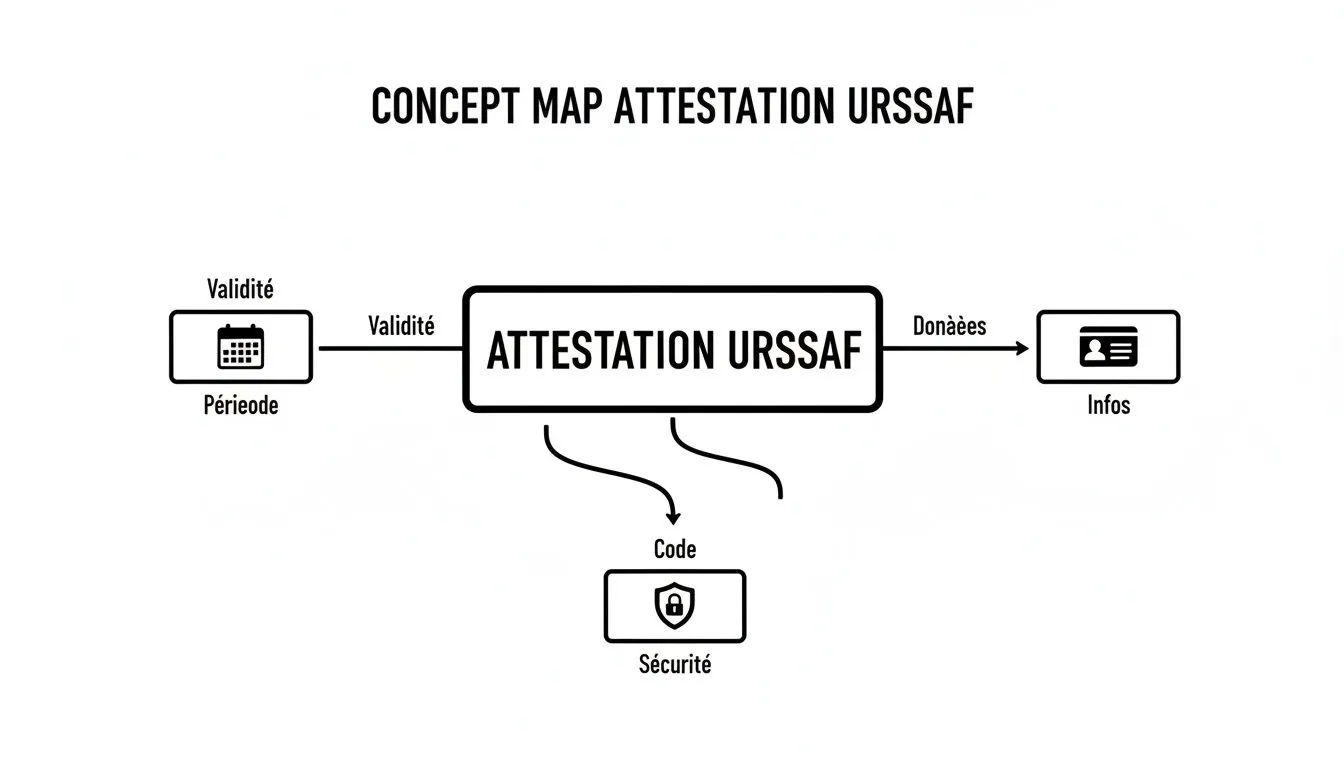
This mind map neatly summarizes the three things to check on the attestation: its validity period, the identification details, and, of course, the security code.
If even one of these elements is missing or incorrect, a particularly strict client could reject your document. Better safe than sorry!
What if the attestation is rejected?
Sometimes the system will block your request. Don’t panic — this is a fairly common situation that almost always gets resolved.
Generally, a rejection comes down to one of two reasons:
- You’re not up to date with your payments: The slightest delay or oversight in settling your social security contributions is enough for the system to say “no.”
- A declaration is missing: If you skipped a revenue declaration or a Déclaration Sociale Nominative (DSN), the system will spot it and block your attestation request.
The solution is simple on paper: sort out your situation. File the missing declaration, pay what you owe, and you’re done. Once URSSAF has recorded your payment, you can try again and get the document. To avoid ever getting your deadlines wrong again, take a look at our guide on quarterly URSSAF declarations.
If you’re going through a tight cash-flow period, above all, don’t bury your head in the sand. Contact URSSAF and negotiate a payment plan. As soon as the schedule is approved and you’ve paid the first installment, you’ll be considered “up to date” again and can obtain your attestation. This proactive approach is always far better received than radio silence.
How to verify that an attestation de vigilance is genuine?
Receiving an attestation de vigilance by email is a good start. But it’s only the beginning. A simple PDF, even one that looks official, can be forged in a few clicks. To protect yourself legally, you absolutely must verify its authenticity. This should become second nature to spare yourself serious trouble.
This step is far from a mere formality. Imagine an audit: if the document provided by your subcontractor turns out to be fake, you could be held jointly liable. It’s as if you’d never asked for it at all. This verification is the foundation of your duty of vigilance.

The security code: your anti-fraud shield
Fortunately, URSSAF has set up a simple and effective tool: the security code. This unique number, which must appear on every official attestation, is the key that guarantees your peace of mind. Without it, the document in your hands has no value.
Think of this code as a tamper-proof digital seal. It creates a direct, secure link between the document and URSSAF’s servers, which alone can confirm its validity.
Expert tip: Your job, every time, is to use this code to confirm the attestation is genuine and up to date. This operation only takes a few seconds, and it’s simply non-negotiable.
Build this check into your administrative processes, just as you would for a SIRET number or a billing address.
Step-by-step verification on the URSSAF website
The process was designed to be quick and accessible to everyone, without even needing to create an account. Here’s how to do it — you can’t go wrong:
- Go to the URSSAF website. The easiest way is to search “vérifier attestation URSSAF” in your search engine. The official link usually appears first.
- Enter the security code. Find this famous code on the attestation your partner sent you. Copy it accurately into the field provided on the verification page.
- Run the search and check the result. The response is instant.
If everything checks out, the site will display a certified digital version of the attestation. Take a moment to compare the details (company name, SIRET, etc.) with the PDF you received. This is the ultimate confirmation.
How to interpret the system’s response
The site’s verdict is final. There are only two possible outcomes.
-
Valid attestation: The system shows you the document’s details. You’re covered! A good habit is to take a screenshot or save the page as a PDF for your records. It’s extra proof in case you need it.
-
Unknown code or invalid attestation: An error message appears. Either the code was copied incorrectly (it happens!), or the document is fake or no longer valid.
In this second case, the rule is simple: don’t panic, but don’t pay either. Contact your provider immediately to flag the issue and demand a valid attestation. Don’t continue the collaboration until the situation is resolved.
For companies managing dozens of subcontractors, this repetitive task can quickly become time-consuming. There are solutions that let you automate this verification via specialized APIs, for ongoing, effortless compliance.
How to manage attestations de vigilance day to day?
Knowing what an attestation de vigilance is is one thing. Truly building it into your habits is another matter entirely. Let’s get practical: it’s time to turn this paperwork into a real shield for your business.
The golden rule to remember is the six-month validity period. An attestation isn’t a document you obtain once and forget about. Forgetting to request a new one puts you in as risky a position as if you’d never had one at all. It’s best to plan ahead so you’re never caught off guard.

Setting up a tracking system that actually works
A bit of organization goes a long way in never missing a deadline again. Here are a few tips that have worked well in practice:
- Calendar alerts: The simplest and most effective option. As soon as you receive an attestation, set a reminder in your calendar for five months later. That leaves you a full month to calmly follow up with your provider.
- A task in your CRM: If you use a CRM, take advantage of it. Link a reminder task directly to your subcontractor’s file to request the new document.
- Smart archiving: Keep all attestations and their verification proofs in a shared folder (ideally in the cloud). Adopt a clear naming convention for your files, such as
PROVIDER_NAME_URSSAF_Attestation_DD-MM-YYYY.pdf.
Good organization inevitably relies on solid business document management, combining security and efficiency.
The real risks if you let your guard down
We’re not talking about a mere formality here. Failing in this duty of vigilance directly exposes you to what’s known as joint financial liability.
Picture this: your subcontractor owes €20,000 to URSSAF. If an audit reveals that you didn’t request or verify their attestation, URSSAF can turn to you and demand payment of this debt, in proportion to the revenue you generated together.
The risk is direct, tangible, and can seriously hurt your cash flow. That’s the price of negligence. And make no mistake — courts are very clear on this: ignorance is never a valid excuse.
The contract clause that saves the day
Here’s one piece of advice that, on its own, can change everything. Consider adding a well-crafted clause to all your service contracts or terms and conditions.
This clause should specify two things:
- Providing an up-to-date URSSAF attestation de vigilance is a non-negotiable condition before any invoice payment.
- Invoice payment will be automatically suspended if the document isn’t provided after a simple follow-up request from you.
With this small clause, you gain an incredible amount of leverage. Not only does it formalize your request, but it also encourages your partners to stay compliant, all while protecting your cash flow from potential administrative holdups. Good document management is key to going further, as explained in our guide on business document management.
Special cases and tricky questions
Even if you know the procedure inside out, certain real-world situations can still raise doubts. That’s completely normal. Let’s untangle the most common questions so you always know the right move.
My provider is based abroad, what do I do?
This is a classic case. The attestation de vigilance is a 100% French document, specific to the URSSAF system. Your partner based outside France, even within the European Union, will therefore never be able to provide you with one.
That said, your duty of vigilance doesn’t disappear. You simply need to ask them for an equivalent document, issued by the relevant authority in their country. This paper must certify that they’re up to date with their social obligations there. For a European provider, the A1 form is often the document to request.
Be careful: a simple sworn statement on their part carries no legal weight. It may be reassuring, but in the event of an audit, it won’t cover you at all. Insist on an official document.
What if the contract is just under the €5,000 threshold?
The law is clear: the obligation to request and verify the attestation only kicks in once cumulative annual revenue with the same partner reaches €5,000 excluding tax. A contract worth €4,800 excluding tax? Technically, you’re not required to.
But is it a good idea to skip it anyway? Honestly, no. My advice: get into the habit of requesting it systematically, even for smaller amounts. It’s an excellent management practice that demonstrates your professionalism and secures the relationship. Imagine a small addendum or extra assignment eventually pushes you over the threshold… Having requested it from the start, you’re already one step ahead.
Think of it as free insurance. It costs nothing to ask for, but it can save you a lot of trouble. It’s a simple habit that speaks volumes about the rigor of your management.
What if a partner refuses to provide their attestation?
This is a tricky situation that can quickly turn into a standoff and hold up an invoice payment. If, despite a polite follow-up, your provider stays silent and doesn’t send you a valid attestation, the law requires you to act.
Your immediate reflex should be to report this failure to URSSAF. Don’t waste time. This step is your only way out of “joint financial liability” if, unfortunately, this partner turns out to be involved in a fraud case. In this specific situation, silence is your worst enemy.
To avoid getting to this point, the best protection is still to include a clause in your contracts. Spell out clearly that invoice payment is conditional on receiving an up-to-date attestation.
Does this also apply to micro-entrepreneurs?
Absolutely, without exception. Make no mistake: the micro-entrepreneur status (formerly known as auto-entrepreneur) changes nothing here.
As soon as a micro-entrepreneur reaches €5,000 excluding tax in cumulative billing over the year with a single client, they’re subject to the same rules as any other business. They must provide their client with an attestation de vigilance. They can obtain it very easily, in just a few clicks, from their personal account on autoentrepreneur.urssaf.fr. This is a non-negotiable step for securing the collaboration.
By centralizing and automating the management of your financial flows, from invoicing to accounting exports, Bizyness helps you secure your compliance day to day. Discover how to turn your accounting into a simple, automated process at https://www.bizyness.fr.
