
Your URSSAF quarterly declaration without the stress
Simplify your URSSAF quarterly declaration. Follow our practical tips to declare your revenue, understand your contributions, and avoid mistakes.

As a sole trader (micro-entrepreneur), the URSSAF quarterly declaration is an unavoidable appointment. Your social contributions are calculated based on your actually collected revenue. This process is done online, and here’s a quick reminder: it’s mandatory, even if your revenue is zero, to avoid any penalty.
The basics to master for your URSSAF declaration
Let’s be honest: for many people, the URSSAF quarterly declaration sounds like an administrative chore. Yet it’s much more than that. It’s what gives you access to retirement, healthcare, and training rights, and ensures you stay compliant. The idea is to demystify all of this so it becomes a simple reflex, without the headache.

The golden rule: only declare what has been collected
The starting point, and this is non-negotiable, is to distinguish between what you invoice and what you actually collect. For URSSAF, only the revenue actually received into your bank account counts.
Let’s take a concrete example: you’re a consultant and you send an invoice for €1,500 on March 25. Your client pays you on April 5. Well, this amount should not appear on the first quarter’s declaration (January-February-March), but on the second quarter’s (April-May-June). Keep this “actually collected” principle in mind — it’s the key to everything.
Clearly separating your activities to declare accurately
URSSAF doesn’t treat all income the same way. Contribution rates vary depending on the nature of your activity. If you juggle several types of activity, it’s essential to properly separate your income into the right categories.
- BIC (Industrial and Commercial Profits): This category covers everything related to buying and reselling goods, selling food, or providing accommodation services.
- BNC (Non-Commercial Profits): Here we’re talking about service provision and liberal professions: consultants, developers, trainers, etc.
Imagine a graphic designer who, in addition to their creative work, sells prints of their artwork. When filing their online declaration, they’ll need to enter two separate amounts: one for their service provision (BNC) and one for the sale of their products (BIC).
Every deadline is an opportunity to validate your social rights and prove your good management. Rigor in your tracking is the key to approaching each URSSAF quarterly declaration with peace of mind and avoiding unpleasant surprises.
This discipline helps you better anticipate your expenses and, ultimately, better manage your cash flow. If you want to go further and master every detail, our complete guide on revenue declaration is here for that. By mastering these fundamentals, what seemed like a constraint becomes a real management tool for your business.
A visual tour of your online declaration
Enough theory, let’s get practical. I’ll guide you step by step through your URSSAF quarterly declaration, directly on their portal. The idea is to demystify this process so it becomes a simple formality, without the headache.
The secret to a fast, hassle-free declaration? Good preparation. Before you even open your browser, your task is to total up all the amounts you collected during the quarter. Careful: we’re talking about the money that actually arrived in your account, not the invoices you sent.
Let’s take a concrete example: a freelance graphic designer. During the quarter, she received €850 via Stripe for a logo, €1,200 by bank transfer for a website, and €450 into her PayPal account for small edits. Her revenue to declare is therefore the sum of all this: €2,500. Simple, right?
Logging in and starting the declaration
Once you have your exact figure in mind, head to autoentrepreneur.urssaf.fr. Logging in couldn’t be simpler: your social security number (or your email) and your password, and you’re in.
This is what your dashboard looks like once you’re logged in. It’s your control center. The “Declare and pay” section clearly highlights the current deadline. Impossible to miss it.
Click on the button corresponding to the deadline, and the process is launched. You’ll land on a streamlined form where you just need to enter the revenue you calculated.
Entering your revenue without making mistakes
The form presents several boxes, each corresponding to a type of activity. This is where the distinction between the sale of goods (BIC) and service provision (BNC) becomes crucial. If you have several types of activity, you’ll need to properly split your income into the right boxes.
To avoid the classic pitfalls, here’s what to watch out for:
- Don’t mix up the categories: Putting service income into the “sale of goods” box completely skews the contribution calculation. Always double-check.
- Be precise down to the cent: Never round. You must declare the exact amount. Invoicing tools like Bizyness give you this figure without having to pull out a calculator.
- Declare even if the figure is zero: If you haven’t collected anything, you still have to file the declaration by entering “0”. Forget it, and you’ll face a €58 penalty.
The URSSAF interface is designed to be very straightforward. Once your revenue is entered, the contributions calculate themselves. Your only responsibility is to make sure the amount you enter perfectly reflects what you actually collected.
After validating your revenue, a summary page appears. It gives you the breakdown of your social contributions, your professional training contribution and, if you chose this option, the flat-rate income tax payment. Take a moment to check that the amounts seem logical to you.
Confirming and choosing how to pay
This is the final stretch. You confirm your declaration and choose your payment method. You generally have two options:
- Card payment: This is the “instant peace of mind” option. You pay immediately, the amount is debited, and you don’t think about it anymore.
- Direct debit (SEPA): If you’ve set up a direct debit mandate, URSSAF will collect the amount from your account on the due date. This is perfect for optimizing your cash flow, since the money stays with you until the last moment.
Once your choice is made and confirmed, your URSSAF quarterly declaration is complete. One last tip: download the acknowledgment of receipt. It’s a valuable document that other agencies, such as France Travail (formerly Pôle emploi), may ask you for. Keep it safe.
How are your social contributions calculated?
Once you’ve entered your revenue on the URSSAF website and clicked “confirm”, the amount of your social contributions appears as if by magic. In reality, there’s nothing magical about it: it’s the result of a very simple calculation.
The formula is always the same: Collected revenue × Contribution rate. Your only job is to declare the correct amount. URSSAF handles the calculation.
The system is therefore very straightforward. The only thing you need to master is the rate that applies to your situation, since it depends entirely on the nature of your activity.
Contribution rates based on your activity
For your URSSAF quarterly declaration, not all income is treated the same way. Contribution rates differ to match the realities of each sector.
Here are the overall rates in effect in 2024 (if you haven’t opted for the flat-rate income tax payment):
- 12.3% for the purchase and resale of goods (BIC category).
- 21.2% for commercial or craft service provision (also BIC).
- 21.1% for other service provision and liberal professions (BNC category).
In practice, a web developer who bills for development work (BNC) won’t have the same rate as an e-commerce seller who sells products (BIC). It makes sense.
If you have several types of activity and combine different lines of work, be very careful to properly split your revenue. A simple mistake in the wrong box, and the calculation of your contributions will be wrong. The impact on your cash flow can be immediate.
The diagram below gives you a good overview of the whole process, from preparing the figures to the final payment.
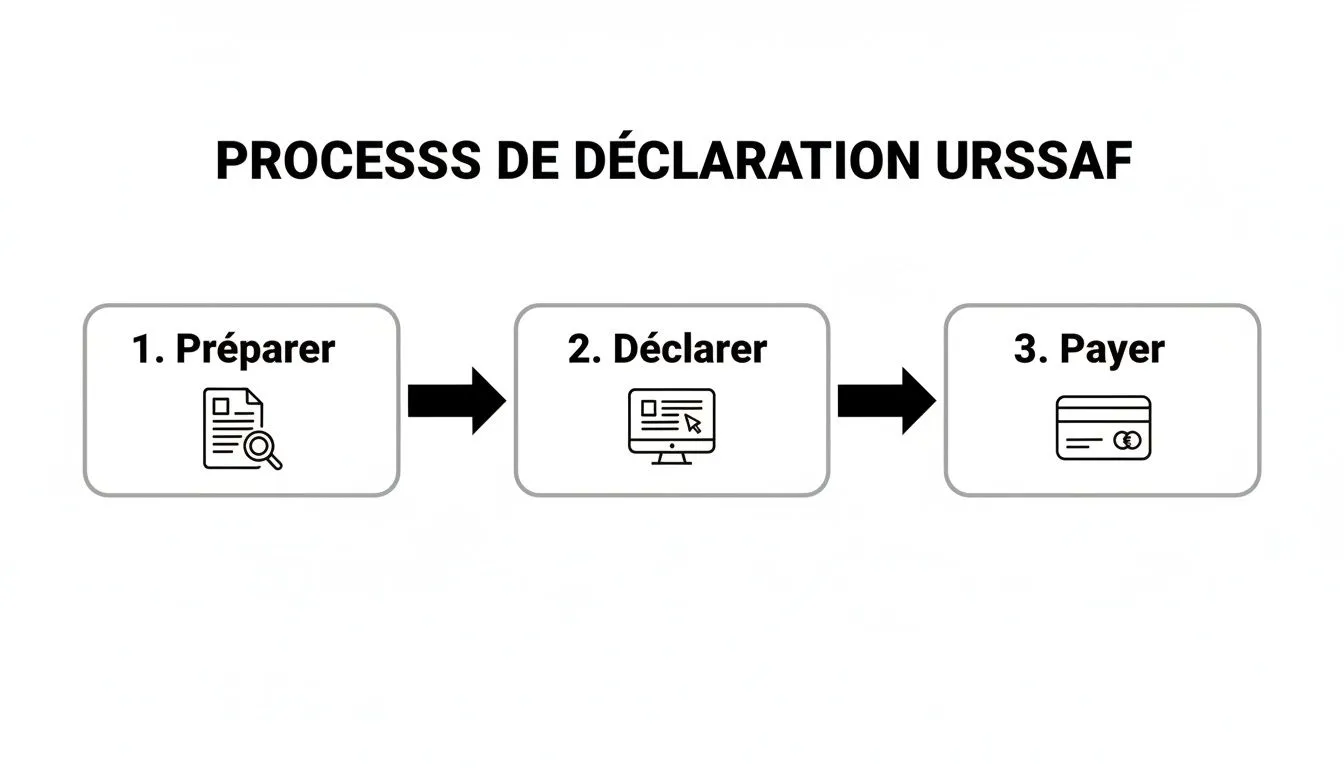
You can clearly see here that everything starts with good preparation. If the initial figures are correct, the rest follows without a hitch.
The ACRE boost
Do you benefit from ACRE (Aide à la Création ou à la Reprise d’une Entreprise)? Excellent news. Your contribution rates are simply cut in half (50% reduction) during your first year.
This is a significant benefit, applied automatically by URSSAF if you’re eligible. You don’t need to do anything special when filing your declaration — the site takes care of it.
An example to make it clearer
Let’s imagine a web developer (liberal profession, so BNC) who invoiced and collected €6,000 over a quarter. They don’t have ACRE.
The calculation couldn’t be simpler: €6,000 (revenue) × 21.1% (BNC rate) = €1,266.
The amount of their social contributions for the quarter will therefore total €1,266.
Note that these rates aren’t set in stone. For example, the rate for liberal activities (BNC) rose to 23.1% on July 1, 2024. It will even gradually increase to reach 26.1% in 2026, in order to fund better retirement rights. Remember to stay informed about these changes to anticipate your expenses.
To go further, our guide on calculating social contributions covers everything you need to know.
The day-to-day life of a micro-entrepreneur is anything but smooth sailing. Your URSSAF quarterly declaration has to adapt to the ups and downs of your business, whether that’s a slow period, a simple oversight, or a nice bit of growth. Knowing how to anticipate these situations will save you plenty of headaches.
The case of zero revenue
This is a question that comes up over and over: what do you do when you haven’t collected anything during the quarter? The answer is simple, but crucial. You absolutely must file a €0 declaration.
Not declaring anything is not an option. URSSAF will treat this as an oversight and apply a flat penalty of €58 for each missing declaration.
By declaring “0”, not only do you avoid this penalty, but you also keep your active status and show your good faith. It’s also the only way to prevent the administration from carrying out an “ex officio taxation” — a calculation based on an inflated estimate of your income that’s rarely in your favor.
I forgot or made a mistake — what should I do?
To err is human, and an oversight can happen to anyone. If you’ve missed the deadline, don’t panic, but act quickly. The first thing to do is log into your online account and submit the missing declaration as soon as possible.
The faster you sort it out, the more you limit late-payment surcharges. If you notice an error in the amounts declared, you can correct it directly online up until the payment deadline. Once that window has passed, the best approach is to contact URSSAF via the secure messaging system in your account to request a correction.
Never leave a declaration hanging. A proactive approach to correcting an oversight is always viewed more favorably by the administration than a lingering omission. The consequences can become much heavier.
How do you handle a change in activity partway through the quarter?
Your business is evolving, and that’s great news! Let’s take a concrete example: a marketing consultant (BNC service provision) starts selling an online course (still BNC) and, alongside that, practical guides in book form (BIC sale of goods). This scenario is very common and requires special attention at declaration time.
You’ll need to make sure to split the revenue into the right boxes:
- Income from consultations and courses goes into the “Service provision” box.
- Income from book sales goes into the “Sale of goods” box.
Rigorous accounting management becomes essential here, both to stay compliant and to steer your growth. In fact, the current trend favors the growth of small businesses. INSEE, for instance, recorded more than 2.32 million hiring declarations in the third quarter of 2025, a figure that reflects entrepreneurial dynamism. For those considering taking the leap into hiring, impeccable declarative management is an absolute prerequisite. You can find these statistics on the INSEE website.
Invoicing tools like Bizyness can be a lifesaver here. They let you categorize every incoming payment as soon as it’s created, acting as a safety net to prepare the amounts to declare without the headache.
Automating your declarations to focus on your business
Your time is precious. Every minute spent juggling administrative tasks is a minute not spent growing your business. The URSSAF quarterly declaration, while unavoidable, can quickly become a headache if you go about it the wrong way. Fortunately, there’s a way to stop dreading it: automation.

The idea is simple: turn this obligation into a simple formality wrapped up in a few clicks. No more combing through bank statements or manually compiling payments received via Stripe, PayPal, or bank transfer.
Centralizing your income without thinking about it
The first step to freeing yourself from this mental load is centralizing all your incoming payments. By connecting your professional bank account to a management tool like Bizyness, every transaction is automatically imported and categorized. That’s the end of manual work and the risk of forgetting something.
This bank sync gives you a clear, up-to-date view of your actually collected revenue. The tool acts as a real financial dashboard that does the collection work for you, letting you focus on what matters.
Automation isn’t a gadget, it’s a real growth strategy. By eliminating the risk of human error and freeing up hours of work, you’re investing directly in the sustainability of your business and in your own peace of mind.
An automated system ensures every cent is properly accounted for, which is the foundation of an accurate declaration. To better understand the productivity gains, discover how automating your administrative tasks can change your day-to-day as an entrepreneur.
Generating the amount to declare in one click
Once your data is centralized, the magic happens. A good management tool doesn’t just list your transactions. It goes further by generating smart reports that calculate the exact amount to declare for you.
This is especially useful if you have several types of activity, such as selling goods and providing services. The tool can split your income into the right categories, preparing the precise figures to enter in each box of the URSSAF form.
The benefits are clear:
- Absolute reliability: The calculation is based on real data from your bank. No more entry errors.
- Massive time savings: The report is generated instantly, with no manual work required.
- Guaranteed compliance: The system ensures you’re declaring the collected revenue, as required by regulations.
This automated tracking is also a safeguard for staying in step with regulatory changes. For example, the quarterly social security ceiling will reach €11,775 in 2025. A high-performing tool helps you monitor this threshold and integrates up-to-date contribution rates, guaranteeing declarations that are always compliant. You can also find out about rates and ceilings directly on the URSSAF website. Automation then becomes your best ally for sound, stress-free management.
Your questions about the quarterly declaration, answered from experience
Getting started with the URSSAF quarterly declaration is a bit like a rite of passage for every sole trader. At the beginning, you fumble around, you have doubts, and that’s completely normal.
To spare you the headaches, I’ve compiled here the questions that come up again and again, with clear answers based on experience. The goal? To make this process a simple formality for you.
Invoiced or collected: which amount should you declare?
This is the golden rule, the starting point of everything, and yet the most common source of error. Remember this: you declare only what has actually been collected into your bank account (or received by any other means) during the period in question. This is what’s known as the “cash accounting” principle.
A concrete example? You issue an invoice for €800 on March 15. Your client pays you on April 5. This €800 amount must not appear on your first quarter declaration (January-March). It should be declared on the following one, the second quarter (April-June).
Oops, I made a mistake in my declaration! What should I do?
Don’t panic, a slip-up happens easily. If you catch it before the deadline, everything’s fine. You can go back to your account on autoentrepreneur.urssaf.fr and edit your declaration as many times as you like.
If the deadline has already passed, the best move is to be proactive. Don’t bury your head in the sand. Log into your account and send a message to URSSAF via the secure messaging system. Simply explain the error and ask how to correct the situation. Acting quickly and transparently is always the best strategy to avoid potential penalties.
A seasoned tip: An oversight or a mistake isn’t a disaster. What matters is communicating openly with the administration. It’s better to initiate a correction yourself than to face one imposed after an audit.
Is it better to declare monthly or quarterly?
Honestly, there’s no right or wrong answer. It all depends on your personal organization and the nature of your income.
-
Quarterly declaration: This is the default option, and many people appreciate it because it limits paperwork to four times a year. It’s ideal if your income is irregular or if you like to batch your administrative tasks and get them done in one go.
-
Monthly declaration: This can be a smart choice if your income is fairly stable. The advantage is that it spreads your contribution payments over the year. It avoids large lump-sum outflows and can really help you manage your cash flow more precisely.
Keep in mind that you can change your option once a year. You simply need to request it from URSSAF before October 31 for the change to take effect the following year.
Is ACRE automatically taken into account?
Yes, fortunately! If you obtained ACRE (Aide à la Création ou à la Reprise d’une Entreprise) when you registered, URSSAF automatically applies the reduced contribution rate. You don’t need to do anything special when filing your declaration. The amount to pay will be calculated directly using this reduced rate during your first year. It’s a genuine boost, and it’s handled for you.
Your URSSAF quarterly declaration shouldn’t cost you precious time you could be spending on your clients. Tools like Bizyness exist for exactly this: centralizing your invoices, calculating your collected revenue in one click, and giving you the exact amount to report. Simplify your life and gain peace of mind.
