

 Français
VAT for micro-entrepreneurs: master your taxes with ease
Learn everything about VAT for micro-entrepreneurs, optimize your taxes and anticipate changes with our expert advice.
The VAT fundamentals that transform your micro-business

Value Added Tax (VAT) is an indirect tax that plays a crucial role in running any micro-business. It directly impacts your selling prices, your relationships with suppliers, and your cash flow. Mastering the fundamentals of VAT is therefore essential for sound, effective management of your business.
It’s not simply an administrative obligation, but a strategic lever that needs to be understood and used wisely. This article covers the key points you need to know to navigate the world of VAT with confidence.
VAT exemption threshold: an asset for getting started
The VAT exemption scheme (franchise en base de TVA) is a simplified regime that most micro-entrepreneurs benefit from. In practice, this means you don’t have to charge VAT to your customers. Your prices are therefore displayed excluding tax (HT).
This scheme has one major advantage: administrative simplification. You have no VAT return to file, which considerably lightens your obligations. In exchange, you cannot reclaim VAT on your business purchases.
Becoming liable for VAT: a new stage for your business
When your revenue exceeds a certain threshold, you become liable for VAT. You must then collect VAT on your sales and remit it to the state. Your invoices must therefore show the VAT amount.
Becoming liable involves regular filing obligations. You must calculate the difference between VAT collected and deductible VAT (the VAT paid on your purchases) and remit it to the tax authorities. The liability thresholds have recently changed. Previously set at €37,500 for services and €85,800 for sales activities, a single threshold of €25,000, covering all activities, is planned to simplify the system. More information on this reform.
Voluntary VAT registration: a strategic option to consider
Even if your revenue is below the legal thresholds, you can opt for voluntary VAT registration. This option can prove advantageous in certain situations, particularly if your customer base mainly consists of VAT-registered businesses.
Indeed, these businesses will be able to reclaim the VAT you charge them, making your offers more attractive. On top of that, you’ll be able to deduct VAT on your own purchases, which can reduce your costs. Whether mandatory or voluntary, VAT liability makes bookkeeping more complex. Tools like Bizyness can help you automate your VAT returns and invoice management, letting you focus on your core business.
Mastering VAT exemption thresholds like an expert
The VAT exemption scheme is a considerable advantage for micro-entrepreneurs. It simplifies bookkeeping by exempting you from collecting and remitting VAT. However, this exemption is subject to revenue thresholds. Exceeding them triggers VAT liability, changing your tax regime. It’s therefore crucial to understand these thresholds and monitor your business to anticipate any change.
Understanding the current thresholds
Currently, VAT exemption thresholds differ depending on your type of activity. For services, the threshold is €34,400. For sales of goods, it is higher, reaching €85,800.
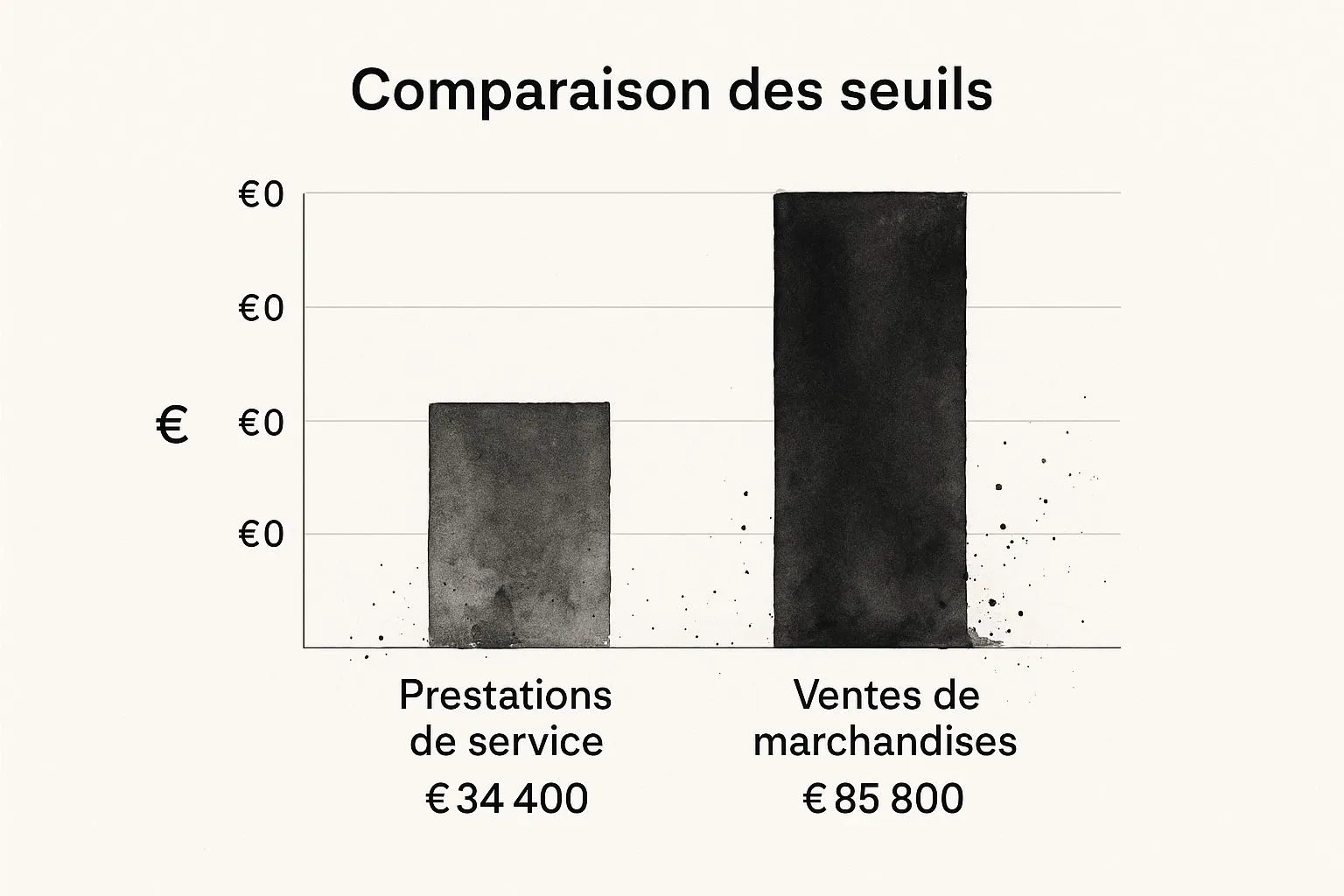
This chart illustrates the significant gap between the two thresholds. This gap gives micro-businesses that sell goods greater room to maneuver. The difference is explained by the generally lower margins in retail, which require higher revenue to achieve equivalent profitability.
To better understand how these thresholds have evolved, let’s look at the following table:
Evolution of VAT exemption thresholds
Comparison of current and future VAT exemption thresholds by type of activity
| Type of activity | Current threshold | New threshold (2025) | Impact |
|---|---|---|---|
| Services | €34,400 | €36,500 (estimate) | Increase |
| Sales of goods | €85,800 | €91,900 (estimate) | Increase |
This table shows the current thresholds and an estimate of the future thresholds for 2025. The impact is a slight increase for both types of activity. It is important to note that these 2025 figures are estimates and may be subject to change.
Anticipating crossing the thresholds
Approaching the VAT exemption threshold shouldn’t be a source of worry. Think of it instead as an opportunity to prepare your business for this transition. Regularly tracking your revenue is essential. Use accounting software like Bizyness to automate this tracking and receive alerts as you approach the threshold. This will let you anticipate administrative changes and prepare your cash flow.
Voluntarily exceeding the threshold: a strategy to consider
In some cases, voluntary VAT registration can be a smart strategy, even if your revenue is below the threshold. If you mainly work with VAT-registered businesses, charging VAT lets them reclaim it. Your services become more competitive as a result, which can make it easier to win new clients. However, it’s important to carefully analyze the impact of this choice on your administrative workload before making a decision.
Managing VAT liability
Crossing the VAT exemption threshold means you must collect VAT on your sales and remit it to the state. This creates new filing obligations, typically monthly or quarterly. You’ll also need to adapt your invoices to include VAT. Bizyness simplifies these steps by automating the creation of compliant invoices and the generation of VAT returns. The tool also lets you calculate deductible VAT on your business purchases, an asset for optimizing your cash flow. Don’t hesitate to use effective tools to ease this transition and focus on growing your business.
The economic equation of VAT for your growth
VAT is often seen as an administrative complexity. Yet it represents an important factor to consider for the growth of your micro-business. Understanding how it works and its economic impact is essential to optimize your strategy and make informed decisions. VAT isn’t just a legal obligation — it’s a key element of your profitability and competitiveness.
The impact of VAT on your business relationships
The VAT regime you choose, liability or exemption, has a direct influence on your relationships with your customers and suppliers. VAT exemption makes your prices more attractive to individual consumers. On the other hand, it can be a disadvantage against VAT-registered businesses, which won’t be able to reclaim VAT on your invoices.
Conversely, if you’re liable for VAT, your before-tax prices are more competitive for businesses. However, the final price, including VAT, may appear higher for individual consumers.
VAT and your margins: an in-depth analysis
VAT management directly impacts your margins. If you’re liable for VAT, you collect VAT on your sales and deduct VAT on your business purchases. This deduction mechanism can significantly ease your costs and improve your profitability.
If you’re under the VAT exemption scheme, you don’t benefit from this mechanism. Your margins may therefore be affected, especially if the amount of your business purchases is significant. A precise analysis of the impact of each regime on your situation is therefore essential.
Adapting your VAT strategy to your target market
The choice of VAT regime also depends on your target market. If you mainly serve individual consumers, VAT exemption can be an asset. If your customer base is mostly made up of businesses, VAT liability will likely be more relevant.
It’s worth remembering the weight of micro-businesses in the French economy. With 2.3 million workers, they contribute around 19% of the value added generated by businesses. Their revenue is split mainly between retail (36%) and services (35%), illustrating their diversity and importance. Discover more information on the economic impact of micro-businesses.
Bizyness: an ally for mastering your VAT
Whatever your choice, tools like Bizyness can help you manage your VAT effectively. From creating compliant invoices to calculating deductible VAT, Bizyness simplifies your obligations and lets you focus on growing your business. Feel free to explore its features to optimize your VAT management and save time.
Turning your VAT obligations into a smooth process
Managing VAT can seem like a real headache for micro-entrepreneurs. Yet, with a rigorous organization and the right tools, this obligation becomes a simple procedure built into your daily routine. Forget the stress of last-minute tax filings! Let’s see together how to handle VAT with peace of mind.
Simplifying the creation of compliant invoices
Compliant invoices are the foundation of sound VAT management. Invoicing software like Bizyness automates this process. Enter the necessary information and the tool generates invoices that meet the standards, with or without VAT depending on your regime. You save precious time that you can devote to your core business.
Choosing the right digital tools
Many digital tools exist to help you manage your VAT. Some, however, can unnecessarily complicate the process. Bizyness stands out with its intuitive interface and features designed for micro-entrepreneurs. Your invoices are centralized, VAT is calculated automatically, and preparing your returns is simplified.
Building VAT tracking into your routine
The trick to hassle-free VAT management? Build it into your routine. Set aside, for example, a weekly slot to check your invoices and record your expenses. Bizyness makes this tracking easier thanks to bank synchronization. Your transactions are imported directly, limiting errors and giving you a clear view of your situation.
VAT obligations calendar
The table below summarizes the deadlines and VAT obligations for micro-entrepreneurs. It will let you quickly see your obligations at a glance.
VAT obligations calendar
Summary of deadlines and obligations relating to VAT for micro-entrepreneurs
| Filing frequency | Deadlines | Documents required | Payment method |
|---|---|---|---|
| Monthly | The 24th of the following month | CA3 | Direct debit, bank transfer, check |
| Quarterly | The 24th of the month following the quarter | CA3 | Direct debit, bank transfer, check |
| Annual (if under the exemption scheme) | None | None | None |
This table lets you quickly identify your filing frequency, the deadlines to meet, the documents to provide, and the various payment options.
Using your VAT data to steer your business
Beyond the legal aspect, VAT is a valuable source of information for steering your business. Analyzing the VAT collected and deductible VAT gives you a precise view of your profitability and how your costs are evolving. Bizyness offers reports that make this analysis easier and help you make informed decisions to optimize your strategy. Analyzing deductible VAT, for example, can help you identify ways to optimize your purchases. Tracking VAT collected, meanwhile, helps you better understand the impact of your selling prices on your revenue.
By taking a proactive approach and using the right tools, VAT management becomes an asset for your micro-business. With efficient organization and a tool like Bizyness, you turn this constraint into a performance lever.
VAT liability: decoding the pros and cons
VAT liability for a micro-business is a complex topic. It’s important to fully understand the implications of this choice, both from a financial and a strategic standpoint. This status influences your competitiveness, your cash flow, and even your business’s image. A thorough analysis of the advantages and disadvantages is therefore essential.
Advantages of VAT liability
Reclaiming VAT on your business purchases is a major advantage. For example, when buying computer equipment, the VAT paid is deductible, easing your expenses. This advantage is particularly attractive for large investments.
A professional image is another benefit. Being liable for VAT is often seen as a mark of seriousness and credibility, especially for businesses working in B2B. This can make it easier to access new markets and strengthen your positioning.
Disadvantages of VAT liability
VAT liability brings additional administrative obligations. Collecting, declaring, and remitting VAT to the state represents a non-negligible workload, even though it is simplified for micro-businesses. Tools like Bizyness can help you manage these steps.
Higher prices for individual consumers, who cannot reclaim VAT, can be a drawback. If your customer base is mostly made up of individuals, the impact on your sales volume needs to be carefully assessed.
Voluntary VAT registration: a relevant strategy?
Voluntary VAT registration, even before reaching the mandatory thresholds, can be a winning strategy if your customer base mainly consists of VAT-registered businesses. They will be able to reclaim the VAT charged, making your prices more competitive. This decision should, however, be carefully thought through.
Making the right decision
To find out whether VAT liability is beneficial for your micro-business, analyze your situation: your activity, your target customers, your investments, and your growth objectives. VAT liability is a strategic choice. Take the time to think it through and don’t hesitate to consult a chartered accountant.
Staying ahead of changes to the VAT regime
In the fast-moving world of micro-business, anticipating tax changes, particularly those related to VAT, is a key factor for staying power and growth. The VAT regime is constantly evolving and can significantly impact your business model. Staying informed and preparing for upcoming changes is therefore crucial.
The single-threshold reform: a major change on the horizon
One of the most significant changes concerns the potential introduction of a single VAT exemption threshold. Currently, thresholds differ depending on the nature of the activity: €34,400 for services and €85,800 for sales of goods. The goal of a single threshold, potentially set at €25,000, is to simplify the system. However, this reform, initially planned then suspended, has significant consequences for micro-entrepreneurs. Staying on top of regulations is essential. For more information, see the guide on pest control regulations. This change could affect a large number of micro-businesses and change how they manage VAT.
Adapting your business to changes in the VAT regime
Anticipating these changes lets you prepare your business for this transition and avoid unpleasant surprises. Several strategies can be put in place:
-
Monitor your revenue: Rigorous tracking is essential to anticipate crossing the thresholds.
-
Adapt your pricing policy: VAT liability impacts your selling prices. Anticipate the adjustments needed to maintain your margins.
-
Optimize your bookkeeping: VAT liability involves regular filings. Tools like Bizyness can help you automate these tasks.
French and European tax trends: understanding the context
Changes to the VAT regime are part of a broader context of tax reforms, both in France and across Europe. Harmonizing rules within the European Union and fighting tax fraud are major issues that influence national decisions. Understanding these underlying trends lets you better anticipate future changes and adapt to them proactively.
Making the most of change: an opportunity for micro-businesses
Beyond the constraints, changes to the VAT regime can also represent opportunities. VAT liability in particular allows you to reclaim VAT on business purchases, which can ease your costs and improve your profitability. Furthermore, for micro-businesses working mainly with other businesses, VAT liability can strengthen their credibility and make it easier to win new clients.
Winning strategies for the future
Anticipation and adaptation are the keys to success in a constantly changing tax environment. By staying regularly informed about changes to the VAT regime and adopting best practices, you can not only comply with new rules but also turn them into a competitive advantage. Don’t hesitate to use effective tools like Bizyness to simplify your bookkeeping and focus on growing your business. Bizyness lets you manage your invoices, your VAT, and your financial transactions simply and intuitively, freeing you from administrative constraints and letting you focus on growing your business. Discover today how Bizyness can support your success: https://www.bizyness.fr
