

 Français
 The complete guide to VAT on online services for 2026
Master VAT on services for your online business. Our 2026 guide covers territoriality, reverse charge, rates and the One-Stop Shop (OSS).
When you sell online services, managing VAT can quickly become a headache. It actually all comes down to two simple criteria: who is your customer (a business or an individual?) and where are they located?
In short, if you invoice a business (B2B) within the EU, the reverse charge principle applies. For an individual customer (B2C), you’ll need to charge VAT at their country’s rate, which is most often handled through the OSS One-Stop Shop.
How VAT on online services works
Forget the dense tax jargon. VAT isn’t just a figure at the bottom of your invoices; it’s the GPS for your international growth. Get it wrong, and you’re guaranteed to run off the road, with penalties waiting at the end. Set it up correctly, and it becomes an ally that secures your growth.
This guide will help you take control of that GPS. To do so, you need to master the three fundamental questions every digital entrepreneur eventually asks.
The 3 pillars of VAT on services
To see things clearly, it all comes down to understanding how these three elements interact:
- Territoriality: In which country is VAT due? The answer depends entirely on where your customer is established and their status (business or individual). This is the starting point for all your thinking.
- Responsibility: Who must declare and pay this VAT? Is it you, the seller, or your customer? This is a crucial question, especially for B2B sales in Europe, where the well-known reverse charge mechanism changes everything.
- Automation: How do you apply these rules across dozens or hundreds of sales without losing hours and risking mistakes? Trying to do it manually is a source of stress and a real compliance risk.
Our goal is simple: turn this administrative constraint into a genuine reflex. By understanding and automating these rules, every sale becomes compliant, whether your customer is in Paris, Berlin, or Lisbon. To revisit the fundamentals, feel free to read our guide on how to calculate VAT the right way.
Correctly setting up VAT is the foundation of healthy international growth. It protects your margins, prevents tax reassessments, and builds customer trust by delivering clear, compliant invoices from the start.
To give you an overview, here’s a summary of the most common situations.
| Customer type | Customer location | Applicable VAT rule |
|---|---|---|
| Business (B2B) | France | Invoicing with French VAT |
| Business (B2B) | European Union | Invoicing net of VAT with reverse charge |
| Individual (B2C) | France | Invoicing with French VAT |
| Individual (B2C) | European Union | Invoicing with the customer’s country VAT (via OSS) |
This table summarizes the scenarios you’ll encounter most often. In the following sections, we’ll break down each scenario with practical examples so you can apply them directly to your business.
For VAT on services, everything starts with territoriality
The very first question to ask, even before thinking about the VAT rate, is: “In which country must the tax be paid?” This is known as the territoriality principle. Think of it as a tax GPS: it tells you the final destination of the VAT you charge. If you get the destination wrong from the start, your entire invoicing will be incorrect.
Fortunately, the basic principle is fairly intuitive. To know where a service is considered “consumed” for tax purposes, everything depends on the nature of your customer. Are they a business buying for their company, or a simple individual? This distinction is the key to everything.
The fundamental difference between B2B and B2C
For every sale, your first reflex should be to identify your customer. Are you selling to another company (B2B, Business-to-Business) or to an end consumer (B2C, Business-to-Consumer)? The rules of the game change radically.
- In B2B, the general rule is that VAT is due in the country where your business customer is established.
- In B2C, it’s much simpler: VAT is due where your individual customer lives.
Let’s take an example to make this clear. You’re a software consultant based in France. If you sell a service to a company in Germany, that’s a B2B transaction. VAT will be handled in Germany. However, if you sell that same service to a student living in Berlin, you switch to B2C, and the rules change.
This simple decision tree illustrates this reasoning perfectly.
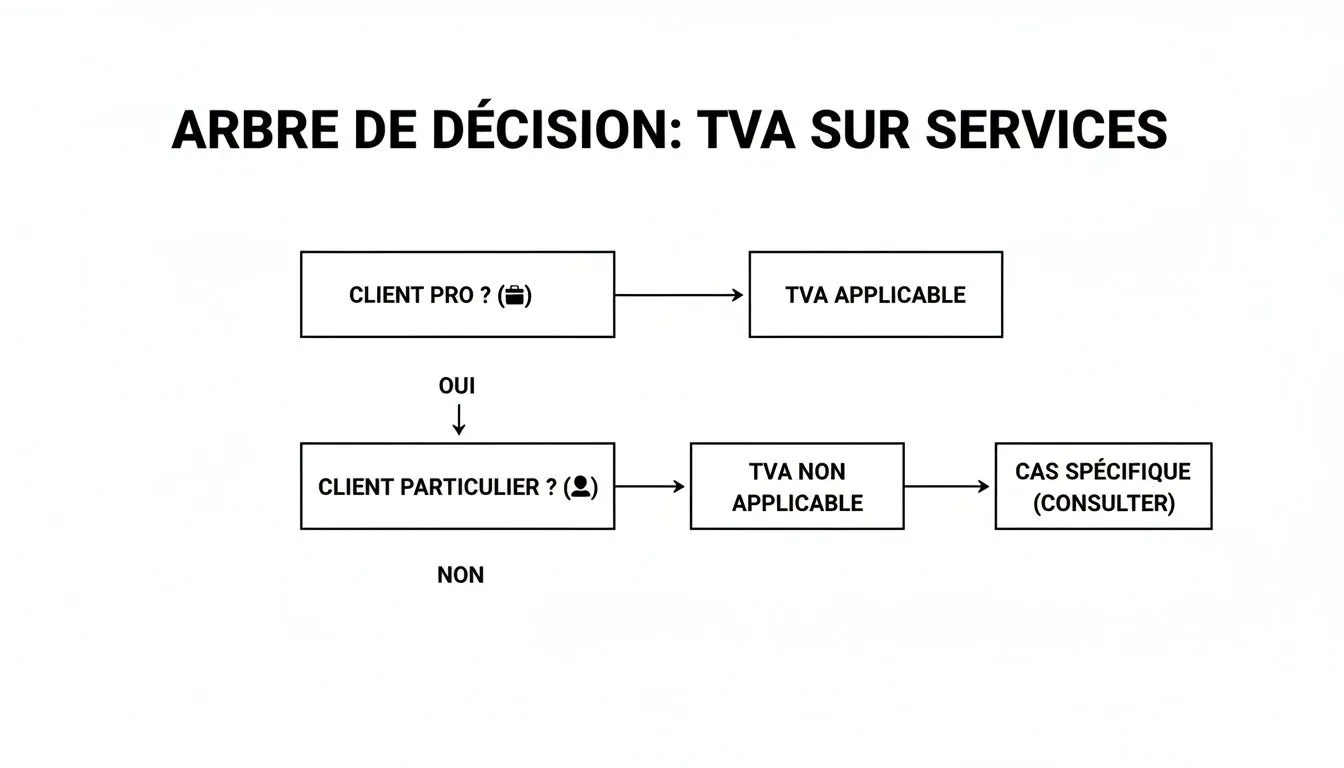
As you can see, everything starts with the customer’s status. This is what determines the rest of your invoicing.
How can you be certain you’re dealing with a business?
Beware: a simple business email address or a website isn’t enough to prove your customer is a company. In the eyes of the tax authorities, the only conclusive proof is a valid intra-community VAT number.
This number is the cornerstone of all your B2B transactions within the European Union. Before invoicing a European customer without VAT (under reverse charge), you have a formal obligation to verify the validity of their number. To do this, use the European Commission’s online service: VIES (VAT Information Exchange System). Remember to keep proof of this check, such as a dated screenshot. It’s your safety net in case of an audit.
If your customer doesn’t provide a VAT number, or if it turns out to be invalid on VIES, you have no choice. You must treat them as an individual customer (B2C) and charge VAT at their country’s rate. Trying to bypass this exposes you to a painful tax reassessment.
Your customer’s address remains, of course, a valuable clue for locating their place of establishment. To fully understand its role, feel free to read our article on the billing address and its implications.
Two concrete scenarios to help you understand
Let’s set the scene. Your company is based in France.
Scenario 1: You sell to a company in Italy (B2B)
You carry out a consulting assignment for a company in Milan. They provide their Italian VAT number, which you immediately verify on the VIES website. Everything checks out.
- Place of taxation: Italy (your customer’s country).
- Your invoice: You issue a net-of-tax invoice, adding the mention “Reverse charge by the recipient.” Your customer will be responsible for declaring VAT in Italy.
Scenario 2: You sell to an individual in Spain (B2C)
You sell an online course to a student living in Madrid. They obviously have no VAT number to provide.
- Place of taxation: Spain (your customer’s country of residence).
- Your invoice: You must invoice by applying the current Spanish VAT rate (for example, 21%). You’ll collect this tax and remit it to the Spanish tax authorities, most often via the OSS One-Stop Shop.
These two examples show just how much the nature of your customer completely transforms the way you manage VAT. Once you master this distinction, you’ve already done the bulk of the work.
When selling services to other businesses in Europe, one mechanism completely changes the game: VAT reverse charge. It’s a fantastic tool, specifically designed to smooth B2B trade within the European Union. No more headache of having to register for VAT in every country where your customers are located!
The idea is simple, yet remarkably effective: responsibility is reversed. Instead of you, the French seller, collecting VAT, it’s your European business customer who handles it directly in their own country. For you, this means much more straightforward invoicing and a lighter administrative burden.
The principle of the responsibility shift
Let’s set the scene. You’re a digital marketing agency based in France running a campaign for a company in Germany. Without reverse charge, you’d be in a minefield, having to juggle German VAT.
Fortunately, this mechanism flips the situation. You’ll issue an invoice for the net (tax-free) amount of your service. Your German customer, in turn, will declare the German VAT they would have owed you, and immediately deduct it.
For the customer, the operation is financially neutral: VAT is declared and deducted at the same time. For you, the gain is enormous: no need for a German VAT number, and no need to get lost in the intricacies of local tax rules. It’s a significant saving of time and money.
This system is now the norm for the vast majority of intra-community B2B services. Mastering it is therefore a must for any company looking to grow smoothly across Europe.
How to apply reverse charge in practice
To keep everything in order, there’s a precise three-step process to follow. Don’t skip any step — it’s what guarantees your compliance in case of an audit.
- Check your customer’s VAT number: This is non-negotiable. You must use the European Commission’s VIES service to make sure your customer’s intra-community VAT number is active. Keep a record of this check (a dated screenshot works perfectly).
- Invoice net of tax: Your invoice must show no VAT amount at all. The total due corresponds solely to the amount of your service. It’s as simple as that.
- Add the mandatory mention: This is the finishing touch that makes your invoice compliant. You must include a specific sentence explaining why VAT isn’t applied. It signals to the tax authorities of both countries that the transaction falls under this special regime.
By rigorously following these three points, you secure your transactions and can rest easy.
The mentions to include on your invoices
This short sentence to add to your invoice is the linchpin of the whole system. Without it, your invoice is technically incorrect, and the tax authorities could come after you for the VAT you didn’t collect.
The most recognized and complete mention is:
“Reverse charge by the recipient pursuant to Article 196 of Directive 2006/112/EC”.
Another, more direct wording, equally valid, is also possible:
“VAT exemption, Article 283-2 of the French General Tax Code”.
Include one of these two mentions clearly and visibly, and your invoice will be perfectly justified. To dig deeper into the topic, our complete guide on VAT reverse charge covers all the practical cases in detail.
Common mistakes to avoid at all costs
Reverse charge is a powerful tool, but a wrong move can be costly. Here are the two most common traps to avoid:
- Applying it to an individual customer (B2C): Reverse charge is strictly reserved for business-to-business (B2B) transactions. If your customer is an individual without a VAT number, a different rule applies: you must charge them VAT at their country’s rate.
- Using it for a customer outside the EU: This mechanism is specific to the European single market. Sales to companies based in Switzerland, the UK, or the United States, for example, follow other exemption rules.
To sum up, reverse charge is a real facilitator, provided you’re rigorous. Careful upfront verification and precise invoicing are the keys to smoothly managing VAT on services across Europe.
What VAT rate should you apply to your services?
Knowing which country to declare your VAT in is the first step. The second, equally crucial one, is determining which rate to apply. The most common mistake? Assuming everything is at 20% and moving on. In reality, the landscape of VAT rates is far more nuanced.
Depending on the exact nature of your service, you might qualify for a reduced rate, or even a full exemption. Mastering these subtleties isn’t just a matter of compliance; it’s a genuine lever for optimizing your prices and protecting your margin.
In France, VAT on services mainly juggles three rates:
- The standard rate of 20%: This is the base rate, applied by default to the vast majority of services. It covers consulting, web development, marketing, graphic design… in short, most intellectual services.
- The intermediate rate of 10%: This one is rarer for purely digital services. It mainly concerns sectors such as passenger transport or certain renovation work.
- The reduced rate of 5.5%: Reserved for goods and services deemed essential, this rate also applies to a handful of digital services, but be careful, the conditions are very strict.
Here, the only golden rule is to never assume. A rate mistake can cost you dearly, whether in the form of a tax reassessment or a loss of competitiveness because your prices are needlessly inflated.
The exceptions that change everything
It’s often in the special cases that the biggest opportunities (and the biggest risks) hide. VAT is an area where the details matter enormously. The same service, on the surface, can shift from one rate to another depending on its legal classification. For online sellers, this is a constant point of vigilance.
Let’s take a concrete example: selling an e-book. In France, it’s treated the same as its paper counterpart and therefore benefits from the ultra-reduced rate of 5.5%. But be careful: if you sell access to an online training platform, even if it’s full of text content, it will be considered an electronic service and taxed at 20%.
Another classic case is continuing professional training. If your organization is properly registered and you meet the formal requirements (holding an activity declaration number), your services may be fully exempt from VAT.
Applying the correct VAT rate isn’t a mere administrative formality. It’s a strategic decision. An exemption or a reduced rate can give you a significant competitive edge or directly improve your profitability.
Getting started: the VAT exemption scheme (franchise en base)
If you’re just starting out, the VAT exemption scheme (franchise en base de TVA) is an option well worth considering. In simple terms, this scheme allows you not to charge VAT to your customers. You therefore have nothing to declare or remit to the government. Your prices are tax-free, which can be a real boost when starting out.
Naturally, this simplicity comes with a trade-off. Since you don’t collect VAT, you also cannot reclaim the VAT you pay on your own business expenses: equipment, software, subscriptions, subcontractors, etc.
This scheme is subject to revenue thresholds, revised periodically. For services, the main threshold is set at €36,800 per year, with a tolerance threshold going up to €39,100.
Choosing the exemption scheme is a pure trade-off:
- Pros: More attractive prices (especially if your customers are individuals), administrative management reduced to its simplest form.
- Cons: Not being able to deduct VAT on your investments can quickly become a drawback. For some larger clients, not being VAT-registered can also project a less established image.
This scheme is ideal for testing a concept or launching a side activity. The key is to anticipate crossing the thresholds so you can prepare a smooth transition and avoid being caught off guard.
Simplifying your sales across Europe with the OSS One-Stop Shop
Selling your services to individuals across the European Union is a fantastic opportunity. But it comes with a notorious headache: managing VAT. Imagine having to register with the tax authorities in Spain, then Germany, then Italy… a real administrative nightmare in the making.
Fortunately, the EU has put a solution in place to spare you this complexity: the VAT One-Stop Shop, better known by its acronym OSS. This tool centralizes all your obligations if you sell to individuals in other EU countries.
Think of the OSS as your single tax embassy for all of Europe. No more juggling between 27 returns, 27 payments, and 27 different administrations. You manage everything from your professional account on the French tax authority’s website. It’s a huge step forward for all online sellers.
Who is affected by the OSS One-Stop Shop?
The OSS system is for you if you sell services to individuals (B2C) in other EU member states. Specifically, you need to join it if you meet both of these conditions:
- You provide services to customers who aren’t liable for VAT (individuals, put simply) and who live in another EU country.
- The total amount of your distance sales of goods and services across the EU exceeds the threshold of €10,000 net per year.
This €10,000 threshold is crucial. It’s a global figure, not per country. As soon as the total of all your B2C sales (services and goods combined) within the EU crosses this threshold over a calendar year, you switch over. You must then charge VAT at each customer’s country rate and declare it via the OSS. Below that threshold, you can keep applying French VAT.
The €10,000 threshold is your gateway into European taxation. Crossing it without registering for the OSS puts you in breach with every country where you’ve made sales. That’s the risk of multiple tax reassessments, complex and potentially very costly.
How does the One-Stop Shop work in practice?
Once registered for the OSS from your professional account on impots.gouv.fr, the process becomes surprisingly simple. The principle is clear: centralize to better redistribute.
The process boils down to three key steps, which you repeat every quarter:
- You charge the correct VAT: For each sale to a European individual, you apply the VAT rate of their country of residence. A customer in Ireland? Irish VAT. A customer in Sweden? Swedish VAT.
- You declare everything in one place: Every quarter, you fill out a single online OSS return. You list, country by country, the total of your sales and the VAT you collected.
- You make a single payment: You transfer the total VAT due for all EU countries directly to the French tax authorities.
The French administration then takes care of remitting each member state’s share. You have no more direct contact with foreign tax authorities. Simple, isn’t it?
The OSS filing and payment process
The OSS operates on a quarterly rhythm. Your return and the accompanying payment must be submitted no later than the last day of the month following the end of the quarter.
| Quarter | Filing and payment period |
|---|---|
| Quarter 1 (January - March) | From April 1 to 30 |
| Quarter 2 (April - June) | From July 1 to 31 |
| Quarter 3 (July - September) | From October 1 to 31 |
| Quarter 4 (October - December) | From January 1 to 31 (Y+1) |
While this single return greatly simplifies things, it requires absolute rigor in return. You must be able to precisely track your revenue and the VAT on services collected for each country.
The OSS thus turns what seemed like an insurmountable administrative barrier into a perfectly manageable process. It makes the European single market genuinely accessible to freelancers, micro-businesses, and SMEs, not just large groups with armies of tax specialists.
Automating your invoicing and VAT returns
Understanding the theory of VAT on services is one thing. Applying it flawlessly, sale after sale, day after day, is another. This is exactly where the complexity of the rules collides with your daily life as an entrepreneur. And this is where the smallest mistake can cost you dearly, in both time and money.
Let’s be clear: managing VAT by hand, especially when selling internationally, is the perfect recipe for pulling your hair out. Identifying each customer, checking their business or individual status, choosing the right rate, issuing the invoice with the correct mentions… the risk of error is everywhere. Automation is therefore no longer a luxury, it’s a necessity.
Compliant invoices, without even thinking about it
Every invoice you send is a legal document. One small missing mention, and it can be challenged. The requirements change entirely depending on the customer in front of you.
Let’s look at three common situations:
- Sale in France (B2C or B2B): This is the simple case. Your invoice must show the VAT rate (for example, 20%) and the amount collected.
- Sale to a business in the EU (B2B): Here, you invoice net of tax. The magic mention never to forget is “Reverse charge by the recipient.” It’s what justifies the absence of VAT on your invoice.
- Sale under the VAT exemption scheme: If you benefit from this scheme, no VAT should appear at all. Your invoice must carry the mention “VAT not applicable, Art. 293 B of the French General Tax Code.”
Trying to juggle these scenarios manually for every sale is an incredible source of stress and a risky bet.
Put your VAT compliance on autopilot
This is where specialized tools like Bizyness really come into their own. Think of them as the co-pilot of your tax compliance. Their mission is to translate every sale, the moment it happens, into an accurate accounting and tax entry, without you having to lift a finger.
By connecting directly to your sales tools (a Shopify or WooCommerce store, or a processor like Stripe), an automation solution analyzes every transaction for you.
Automation isn’t just a time-saver. It’s a life insurance policy for your business. It ensures every euro of VAT is correctly calculated, invoiced, and declared, protecting you from the risk of an audit and tax reassessment.
The mechanism is both powerful and invisible. For each order, the tool will:
- Identify the customer: It analyzes their location and status (individual or business) based on the order information.
- Apply the correct VAT rule: Depending on the customer’s profile, it intelligently chooses between French VAT, the reverse charge mechanism, or local VAT via the OSS One-Stop Shop.
- Generate a 100% compliant invoice: The invoice is created instantly with the correct rate, the correct amounts, and the required legal mentions.
- Pre-fill your returns: All the data is then organized and ready to feed into your French VAT return (CA3) or your OSS return.
By entrusting these repetitive tasks to a reliable system, you free yourself from an enormous mental load. You can finally focus on what really matters — growing your business — with the peace of mind of knowing your finances are in order and ready to follow you, whether you’re selling in France or on the other side of Europe.
Frequently asked questions about VAT on online services
Managing VAT on online services can quickly feel like a headache. To help you see things more clearly, we’ve gathered the most common questions from web entrepreneurs, with simple, direct answers.
Do I need to charge VAT to a customer outside the European Union?
Simply put: no. Whether your customer is a business (B2B) or an individual (B2C), if they’re located outside the EU, the service isn’t subject to French VAT.
You must therefore issue your invoice net of tax. Don’t forget to add the mention that justifies this absence of tax: “VAT exemption - Article 259 B of the French General Tax Code.” This short sentence is what keeps you compliant in case of an audit.
Can I deduct VAT on my purchases if I’m under the exemption scheme?
No, and that’s the whole point of this scheme. The VAT exemption scheme lets you avoid charging VAT to your customers, which can be a nice advantage for your prices.
In exchange, you can’t reclaim VAT on your business expenses (software subscriptions, equipment, advertising, etc.). It’s a calculation to make: is the advantage of selling without VAT more worthwhile than the loss of deductible VAT? The answer really depends on your business model.
How do I check an intra-community VAT number?
Checking a European customer’s VAT number isn’t a mere formality — it’s an essential step before you can invoice them under reverse charge. Fortunately, it’s easy and free thanks to the European Commission’s official service: the VIES system (VAT Information Exchange System).
The check is instant. Our advice: always keep proof of this verification, such as a dated screenshot. This simple habit will protect you and prove your good faith in case of a tax audit, securing all your B2B sales across Europe.
What happens if I forget to register for the OSS?
Failing to register for the One-Stop Shop (OSS) when required can be very costly indeed. As soon as you exceed the €10,000 annual revenue threshold on your online service sales to individuals in the EU, registration becomes mandatory.
If you forget, you’re exposed to VAT reassessments, penalties, and late-payment interest from the tax authorities of every country where you have customers. Trying to sort out the situation after the fact can quickly turn into a genuine administrative and financial nightmare.
Simplify your tax management and focus on your growth. Bizyness automates your invoicing, VAT returns, and accounting so you’re always compliant, effortlessly. Discover how Bizyness can secure your online business at bizyness.fr.
