

 Français
 VAT on Shipping Costs: The Complete Guide
Understanding VAT on shipping costs is crucial. Our guide explains the rules, rates, and exceptions for flawless invoicing.
Yes, VAT does apply to shipping costs, and the rule is actually quite simple: shipping costs are taxed at the same rate as the products you sell. If an item is taxed at 20%, its shipping costs will be too. You really need to forget the still-too-common idea that they’re exempt. Getting this wrong can quickly get expensive.
Why is VAT applied to shipping costs?
VAT on shipping costs may seem complicated, but it all rests on a basic principle of tax law: the ancillary supply rule. Think of it this way: shipping costs are just a supplementary service, entirely tied to the main sale. Transport isn’t what the customer is actually buying; it’s simply the means by which they receive their goods.
Tax authorities therefore logically consider that this “ancillary” service (delivery) must follow exactly the same tax treatment as the “principal” element (the product). This simple logic prevents artificially splitting a sale in two in order to pay less tax.
A strategic question for your business
Understanding and correctly applying this rule is far more than a simple administrative constraint. Rigorous management brings you concrete benefits:
- Securing your transactions: By avoiding invoicing errors, you protect yourself from a potential tax reassessment.
- Optimizing your cash flow: Accurate bookkeeping ensures you collect and declare the right VAT amounts, with no bad surprises.
- Strengthening customer trust: Clear, transparent, compliant invoices are a mark of seriousness and professionalism.
It’s the European directive 2009/132/EC that really anchored this approach in France. It specifies that VAT is due at the same rate as the goods being shipped, since shipping costs are an integral part of the sales transaction.
This tax rule is far from a minor detail. In 2024, this mechanism accounted for several hundred million euros in VAT collected on shipping costs for French businesses. That shows how important it is to public finances. To dig deeper into current market trends, the forecast scenarios for container shipping on Upply.com offer interesting analysis.
This guide is here to help you see things clearly, from theory to practice, so that managing VAT on shipping costs is no longer a headache.
Understanding the ancillary supply rule
To truly master VAT on shipping costs, there’s one concept you absolutely need to understand: the “ancillary supply.” It may sound like tax-lawyer jargon, but in reality it’s a rule of pure common sense that governs the taxation of all deliveries in France.
Let’s use a simple image to picture it. You walk into a shop and fall for a beautiful vase. To get it home safely, the seller offers you special ultra-protective packaging. You would never have bought that packaging on its own. Its sole purpose is to serve the main item, the vase. It is therefore “ancillary” to your purchase.
Well, for tax authorities, it’s exactly the same logic. Shipping costs have no independent existence for the customer. Their only reason for being is to ensure the ordered product arrives safely. They are therefore entirely tied to the main purchase.
The ancillary follows the principal
From this observation follows a golden rule, simple and direct: the tax treatment of the ancillary item always follows that of the principal item. In other words: the VAT rate you apply to shipping costs must be strictly the same as that of the product you’re selling.
For tax authorities, delivery is simply the logical extension of the sale. Trying to separate the two in order to apply a different VAT rate (or no VAT at all) to transport is viewed as a tax-reduction trick, which is formally forbidden.
This rule ensures fair, consistent taxation. If you sell a book, which benefits from the reduced rate of 5.5%, the shipping costs will also be subject to 5.5%. On the other hand, if you sell a smartphone, taxed at the standard rate of 20%, delivery will be billed at that same rate of 20%. It’s as simple as that.
Why is this the starting point for everything?
Grasping this inseparable connection between the product and its delivery is the foundation for any business that charges shipping fees. It’s what will save you from invoicing errors, headaches for your accountant, and, in the worst case, a tax reassessment. It really is the cornerstone of your entire accounting management.
Concretely, this approach brings you several benefits:
- Simplified calculation: For an order with a single type of product, the calculation becomes child’s play.
- Peace of mind: By following this principle, you’re sure to stay compliant with the tax authorities.
- More clarity for your customers: An invoice where the VAT rate is applied uniformly to the product and the delivery is much easier to understand.
Once this ancillary supply rule is firmly understood, you have the key to invoicing with confidence. It’s the foundation that will then let you handle more complex situations, such as the famous baskets containing products with different VAT rates.
Calculating the right VAT rate for your deliveries
Now that the ancillary supply concept is clear, let’s move on to practice. Knowing which VAT rate to apply to your shipping costs is a key point for making your invoices flawless. Fortunately, the logic is fairly simple and comes down to a few situations every entrepreneur eventually encounters.
The simple case: a single VAT rate in the order
The most common scenario is an order containing only products subject to the same VAT rate. Here, no headaches: shipping costs follow the same rule as the items. If you sell a t-shirt, subject to 20% VAT, the delivery costs will also be subject to 20%. It’s as simple as that.
This logic naturally also applies to products that benefit from a reduced rate. For an order containing only books (VAT at 5.5%), the VAT on your shipping costs will be 5.5%. This is the ideal scenario, one that leaves no room for interpretation.
The mixed case: several VAT rates in the cart
Things get a little trickier when your customer’s cart mixes items with different VAT rates. This is a classic in e-commerce. Imagine a customer who buys a book (VAT at 5.5%) and an electronic gadget (VAT at 20%) at the same time. What do you do?
Tax authorities have settled on a simple, pragmatic solution: to avoid endless calculations, you must apply the highest VAT rate in the order to the entire shipping cost.
In our example, even though the book is taxed at 5.5%, the presence of the electronic gadget at 20% requires you to apply that 20% rate to the entire delivery cost. This is a method that greatly simplifies invoicing and reduces the risk of error, even if it isn’t surgically precise.
This visual summarizes the VAT rates to apply on shipping costs based on the parcel’s destination.
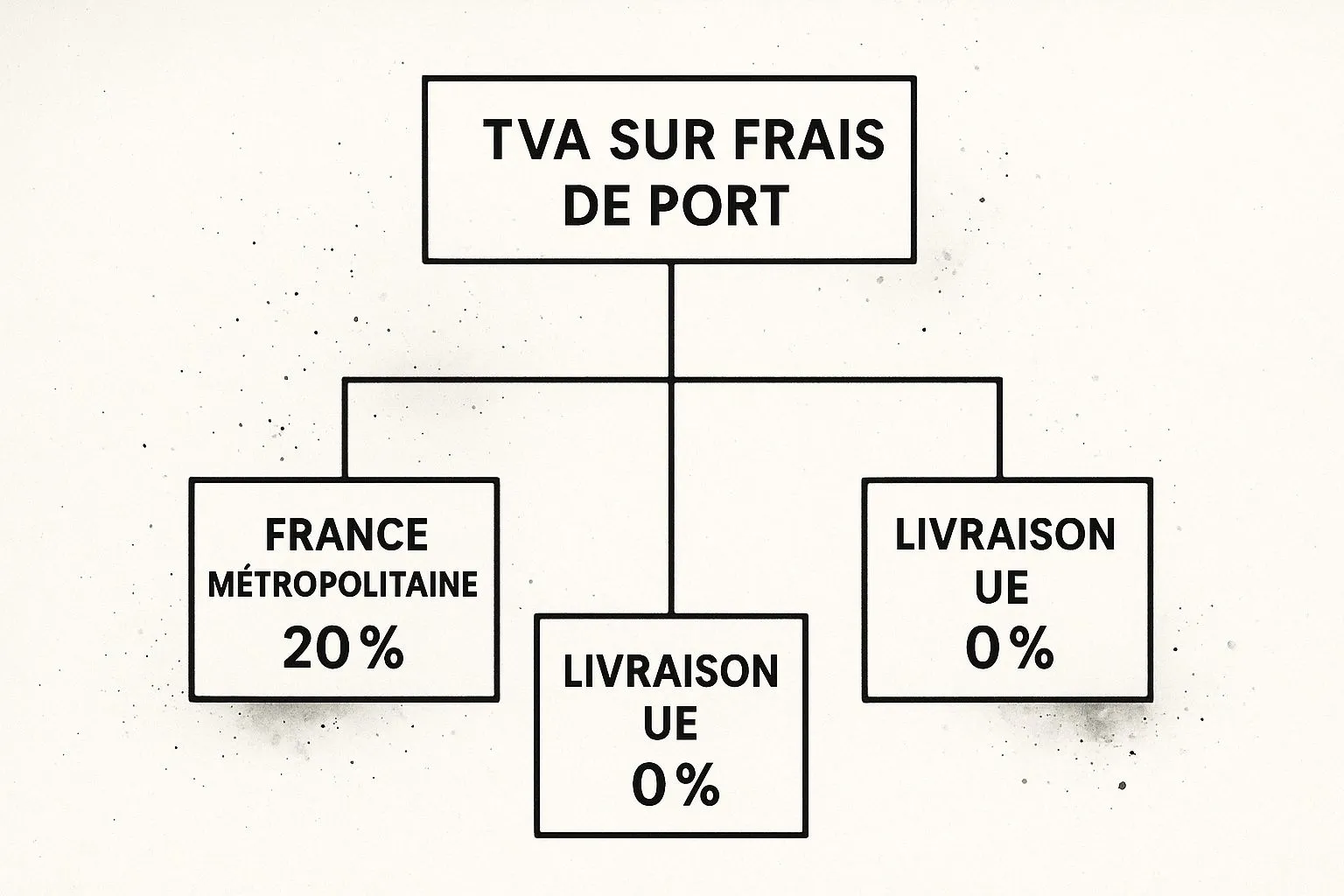
You can clearly see that while the standard rate of 20% is the norm in mainland France, shipments to other European Union countries or exports outside the EU may be exempt, under certain conditions.
Summary of applicable VAT rates on shipping costs
To make things clear and remove any lingering doubt, here’s a small table summarizing everything. Think of it as your cheat sheet for always-accurate invoicing.
This table summarizes the rules for determining the VAT rate on shipping costs based on the products contained in the same order.
| Order situation | VAT application rule | Simplified example |
|---|---|---|
| A single VAT rate | The VAT rate on shipping costs is the same as that of the products. | Order of toys for €150 excl. VAT + €10 excl. VAT shipping. The 20% VAT applies to both the products and the shipping costs. |
| Several VAT rates | The highest VAT rate among the products applies to the entire shipping cost. | Order of a book (5.5%) and a DVD (20%) + €10 excl. VAT shipping. The 20% VAT applies to the shipping costs. |
By mastering these two scenarios, you already cover the vast majority of situations.
Rigorous management of these calculations is truly essential. If you want to dig deeper and understand all the nuances, you can learn more about calculating the VAT rate in our dedicated article. By mastering these rules, you ensure sound bookkeeping and protect yourself in the event of a tax audit.
Uncovering exceptions and special cases
The general “ancillary supply” rule is fairly easy to understand. But as always in tax matters, the devil is in the details. To avoid costly surprises and mistakes, it’s crucial to master the few exceptions that exist for VAT on shipping costs.
In certain specific scenarios, it is indeed possible to legally separate the sale of the product from its delivery. These cases are less common, it’s true, but they completely change the invoicing picture.
Disbursement rebilling: a tightly regulated practice
The best-known exception is undoubtedly that of “disbursements” (débours). This method allows you to rebill shipping costs without applying VAT to them. Be careful, though: the conditions for using it are so strict that most e-merchants can’t actually use it in practice.
Put simply, a disbursement is when you advance money on behalf of, and in the name of, your customer. You’re merely a financial intermediary. The carrier’s invoice must therefore be issued directly in your customer’s name, not yours.
For tax authorities to agree to treat the transaction as a disbursement (and thus exempt it from VAT), you must tick all four of these boxes, without exception:
- A clear mandate: Your customer must have given you explicit, prior agreement for you to incur this expense on their behalf.
- The invoice in the customer’s name: The carrier’s invoice must be made out to the exact name of your end customer. If your name appears, it doesn’t qualify.
- Rebilling to the exact cent: You must rebill the exact amount you paid. Not a single cent more, no margin is tolerated.
- Impeccable bookkeeping: These sums must pass through a suspense account (a third-party account), and must never appear as an expense or revenue in your accounting.
If even one of these conditions is missing, the transaction will automatically be reclassified as a standard rebilling of costs, and thus subject to VAT. Does this cost-management logic sound familiar? That’s normal. To go further, you can take a look at our guide on VAT applied to banking fees, which explores fairly similar mechanisms.
When the customer manages their own carrier
Here’s a much simpler scenario. If it’s your customer who arranges the transport of their goods themselves, the question of VAT on delivery no longer even arises for you.
Concretely, they arrange their own carrier, who comes to collect the parcel directly from your premises. On your end, you simply invoice for the products. The transport contract is between the customer and their provider. It’s therefore the carrier who will bill the delivery to the customer, applying the corresponding VAT. Your role ends as soon as the goods are made available.
Managing international deliveries
Sales abroad are a world of their own. The ancillary supply rule still applies, but it’s the VAT regime of the product (the “principal” element) that changes, and it drags the shipping costs along with it.
- Intra-community sales (to a VAT-registered business in the EU): If you sell to a VAT-registered business in another European Union country, the sale is exempt from French VAT (under the reverse-charge principle). Logically, the shipping costs you charge are also VAT-exempt.
- Exports (outside the EU): Same principle for goods you ship outside the European Union. The sale is VAT-exempt, and the shipping costs that go with it benefit from the same exemption.
One crucial point of caution: to benefit from these exemptions, you must absolutely keep solid proof that the goods were shipped outside France. Think transport documents or customs declarations. Without this evidence, the tax authorities could come after you for the VAT.
The impact of logistics costs on your VAT

VAT on shipping costs isn’t just a simple line on an invoice. It’s a living figure, directly plugged into the ups and downs of the global economy. The turbulence observed in the logistics market has an immediate effect on the VAT you collect and that your customers ultimately pay.
When sea-freight costs soar or port handling fees rise, these increases cascade down onto the price of your deliveries. And since VAT is just a percentage applied to that price, any rise in logistics costs mechanically inflates the base on which it’s calculated.
The mechanics of cost pass-through
It’s fairly easy to understand. Imagine your logistics costs for a standard shipment suddenly rise by €2. If you pass this increase on to the shipping costs charged to the customer, they won’t just pay €2 more. They’ll also have to pay VAT on that €2.
At a VAT rate of 20%, that’s an extra €0.40 in VAT. This small amount, multiplied across hundreds or thousands of orders, ends up weighing heavily on consumers’ wallets and directly impacts your competitiveness. Tight management is therefore essential, and our article on e-commerce accounting can help you see things more clearly.
In 2025, despite slight growth in French maritime traffic with 71.6 million tonnes in the first quarter, cost volatility hasn’t disappeared. Increases of +$500 USD per 40-foot container have been observed, which inevitably pass through to the ancillary fees charged to e-merchants.
This situation is a perfect example of how macroeconomic factors, such as fluctuating freight prices, end up directly in your invoicing. You can also explore these maritime traffic trends on StrategiesLogistique.com in more detail.
Numerical example of the impact on an invoice
To really visualize this domino effect, nothing beats a concrete example.
-
Initial situation:
-
Shipping costs billed excl. VAT: €8.00
-
VAT at 20%: €1.60
-
Total incl. VAT paid by the customer: €9.60
-
After a rise in logistics costs:
- Shipping costs billed excl. VAT: €10.00 (including the €2 increase)
- VAT at 20%: €2.00
- Total incl. VAT paid by the customer: €12.00
You can clearly see: the €2 excl.-VAT increase in logistics costs caused a €2.40 incl.-VAT increase for the end customer. For a business, understanding this mechanism is absolutely essential for adjusting your pricing strategy and communicating about it transparently.
FAQ on VAT and shipping costs
Managing VAT on shipping costs can quickly become a daily headache. Even when you understand the broad strokes, certain very concrete situations always raise questions. You often wonder whether you’re doing things right, especially when it comes to returns or invoices.
No need to worry. This section is here to simply answer the most frequently asked questions. The goal is to dispel any remaining doubts so you can handle all of this calmly, in full compliance.
What should be done with VAT on shipping costs when a customer returns their order?
When a customer sends a product back to you, the logic is simple: you need to cancel the original sale. This cancellation covers both the product itself and the shipping costs you had charged. You must therefore refund the customer the full amount they paid, VAT included.
To record this transaction, you must issue a credit note. It’s essentially the mirror image of the original invoice, but in reverse.
The credit note must include a full breakdown of the amount excl. VAT, the VAT amount, and the total incl. VAT for the returned products, as well as for the shipping costs. Using this document, you correct your bookkeeping and can deduct the VAT you had originally collected and declared.
In short, the refund of shipping costs follows exactly the same rule as that of the product: you refund the amount incl. VAT, and you recover the corresponding VAT on your end.
Should VAT on shipping costs be shown on a separate line on invoices?
When it comes to invoicing, transparency is always your best ally. Even though the law doesn’t require a separate VAT line for each item, it’s a practice we can only recommend. It’s cleaner, and it avoids any confusion.
A clear, well-detailed invoice is a sign of professionalism to your customers and, believe me, it will greatly simplify your life (and that of your accountant).
The ideal is to present things like this:
- Line 1: Product A (Amount excl. VAT | VAT rate | VAT amount | Amount incl. VAT)
- Line 2: Product B (Amount excl. VAT | VAT rate | VAT amount | Amount incl. VAT)
- Line 3: Shipping costs (Amount excl. VAT | VAT rate | VAT amount | Amount incl. VAT)
This method lets your customer understand precisely what they’re paying for. And if your order contains products with different VAT rates, remember the rule: it’s the highest rate that applies to the entire shipping cost. All the more reason to show it clearly on its own line.
What if I offer free shipping — what’s the impact?
Offering free delivery is an excellent commercial strategy. From a tax standpoint, it’s very simple: if you don’t charge the customer anything, you don’t collect any VAT on this service. It makes sense: your customer pays €0, and VAT on €0 is… well, €0.
However, this doesn’t change anything about what you owe your carrier. You still pay for a service to have the parcel delivered.
The invoice your carrier sends you will include VAT. This VAT, paid on a business expense, is fully deductible. You can therefore reclaim it just like any other expense through your VAT return. The fact that you’re offering this service to your end customer for free doesn’t take away your right to deduct it at all.
To manage your invoices, your returns, and VAT on shipping costs effortlessly, take a look at Bizyness. Our tool automates your accounting so you can focus on what matters most: growing your business. Simplify your daily life by visiting https://www.bizyness.fr.
