

 Français
VAT for Sole Traders: A Guide to Optimizing Your Management
Master VAT as a sole trader, simplify your tax procedures and maximize your benefits with our practical, proven advice.

Demystifying VAT for sole traders

The sole trader (micro-entrepreneur) status offers many advantages, but VAT (Value Added Tax) often remains a source of confusion. Understanding how it works is essential to running your business with peace of mind. This guide will shed light on the key points regarding VAT for sole traders.
VAT exemption threshold: a major advantage
A significant benefit of the sole trader status is the VAT exemption threshold (franchise en base). In practice, this means you are not required to charge VAT on your invoices. Your prices are therefore more competitive for your clients. Furthermore, this exemption greatly simplifies your administrative management: no VAT return, no complex calculations. In return, you cannot deduct VAT on your business expenses.
Exemption threshold vs. exoneration: two distinct concepts
It is essential to clearly distinguish the exemption threshold from exoneration from VAT. The exemption threshold releases you from charging and remitting VAT, while exoneration exempts you from it entirely. Under the exemption threshold, you remain subject to VAT, but are released from it up to a certain revenue ceiling. Understanding this nuance is fundamental.
Exemption thresholds: limits to know
The revenue thresholds allowing you to benefit from the VAT exemption vary depending on your activity. They are set at €37,500 for services and €85,800 for commercial activities. These thresholds are regularly debated and may be revised. The 2025 reform project, which aimed to lower the threshold to €25,000, was ultimately suspended. For now, the thresholds therefore remain unchanged. More information on this abandoned reform
Impact on your competitiveness
The VAT exemption threshold represents a significant competitive advantage, especially against VAT-registered businesses. Your prices can be up to 20% lower, a compelling argument for attracting clients. However, this can become a drawback if your client base is mainly made up of VAT-registered businesses, since they cannot reclaim the VAT on your invoices.
Anticipating VAT registration in case of growth
If your business is thriving and you are approaching the exemption thresholds, it is wise to plan ahead for VAT registration. You will then need to charge, declare, and remit VAT to the government. This transition requires adapting your administrative organization and pricing policy. However, it will allow you to deduct VAT on your business purchases, which can represent significant savings.
VAT exemption thresholds: understanding the opportunities and limits
Understanding the VAT exemption thresholds is fundamental for any sole trader. These ceilings determine your obligation to charge and remit VAT, thereby affecting your administrative management and business strategy. Let’s explore the different applicable thresholds and their implications.
What are the thresholds?
The VAT exemption thresholds are currently set at €34,400 for services and €85,800 for sales activities. These figures represent the maximum annual revenue allowed to remain under the exemption. Exceeding these limits triggers VAT registration.
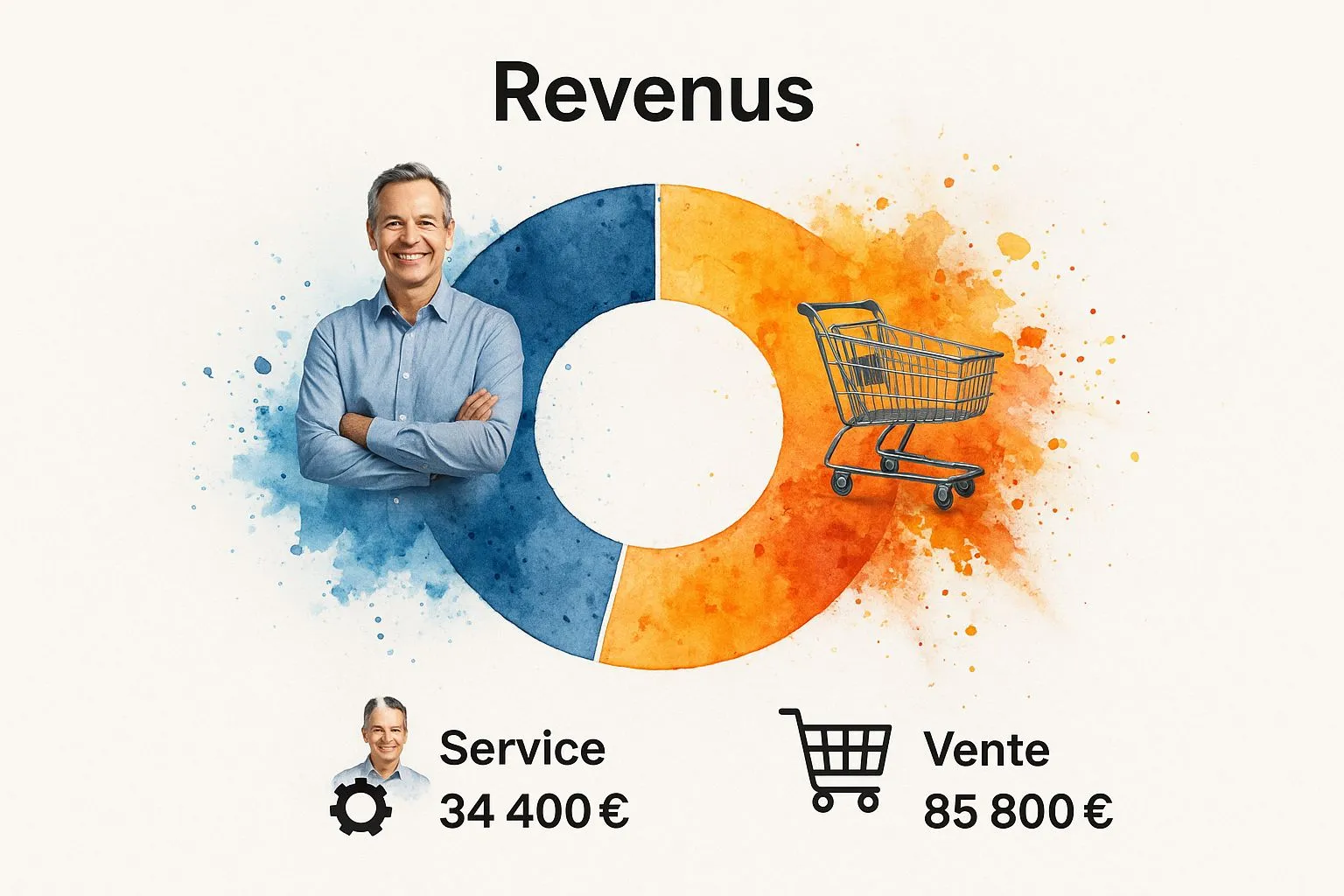
The infographic above illustrates the VAT exemption thresholds: €34,400 for services and €85,800 for sales. Visualizing these figures helps to better grasp their importance in a business’s strategy.
The tolerance margin: some room to maneuver
A tolerance margin exists for these thresholds. You can therefore exceed them for one year without being immediately subject to VAT, under certain conditions. It is essential to understand these conditions well to avoid inconvenience. Exceeding the threshold for two consecutive years results in VAT registration starting the following year.
The suspension of lowering the exemption threshold to €25,000 spared roughly 200,000 micro-entrepreneurs from complications. This measure would have affected their competitiveness and administrative management. Learn more about the suspension of the exemption threshold
Anticipating the change of regime: an essential step
Approaching the VAT exemption thresholds requires careful planning. Adapting your business model and preparing for the administrative changes tied to VAT registration is essential. This may involve revising your rates, setting up more complex bookkeeping, and training in VAT management. This foresight ensures the stability and continuity of your business.
Here is a summary table of the exemption thresholds:
VAT exemption thresholds for sole traders
Comparison table of VAT exemption thresholds by type of business activity
| Type of activity | Standard threshold | Tolerance threshold | Consequence of exceeding it |
|---|---|---|---|
| Services | €34,400 | €36,000 | VAT registration the following year if exceeded two years in a row |
| Sales activities | €85,800 | €92,900 | VAT registration the following year if exceeded two years in a row |
This table summarizes the key information regarding the exemption thresholds and the consequences of exceeding them. It is important to regularly check current regulations to stay informed of any changes.
Optimizing your strategy around the thresholds
Some sole traders set up strategies to optimize their position relative to the thresholds. Adjusting business volume to stay below the limits, or planning ahead for VAT registration in order to deduct VAT on purchases, are examples of such strategies. These practices help optimize the business’s financial and tax management.
The art of invoicing with or without VAT
Invoicing is an essential step for every sole trader. It reflects the professionalism of your business and ensures legal compliance. This process varies depending on whether you are under the VAT exemption or registered for VAT. Let’s look at both cases.
Invoicing under the VAT exemption: simplicity first
When you are under the VAT exemption, you are not required to charge it to your clients. This simplifies your invoices and can make you more attractive on price. However, it is crucial to clearly state your status on every invoice. The wording “VAT not applicable – Article 293 B of the French Tax Code” is mandatory. This wording informs your clients of your non-VAT-registered status and justifies its absence from the document.
Invoicing with VAT: rigor and obligations
If your revenue exceeds the exemption thresholds, you become subject to VAT registration. Your invoices must then include the amount of VAT charged, the applicable rate, and your intra-community VAT number. The invoice becomes more complex and requires great rigor. Mastering VAT calculation is essential to avoid mistakes. Need a refresher? Check out this article: How to master VAT calculation.
Special cases and specific wording
Certain situations, such as international invoicing or services with multiple tax rates, require specific wording on your invoices. For example, for intra-community transactions, you must state your client’s intra-community VAT number and the wording “VAT exemption – Article 262 I of the French Tax Code”. This information is essential to prevent disputes and tax audits.
Transparent communication with your clients
Whether you are under the exemption or registered for VAT, clearly informing your clients of your situation is essential. This avoids misunderstandings and strengthens your credibility. Don’t hesitate to explain the consequences of your status on your rates, especially if you move from the exemption to VAT registration. Transparent communication fosters a healthy, lasting client relationship.
Example invoice without VAT
- Your name/business name and address
- Client’s name and address
- Invoice number
- Invoice date
- Description of the service/product
- Unit price excl. tax
- Quantity
- Total excl. tax
- Wording: “VAT not applicable – Article 293 B of the French Tax Code”
Example invoice with VAT
- Your name/business name, address, and intra-community VAT number
- Client’s name and address
- Invoice number
- Invoice date
- Description of the service/product
- Unit price excl. tax
- Quantity
- Total excl. tax
- VAT rate (e.g., 20%)
- VAT amount
- Total incl. tax
Mastering invoicing, with or without VAT, is therefore essential for every sole trader. Clear, accurate, and legally compliant invoicing is a mark of professionalism and protects you from administrative difficulties.
Crossing the threshold: managing VAT registration
Exceeding the VAT exemption thresholds is often a sign of success and growth for a business. This milestone marks an important transition: VAT registration. Let’s look at how to approach this new stage with confidence.
Understanding the implications of VAT registration
VAT registration takes effect after exceeding the exemption threshold for two consecutive years. These thresholds are set at €34,400 for services and €85,800 for commercial activities. Once these thresholds are exceeded, registration with the relevant Business Tax Office (SIE) is mandatory. VAT registration takes effect on January 1st of the following year.
Adapting your business model
Including VAT in your rates is the main consequence of VAT registration. You will need to charge it to your clients, declare it, and remit it to the government. It is therefore crucial to adapt your business model by anticipating the impact on your prices and margin. Resources such as this article on sole trader invoicing can help you through this transition.
Benefiting from VAT deduction
VAT registration doesn’t only bring constraints. It also grants the right to deduct VAT on your business purchases. This mechanism helps offset part of the VAT charged, positively impacting your cash flow. Rigor in managing your invoices is then essential, much like the diligence required during a restaurant hygiene inspection.
Informing your clients
Transparent communication with your clients is essential. Clearly explain the reasons for VAT registration and its impact on your rates. Don’t forget to highlight the deductibility of VAT for business clients. Well-handled communication preserves the client relationship and avoids misunderstandings.
Learning from success stories
Many entrepreneurs have successfully navigated the transition to VAT registration. Their testimonials show that it is possible to turn this obligation into a growth opportunity. By adapting their strategy and communicating effectively, they have maintained their competitiveness and grown their business.
To help you with your procedures, here is a summary table:
Roadmap to VAT registration
Timeline of steps to take when exceeding the exemption thresholds
| Timing | Action to take | Relevant administration | Required documents |
|---|---|---|---|
| Exceeding the thresholds (Year N and N+1) | Inform the SIE of your new revenue | SIE | Revenue declaration |
| Before December 31, N+1 | Request your intra-community VAT number | SIE | Registration form |
| January 1, N+2 | Start of VAT registration | SIE | - |
This table summarizes the key steps for a smooth transition. Don’t hesitate to consult a chartered accountant for personalized support.
VAT optimization strategies for sole traders
VAT, far more than a simple obligation, represents a strategic lever for the sole trader. This section explores the different approaches to optimizing your VAT management, all within the bounds of the law.
Opting into VAT: a choice worth considering
The VAT exemption threshold simplifies administrative management, especially for young businesses. However, it can prove less advantageous if your client base is mainly made up of VAT-registered businesses. Indeed, these clients will not be able to reclaim the VAT on your invoices, which can affect your competitiveness. Voluntarily opting for VAT registration, even before reaching the thresholds, can then strengthen your credibility with businesses and ease your business relationships. How to master tax optimization as a sole trader? This article offers interesting food for thought.
The different VAT rates: an asset to leverage
Certain sectors benefit from reduced VAT rates (5.5% or 10%) or even an exoneration. It is crucial to know the rates applicable to your business and structure your offering accordingly. For example, some personal services benefit from a reduced rate, while others are exonerated. A good understanding of these specifics can help you optimize your pricing policy.
Anticipating the exemption thresholds: proactive management
Approaching the VAT exemption thresholds requires careful planning. An accurate forecast of your projected revenue is essential to avoid an abrupt shift to VAT registration. This change of regime, if not anticipated, can cause administrative complications and affect your cash flow. Proactive management will allow you to smoothly adapt your business model and pricing policy.
Concrete optimization examples by activity
The ideal VAT optimization strategy varies depending on the activity and target clientele. Take the example of an IT consultant working mainly with businesses. Opting into VAT, even before reaching the exemption threshold, can be a smart choice. Conversely, a craftsperson selling mainly to individuals may benefit more from the VAT exemption. For an online retailer, the situation is more complex and depends on the nature of the products sold and the location of their clientele.
Seasonality: adapting your strategy
For businesses with strong seasonality, fluctuating revenue can be a factor to consider in VAT management. If your activity is concentrated over a few months of the year, it is possible to optimize your status accordingly. You could, for example, stay below the exemption threshold during slow periods and opt for VAT registration during peak activity, after a thorough analysis of the pros and cons.
Complying with the law: an absolute priority
VAT optimization must always be carried out in strict compliance with the law. It is essential to stay informed of regulatory changes and to consult a chartered accountant in case of doubt. A misinterpretation of the rules can lead to significant financial penalties.
Summary: key points to remember
- Clientele: Identify your target clientele (B2B or B2C).
- Applicable rates: Know the VAT rates applicable to your business.
- Exemption thresholds: Anticipate approaching the thresholds and forecast your projected revenue.
- Seasonality: Adapt your strategy based on activity fluctuations.
- Legislation: Comply with current regulations and consult an expert when needed.
By mastering these elements, you can turn VAT from a constraint into an asset for growing your sole trader business.
Avoiding the pitfalls: special situations and exceptions
VAT for sole traders, simplified by the exemption threshold, can become complex in certain cases. These special situations, often a source of confusion and tax reassessments, require extra attention.
Intra-community transactions
Intra-community transactions, meaning sales or purchases with businesses in the European Union, follow specific VAT rules. Your invoices must include your client’s intra-community VAT number and wording such as “VAT exemption – Article 262 I of the French Tax Code.” Omitting this information can lead to administrative difficulties and penalties.
Mixed activities: exemption and VAT registration
Managing several activities, some under the VAT exemption and others not, requires rigorous organization. It is essential to clearly separate the revenue of each activity in order to apply VAT correctly. Take the example of a sole trader offering consulting services (VAT-exempt) and selling products (VAT-registered). Separate bookkeeping for each activity is essential.
Intangible services
VAT applicable to intangible services, such as online training or consulting, can be complex. The client’s location and the precise nature of the service determine the applicable regime. Finding out about the rules in force is therefore essential to avoid any mistakes.
Advances and deposits
Invoicing advances and deposits, a common practice to secure transactions, requires the mention “deposit” or “advance” on the invoice. Under the VAT exemption, the wording “VAT not applicable – Article 293 B of the French Tax Code” is still mandatory. When VAT-registered, VAT applies to the deposit amount.
Unpaid invoices and VAT
An unpaid invoice allows you to reclaim the VAT paid to the government. The claim for VAT refund on bad debt is the procedure to follow, provided certain conditions are met and supporting documents are provided.
Self-supply
Self-invoicing with VAT applied is mandatory if you use for personal purposes goods or services originally intended for your business. This practice, known as self-supply, is governed by precise rules.
Tax documentation
Given the complexity of these situations, rigorous documentation of your tax choices is crucial. Keep all supporting documents (invoices, contracts, correspondence with the tax authorities) so you can justify your decisions in the event of an audit.
Professional support
The expertise of a chartered accountant can prove valuable for handling these special situations. They will help you avoid costly mistakes and optimize your VAT management.
In conclusion, despite the simplification brought by the exemption threshold, VAT for sole traders involves exceptions and special cases that are important to know. A good understanding of these situations and rigorous documentation will help you avoid pitfalls and run your business with peace of mind. Don’t hesitate to visit the Bizyness website and seek professional help if needed.
Key questions on VAT for sole traders
VAT for sole traders raises questions that go beyond the basics. This section addresses complex and strategic points to help you master this essential aspect of your business.
Impact of VAT on price competitiveness
The absence of VAT on your invoices, made possible by the VAT exemption threshold, makes you more competitive. However, if your clients are mainly VAT-registered businesses, they will not be able to deduct it.
This can make your services less attractive, particularly in B2B (Business to Business) activities. Opting into VAT, even before reaching the exemption thresholds, may then be worth considering.
Consequences of a change in legal status
Moving from sole trader status to another legal form (EURL, SASU…) automatically triggers VAT registration.
This change requires adapting your invoicing, bookkeeping, and rates. Anticipating this transition is essential to avoid disrupting your business.
Interactions between VAT and other taxes
VAT is a separate tax from income tax. Benefiting from the VAT exemption threshold has no impact on the calculation of your income tax.
It is important to understand the interactions between these different taxes in order to optimize your overall tax situation.
Exoneration vs. exemption threshold: clarifications
Exoneration means you are not concerned by VAT at all. The exemption threshold, on the other hand, releases you from it up to a certain revenue ceiling.
For sole traders, it is indeed an exemption threshold and not an exoneration. This distinction is important for understanding your obligations correctly.
Calculating the thresholds: calendar year or rolling year?
The VAT exemption thresholds (€34,400 for services, €85,800 for commercial activities) are calculated on a calendar-year basis. This means the calculation runs from January 1 to December 31.
Exceeding these thresholds for two consecutive years results in VAT registration the following year.
Regulated professions: specific rules?
Certain regulated professions may be subject to specific VAT rules. It is advisable to check with your professional body or a chartered accountant.
Concrete example: a consultant and VAT
An independent consultant working mainly with large companies might consider opting into VAT. Although this makes their management more complex, it allows them to charge VAT to their clients, who can then deduct it.
This option can strengthen their credibility and ease their business relationships.
Practical recommendations
- Track your revenue: Regularly monitoring your revenue is essential to anticipate approaching the exemption thresholds.
- Prepare for VAT registration: If you expect to exceed the thresholds, prepare in advance by adapting your bookkeeping and invoicing tools.
- Consult an expert: Don’t hesitate to seek advice from a chartered accountant for complex or situation-specific questions.
Simplify your VAT management and focus on growing your business! Bizyness supports you at every step of your entrepreneurial journey. From invoicing to financial management, Bizyness automates your administrative tasks and guarantees optimal compliance. Discover the benefits of Bizyness today and take advantage of a free offer to get started: Simplify your management with Bizyness
