

 Français
What is a bank identity statement (RIB) and how to use it
What is a bank identity statement? Our simple guide explains your RIB, IBAN and BIC so you can manage payments and invoices safely.
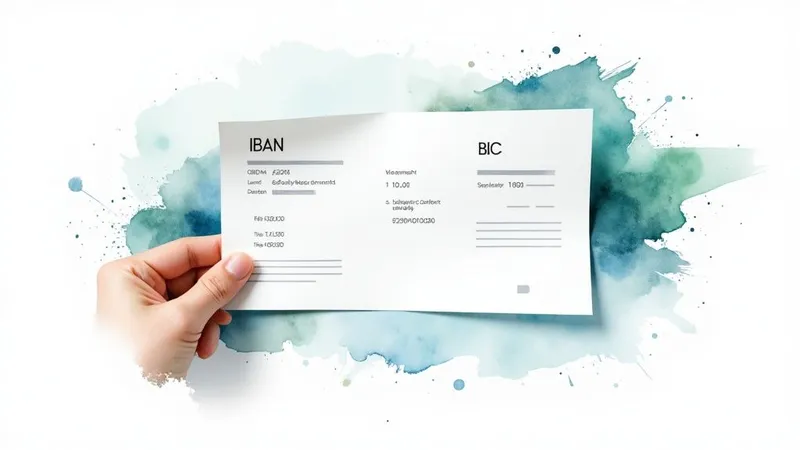
What is a bank identity statement?
Think of your RIB (bank identity statement) as your account’s ID card. It brings together all the information needed to receive a transfer or set up a direct debit.
Understanding the bank identity statement
Think of each part of the RIB as a puzzle piece that guarantees your money reaches the right place. Both local and international, this set of codes makes your transactions safer and smoother.
- Bank code (5 digits): identifies your banking institution
- Branch code (5 digits): indicates the relevant branch
- Account number (11 characters): identifies your unique account
- RIB key (2 digits): prevents data-entry errors
- IBAN (27 characters in France): SEPA format for European transfers
- BIC: your bank’s international code
Another key change: since SEPA arrived in 2014, the IBAN has largely replaced the traditional RIB concept. Today, nearly 100% of transfers and direct debits are made using the IBAN. To learn more, see Wikipedia.
The key components of your RIB explained simply
This table helps you visualize and understand each piece of information on your bank identity statement.
| Component | Its role in your transactions |
|---|---|
| Bank code | Identifies the banking institution |
| Branch code | Locates the branch |
| Account number | Designates the account to be credited |
| RIB key | Verifies the validity of the account number |
| IBAN | SEPA standard for transfers in France and Europe |
| BIC | International code to identify your bank outside SEPA |
Thanks to this table, every line of your RIB becomes clear, giving you confidence when sharing your bank details.
Why a RIB is essential
Whether you’re a sole trader or run a small business, your RIB is the key to getting paid quickly. For example, to pay a salary, invoice a client, or activate a subscription, this string of numbers avoids any risk of error.
In practice, sharing your RIB is like handing over a stamped envelope with the correct address: the payment lands exactly where it should. With Bizyness, you save this information with a single click, and it’s automatically inserted into your quotes and invoices.
Decoding IBAN and BIC codes without mistakes
Does this long string of numbers and letters on your RIB seem a bit cryptic? That’s normal. But once you have the key to reading it, everything becomes very logical. You just need to break it down to see that each block has a precise function.
The IBAN (International Bank Account Number) is a bit like the international ID card for your bank account. In France, it’s always made up of 27 characters, and its structure is designed to prevent any errors.
The structure of your French IBAN
Think of your IBAN as an ultra-precise postal address for your money. Each element guides transfers and direct debits exactly to the right place.
Let’s take a fictional example to make things clearer: FR76 3000 6000 0112 3456 7890 189.
- FR: The first two letters are simply the country code. Here, France.
- 76: This is the control key. These two digits are the result of a small calculation that validates the whole number. It’s a very effective safeguard against typos.
- The next 23 digits: This is actually just your good old national RIB! In order, you’ll find your bank code (5 digits), your branch code (5 digits), your account number (11 characters), and the RIB key (2 digits).
This infographic nicely summarizes how the RIB is now an envelope containing your two key identifiers: the IBAN and the BIC.
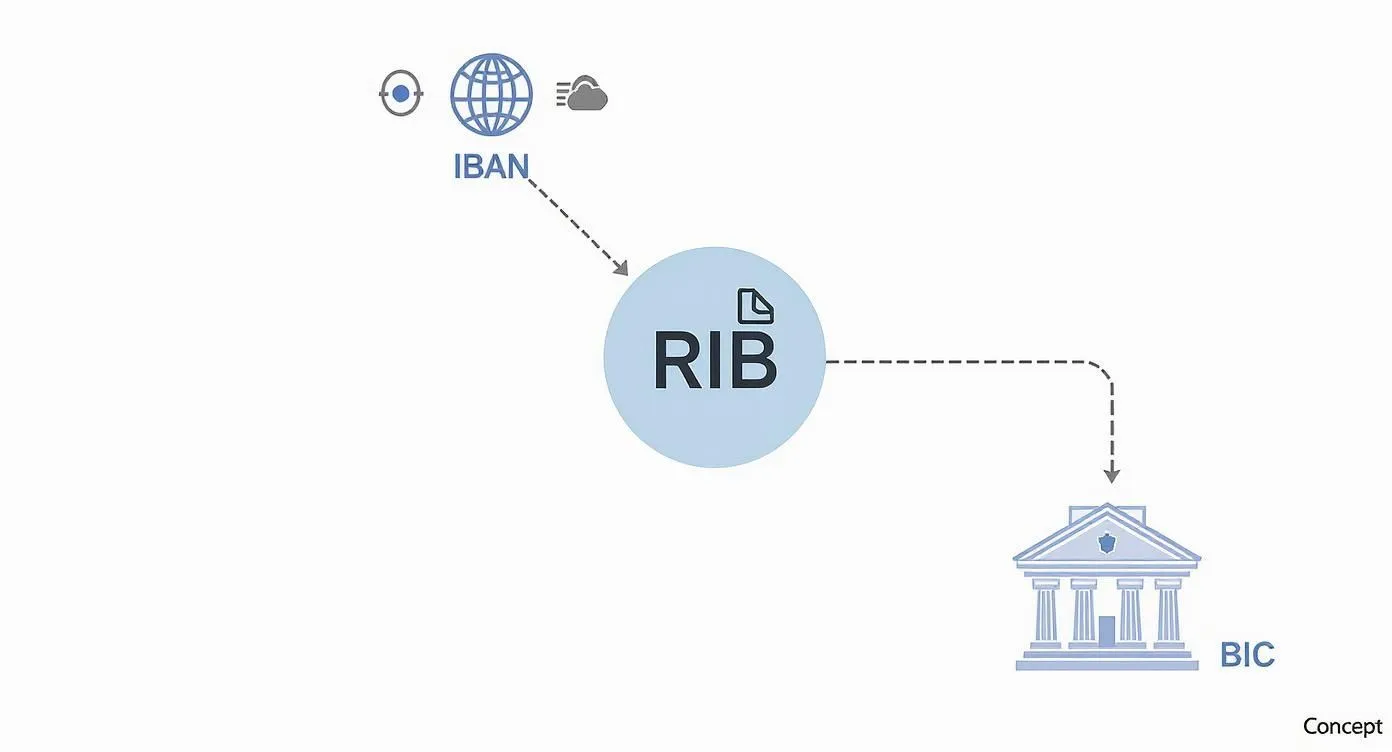
As the image shows, the IBAN and BIC are the two pillars that allow your account to be recognized without any ambiguity, whether for a domestic French transaction or one on the other side of the world.
Understanding the role of the BIC code
Right next to the IBAN, you’ll always find the BIC (Bank Identifier Code). It’s also sometimes called the SWIFT code. To continue our analogy, if the IBAN is your account’s address, the BIC is your bank’s address on a global scale.
The BIC is essential for international transactions, especially those outside the SEPA zone. It ensures the money arrives at the right bank, wherever it is on the planet.
It’s shorter, with 8 to 11 characters. For example, BNPAFRPP breaks down as follows: BNPA identifies the bank (here, BNP Paribas), FR the country (France), and PP the bank’s location.
Once you understand these two codes, you know exactly what you’re sharing and why. No more mystery.
Using your RIB to manage your business finances
For an entrepreneur, a RIB isn’t just a string of numbers on a piece of paper. It’s a genuine tool at the heart of managing your cash flow, the key to making sure incoming and outgoing money moves without a hitch.
Knowing how to use your RIB properly is above all a matter of professionalism and efficiency. By integrating it correctly into your invoices and setting up clear processes, you make life easier for your clients, your suppliers, and yourself in the process.
Making incoming payments easier
The simplest way to get paid without delay? Clearly display your IBAN and your BIC on all your invoices. It’s a direct invitation to pay, sparing your clients from having to contact you again for your details. The fewer the obstacles, the faster the money reaches your account.
If you have recurring payments, such as subscriptions or service contracts, consider a SEPA direct debit mandate. Once your client gives their consent, payments are automated on a fixed date. It’s the perfect solution to stabilize your cash flow and say goodbye to chasing unpaid invoices.
With digitalization, the RIB has become the cornerstone of financial exchanges. Whether it’s transfers or direct debits, everything relies on the secure transmission of these bank details.
This practice has become the norm, in fact. To give you an idea, the volume of SEPA transfer transactions jumped by nearly 30% between 2015 and 2023. It’s a deep-rooted trend that shows just how embedded these tools are in our daily lives.
Securing outgoing payments
Your RIB is just as essential for managing your own expenses. Paying suppliers, settling expenses, transferring salaries… the SEPA transfer remains the most reliable and transparent method. Every operation leaves a digital trace, which greatly simplifies tracking your accounts. In fact, to keep your books flawless, it’s essential to know how to do a bank reconciliation.
Paying salaries, in particular, tolerates no errors. A misentered employee IBAN means the start of delays and administrative complications. Precision is therefore essential. For everything you need to know about best practices, this guide on the salary payment deadline highlights how crucial a correct RIB is for paying salaries on time.
Obtaining and sharing your RIB securely
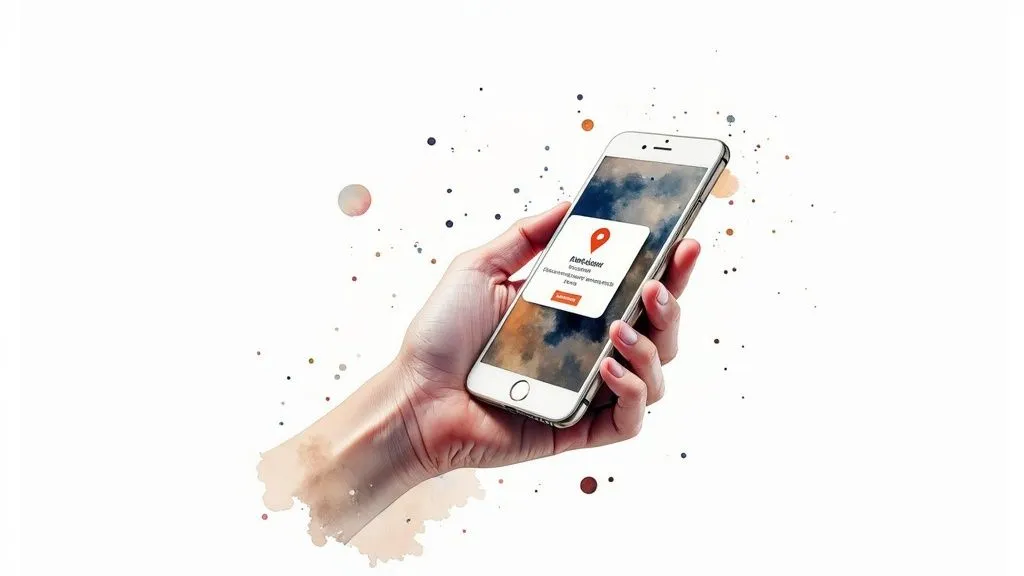
Your RIB is a bit like your bank account’s ID card: it certifies your identity and simplifies every transaction. You don’t need to be an expert to get it; in just a few clicks, it appears before your eyes.
Where to find your RIB
Whether you’re at the office or on the go, it’s always within reach:
- Mobile app: usually under “My documents” or directly on the home page.
- Online customer area: a simple PDF download is all it takes.
- Chequebook: a few detachable stubs, placed at the ends.
- Account statement: it always appears at the bottom of each page.
Best practices for secure sharing
Sharing your RIB may seem harmless, but a few good habits will guarantee your peace of mind:
- Verify the recipient’s identity: employer, government agency, or an already-known supplier.
- Choose a protected channel: avoid unencrypted email and favor secure portals.
- Delete the documents once receipt is confirmed to limit any risk.
Sharing a RIB is a common procedure, governed by law. In the event of an unauthorized direct debit, you have 13 months to dispute it with your bank and obtain a refund.
Beyond the transaction itself, your RIB feeds into the state’s FICOBA file. This national register of bank accounts fights tax fraud and officially links an account to its holder. To learn more, see how the bank account file works.
Finally, for a sole trader or small business, managing your banking details well is a real asset. Consider a business account tailored to sole traders to gain efficiency and peace of mind.
Simplifying the management of your bank details
When you’re an entrepreneur, paperwork can quickly become a headache. Fortunately, some technology tools are here to make life simpler, especially for everything related to the famous bank identity statement.
The idea is to turn this repetitive task, where an error can happen quickly, into something that works in your favor. By automating the addition of your bank details, you’ll see the time savings right away.
Automation, an ally for your cash flow
Modern invoicing tools like Bizyness let you save your IBAN and your BIC once and for all. Once that’s done, they appear as if by magic on all your quotes and invoices.
It’s simple, but this small automation changes everything. No more typos that delay a payment; your documents are always flawless and compliant. And let’s be honest, a client who receives a clear, complete invoice often pays faster.
By centralizing your banking information in a single tool, you can be certain every document you send is correct. It’s a mark of credibility that keeps your cash flow moving smoothly without you even having to think about it.
To give you an idea, here’s what the Bizyness interface looks like, where you set up your banking info so it integrates into your documents.
The image clearly shows how a well-designed tool makes this step incredibly intuitive. No more need to manually check every invoice before sending it. It’s also a great starting point for properly organizing your administrative documents.
In short, by adopting the right software, you turn an administrative burden into a genuine asset. And the time you save, you can finally spend on what really matters: your business.
Some questions you probably have about the RIB
Even after breaking down its components, the bank identity statement often raises very practical questions. Let’s go over them together so you can handle your bank details with total peace of mind.
These questions are entirely legitimate. After all, they touch on both the security of your finances and your rights. A good understanding of the details will save you plenty of headaches.
At the end of the day, what’s the difference between a RIB and an IBAN?
To make things clearer, think of the RIB as the complete ID card for your account, a document that gathers all the information. The IBAN is a bit like your international phone number for being reachable financially.
In other words, the RIB is the classic French document that contains all your details, including your IBAN. The IBAN is the international standard that uniquely identifies your account throughout the SEPA zone and beyond. Today, when someone asks for your RIB, it’s almost always the IBAN they’re really after.
Am I taking a risk by giving out my RIB?
To receive a transfer, no, it’s perfectly safe. The main risk, although minimal, is that someone with bad intentions tries to misuse your information to set up a fraudulent direct debit.
Fortunately, the law protects you very well on this point.
The rule is simple: you have 13 months to dispute any direct debit you didn’t authorize. Your bank is then required to refund you in full. This solid protection makes the risk of fraud genuinely very limited.
The right instinct remains the same: only give your RIB to trusted organizations and people. Your employer, the tax authorities, your clients, or a known supplier, for example. Simply avoid leaving it on public forums or sending it through unsecured messaging.
Can a client or employer refuse my foreign RIB?
Absolutely not. It’s illegal. Such a refusal has a name: “IBAN discrimination.” It’s a practice formally banned within the Single Euro Payments Area (SEPA), which covers 36 countries, including France.
Whether your IBAN starts with FR (France), DE (Germany), ES (Spain), or IT (Italy), an employer, an energy supplier, or any other organization is legally required to accept it for transfers and direct debits. If you face a refusal, you’re fully entitled to report it to the relevant authorities, such as the Banque de France or the DGCCRF.
Save time and avoid errors by automatically adding your bank details to all your documents. With Bizyness, your invoices are always compliant and ready to be paid, without you having to think about it. Simplify your management today at bizyness.fr.
