

 Français
What Is a Quote? A Complete Guide to Understanding It
Find out what a quote is, its legal value, and the mandatory details for writing clear, compliant quotes. Learn everything here!

We often imagine a quote is just a rough price estimate, a figure scribbled on a piece of paper. But it’s so much more than that. In reality, it’s a formal commercial proposal, the true starting point of a collaboration. This document details the services provided, lists the materials needed and, of course, sets the total cost before the first hammer blow or the first line of code.
A quote is the roadmap that turns a simple conversation into a concrete commitment. It serves as the foundation of trust between you, the professional, and your client.
Beyond a simple document: understanding the spirit of the quote
Think of the quote as a flight plan before takeoff. It doesn’t just state the destination (the finished project) — it maps out the precise route to follow (the services), lists the resources on board (materials, labor) and states the ticket price. This clarity is essential so everyone boards with peace of mind.
For a tradesperson or a freelancer, the quote is a major strategic tool. It gives a professional framework to your exchanges, protects your work, and lays the groundwork for a healthy relationship. It’s the best way to set expectations straight and avoid the misunderstandings that can quickly poison a project.
For the client, it’s a genuine guarantee of transparency. The quote lets them understand exactly what they’re paying for, compare offers objectively, and make an informed decision. Without a quote, everyone is flying blind, leaving the door wide open to uncertainty and potential conflict.
The key roles of a quote at a glance
To fully grasp the importance of a quote, you need to understand that it plays on three fronts at once. This table summarizes its main functions and shows how each party benefits.
| Function | Benefit for the professional | Benefit for the client |
|---|---|---|
| Informational | Formalizes the offer and demonstrates seriousness and transparency. | Provides a clear, detailed view of the services and total cost. |
| Legal | Once signed, it acquires the value of a contract and offers protection in case of a dispute. | Locks in the professional’s commitment on the agreed price and timeline. |
| Commercial | Acts as a sales tool that can set you apart from the competition. | Allows comparison of several proposals to make the best choice. |
Each role is a piece of the puzzle, creating the balance essential to a successful business relationship.
More than an obligation, a real opportunity
Never see the quote as a mere administrative constraint. Above all, it’s a tremendous opportunity. Think about it: it’s often the very first official document your client receives from you. The quality of this quote directly reflects the care you’ll bring to their project. A well-structured, clear document without a single typo instantly inspires confidence.
It turns a simple information request into a concrete discussion based on goals, timelines and budget. To go further and master every aspect, our complete guide on how to create a proper quote is the perfect resource to get started.
In short, what is a quote? It’s the moral and legal contract that precedes the commercial contract. It aligns visions, defines each party’s responsibilities, and ensures the project starts on solid, shared foundations.
What is the legal value of a signed quote?

Many entrepreneurs see a quote as a simple commercial document. And at first, that’s exactly what it is: a proposal, an offer that your prospect is entirely free to accept or reject. But watch out — everything changes the moment they sign it.
Once your client has signed, often adding the famous wording “approved” or “work approved”, the quote changes nature. It’s no longer a suggestion. It becomes a fully-fledged contract that binds both parties.
This transformation is crucial, as it creates concrete obligations for both you and your client. Understanding this mechanism is key to securing your professional relationships and preventing a lot of headaches.
A contract that commits everyone
As soon as the quote is signed, you are legally obligated to carry out the service exactly as described in it. You must follow the agreed details to the letter: the tasks to be performed, the materials to be supplied, the deadlines set and, of course, the price stated. You can’t change the rules of the game along the way on your own.
For their part, the client takes on an equally serious commitment. Their signature obligates them not only to pay the agreed amount once the work is complete, but also to let you carry out the service under the agreed conditions.
A signed quote is quite simply material proof of a mutual agreement. It acts as the law between you and your client. The terms of the quote become the rules everyone must follow.
It’s this commitment on both sides that gives the quote its full legal weight. It protects you if either party fails to keep their word.
What happens if one of the two parties fails to meet their commitments?
It’s often when things go wrong that we truly understand the importance of a well-drafted quote. In the event of a dispute, this document becomes your best ally in defending your rights.
Let’s take two very concrete examples:
- Your client refuses to pay. You’ve finished the work, everything matches the quote, but the invoice remains unpaid. The signed quote is irrefutable proof of their obligation to pay. It’s the base document that will allow you to send a formal notice and, if that’s not enough, to launch a payment order procedure before the court.
- You don’t finish the work. Conversely, if a tradesperson walks off a job midway through or uses lower-quality materials than agreed, the client can rely on the signed quote to demand that the work be finished properly or to claim damages.
Understanding the scope of a simple signature is therefore fundamental. The quote isn’t just an administrative formality. It’s your first line of legal defense, a powerful tool for building healthy business relationships based on trust and respect for commitments made.
How do you master a quote’s mandatory details?
A well-drafted quote is above all a compliant one. To serve as your commercial and legal shield, it must include a precise list of legal information. This isn’t just paperwork; each item has a reason to exist: identifying who’s who, describing the job in full detail, and setting the financial rules of the game.
Skipping one of these steps weakens your document. In the event of a hiccup or disagreement, an incomplete quote can seriously undermine your position. Think of these details as the foundations of your offer. A complete, buttoned-up quote is the first proof of your professionalism.
The image below perfectly sums up the three pillars of a well-structured quote, from who you are to what it costs.
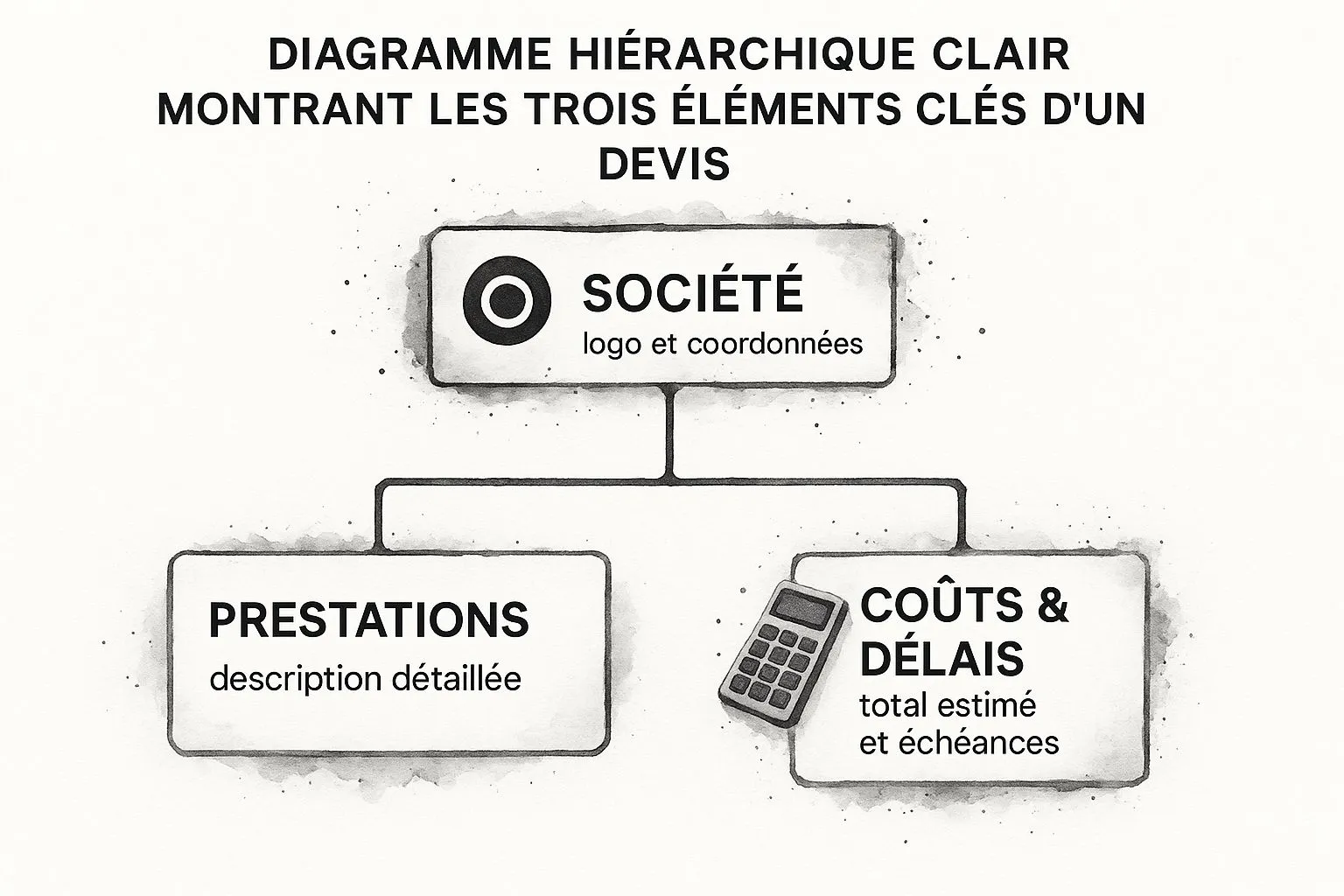
What matters is that these three aspects — your identity, the description of your offer, and its price — are inseparable in guaranteeing full transparency with your client.
H3: The information that identifies you (and isn’t negotiable)
The very first part of your quote must let your client know immediately who you are. It’s a legal requirement, of course, but above all it’s a mark of seriousness that builds trust.
Here’s what absolutely must appear:
- Your full identity: First and last name if you’re a sole trader, or your company’s legal name, along with the address of the registered office.
- Your contact details: A phone number and an email address. Simple, but essential so you can be reached easily.
- Your identification numbers: Your legal status (for example, SAS, sole trader) and your SIREN number.
- Your intra-community VAT number: This is essential if you charge VAT.
Think of this as your company’s ID card. This information must be impeccable and clearly visible. Your client needs to know precisely who they’re dealing with.
Checklist for a fully compliant quote
Use this table to quickly check that all the required legal information appears on your quotes. It’s an excellent habit to build so nothing gets missed and every proposal is secured.
| Mandatory detail | Concrete example | Why is it essential? |
|---|---|---|
| Business identity | BIZYNESS Company, SAS - 10 rue de la Paix, 75002 Paris | Allows clear, legal identification of the service provider. |
| SIREN number | SIREN: 123 456 789 | Proves that your business is properly registered and legally exists. |
| Client identity | Mr. John Smith - 25 avenue des Champs, 75008 Paris | Clearly defines the person or entity receiving the offer. |
| Quote number and date | Quote No. 2024-058 - Issued on 05/20/2024 | Essential for tracking, record-keeping and communication. |
| Detailed description | ”Logo creation (3 proposals, 2 revisions)” - Qty: 1 - Unit price excl. VAT: €800 | Avoids any ambiguity about the nature and scope of the service. |
| Price (excl. VAT, VAT, incl. VAT) | Total excl. VAT: €1,200 - VAT (20%): €240 - Total incl. VAT: €1,440 | Ensures full financial transparency, as required by law. |
| Validity period | ”Offer valid for 30 days from the date of issue.” | Protects you against fluctuations in your own costs (suppliers, etc.). |
| Payment terms | ”30% deposit on signature, balance on delivery.” | Sets the rules for cash flow and avoids misunderstandings. |
Having this checklist on hand turns writing quotes into a simple, secure routine, freeing your mind to focus on your core business.
H3: Describing your service with surgical precision
This is where everything is decided — the heart of your proposal. A vague description opens the door to misunderstandings and frustration. Every line must be crystal clear.
For each product or service, you absolutely must detail:
- The exact nature: Don’t settle for “bathroom renovation.” Prefer: “Removal of old wall tiles (8m²), installation of Cérame-model floor tiles (8m²), installation of a vanity unit Ref. 123.” That’s precise, that’s clear.
- The quantity: Use a meaningful unit of measurement (m², hours, days, unit, flat rate…).
- The unit price excluding tax: The cost of each item in the service.
This rigor protects you as much as it protects your client. They know exactly what they’re paying for, and you have a clear brief to follow. To go even further, our complete guide on a quote’s mandatory details offers a comprehensive checklist.
H3: Framing the time and the money
Finally, your quote must lock in the financial and time-related aspects of your offer. These points are crucial for managing the project well and, of course, for your cash flow.
Never skip:
- The issue date and quote number: Essential for flawless administrative tracking.
- The offer’s validity period: Generally, 30 days is stated. This clause protects you if the cost of your raw materials rises in the meantime.
- The total amounts: The total excluding tax and the total including all taxes, clearly specifying the applicable VAT rates.
- Payment terms: Deposit due on signature, balance paid on delivery, payment deadlines… Everything must be spelled out in black and white.
Your quotes facing market volatility: how do you adapt?

In certain trades, particularly construction and craftwork, material and energy prices are anything but stable. A quote you sign in January can easily become a financial headache in March if the price of steel or wood has spiked in the meantime. In this context, a quote that’s too rigid quickly turns into a trap, capable of seriously eating into your margins.
Think of your quote not as a snapshot frozen in time, but rather as a commercial proposal with an expiration date. To protect your cash flow, it’s vital to build in safeguards that reflect this economic reality. The idea isn’t to mislead the client, but to establish a transparent, fair relationship for everyone.
Limiting the validity period: a simple, effective protection
The first, and simplest, line of defense is to set a clear validity period for your offer. It’s more than a mandatory detail — it’s a real strategic tool.
Writing “Offer valid for 30 days” is not just an administrative formality. In practice, it means that once this period has passed, the prices you proposed no longer bind you. This small sentence gives you back the freedom to recalculate your costs if your client takes their time deciding. It’s an essential safety net so you don’t end up working at a loss.
For the client, it sets a clear framework. They know they have a limited time to take advantage of the terms offered, which encourages them to make their decision without letting things drag on.
Setting a validity period turns a financial risk into a clear rule accepted by both parties. It’s the most direct way to protect your profitability without complicating your quote.
This precaution is all the more important today. According to INSEE, the Price Index for Maintenance and Improvement Work (IPEA) rose by 17.6% between 2021 and early 2024. This inflation, driven by material and energy costs, clearly shows why a rigid quote is no longer a viable option. If you’d like to dig deeper, you can check the INSEE indices here.
Including a price revision clause for long projects
When you commit to projects that stretch over several months, a simple validity period is no longer enough. Imagine a renovation project lasting six months: material prices can change completely between the moment the quote is signed and the moment you actually need to buy them.
That’s where the price revision clause comes in. This clause, added to your quote, allows you to adjust your rates based on the movement of official indices (such as the well-known BT01 index for construction).
Be careful — to be valid, this clause must meet two conditions:
- Be transparent: It must clearly explain the calculation formula and the reference indices you use. No room for doubt.
- Be accepted: The client must have been made aware of it and have approved it by signing the quote.
Far from being a bad surprise, a well-explained revision clause is proof of your professionalism. It shows that you anticipate market realities and are seeking a balanced solution to see the project through. It’s the best way to protect your business while maintaining a relationship of trust with your client.
The quote: much more than paper, your first sales tool
For a tradesperson or a small-business owner, the quote is often seen as an administrative chore. A mere formality. In reality, it’s quite the opposite: it’s your first commercial weapon, a unique opportunity to make an impression before you’ve even driven the first nail.
A well-drafted quote doesn’t just line up numbers. It tells a story. The story of your professionalism, your rigor, and the attention you bring to your future client’s project. This is the document that turns a simple price request into a value proposition that makes people want to sign.
Justifying your prices to build trust
A detailed, transparent quote is your best advocate for defending your rates. When you take the time to break down each line item, you show the client concretely where their money is going. This clarity reassures, dispels doubts, and proves that your price wasn’t pulled out of thin air, but reflects the true value of the materials and the time you’ll invest.
A quote isn’t just an addition. It’s a demonstration of your expertise that helps the client understand the value of your work, well beyond the final amount.
This somewhat educational approach is the key to starting a relationship of trust. A client who understands what they’re paying for will be much more willing to accept your proposal, even if a competitor is a bit cheaper.
Standing out from the competition
In construction, competition is fierce. Consider this: out of 381,000 businesses, nearly 365,000 are craft-based structures. In this jungle, you need to know how to stand out. A polished quote is a formidable weapon for doing just that. While others send rough estimates dashed off in a hurry, a clear, well-presented document without a single mistake immediately places you in the category of serious, reliable professionals. To better understand this environment, take a look at these key figures on the construction market.
This attention to detail is never trivial. It suggests that the rigor you put into your paperwork will be reflected on site. And that makes all the difference.
A valuable tool for securing your cash flow
The quote is also a fantastic tool for steering your business. By clearly building in a deposit request, you secure part of your cash flow before you even start working. This is a completely normal, even essential, practice. It lets you cover the purchase of materials and protects you if a client backs out at the last minute.
Requesting a deposit is also a way to formalize the client’s commitment. The project starts on healthy financial footing, which is essential for your business’s profitability. Every signed quote then becomes a well-framed operation, from A to Z.
Writing a quote for a construction project
For large projects, such as new construction, the quote takes on a completely different dimension. It’s no longer just a price proposal — it’s the true cornerstone of the entire project. It becomes a strategic document, designed to convince not only the client, but also and especially banks and administrative bodies.
In this context, a solid, ultra-precise quote is simply the prerequisite for hoping to secure a building permit or financing. This is the document that will prove your project stands on solid ground.
A mark of credibility for third parties
We know material costs can quickly skyrocket. A well-drafted, transparent construction quote then becomes your best argument for reassurance. It shows that every expense item has been thought through and anticipated, which limits the risk of budget overruns — the nightmare of lending institutions.
Ultimately, the rigor of your initial costing is the first indicator that the project will run smoothly. You show that you know your subject and that the project rests on solid foundations.
For a construction project, the quote isn’t just a costing. It’s a genuine business plan that justifies the investment and secures all stakeholders.
This approach is fundamental in construction. Consider this: each of the 360,200 housing units authorized for construction over a year in France necessarily needed a detailed quote to get all the green lights, whether administrative or financial. This figure shows just how much the quote is an indispensable validation tool.
Presenting complexity with clarity
A quote for a complete house can quickly turn into an unreadable brick. The secret to keeping it readable is organizing it well.
Here are a few best practices:
- Think in phases: Clearly separate the structural work, plumbing, electrical, finishes… Each trade gets its own section. It’s clearer for everyone.
- Detail every material: Don’t be vague. State the references, brands, quantities. For flooring, for example, it’s always good to know the specifics of engineered vs. solid hardwood flooring to justify your choices.
- Use appendices: For product technical sheets or detailed plans, put them in an appendix. This avoids burying the essential information in the body of the quote.
This structure is essential. If you want to dig deeper into drafting techniques, our guide on how to write a quote will give you excellent foundations, applicable to any project.
By presenting a clear, well-structured document, you prove that the complexity of the project doesn’t faze you. And that’s the sign of a trustworthy partner.
Frequently asked questions about quotes
Let’s finish with the questions that come up most often. Here are clear, direct answers to help you see things more clearly in your day-to-day as an entrepreneur.
Can a quote be paid?
Yes, it’s entirely possible, but there’s one golden rule: the client must be informed in advance. Never after the fact.
A quote can become chargeable if it requires significant work on your part: an in-depth study, a specific site visit, or extensive research. In that case, best practice is to deduct this amount from the final invoice if the client accepts your offer. Transparency is your best ally.
How do you modify a quote that has already been signed?
Watch out — tricky territory! Once a quote is signed, it carries the same weight as a contract. So you absolutely cannot change it on your own. Every modification, even the smallest one, must have your client’s explicit agreement.
The cleanest, most professional solution? Draft a quote amendment. This is a document added to the original quote, detailing the changes (new tasks, price adjustments, etc.). It too must be signed by both parties to be valid.
What’s the difference between a quote and an invoice?
It’s a matter of timing. The quote is your commercial proposal — it comes before the job. It describes what you’re going to do and at what price.
The invoice comes after. It’s the official document that requests payment for the work you’ve completed. It must exactly reflect the signed quote, unless, of course, an amendment has changed things in the meantime.
How long is my quote valid for?
You set the rules! This is what’s known as the validity period. You must state it clearly on the document, for example with wording like “Offer valid for 30 days.”
Once that date has passed, you’re no longer bound by the rates and terms you proposed. This is an essential safeguard, especially when your own suppliers’ prices can rise.
Manage your quotes and invoices effortlessly with Bizyness. Simplify your admin and focus on what really matters: your trade. Discover the solution at https://www.bizyness.fr.
