

 Français
 What Is a Quote: A Complete Guide for Beginners
Discover what a quote is with our practical guide. Everything you need to know about this essential document, explained simply.

What Is a Quote: Understanding This Essential Document
More than a simple formality, a quote can be seen as the blueprint for a future collaboration. It’s not just a price estimate, but a document that lays the foundations of a trusted relationship between a professional and their client. It details the scope of work, its cost, and the terms of its execution. It’s essentially a written promise that protects both parties before the project begins. Mastering it is a valuable skill for saving time and avoiding misunderstandings.
Its role in French business is central. The quote is a widely used formalization tool. In fact, around 85% of small and medium-sized businesses (SMEs) use it regularly to frame their offers, particularly in the services and construction sectors. It provides a solid basis that clarifies mutual expectations from the outset. To learn more about the economic situation of businesses, you can check the latest surveys from the Banque de France.
Clarifying the Terms: Quote, Pro Forma Invoice and Price List
It’s important not to confuse a quote with other business documents. To fully grasp what a quote is, you need to distinguish it from its close relatives:
- The price list: This is a simple list of standard prices for well-defined products or services. It is not personalized and does not represent a contractual offer.
- The pro forma invoice: This is akin to a “mock invoice” issued for information purposes. It looks like a final invoice but has no accounting value. It is often used for international transactions or financing requests.
- The quote: This is a personalized, detailed commercial offer. Once signed with the words “approved” (“bon pour accord”), it takes on the value of a contract. It then commits the professional to carry out the service according to the stated terms, and the client to pay the agreed amount.
This distinction is essential for properly managing your business. The quote is the first step in a secure transaction, paving the way for final invoicing. If you’d like to explore this topic in more detail, you can also discover our complete guide to quotes.
The 7 Mandatory Details of a Quote to Stay Compliant
Putting together a quote is a bit like preparing a recipe: if you forget a key ingredient, the dish won’t taste as expected. For a sole trader, a well-drafted quote is the foundation of a successful transaction. It’s not just about listing prices, but about setting a clear, reassuring framework for both you and your client.
A complete, accurate quote avoids misunderstandings and builds trust from the start. It serves as a roadmap for the project and protects both parties in case of disagreement. Let’s look at the elements that absolutely must not be missing.
The Essential Information to Include
For a quote to be legally valid, it must contain several crucial pieces of information. Think of it as the identity card of your service. Here are the elements you should always check:
- Identification of the parties: Your full contact details (name, address, business registration number) and those of your client. This is the basis for knowing who is committing to what.
- A detailed description of the services: A precise breakdown of each service or product, indicating the quantity and unit price before tax (excl. VAT). Clarity is your best ally for avoiding any ambiguity.
- Total amounts and VAT: The total amount due must appear clearly both excluding VAT and including all taxes. Don’t forget to specify the applicable VAT rates or the note “VAT not applicable, art. 293 B of the French Tax Code” if you fall under the VAT exemption scheme.
- The offer’s validity period: This is the period during which your prices and terms remain unchanged. This is generally 1 to 3 months.
- Payment terms: Specify the payment arrangements, such as a deposit or the expected payment deadlines after delivery.
- Start date and estimated duration of the service: Give a clear idea of the timeline so your client knows what to expect.
- The handwritten notation: Once accepted, the quote must include the words “Approved” (“Bon pour accord”) or “Quote received prior to work commencing,” along with the date and your client’s signature.
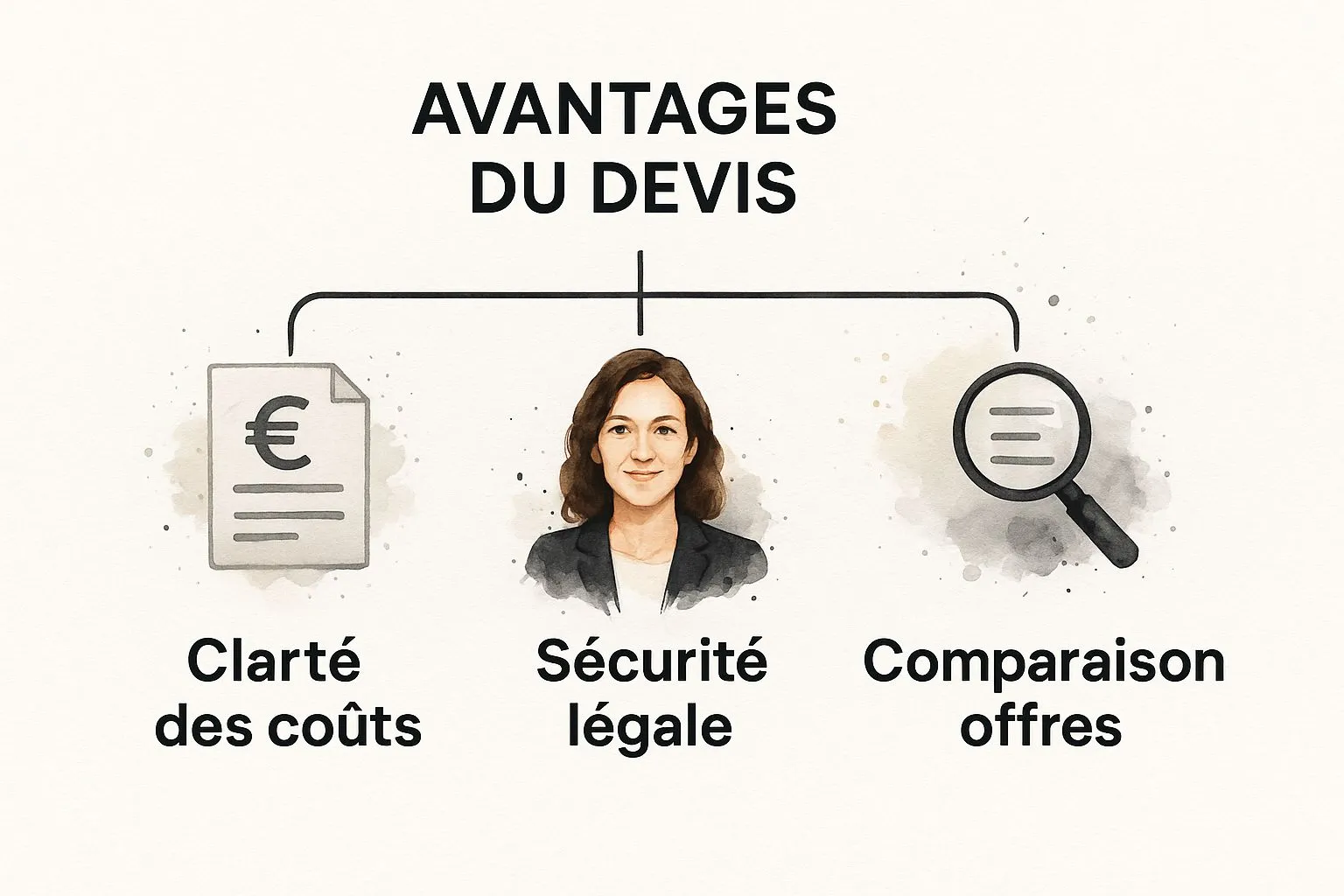
The infographic below summarizes the benefits of a well-constructed quote.
Mandatory or Recommended Details: The Summary Table
To help you see things more clearly, we’ve prepared a table that distinguishes the legally required details from the elements that are good practice to add for an even more professional quote.
| Element | Mandatory | Recommended | Purpose |
|---|---|---|---|
| ”Quote” label | Yes | Clearly identify the nature of the document. | |
| Your full contact details | Yes | Allow your legal identification and facilitate contact. | |
| Client’s contact details | Yes | Clearly identify the recipient of the offer. | |
| Quote number | Yes | Ensure unique tracking and administrative traceability. | |
| Issue date | Yes | Mark the starting point of the offer’s validity. | |
| Detailed description | Yes | Specify the nature, quantity, and price of each service. | |
| Price (excl. VAT, VAT, incl. VAT) | Yes | Ensure financial transparency and tax compliance. | |
| Offer validity period | Yes | Set a time limit on the price commitment. | |
| Client’s date and signature | Yes | Turn the quote into a contract binding both parties. | |
| Payment terms | No | ✓ | Clarify the payment arrangements (deposit, deadlines). |
| Delivery terms | No | ✓ | Define the conditions for carrying out or delivering the service/product. |
| Late penalties | No | ✓ | Inform of the consequences of late payment. |
| Guarantees (legal/commercial) | No | ✓ | Reassure the client about quality and after-sales service. |
This table highlights the fact that while the mandatory details guarantee your quote’s legal compliance, the recommended elements strengthen your professionalism and your client’s trust.
Ultimately, every detail matters. A well-constructed quote is not a mere administrative formality; it becomes a genuine contract once signed, laying solid groundwork before moving on to the invoicing stage. To better understand the rest of the process, feel free to check our guide on the differences between quotes and invoices.
When the Law Gets Involved: The Legal Obligations of a Quote

A quote is not just a commercial document. It is also governed by law to protect both the professional and their client. Think of these rules as traffic lights on a road: they’re there to make sure everything runs smoothly and safely. Ignoring these obligations risks turning a simple service into a complex dispute. Once signed, the quote becomes a genuine contract that firmly binds both parties.
In Which Cases Is a Quote Mandatory?
In many situations, providing a quote is not a choice but a legal obligation. This requirement generally depends on the type of business or the amount of the service. For example, it is mandatory for all work and repairs with a total amount exceeding €150 including VAT. This rule applies to various fields such as:
- Connection, installation, maintenance, and repair work on electrical, electronic, and household appliance equipment.
- Repair, maintenance, and troubleshooting services for masonry, plumbing, or carpentry work.
- Personal services, once the monthly service reaches or exceeds €100 including VAT.
The Legal Value of a Quote in the Event of a Dispute
The legal weight of a quote is very significant. Once signed, it becomes formal proof of the agreement reached between you and your client. If a disagreement arises over price, deadlines, or the nature of the work, this document will serve as the reference in court. That’s why its accuracy is essential.
Interestingly, a large share of business disputes involving small companies stems from poorly drafted or unfulfilled quotes. A study by INSEE (the French national statistics institute) shows that nearly 40% of these conflicts are linked to such issues. This clearly shows that a clear, complete document is the best form of prevention. To learn more, you can check INSEE’s analyses on business disputes. Failure to include mandatory details or to honor the terms of a quote can also lead to financial penalties for the professional.
Quotes by Industry: Necessary Adaptations
A quote is not a universal, rigid document. It should rather be seen as a toolbox that adjusts to the specifics of each profession. A plumber won’t use the same tools as a web developer, and similarly, the structure of a quote varies to reflect the reality of each trade.
Specifics by Major Business Sector
The nature of the service you offer directly influences the content and format of your quote. Each sector has its own conventions and requirements.
- Construction and trades: In these fields, the quote is often very detailed. It must precisely list materials, labor costs, and sometimes include clauses for technical contingencies. A sample quote for a sole trader in construction will be much more extensive than one from a consultant.
- Digital services (development, marketing): Here, the quote focuses on intangible deliverables. Billing may be based on a daily rate, a flat fee for a complete project, or even a subscription for recurring services.
- Auto repair: Transparency is essential. The quote must clearly distinguish the cost of spare parts from that of labor so the client understands exactly what they’re paying for.
- Creative professions (graphic design, events): The document often includes notions such as the transfer of copyright, the number of proposals or revisions included, and a precise schedule of creative milestones.
The practice of issuing quotes is also influenced by market habits. A business survey conducted by the Banque de France found that 65% of companies systematically issue a quote. On the other hand, 25% only do so if the client requests it. These figures confirm that while producing a quote is a majority practice, it remains flexible depending on the sector’s habits. To learn more, you can check the Banque de France survey.
Mastering the Art of Quote Negotiation

Receiving a quote isn’t the finish line — it’s more the starting point of a discussion. Think of it not as a battle to win at all costs, but as the beginning of a collaboration. A successful negotiation is one where you and the professional reach an agreement that respects your budget while recognizing the fair value of the work.
How to Compare Offers Intelligently
It’s tempting to jump at the cheapest quote, but that strategy can prove costly in the long run. A good comparison goes beyond price alone. It takes into account the clarity of the document, the level of detail, and the professionalism it conveys. A low price can hide incomplete services or lower-quality materials.
To help you compare several quotes without getting lost, we’ve prepared a table. It will guide you in asking the right questions and evaluating each proposal against essential criteria.
| Criterion | Importance | Questions to ask | Points to watch |
|---|---|---|---|
| Clarity and detail | High | Are the services listed precisely? Are quantities and unit costs indicated? | A vague quote is a potential source of misunderstandings and hidden costs. |
| Quality of materials/technologies | High | Are the brands or references of the materials specified? Are the products equivalent across quotes? | A price difference is often explained by the quality of supplies. Make sure you’re comparing like for like. |
| Guarantees and after-sales service | Medium | What guarantees are included (10-year, 2-year)? Is after-sales service mentioned? | Good support in case of a problem can justify a slightly higher initial investment. |
| Reputation and references | Medium | Can the professional provide examples of similar projects? Do they have verifiable customer reviews? | Trust is paramount. Don’t hesitate to check the company’s reputation. |
| Total price | High | Does the final price include VAT and all expense items? Are there options? | Analyze the price last, once you’ve assessed the real value of the offer. |
This guide helps you look beyond the final figure. By weighing each criterion, you make an informed choice that prioritizes the quality and security of your project, not just immediate savings.
What Can You Actually Negotiate?
Not everything is necessarily up for negotiation. The cost of raw materials or a tradesperson’s base hourly rate are often fixed items. However, there are levers you can use to adjust the final amount:
- The scope of the service: Ask whether it’s possible to remove a lower-priority option to reduce the bill.
- Completion timelines: If you’re not in a hurry, greater flexibility on the schedule can sometimes lead to a commercial concession.
- Payment terms: Offering a larger deposit or a different payment schedule can sometimes open the door to a small discount.
The approach matters. Instead of asking for a flat discount, ask questions to understand how the price is put together. An open, respectful discussion is the best way to find common ground and start the collaboration on solid footing.
Modern Tools for Creating Effective Quotes
The days of quotes scribbled by hand on a corner of a table are well and truly over. Today, digital solutions have turned this sometimes tedious administrative task into a genuine business asset. For sole traders and craftspeople, using the right tools is a simple way to save valuable time while strengthening their brand image.
Choosing the Right Quoting Software
Today’s market is full of solutions for every need, from lightweight mobile apps for professionals on the go to full platforms for more established businesses. Good quoting software doesn’t just look nice — it delivers concrete benefits.
- Smart automation: It automatically generates quote numbers following a logical sequence, calculates totals excluding tax and including all taxes, and applies the correct VAT rates. This considerably reduces the risk of human error.
- Customizable templates: You can prepare templates in your own image, with your logo and legal information. This ensures a professional, consistent presentation for every client.
- Centralized data: No more endless searches through your contacts or old files. Client records and product or service catalogs are gathered in one place, making it much faster to create new documents.
- Conversion into an invoice: Most tools, like Bizyness, let you convert an accepted quote into an invoice in a single click. This feature simplifies the entire sales cycle and saves you from having to re-enter everything.
Far from being mere gadgets, this software is designed to structure and strengthen your business processes, giving you more time to focus on your core work.
The official French administration website, service-public.fr, provides a clear guide to the rules to follow, as shown in this screenshot.
This image highlights the importance of formalizing your offers, particularly in the construction and repair sectors where the law requires it. Modern software builds these legal obligations directly into its templates, ensuring you stay compliant without even having to think about it. By adopting these technologies, the quote shifts from a mere formality to a powerful management and sales tool.
Avoiding the Pitfalls: Common Mistakes Not to Make
Even with the best intentions, a quote can quickly become a source of confusion if it isn’t drafted carefully. To avoid falling into this trap, it’s best to know the most common mistakes, whether you’re the service provider or the client. Think of a quote as a shared itinerary: the slightest vague instruction can cause both of you to lose time and energy.
The first typical mistake is a lack of precision. A quote that simply states “bathroom renovation” without detailing the specific tasks (removal of existing fixtures, tiling, plumbing, etc.) opens the door to misunderstandings and extra costs. Every service must be clearly listed, with its quantity and unit price.
The Oversights That Cost You
Certain oversights, which may seem minor at first glance, can lead to significant administrative or financial complications.
- Forgetting the validity period: Without this notation, a client might assume your prices are valid indefinitely. This exposes you to the risk of having to carry out a service at a rate that’s no longer profitable months later.
- Getting VAT wrong: Applying an incorrect rate or failing to include the “VAT not applicable” notation for sole traders complicates invoicing and can lead to tedious tax corrections.
- Neglecting payment terms: Failing to clearly specify the arrangements (deposit, balance payment) can create delays in your collections and weaken your cash flow.
By avoiding these pitfalls, your quote becomes a genuine tool for clarity that strengthens trust. To generate consistently compliant documents effortlessly, a tool like Bizyness can prove to be a valuable ally. It automates the creation of your quotes by including all the mandatory details, ensuring smooth, professional exchanges.
Simplify your management and create perfect quotes with Bizyness.