

 Français
Where to find an intra-community VAT number — a practical guide for your business
Find out where to find your partners' intra-community VAT number and how to check its validity to stay compliant across Europe.
To get your hands on an intra-community VAT number, the simplest approach is usually the most effective: ask your business partner directly, or take a look at their invoices. This number is also frequently found in the legal notices on their website or in their customer account on your store. It’s the starting point for ensuring your B2B transactions are compliant across Europe.
Where to look to find a VAT number
Finding a European partner’s intra-community VAT number is a crucial step for any online seller who wants to invoice by the book. Without this key piece of information, you can’t apply the reverse-charge mechanism or issue a tax-free invoice (excl. VAT). It’s a process that not only simplifies tax management but also helps you avoid mistakes that can prove costly.
So, concretely, where should you look? Most of the time, the answer is in documents you already have on hand.
Start with direct, reliable sources
The most obvious method remains the best: simply ask your customer or supplier for this information. It’s a standard business practice, and no one will be surprised. On the contrary, it shows that you’re rigorous and professional, which is always good for business.
If you’ve already worked together, your search may already be over. Take two minutes to check:
- Previous invoices the company has sent you.
- Quotes or purchase orders it may have issued.
- Contracts or terms and conditions of sale you’ve signed.
These official documents are legally required to include the company’s identifiers, including its VAT number. A quick check that can save you precious time.
Pro tip: Add an “Intra-community VAT number” field to your e-commerce site’s sign-up form, and make it mandatory for business accounts. It’s a simple habit that automates the collection of this information from the start and spares you dozens of emails.
Explore public sources
If direct methods haven’t turned anything up, don’t panic — there are still avenues to explore. Your partner’s website is often a goldmine. Head straight to the legal notice page or the terms and conditions of sale. European legislation is clear: companies must list their legal identifiers there, including their VAT number.
For French companies, there’s a handy trick to know: the VAT number is built from the SIREN number. If you have the latter, you can very often reconstruct or verify the full VAT number. To better understand the link between these identifiers, our article on the difference between SIRET and SIREN numbers will help clear things up.
To help you see things more clearly, here’s a summary of the most effective avenues for your search.
Key sources for locating an intra-community VAT number
This table summarizes the most effective methods for obtaining a partner company’s VAT number within the EU.
| Source | Reliability | Recommendation |
|---|---|---|
| Direct request to the customer | Very high | The simplest and safest approach. A real piece of cake. |
| Existing invoices and quotes | High | The first thing to check. The information is often right in front of you. |
| Customer profile on your site | Variable | Useful, but needs verifying. It all depends on how thorough the customer was at sign-up. |
| Legal notices on the website | Medium | A good fallback option when other methods have failed. |
| Databases (Sirene, BCE) | High | The information is official, but the search may take a bit longer. |
By combining these approaches, you should be able to locate this number without too much trouble, ensuring your invoices are fully compliant.
The VIES reflex for validating a VAT number
Finding your European customer’s intra-community VAT number is good. Validating it is essential. This step isn’t a mere formality — it’s a legal obligation that protects you in the event of a tax audit. It’s your only tangible proof that you were entitled to issue a tax-free invoice (excl. VAT).
Fortunately, the European Union has set up a tool for this: the VIES service (VAT Information Exchange System). It’s the official, free reference database that centralizes information on all businesses liable for VAT in member states. Think of it as your single source of truth.
The value of VIES is that it confirms in real time that a VAT number is indeed active for transactions between EU countries. This validation is what authorizes you to apply the reverse-charge mechanism.
How does the check work in practice?
The VIES portal is designed to be fast. It’s sorted in a matter of seconds. All you need to do is fill in two fields.
Here’s what the verification interface looks like:
As you can see, nothing complicated. You select your customer’s member state, enter their VAT number in the box provided, and the answer is instant.
The system will give you one of two verdicts:
- Yes, valid VAT number: Perfect! The number is correct and active. The company’s name and address are displayed, letting you confirm it’s indeed your customer.
- No, invalid VAT number: Careful. Either there’s a simple typo, or the company isn’t (or is no longer) registered for intra-community trade.
Pro tip: always keep a record
Don’t just run the check — archive it! A dated screenshot, attached to the invoice or saved in the customer’s file, does the job perfectly. In the event of an audit, this small file will justify why you didn’t charge VAT and prove that you did things by the book.
Automate validation to save time
For an online seller or a business handling dozens of B2B orders every day, manually checking every number on the VIES site quickly becomes a nightmare. It’s repetitive, time-consuming, and the risk of human error is very real.
That’s where automation changes everything. VIES offers what’s known as an API, a kind of gateway that lets other software connect to its database.
Modern invoicing and accounting tools, like Bizyness, use this API to build validation directly into your process. In practice, when a new business customer signs up or places an order on your site, the system queries VIES in the background. If the number is valid, the invoice is automatically generated excl. VAT. All without you having to lift a finger.
To better visualize the rules that apply, take a look at our intra-community VAT calculator.
This automated approach is a genuine safeguard. It guarantees your compliance, eliminates oversights, and saves you precious time that you can reinvest in your business.
Handling an invalid or unfindable VAT number
The VIES verdict is in: “Invalid VAT number.” Don’t panic. Before imagining the worst, know that this situation is far more common than you might think, and rarely hides an attempt at fraud. Most of the time, it’s a simple human error.
Your first move? Pick up the phone or send an email to your customer. It’s the simplest and fastest way to clarify the situation. A typo in the order form, two digits swapped, a missing country code (FR, DE, ES…) — these little slip-ups happen easily and account for the vast majority of invalid numbers.
Why can a VAT number be invalid?
If, even after talking with your customer, the number still can’t be found on VIES, you’ll need to dig a bit deeper. Several scenarios are possible.
It could be that your customer’s company does have a national VAT number, but it simply hasn’t been activated for intra-community trade. This is a specific step each company must take with its tax authority in order to trade within the European Union.
Also consider checking your customer’s status. Some entities simply aren’t liable for VAT and will never be able to provide you with a valid number. This is the case for:
- Micro-entrepreneurs (or sole traders) who benefit from the VAT exemption threshold.
- Associations and other public bodies that don’t carry out taxable commercial activities.
In these cases, the VAT reverse-charge mechanism doesn’t apply.
Remember this: without a valid, verified intra-community VAT number active in the VIES database, it is strictly forbidden to invoice tax-free (excl. VAT). It’s a golden rule to avoid trouble during a tax audit.
This decision tree perfectly summarizes the steps to follow to determine whether your invoice should be issued excl. VAT or incl. VAT.
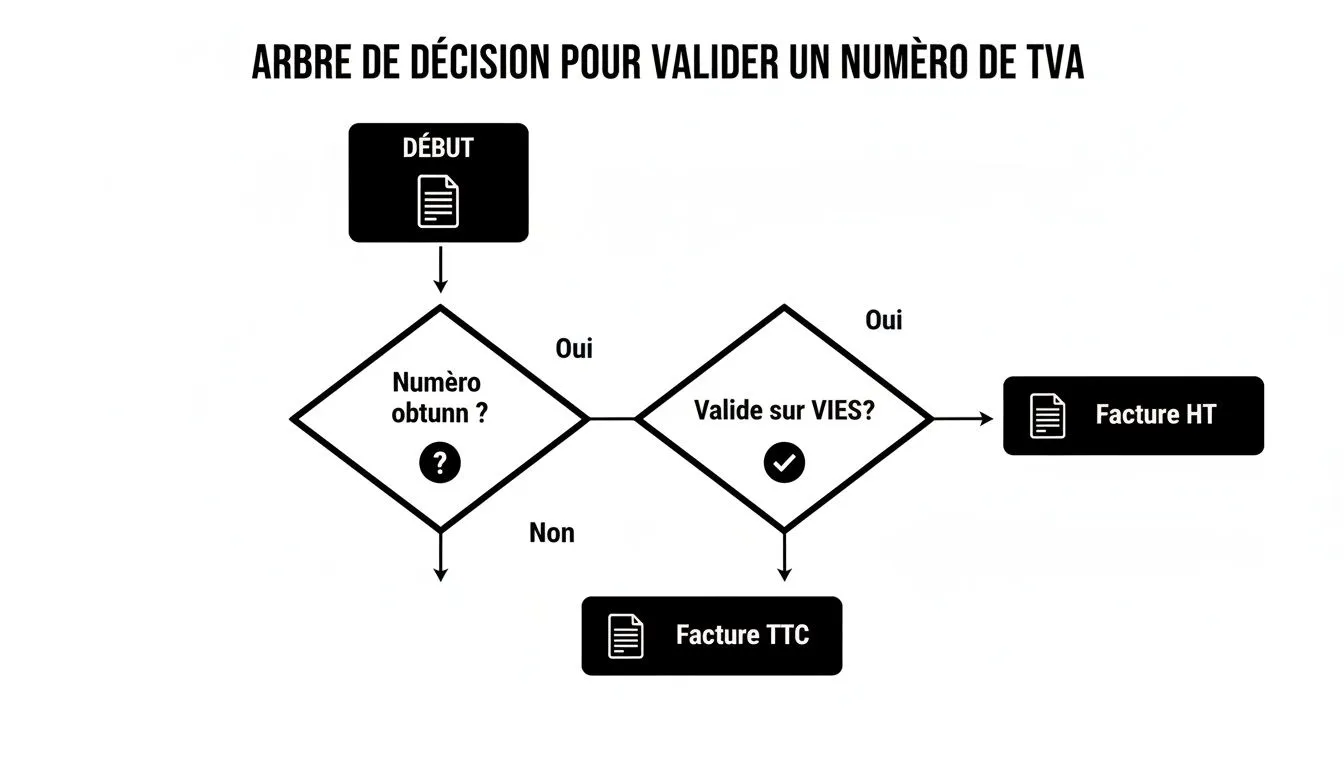
It’s clear: validation on VIES is the central pivot that determines everything else.
How to invoice when the number isn’t valid
So, concretely, what should you do if your customer’s number is incorrect and they can’t provide another one, if it isn’t activated for the EU, or if your customer isn’t liable for VAT?
The rule is simple: you must treat this sale exactly as you would a sale to an individual customer residing in France.
Your invoice must therefore mention and include French VAT at the applicable rate. You collect the tax, then pay it back to the state when filing your VAT return, just like any other domestic sale. A bit of caution today will spare you major headaches tomorrow. It’s the ABC of sound, compliant management.
E-commerce: why you absolutely must automate VAT management
For an online seller, spending time manually checking every business customer’s VAT number isn’t just time-consuming — it’s also taking on unnecessary tax risk. Let’s be clear: automation is no longer a luxury. It’s an essential building block for securing your compliance and freeing up time to focus on what really matters: growing your business.
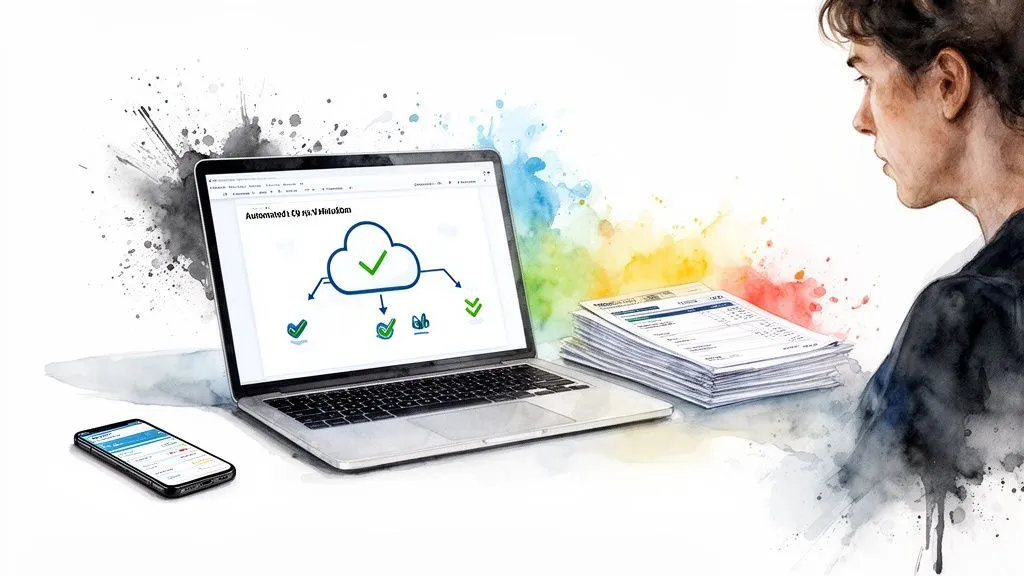
Most e-commerce platforms, such as Shopify or WooCommerce, do let you add a field for your B2B customers to enter their VAT number. But this first step is far from enough. Too often, validation remains a manual chore, forcing you to copy and paste each identifier into the VIES system. A slow, tedious process prone to errors.
Shift into higher gear with API integration
True peace of mind comes from specialized tools that plug directly into your store via an API. This isn’t just about collecting information anymore — it’s about creating a genuinely smart, autonomous workflow.
In practice, here’s how a well-oiled system works:
- Automatic collection: Your business customer fills in the VAT field on your site, as usual.
- Instant validation: Behind the scenes, the tool immediately queries the VIES database to check whether the number is valid.
- Applying tax rules: If the number is correct, the system applies the reverse charge and generates a tax-free invoice (excl. VAT). If it’s invalid, it applies your country’s VAT, as it would for an individual customer.
This chain of operations ensures every B2B transaction is handled correctly from the outset, without you having to lift a finger.
Bulletproof your tax filings
Automation doesn’t stop at invoicing. A good system also lays the groundwork for your mandatory filings. In France, the intra-community VAT number is a cornerstone for any online seller trading within the European Union.
Since 2022, if you make intra-community deliveries, you must report them via the État Récapitulatif TVA (ERTVA). Be careful, because the tax authorities don’t take this lightly. Since 2020, if an intra-community delivery doesn’t appear on your ERTVA, the VAT exemption can simply be cancelled in the event of an audit. The result? A hard tax reassessment of 20% VAT on the amounts concerned. To fully understand the stakes of the ERTVA and the penalties involved, it’s best to be well informed.
By automating validation and invoicing, you ensure that the data submitted to the authorities is reliable. This guarantees that your ERTVA is accurate and protects you from tax reassessments that can really hurt. This peace of mind is priceless.
Platforms like Bizyness were designed for exactly this. They integrate with your e-commerce ecosystem (Shopify, Stripe, etc.) and handle the whole cycle: from VAT number validation to preparing accounting entries. This centralized approach also greatly simplifies collaboration with your accountant. In fact, knowing how to choose the right accountant for your e-commerce business can really make a difference in how you manage your business.
Ultimately, automation turns a complex administrative burden into a smooth, secure process. It frees you from repetitive tasks, reduces the risk of human error to nearly zero, and lets you navigate the maze of European taxation with confidence.
Navigating e-commerce edge cases
Managing intra-community VAT is, unfortunately, no walk in the park. In the world of e-commerce, things get complicated fast, and several common situations require particular attention. Understanding these nuances is the key to staying compliant and avoiding mistakes that can prove costly.

If you sell on marketplaces like Amazon or Cdiscount, you might think everything is automated. That’s partly true for sales to individuals (B2C), where the platform often collects VAT on your behalf. But for business-to-business sales (B2B), the ball is still in your court: it’s up to you to check your customer’s VAT number and make sure your seller account is properly configured.
The headache of micro-entrepreneurs and digital products
A situation you’ll encounter every day: French micro-entrepreneurs. As long as they’re within the VAT exemption threshold, they simply don’t have an intra-community VAT number. As a result, they can neither charge VAT nor reclaim it. Everything changes once they cross the revenue thresholds. They must then obtain a number and start managing VAT for all their future B2B sales in Europe.
The sale of digital products (such as SaaS, online courses or e-books) also has its own rules. For this type of service, the applicable VAT is that of the customer’s country, not the seller’s. This rule, simple as it seems, requires you to precisely identify each buyer’s location in order to apply the correct rate.
To avoid having to register for VAT in every EU country, the OSS (One-Stop Shop) portal was set up. It’s a real breath of fresh air: it lets you declare and pay all the VAT collected across Europe through a single return filed with your own tax authority.
Certain sectors also have specific obligations. It may be worth looking into the VAT requirements for beauty professionals, for example, to understand how to apply them in an online sales context.
Why VAT rates matter so much
All this complexity is compounded by the fact that VAT rates vary widely from one country to another. In mainland France, the standard rate is 20%, but there are also reduced rates of 10% and 5.5%. Looking at our neighbors, the EU average sits around 21.82%, placing France slightly below it.
Overlooking these edge cases means risking mistakes in your invoicing and facing a tax reassessment. Tax authorities are paying increasingly close attention to cross-border transactions, whether they involve physical goods or online services. Rigorous management isn’t optional — it’s your best insurance policy.
FAQ: The intra-community VAT number in practice
Managing an intra-community VAT number often raises very concrete questions, especially in the heat of the moment. To help you see things clearly and avoid common pitfalls, here are some straightforward answers drawn from situations you might encounter.
The goal is to give you simple, effective reflexes for handling these cases without stress.
How do I get my own intra-community VAT number?
Rest assured, it’s a simple and entirely free process. In France, everything is handled through your local Service des Impôts des Entreprises (SIE).
If you’re in the middle of launching your business, simply check the right box on the company registration form. Already up and running? A simple request from your professional account on impots.gouv.fr is enough.
Good to know
Once the request is approved, the number is generally active within 48 hours. It then becomes the key to all your B2B transactions within the European Union.
As a reminder, its structure is always the same in France:
- The country code FR
- A 2-digit check key
- Your 9-digit SIREN number
What should I do if the name that comes up on VIES isn’t my customer’s?
This is the kind of situation that should immediately grab your attention. If the name or address returned by VIES doesn’t match perfectly with the information for the company you’re about to invoice, it’s time to pause.
Several reasons can explain this: a simple typo, the use of another subsidiary’s VAT number within the same group, or, in the worst case, an attempt at fraud. Whatever the cause, the reflex is simple: never apply the VAT exemption when in doubt.
The first thing to do is contact your customer to clarify the situation. Ask them to provide the VAT number that exactly matches the entity placing the order. Until you have that exact match, verified by VIES, you’re legally required to charge French VAT.
A small tip: keep careful records of these exchanges. These emails can prove your good faith and diligence in the event of a tax audit.
National VAT number vs. intra-community VAT number: what’s the difference?
Even though they look similar, these two numbers don’t serve the same purpose at all. A French company’s national VAT number, often linked to its SIREN, is only used for business conducted within our borders.
The intra-community VAT number, on the other hand, was specifically created for the exchange of goods and services between businesses in different EU countries. Its country prefix (FR, DE, ES, IT…) is what makes it identifiable.
It’s entirely possible for a company to be liable for VAT in its own country while not having a number activated for European transactions. This is precisely why checking the VIES database isn’t optional — it’s mandatory.
The VIES service doesn’t just tell you whether a number exists. More importantly, it confirms that it’s actually active for intra-community trade, which gives you the green light to apply the reverse-charge mechanism.
Navigating the intricacies of intra-community VAT can seem intimidating, but the right tools can turn this obligation into a simple formality. With Bizyness, you can automate VAT number validation, issue compliant invoices in just a few clicks, and prepare your tax filings stress-free. Simplify your e-commerce accounting today at https://www.bizyness.fr.
