

 Français
Withholding tax for sole traders: the complete guide
Master withholding tax as a sole trader (micro-entrepreneur): rules, calculations, instalments and practical tips to optimize your tax management.

Understanding the system that changed your taxation
Withholding tax at source (PAS) has changed the way sole traders manage their taxes. This system, designed to simplify taxation for the self-employed, lets you pay income tax as you collect your revenue. No more need to settle a large annual amount! The withholding system fits perfectly with the micro-entrepreneur regime and secures your financial management by avoiding unpleasant surprises.
This mechanism works through instalments, calculated on your past income. For sole traders, the tax authorities deduct income tax directly from professional earnings in the form of monthly instalments, generally on the 15th of each month. This system makes paying income tax easier and smooths out your cash flow management. Find out more about withholding tax for the self-employed.
How does withholding tax work for sole traders?
Withholding tax for sole traders is based on monthly or quarterly instalments, deducted directly from your bank account. These instalments are calculated based on the revenue declared the previous year. The tax authorities apply a flat-rate allowance for professional expenses.
- 71% for sales activities
- 50% for commercial services
- 34% for non-commercial services
The withholding rate is then determined based on income after the allowance and your household situation.
The system provides for adjustments. After your annual income tax return, the tax authorities recalculate your rate and adjust the amount of your instalments for the following year. This recalculation fine-tunes the withholding and adapts it to your situation. You might also be interested in: How to file your taxes as a sole trader?
The benefits of withholding tax
The PAS system offers greater flexibility. You can adjust the amount of your instalments up or down as your business evolves. If you expect a drop in activity, you can request a reduction in your withholdings. If your business is growing, you can increase your instalments to avoid a large balancing payment the following year.
The system offers better visibility over your cash flow. By paying your tax regularly, you avoid unpleasant surprises and manage your finances more effectively. Withholding tax also simplifies your administrative tasks. You no longer have to worry about settling a large annual sum, letting you focus on your business.
Choosing between monthly and quarterly: which option suits you?
Withholding tax for sole traders offers two options for paying your instalments: monthly or quarterly. This flexibility lets you adapt the withholding rhythm to your situation. But how do you choose the option best suited to your business? Let’s look at the pros and cons of each to help you make the right choice.
Monthly withholding: smoother management
The monthly option offers better visibility over your cash flow. The amounts withheld are smaller, making it easier to manage your day-to-day budget. This lets you fold tax payments into your regular expenses, like a recurring bill. For sole traders with stable, regular activity, this option offers a certain peace of mind.
- Advantages: Better cash flow management, smaller amounts, simplified tracking.
- Disadvantages: More withdrawals to manage administratively.
Quarterly withholding: simplified administrative tracking
Quarterly withholding, on the other hand, simplifies your administrative tracking. With only four withdrawals a year, you have fewer transactions to record. This option can be particularly appealing for sole traders whose business is seasonal or irregular. By grouping payments together, you can better anticipate busy periods and slow periods.
- Advantages: Simplified administrative tracking, fewer withdrawals to manage.
- Disadvantages: Larger amounts with each withdrawal.
To help you choose the best option, here is a comparison table:
Comparison of withholding arrangements
Comparison table between monthly and quarterly withholding for sole traders
| Arrangement | Frequency | Withdrawal date | Advantages | Disadvantages |
|---|---|---|---|---|
| Monthly | 12 times a year | The 20th of each month | Better cash flow management, smaller amounts, simplified tracking | More withdrawals to manage administratively |
| Quarterly | 4 times a year | February 15, May 15, August 15 and November 15 | Simplified administrative tracking, fewer withdrawals to manage | Larger amounts with each withdrawal |
This table summarizes the main differences between the two options. The choice will therefore depend on your situation and your preferences in terms of management.
How to make the right choice?
The infographic below illustrates the key questions to ask yourself to determine the best option for you.
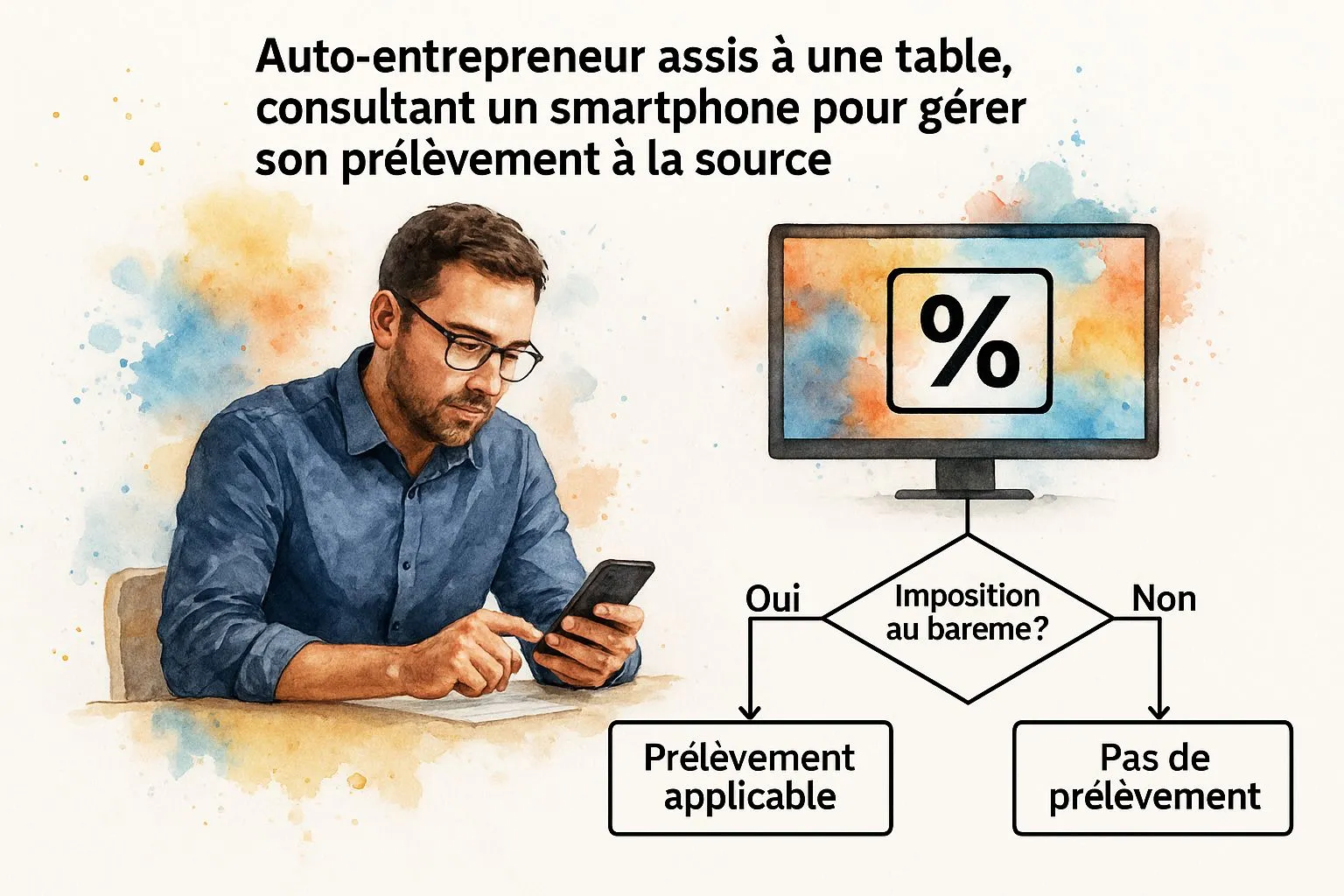
It highlights the importance of analyzing the regularity of your income and your preference for case-by-case management versus a quarterly overview.
The choice between monthly and quarterly therefore depends on your organization and your preferences. If you’re comfortable with regular management and appreciate the smoothness of level cash flow, the monthly option is ideal. If you prefer to simplify your administration and have a fluctuating business, the quarterly option is more relevant.
Remember that you can change your choice at any time in your personal space on impots.gouv.fr. It’s important to choose the option that lets you best manage your business and avoid any stress related to managing your taxes. Experiment and adjust your choice as your sole proprietorship evolves. Platforms like Bizyness can also help you automate and simplify managing your withholding tax.
Changing your frequency: a welcome flexibility
One of the advantages of withholding tax is the ability to change the frequency of your instalments. If you start with monthly withholdings and realize that quarterly management would be more suitable, you can easily make the change. Likewise, if your business evolves and you prefer to go back to a monthly option, the process is simple and quick. This flexibility is a major asset for sole traders, letting them adapt their tax management to the evolution of their business. Don’t hesitate to contact the tax authorities with any questions about changing your frequency.
Mastering the calculations based on your revenue

Understanding how your revenue impacts your withholding tax is essential for sound financial management of your sole proprietorship. The amount of instalments you pay is directly linked to your income. It’s therefore important to fully grasp the calculation mechanism that connects these two elements. Let’s find out together how it works.
How does revenue influence your instalments?
To calculate your instalments for year N, the tax authorities base their calculation on the revenue you declared for year N-1. A flat-rate allowance for professional expenses is applied to this revenue. The rate of this allowance varies depending on the nature of your business: 71% for buying/reselling activities, 50% for commercial services and 34% for non-commercial services. The amount obtained after the allowance forms the basis for calculating your instalments. This system estimates your taxable income and applies the corresponding withholding rate to it.
It’s also worth noting that the revenue threshold for the micro-entrepreneur regime has been revalued. The cap is now set at 120,000 euros as of January 1, 2024 for the micro-BA regime. This change directly impacts the tax and social management of sole traders, particularly regarding withholding tax. For more information on revenue thresholds, you can check the INSEE website: Detailed statistics on revenue. Understanding the impact of these thresholds on your withholding tax is therefore essential.
Anticipating variations and optimizing your management
Anticipating the evolution of your revenue is fundamental to adjusting your instalments. If you expect an increase in your business, it’s advisable to raise your instalments to avoid a significant balancing payment the following year. Conversely, if you anticipate a drop in activity, you can request a reduction in your withholdings. This flexibility lets you adapt your withholding tax to the reality of your business and optimize your cash flow. Proactive management will help you avoid unpleasant surprises. To learn more about VAT management as a sole trader, you can read this article: Mastering VAT as a sole trader.
Tools and strategies for effective management
Various tools and strategies can support you in managing your withholding tax. Regularly tracking your revenue is essential. Using accounting software, like Bizyness, can help you automate this tracking and clearly visualize the impact of your income on your withholdings. In addition, simulating different scenarios for your business’s evolution can help you anticipate changes and adjust your instalments accordingly. These tools give you better control over your tax situation and help you make informed decisions. By combining rigorous tracking with the use of suitable tools, you’ll turn managing your withholding tax into a real asset for your sole proprietorship.
Sole proprietorship: a success story transforming the French economy
The sole trader (auto-entrepreneur) regime has profoundly changed the French entrepreneurial landscape. Since its launch, this status has attracted more and more entrepreneurs, proof of its simplicity and appeal. This widespread adoption has had a considerable impact on the French economy, spurring innovation and redefining the rules of business creation. Withholding tax fits fully into this drive toward tax modernization, simplifying management for sole traders.
Key sectors of sole proprietorship
Certain business sectors have particularly benefited from the simplicity of the sole trader regime. The personal services sector, for example, has seen the emergence of many sole traders meeting growing demand. Likewise, online retail and creative activities have found this status to be a framework conducive to their development.
This concentration in certain sectors demonstrates the regime’s ability to adapt and support diverse activities. The growth of these sectors thanks to sole proprietorship contributes to the diversification of the French economy.
Enthusiasm for this regime was evident from its very start. In 2009, at its launch, the sole trader regime met with immediate success. Within the first half of the year, 149,000 sole traders declared revenue of 934 million euros. By the end of 2009, 328,000 sole traders were registered, generating overall revenue of nearly one billion euros. Discover more statistics on sole proprietorship. This initial success confirmed the need for a simplified regime for business founders.
Evolving profiles of sole traders
The profile of sole traders has diversified over the years. Initially, the regime mainly attracted people in career transition or looking for supplementary income. Today, we see a much wider variety of profiles, with more recent graduates and employees starting their own businesses.
This shift shows that the status has become a genuine path into entrepreneurship, regardless of background. This trend reflects the evolution of the labor market and the growing desire for autonomy and flexibility.
Impact on public policy
The success of sole proprietorship has influenced public policy in support of business creation. Specific measures, such as training programs, financial aid and administrative simplification schemes, have been put in place to support these entrepreneurs.
These initiatives aim to encourage entrepreneurship and facilitate the development of sole proprietorships. The goal is to create an environment conducive to their growth and their contribution to the French economy. The introduction of withholding tax fits into this logic of simplification and reflects the desire to support sole proprietorship. By using Bizyness, you further simplify your administrative management and can focus on what matters: growing your business.
Tools and methods for stress-free management
As a sole trader, effectively managing withholding tax is crucial for your peace of mind and the financial health of your business. With the right tools and practices, this administrative task can become an asset for your growth. Let’s explore together strategies and tools to simplify and optimize this process.
Automating and simplifying tracking
Digital tools are essential for automating the tracking of your withholding tax. Solutions like Bizyness Bizyness let you manage your invoices, your VAT and your transactions, simplifying the calculation and payment of your instalments. Other accounting software offers similar features. By automating these tasks, you save time and ensure the accuracy of your data, minimizing the risk of errors. This time saved lets you focus on growing your business.
Anticipating and adjusting your instalments
Anticipation is key to peaceful management. Regularly track your revenue and analyze your business trends to proactively adjust your instalments. If you expect an increase in activity, raise the amount of your instalments to avoid a significant balancing payment the following year. Conversely, in case of an anticipated drop in activity, you can request a reduction in your withholdings. This flexibility lets you adapt your withholding tax to your situation and optimize your cash flow.
Managing seasonal variations
Seasonal variations in activity are common for many sole traders. Anticipating periods of high and low activity is essential for managing these fluctuations effectively. During slow periods, request a reduction in your instalments to preserve your cash flow. Conversely, during peak activity, increase your withholdings to anticipate the annual balancing payment.
Maintaining balanced cash flow
Well-managed withholding tax contributes to better cash flow management. Paying your tax regularly helps you avoid building up a significant tax debt and lets you better control your cash flow. This lets you plan your investments and manage your expenses more calmly. Taking care of your professional image is also important for stress-free management. If you’re interested in creating a professional headshot, this article might be useful to you.
Recommended management tools
The table below presents various tools and methods for optimizing the management of your withholding tax.
| Tool/Method | Main function | Frequency of use | Difficulty level |
|---|---|---|---|
| Bizyness | Invoicing, VAT, transactions, instalment tracking | Daily/Weekly | Easy |
| Spreadsheet (Excel, Google Sheets) | Tracking revenue and instalments | Monthly/Quarterly | Intermediate |
| Online tax simulator | Estimating the tax amount | One-off/Annual | Easy |
| Contact with an accountant | Personalized advice and tax optimization | One-off/Annual | Variable |
By combining these tools and adopting a proactive approach, withholding tax becomes a real asset for managing your sole proprietorship. Organization and planning are the keys to stress-free management.
Avoiding pitfalls and optimizing your management
Withholding tax for sole traders considerably simplifies the management of your taxation. However, a few common mistakes can have significant financial consequences. This section will guide you in avoiding these pitfalls and optimizing the management of your withholding tax as a sole trader.
Costly mistakes to avoid
Underestimating your revenue is a common mistake. Declaring revenue lower than reality to reduce the amount of your instalments can lead to a significant balancing payment the following year. Forgetting to declare income from a supplementary activity can also incur penalties.
Not adjusting your instalments to match the evolution of your business is another common mistake. If your business is growing, you need to increase your instalments. Conversely, if your business is slowing down, you can request a reduction in your withholdings. Good management also involves a polished professional image. If you’d like to create a professional headshot, this article might interest you.
Warning signs to watch for
Certain signs should alert you and prompt you to react. Regularly negative cash flow may indicate that your instalments are too high relative to your income. A significant gap between your instalments and your final tax bill during the annual balancing can also be a sign that an adjustment is needed.
Reminders from the tax authorities for unpaid instalments are a major warning sign. These reminders can lead to penalties and surcharges. It is therefore essential to react quickly and regularize your situation.
Best practices for optimal management
Adopting good practices will let you manage withholding tax with peace of mind. Regularly track your revenue and anticipate variations in your business. Using management tools to automate your tracking and simulate different scenarios can prove very useful.
Maintain regular dialogue with the tax authorities. Don’t hesitate to contact them with any questions or to report a change in your situation. Good communication with the authorities will help you avoid misunderstandings and problems. For more information, read this article on tax optimization for sole traders.
Preventive strategies to save time and money
Putting preventive strategies in place will let you save time and money. Build up a cash reserve to cope with activity fluctuations and any balancing payments. Regularly train yourself on withholding tax to stay informed of legislative changes.
Anticipate changes in your situation, such as a change of activity or a significant variation in your income, and adjust your instalments accordingly. Being proactive will help you avoid unpleasant surprises and financial difficulties.
Toolkit for peaceful management
Here is a summary of the tools and strategies for optimized management:
- Regular revenue tracking: Essential for anticipating variations and adjusting instalments.
- Management tools: Accounting software, online simulators, etc. to automate tracking and management.
- Communication with the tax authorities: To ask questions, report changes and build a relationship of trust.
- Cash reserve: To cope with the unexpected and balancing payments.
- Continuous training: To stay up to date on legislative changes.
By applying this advice, you’ll turn withholding tax into an asset for managing your sole proprietorship. Simplify your life and focus on your business with Bizyness, the all-in-one solution for managing your sole proprietorship.
