

 Français
 Account naming made simple for sole traders
Master account naming for your bookkeeping and invoices. Our guide explains how to choose and use it without mistakes.

Behind the somewhat formal term “account name” hides a very simple idea: it’s the name you give to a financial category in your business. Think of it as a label, both clear and descriptive, that lets you instantly identify a client, a supplier, a type of expense, or a source of revenue. Once mastered, this concept makes your bookkeeping crystal clear.
Breaking down the account name
Let’s forget accounting jargon for a moment. To really understand what an “account name” is, imagine your business as a large library. Each book represents a financial transaction: a sale made, a software subscription, a payment to a supplier, and so on. Without a good filing system, finding a specific book would quickly turn into a nightmare, wouldn’t it?
Well, the account name is simply the label you stick on each shelf. One shelf might be called “Graphic design sales,” another “Google advertising costs,” and a third “Invoices – Client Dupont.” Each book, meaning each transaction, is then placed on the shelf it belongs to. At a glance, you know where everything is and what each category contains.
But why does this matter so much?
This method, simple as it is, brings essential clarity to your financial management. It turns what could be a pile of numbers into an organized, logical structure, letting you see exactly where your money comes from and where it goes. For a sole trader, clearly defining account names is truly the first step toward healthy, stress-free management.
This infographic sums up the three pillars behind good use of account names.
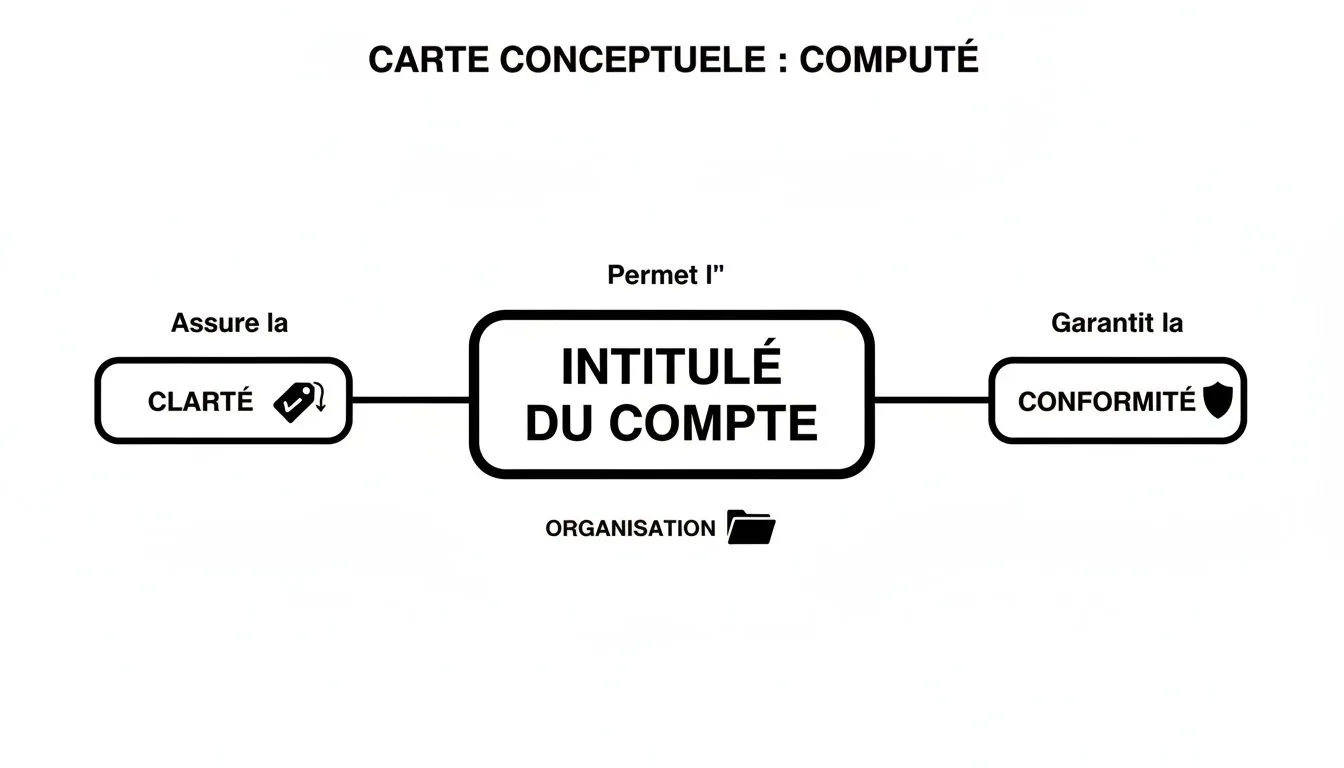
As you can see, everything starts with clarity. This clarity naturally leads to better organization and, ultimately, ensures your compliance with applicable rules.
The account name isn’t just an administrative formality; it’s the DNA of your financial organization. A good name tells a clear story about every euro that enters or leaves your business, giving you the power to analyze your performance and make informed decisions.
This organization is vital for several very concrete reasons:
- Accurate invoicing: You can attribute each payment to the right client or project, without ever getting confused.
- Sound bookkeeping: Tracking your expenses and revenue by category lets you analyze what’s profitable and what isn’t.
- Stress-free compliance: In the event of an audit, you can justify every line of your accounts simply and quickly.
The table below sums up where and how the account name comes into play in your everyday life as an entrepreneur.
Account naming at a glance
This table summarizes the main use cases for account naming and its role in each of them.
| Context | Role of the account name | Concrete example |
|---|---|---|
| Invoicing | Clearly identify who is paying or being paid. | Client account name: “Martin Ltd” |
| Bank statement | Describe the nature of the transaction (salary, rent, purchase). | Transaction label: “Software purchase” |
| Chart of accounts | Categorize transactions according to a standardized nomenclature (purchases, sales, taxes). | Account 6063: “Maintenance supplies” |
In short, whether for your invoices, your bank, or your bookkeeping, a relevant name is key.
The choice of your account names is also closely tied to the very structure of your bookkeeping. To better understand how these categories are standardized, feel free to check out our guide on the general chart of accounts. Ultimately, well-thought-out names are your best ally for keeping total control over your finances.
What is the account name actually used for?
The account name is nothing like jargon reserved for accountants. It’s something you use every day, sometimes without even realizing it. Think of it as the thread that ties together every aspect of your management and gives concrete meaning to your figures.
To see just how practical it is, let’s look together at where it comes into play in your daily life. You’ll quickly see that a well-chosen name is a real time-saver and a source of clarity.
On your invoices: for hassle-free client tracking
The first contact with the account name happens on your sales documents. On an invoice, the client account name is simply your client’s name. It might be a company’s official name (like “Dupont & Sons Ltd”) or an individual’s first and last name.
This name is absolutely essential. It’s what guarantees you can instantly attribute each payment received to the right person and the right invoice. No more mystery transfers floating around in your books! A clear name, and you know right away who has settled their debt.
Think of the client name as the address on an envelope. If it’s unclear or incorrect, the mail (your payment) risks getting lost or taking forever to arrive, creating needless confusion and delays.
On your business bank account: your activity’s ID card
The second place where the name is crucial is your business bank account. There, it takes on a more formal shape: it’s the legal name of your business. For a sole trader, this means your first and last name must appear on it.
A correct bank account name isn’t just a detail — it smooths out your exchanges and builds your credibility.
- It reassures your partners: A client who sees a transfer labeled “First Name Last Name EI” knows they’re dealing with a properly registered professional structure. It’s a sign of seriousness.
- It simplifies paperwork: Bodies like URSSAF identify your contributions much more easily, sparing you errors or processing delays.
This name is your micro-business’s financial ID. To dig deeper into the topic, feel free to read our article explaining in detail what a bank identity statement is.
In your bookkeeping: your personal dashboard
And finally, the third area where the account name matters is your chart of accounts. No need to panic — for a sole trader, this is far from the hundreds-of-pages document you might imagine! Think of it instead as your own filing system for your finances.
Here, you’re the one creating the names to organize your income and expenses logically.
- On the income side: Instead of a vague “Sales,” you can create names like “Graphic design services” or “Handmade jewelry sales.”
- On the expenses side: Rather than a catch-all “Miscellaneous expenses,” be more precise with “Software subscriptions,” “Raw materials purchases,” or “Travel expenses.”
Thanks to these custom names, your bookkeeping turns into a real dashboard. At a glance, you can see which activity is most profitable or which expense category is eating into your budget. It’s the key to making the right decisions and steering your business with confidence.
How do you choose the right names for your accounts?
Choosing an account name might seem like a minor administrative detail, but it’s actually a crucial decision for the clarity of your financial management. Picture your accounts as a library: with precise labels, you find what you’re looking for in an instant. Well-thought-out names do exactly that — they turn a mass of raw numbers into a readable dashboard, helping you make better decisions.
The idea is that every account line should be clear, even months later, without needing an accounting degree. To get there, just follow three common-sense principles: clarity, consistency, and compliance. Each name should precisely describe the transaction, stay the same for similar transactions, and of course, follow the few applicable rules.
The golden rules to apply to your account names
For the bank account you dedicate to your freelance activity, the rule is clear and non-negotiable. The name must include your first and last name, followed by the mention “EI” for Entrepreneur Individuel (Sole Trader). You can absolutely add your trade name to make it more meaningful. For example: “Jane Doe EI – Agile Quill.”
This formality is essential so that URSSAF and the tax authorities can identify you without any ambiguity. For your income and expense categories, on the other hand, you have much more freedom. The logic, though, stays the same.
- Be precise, not vague. Avoid catch-all terms like “Supplies” or “Sales.” Opt instead for “Office supplies,” “Raw materials purchases,” or “Marketing consulting services.”
- Adopt a logic and stick to it. If you record an expense under “Design software subscription,” don’t switch to “Software costs” the following month. This consistency is key.
- Think about your future analysis. Create categories that will help you assess your profitability. If you offer several services, give each revenue source a name, like “Online course sales” and “One-on-one coaching.”
A good account name is like a chapter title. It should tell you exactly what you’ll find inside, without needing to read everything. The goal is to be able to skim your accounts and instantly understand the health of your business.
Why this rigor matters so much for the self-employed
Taking the time to name things properly from the start is a small investment for great peace of mind down the line. It’s the first building block of well-managed cash flow and stress-free tax filings.
This discipline matters even more as the number of sole traders keeps growing. In France alone, out of the 731,772 business registrations recorded in the first half of 2024, sole proprietorships (including micro-entrepreneurs) accounted for 38.26% of new business creations. For this huge wave of self-employed people, mastering the basics — like choosing the right account name — is fundamental to building a business on solid foundations. To learn more, feel free to check the INPI statistics on entrepreneurial trends.
Ultimately, well-chosen account names aren’t a constraint. They’re your best ally for running your business independently and with clarity.
Common mistakes to avoid with your account names
Knowing how to choose a relevant account name is one thing. Avoiding the classic pitfalls is even better. Some mistakes, which seem harmless at first, can quickly turn your bookkeeping into a real headache. In the end, you lose time, clarity, and sometimes even money.
Let’s go over the most common missteps to help you start off on the right foot.
Enemy No. 1: “catch-all” names
By far the most common mistake is giving in to the temptation of vague names. Who hasn’t created a “Miscellaneous” or “Various expenses” category to quickly dump an expense they don’t know how to classify? It’s an easy way out that costs you dearly later.
At the time, it gets you out of a jam. But by the end of the quarter, when you’re trying to figure out where your money went, these categories become black boxes. How can you steer your business if a good chunk of your costs is buried in accounting fog? It’s the surest way to completely lose control of your finances.

Lack of consistency, a silent adversary
Another very common pitfall is a lack of consistency. Picture this: in January, you record your design software subscription under “Software subscriptions.” In February, the same invoice ends up under “Creative tools,” then in March, under “Graphic software costs.” Yet it’s the exact same expense — just scattered across four corners of your bookkeeping.
The day you want to review your annual software spending, you’ll be in for a treasure hunt. You’ll have to track down and manually add up these three lines, with a huge risk of missing one along the way.
The solution, though, is simple: once a name is created for a type of transaction, stick with it. This discipline isn’t a constraint — it’s the key to reliable, hassle-free tracking.
Think long-term from the moment you create a name. A little effort up front will save you hours of tedious corrections and analysis later. Consistency is an investment in your peace of mind.
Mistakes specific to the bank account
The pitfalls aren’t limited to your chart of accounts. Your business bank account name is also a source of potential errors, especially for sole traders.
One of the most serious mistakes is using only your trade name as the account name. The law, however, is very clear on this point.
- Format to avoid: “My Super Agency”
- Correct format: “John Doe EI” or “John Doe – My Super Agency”
Why such rigor? Simply because a non-compliant name can block essential transactions. Bodies like URSSAF, which need to precisely identify the sole trader, could reject your transfers or direct debits.
It can also raise doubts among your clients or suppliers, who may question the legitimacy of the account. By following the legal format, you ensure smooth financial flows and strengthen your credibility. It’s a simple detail that avoids plenty of administrative roadblocks.
Putting it into practice: setting up your account names in Bizyness
Alright, enough theory! It’s by getting your hands dirty that good habits really take hold. Now that you understand why a well-chosen account name matters so much, let’s see concretely how to set all this up in your Bizyness management tool. This is exactly the stage where thoughtful organization becomes a phenomenal time-saver.
Think of this initial setup as a small investment that will pay off big time in your daily life. A clean, tidy configuration guarantees accurate financial reports and a clear view of your business, without having to recalculate everything by hand.
Setting up your expense and income categories
The very first thing to do is build your own filing system. The advantage of Bizyness is that you can customize these categories to fit your reality perfectly.
Here’s how to get started, step by step:
- List your main sources of income. Instead of a vague “Sales,” be more specific. Think “SEO consulting services,” “Online course sales,” or “Affiliate revenue.” The difference is huge.
- Identify your recurring expenses. Here too, detail is everything: “Software subscriptions,” “Facebook advertising costs,” “Raw materials purchases,” or “URSSAF social contributions.”
- Give each category a clear name. The idea is to understand what it is at a glance, even six months from now, without racking your brain.
This screenshot of the Bizyness interface shows you the result: once the setup is done, your transactions are classified automatically.
You can clearly see the power of automation here. Each bank line is directly linked to a clear account name, giving you an immediate overview of your money coming in and going out.
Creating and managing client and supplier records
A meaningful account name also applies to the people and businesses you work with. The best practice is simple: for each new client or supplier, create a dedicated record in Bizyness. The name? Nothing simpler: their legal name (for a company) or their first and last name (for an individual).
Think of each client record as an individual file. By gathering all their invoices, quotes, and payments in one place, you build a complete and reliable history. This rigor avoids misattribution errors and makes tracking payments incredibly simple.
It’s this kind of detail that makes the difference for a smooth client relationship and follow-ups that hit the mark.
Using bank syncing to automate everything
The real magic of Bizyness is its ability to do the classification work for you. Once you’ve connected your business bank account, the software analyzes your transaction labels and suggests smart matches.
- Create classification rules: For example, you can tell the system that all transactions coming from “OVH” should automatically go into the “Web hosting” category. It’s simple and remarkably effective.
- Validate in one click: Bizyness presents its suggestions, and all you have to do is confirm them. The time you used to spend manually entering data? It melts away like snow in the sun.
This feature turns a time-consuming chore into an almost instant process. To see everything Bizyness can do to simplify your life, take a look at the features of our accounting solution for sole traders. By taking the time to properly set up your account names, you turn Bizyness into a true copilot for your business.
Your questions, our answers on account naming
The account name is at the heart of your management, but in practice, it raises quite a few questions. We see it every day with the self-employed people and small business owners we support.
To save you time, here are the questions that come up most often, with clear, direct answers to help you out. The goal? Clear away the fog so you can manage your accounts with more peace of mind.
As a sole trader, am I required to use the chart of accounts’ numbering?
The answer is simple: no, absolutely not. Bookkeeping for a micro-business is designed to be lightweight. You have no obligation to follow the strict numbering of the General Chart of Accounts (Plan Comptable Général, or PCG).
What really matters is that your names are clear, logical, and that you stick to them. That’s the key to effectively tracking your money in and out. This is precisely why tools like Bizyness offer simplified charts of accounts, much better suited to your reality and your tax filings.
Remember this: for a micro-business, a name like “Raw materials purchases” is far more meaningful than the account “607.” Clarity beats accounting jargon.
Can I change an account name once it’s been created?
Yes, technically, most software lets you. But be careful — it’s an operation to handle with great care. My advice: only change a name to fix a simple typo or make it more precise.
Avoid changing your account names constantly at all costs. Why? Because it completely skews the comparison of your financial reports from one year to the next. If an expense category changes or splits into two, it’s far wiser to create a new account rather than rename an old one already linked to dozens of transactions. Consistency is the foundation of reliable long-term tracking.
What name should I use for my URSSAF contributions?
Here, no hesitation: give them their own dedicated expense account. It’s essential for clarity. The most effective and common names are:
- “URSSAF social contributions”
- “Professional social charges”
- “Social security deductions”
By isolating them in their own category, you can measure their real weight in your revenue at a glance. It’s an essential habit for anticipating your deadlines and steering your profitability. In Bizyness, for example, creating this dedicated category lets you automate this tracking and always have an up-to-date view.
Can my trade name be the only name on my bank account?
No, and this is a major point of caution for any sole trader. For a sole proprietorship, the legal name of the bank account dedicated to your business must include your first and last name.
You can of course add your trade name, but your legal identity remains the foundation. The correct format is therefore “First Name Last Name EI” or, to be even clearer, “First Name Last Name – [Your Trade Name].” It’s a simple rule that keeps you compliant and makes it easier for bodies like URSSAF to identify you. You’ll spare yourself plenty of hassle and the risk of blocked transactions.
Ready to put your finances in order and shift into high gear? With Bizyness, you can create clear account names, sync your transactions, and run your business without the headaches. Discover how Bizyness can simplify your daily life starting today.
