

 Français
Micro-entrepreneur accounting obligations: understand and manage them easily
Discover the accounting obligations of a micro-entrepreneur and how to simplify everything - invoicing, VAT and filings, for calm and efficient management.

As a micro-entrepreneur, accounting obligations boil down to three fundamentals: keeping a receipts book, issuing proper invoices, and, of course, declaring your revenue. Far from being a mere formality, this simplified accounting is precisely designed so you can handle it yourself, without needing an accountant.
Getting started stress-free with micro-entrepreneur accounting

Starting out as an entrepreneur is often exhilarating, but the mere mention of the word “accounting” can quickly dampen the enthusiasm. Many people choose the micro-entrepreneur status for its famous simplicity, sometimes wrongly assuming there are no administrative rules to follow at all. The reality is a bit different: the regime is indeed “lightened,” but not non-existent.
The secret is to change your perspective. Instead of seeing micro-entrepreneur accounting obligations as a chore, view them as the solid foundations of your business. Good management is above all a powerful tool for steering your business, knowing where you stand financially, and preparing for the future.
The three pillars of sound management
A micro-entrepreneur’s accounting relies on simple but essential principles. By mastering them from the start, you’ll spare yourself a lot of headaches and hours lost fixing mistakes.
- Rigorous tracking of receipts: This is the heart of the matter. Every cent you receive must be recorded somewhere.
- Impeccable invoicing: Your invoices aren’t just pieces of paper; they’re the showcase of your professionalism and a tightly regulated legal obligation.
- Timely filings: Declaring your revenue to URSSAF is an appointment you should never miss, even if you earned nothing.
The idea isn’t to turn you into an accountant overnight, but to set up a simple, effective routine. By turning these tasks into habits, you keep your mind free for what really matters: growing your business and taking care of your clients.
These three pillars aren’t burdens to drag around. On the contrary, they’re allies for your growth. They give you a clear view of your cash flow, help you make the right decisions, and protect your business in the event of an audit. There are also excellent tips on how to do your own bookkeeping that can save you precious time.
By adopting good organization from day one, you build a solid foundation for your success.
The winning duo: mastering the receipts book and the purchases register
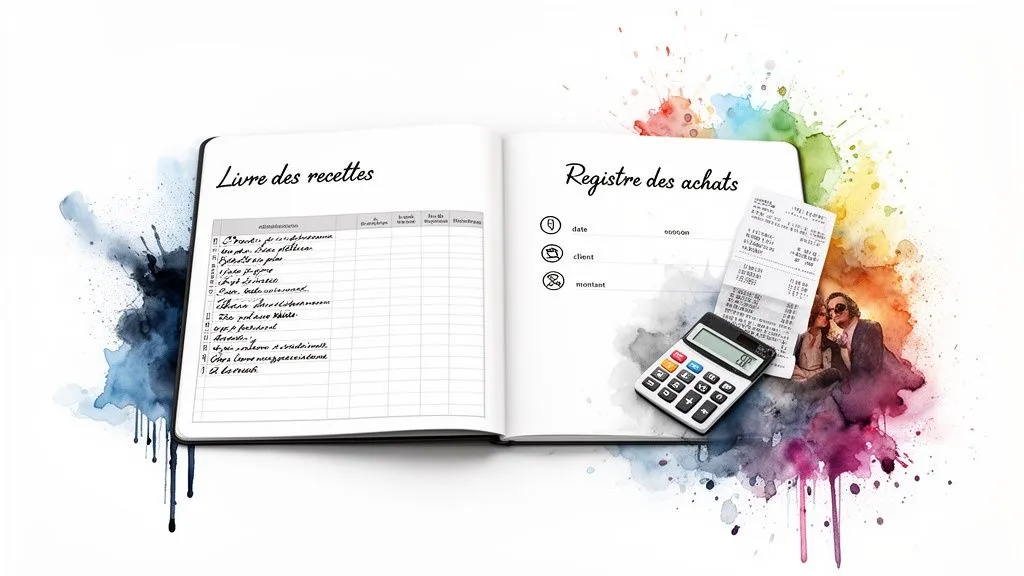
At the heart of micro-entrepreneur accounting are two key documents: the receipts book and, in some cases, the purchases register. Think of them as your business’s logbook. They’re not just there for administrative purposes; they’re a faithful reflection of your financial health and your best allies for steering your business day to day.
The secret is regularity. By recording everything as you go, what might seem like a chore becomes a simple habit that takes a few minutes. Trust me, this discipline will spare you enormous stress and hours of catching up right before you have to file your URSSAF declaration.
The receipts book: your financial logbook, mandatory for everyone
Whatever your trade, the receipts book is absolutely non-negotiable. It’s the basic document that tracks, in chronological order, every sum you receive. It’s irrefutable proof of your revenue.
For it to be valid in the eyes of the authorities, each entry must be precise. A single line per payment is enough, as long as it contains everything required.
Here’s the information you should never forget:
- The date of receipt: The exact day the money arrived in your account.
- The invoice reference: The unique number of the corresponding invoice.
- The client’s name: Who paid you? An individual or a company.
- The nature of the service: A short description of what you sold or did.
- The amount received: The exact sum you received.
- The payment method: Bank transfer, cheque, cash, card…
Concrete example for a web developer:
- Date: 15/07/2024
- Invoice ref.: FACT2024-032
- Client: SARL Dupont
- Nature: Creation of a showcase website
- Amount: €1,200
- Method: Bank transfer
This rigorous tracking isn’t just a legal obligation. It’s also a great tool for seeing where your money comes from and who your best clients are.
The purchases register: a valuable tool (and sometimes mandatory)
A second document is added to the list if your activity involves selling goods, supplies, food (eat-in or takeaway), or accommodation services. This is the purchases register. For most service providers (consultants, writers, coaches…), it isn’t necessary.
This register is simply the chronological list of all expenses incurred specifically for the needs of your business. It’s essential for getting a clear view of your costs and, above all, for calculating your real margins.
Each expense must be detailed carefully:
- The date of the purchase and its amount.
- The supplier’s name.
- The nature of the purchase (e.g. stock of raw materials, small equipment).
- The payment method you used.
- The reference of the supporting document (your supplier’s invoice, a receipt).
Concrete example for an online jewellery creator:
- Date: 10/07/2024
- Document ref.: FACT-FOURN-987
- Supplier: Perles & Co
- Nature: Purchase of beads and silver findings
- Amount: €350
- Method: Bank card
Structure of the receipts book and the purchases register
To help you visualize how to organize this information, here’s a summary table. This is the basic structure you can use, whether on a notebook, a spreadsheet, or accounting software.
| Information | Receipts book (mandatory for everyone) | Purchases register (mandatory for certain activities) |
|---|---|---|
| Date | Date of receipt | Date the expense was paid |
| Document reference | Client invoice number | Supplier invoice number, receipt |
| Third-party identity | Client’s name | Supplier’s name |
| Nature | Description of the sale or service | Description of the purchase |
| Amount | Amount received including VAT | Amount of the expense including VAT |
| Payment method | Bank transfer, cheque, cash… | Bank transfer, card, cheque, cash… |
Keeping this clear structure in mind ensures you don’t forget anything and stay perfectly compliant in the event of an audit.
The micro-entrepreneur regime is designed to be simple, but “simple” doesn’t mean “without rules.” Keeping these registers is a requirement to take very seriously, just like declaring your revenue. Failing to do so exposes you to penalties. To dig deeper into the topic, the official entreprendre.service-public.fr website is a mine of reliable information.
Ultimately, well-kept registers are your best protection. They prove your good faith and the seriousness of your management, leaving your mind free to focus on what really matters: growing your business.
Issuing invoices by the book (and getting ready for the electronic revolution)
An invoice isn’t just a piece of paper to claim what’s owed to you. Think of it instead as the business card of your professionalism. It’s the document that seals a transaction and, above all, an accounting record that must comply with very precise rules. A single missing mention, a small error, and your credibility takes a hit, not to mention the risk of financial penalties in the event of an audit.
Think of every invoice as concrete proof of your professionalism. For your clients, it’s a mark of trust. For the tax authorities, it’s the justification of your income. In short, taking the time to create flawless invoices is never a waste of time, but a real investment in the health of your business.
The checklist for a perfect invoice
To make sure you don’t forget anything, here’s the list of information that absolutely must appear on every one of your invoices. The trick? Use invoicing software like Bizyness, which automatically includes all these legal mentions. That’s peace of mind guaranteed.
- Your full identity: First name, last name, and the address of your micro-entreprise.
- Your SIREN number: This is your business’s unique registration number.
- The mention “EI” or “Entrepreneur Individuel”: Mandatory, to be placed just before or after your name.
- Your client’s identity: Their name and address. If it’s a professional, add their company name and registered office address.
- The invoice number: It must be unique and follow a chronological sequence with no gaps (for example: F2024-001, F2024-002, etc.).
- The invoice issue date.
- The date of the sale or the end of the service.
- The details of the service or product: Be precise about the description, quantity, and unit price excluding tax.
- The total amount due.
- The VAT mention: If you’re under the VAT exemption scheme, you must write: “TVA non applicable, art. 293 B du CGI”.
Watch out, a non-compliant invoice can cost you dearly. The fine is €15 per missing or incorrect mention, capped at a quarter of the invoice’s total amount. On a €1,000 invoice, a series of omissions could therefore cost you up to €250.
Get ready: electronic invoicing is coming
Beyond the current rules, a small revolution is on the way for all entrepreneurs, including micro-entrepreneurs. Electronic invoicing is going to become the standard for all business-to-business (B2B) transactions. And no, it will no longer be a matter of simply sending a PDF by email. You’ll need to go through certified platforms to issue, send, and receive invoices in a standardized digital format.
The goal of this reform is threefold: simplify VAT filings, fight fraud, and modernize the economy. For you, it’s a great opportunity to automate part of your administrative management and secure your business exchanges.
The timeline is already set. There will be an obligation to receive electronic invoices starting 1 September 2026, followed by an obligation to issue them from 1 September 2027. In concrete terms, this means you’ll need to be equipped with a compatible invoicing solution. Moreover, studies conducted by platforms like Bizyness show that this transition can save micro-entrepreneurs 20 to 40% of time on invoice management.
Don’t wait until the last minute. By equipping yourself now with the right tool, you turn a future constraint into an immediate advantage. To fully understand what lies ahead, dive into our complete guide on electronic invoicing for sole traders and approach this change with peace of mind.
Navigating VAT thresholds without unpleasant surprises
Managing VAT is often the first major turning point in the life of a micro-entreprise. At the start, everything is simple thanks to the VAT exemption scheme (franchise en base). Concretely, this means you don’t charge VAT to your clients. A great advantage for offering attractive rates and getting started without drowning in paperwork.
But be careful, this tax gift isn’t forever. It’s directly tied to your revenue, and the tax authorities have set very clear thresholds. Keeping an eye on these thresholds is therefore one of the most critical micro-entrepreneur accounting obligations. It’s the key to steering your growth calmly.
Understanding the famous VAT exemption thresholds
To get your bearings, you should know there isn’t just one, but two VAT thresholds to watch: the base threshold and the increased threshold, also called the tolerance threshold. Crossing either one is what tips you into the world of VAT.
- The base threshold: This is the “normal” annual revenue limit. As long as you stay below it, all is well, you remain exempt.
- The increased threshold: This is a higher limit. If you exceed it during the year, VAT applies immediately. It’s the red alert signal.
Exceeding the first threshold without touching the second is like a warning. The authorities grant you a reprieve, but tell you clearly: “Get ready, change is coming!” It’s the perfect time to start revisiting your pricing and organization.
The table below sums up the figures you should know by heart to avoid unpleasant surprises.
Summary of VAT thresholds for micro-entrepreneurs
| Threshold type | Services (BNC/BIC) | Sale of goods (BIC) | Consequence of exceeding it |
|---|---|---|---|
| Base threshold | €36,800 | €91,900 | Subject to VAT from 1 January of year N+2 if revenue is between the two thresholds for 2 consecutive years (N and N+1). |
| Increased threshold (tolerance) | €39,100 | €101,000 | Subject to VAT from the 1st day of the month it’s exceeded. Liability is immediate. |
This table is your compass. It lets you know exactly where you stand and what to expect if your business takes off faster than planned.
What actually happens when you exceed a threshold?
Leaving the VAT exemption isn’t a punishment. On the contrary, it’s proof that your business is doing well! However, this change has direct impacts on your cash flow and management, and it’s better to be prepared.
The timing for starting to charge VAT depends on which threshold you crossed. If your revenue falls between the base threshold and the increased threshold, you get a bit of a grace period. For example, a service provider who takes in €38,000 will need to start charging VAT from 1 January of the following year.
On the other hand, if you blow past the cap and exceed the increased threshold… the situation becomes far more urgent.
You become liable for VAT starting from the first day of the month it’s exceeded. This means all invoices issued from that date must include VAT. Yes, even those corresponding to work started before!
This shift to VAT transforms your daily life as an entrepreneur. You’ll need to:
- Promptly request an intra-community VAT number from your Business Tax Department (SIE).
- Update all your invoice templates to show the VAT rate and the amount collected.
- Choose a VAT regime (often the simplified regime at first) to file your returns.
The diagram below gives you an idea of another major deadline coming up: electronic invoicing.
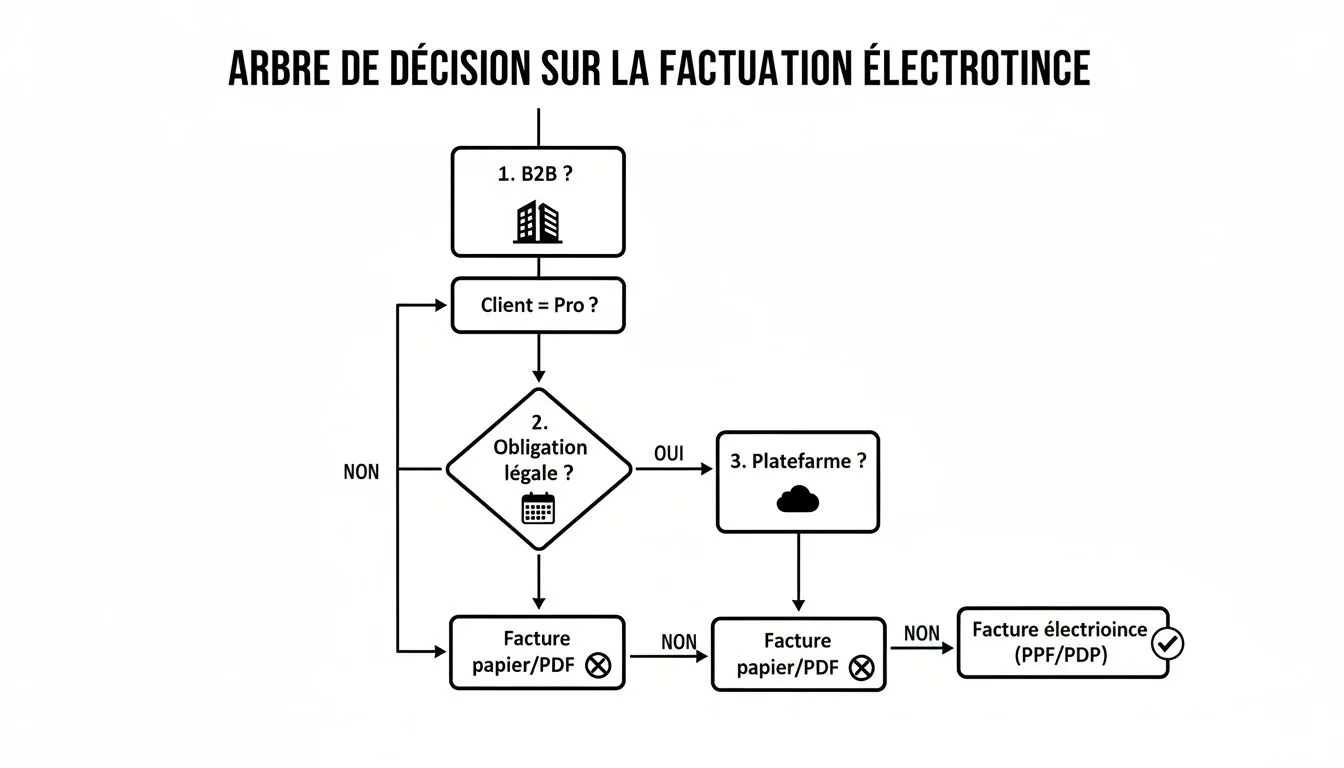
As with VAT, anticipation is your best ally for adapting without stress to these new rules of the game, which will eventually affect everyone. To learn more, feel free to check out the upcoming changes for sole traders in 2025.
Two concrete examples to understand it all
To make this more tangible, let’s walk through some scenarios.
Scenario 1: A marketing consultant (services) This consultant invoices around €3,000 a month. By the end of October, their cumulative revenue is €30,000. In November, they land a big contract and receive an invoice payment of €8,000, pushing their annual revenue to €38,000. They’ve exceeded the base threshold (€36,800) but remain below the increased threshold (€39,100). They’ll therefore finish the year exempt, but will have to charge VAT from the following 1 January.
Scenario 2: An online jewellery shop (sale of goods) The owner has a blowout Black Friday. On 28 November, an order pushes her annual revenue to €102,000. She has just exceeded the increased threshold of €101,000. The consequence is immediate: all invoices she has issued since 1 November must be corrected to add VAT. It’s a real headache if you’re not prepared.
Anticipating this shift is vital. Warn your clients that your prices are going to increase (by the amount of VAT), update your pending quotes, and, above all, equip yourself with a tool that saves you time. Software like Bizyness can automate VAT calculation and generate your filings, turning what looks like an administrative mountain into a simple step in your development.
Declaring your revenue and paying your contributions without error
Once you’ve kept your receipts book properly, it’s time to move to the next step: declaring your revenue. This is a crucial moment where all your tracking work pays off. Far from being a mere administrative chore, this declaration is the cornerstone of your relationship with URSSAF and the tax authorities.
It’s a regular appointment, whose frequency (monthly or quarterly) you chose when setting up your micro-entreprise. Whatever your choice, punctuality is a must. The good news is that everything is done online, on the URSSAF site dedicated to sole traders.
When and how to file your URSSAF declaration?
The process is designed to be simple, but it tolerates no imprecision. Every declaration is an essential step to stay compliant and avoid penalties that, believe me, can add up quickly.
Concretely, here’s how it works:
- Log in to your personal account on autoentrepreneur.urssaf.fr. Think of it as your official dashboard.
- Go to the “Déclarer et payer” section and choose the period you need to declare (the month or quarter that just ended).
- Enter the revenue actually received in the corresponding fields. This is where you need to be careful: it’s essential to clearly separate income from the sale of goods (BIC) from that of services (BIC or BNC), since the contribution rates are not the same at all.
- Validate, and that’s it! The amount of your social security contributions is then calculated automatically by the system.
A fundamental point to keep in mind: you declare the money you have actually received into your account during the period, not the amount you invoiced. If a client pays you in July for an invoice issued in June, that income must be declared for the July period (or the third quarter).
A golden rule never to forget: the declaration is mandatory even if your revenue is €0. A missed filing, even for zero revenue, will cost you a flat penalty of €58 per missing declaration.
Understanding how your contributions are calculated and the flat-rate income tax option
Once your revenue is declared, URSSAF applies a fixed contribution rate to determine what you owe. This percentage, which depends on the exact nature of your activity, covers your entire social protection (health, retirement, family benefits…).
To give you an idea:
- Sale of goods (BIC): About 12.3%.
- Commercial and craft services (BIC): About 21.2%.
- Other services and liberal professions (BNC): About 21.1%.
By default, income tax is withheld separately, once a year, after a flat-rate deduction applied to your revenue. But there’s a very interesting tax option to simplify things: the flat-rate income tax withholding (versement libératoire).
By choosing this option, you pay your income tax at the same time as your social security contributions, each month or each quarter. A small percentage is then added to your contribution rate:
- +1% for sales activities.
- +1.7% for BIC services.
- +2.2% for BNC activities.
This option (subject to income conditions) lets you spread your tax evenly across the year. It’s an excellent strategy for better managing your cash flow and saying goodbye to the big year-end tax adjustment.
Relying on a tool like Bizyness can change your life. The software doesn’t just track your receipts in real time; it can also prepare your declarations in advance. This way, you’re sure to never miss a deadline and to always declare the right amounts, in the right boxes. Peace of mind, plain and simple.
Archiving your documents to stay calm in the event of an audit
Invoices sent, receipts book up to date… you might think the work is done. But one last step, often overlooked yet essential, awaits: archiving. It’s not the most exciting task, that’s true, but think of it as your best anti-stress insurance in the event of an audit.
Don’t forget that the tax authorities and URSSAF can go back several years to check your declarations. Having well-organized archives is therefore not just good practice, it’s a legal obligation that shows the seriousness of your management and your good faith.
Understanding legal retention periods
The law sets very precise retention periods for your professional documents. These periods vary depending on the type of document, but to keep it simple and stay safe, aim for a retention period of 10 years for anything purely accounting-related.
- Client and supplier invoices: Keep them for 10 years after the close of the relevant accounting period.
- Receipts book and purchases register: Same rule, 10 years after the very last entry.
- Revenue declarations (URSSAF): Keep them for 3 years, in addition to the current year.
- Tax returns: The rule is the same, 3 years plus the current year.
Going digital is your best ally here. Secure, dematerialized archiving, with copies on a cloud service and an external hard drive, protects you against loss, theft, or a simple water damage incident. It’s infinitely more reliable and easier to manage than stacks of binders gathering dust.
What actually happens during a tax audit?
Forget the stereotypical image of a nerve-wracking tax audit. Most of the time, it’s a simple routine check. The inspector wants to make sure of one thing: that the revenue you declare actually matches the money you actually received.
To do this, they’ll ask you for supporting documents. Your ability to provide these documents quickly, without panicking, is key. Good organization turns this step into a mere formality. Here’s what you should have on hand:
- Your sales invoices, properly numbered and with no gaps in the sequence.
- Your receipts book, kept in chronological order.
- Your statements from the bank account dedicated to your business.
- Your revenue declarations.
In short, well-kept archives are the secret to a peaceful entrepreneurial life. To dig deeper into the topic, feel free to read our full article on accounting documents to keep, which will give you all the tips for flawless archiving.
The questions everyone asks about micro-entreprise accounting
When you’re getting started, questions about accounting are numerous and entirely legitimate. It often feels like you’re flying blind. Let’s clear things up by answering the most frequent questions, so you can steer your business with peace of mind.
Is a simple Excel file enough for my accounting?
On paper, yes. The law allows you to use a spreadsheet, whether Excel or Google Sheets, to keep your receipts book and purchases register. The key is to respect a golden rule: everything must be recorded in chronological order, with no tampering or modification of already-validated lines.
But let’s be honest, it’s a solution that quickly shows its limits. A spreadsheet will never check whether your invoices are compliant, won’t warn you if you’re getting close to the VAT thresholds, and won’t help you at all with the electronic invoicing that’s fast approaching. Not to mention the risk of human error, a simple typo can easily happen.
What happens if I forget to file a revenue declaration?
Ouch. Forgetting your URSSAF declaration, even if you received nothing, is never a good idea. The authorities won’t let it slide and will apply a flat penalty for each missed filing. Currently, it’s €58.
If the omission drags on and you don’t react, things get complicated. URSSAF will then estimate your social security contributions itself, on an increased basis that’s often much higher than reality. This automatic assessment can cost you a small fortune. Regularity is therefore your best ally.
A slip-up happens. But recurrence is where things really go wrong. A simple reminder in your phone or calendar can spare you frankly avoidable penalties and the stress that comes with them.
Is a dedicated bank account really mandatory?
Yes, it becomes a strict legal obligation as soon as your revenue exceeds €10,000 per year, two years in a row.
Below that threshold, it’s not mandatory, but it’s one of the best habits to adopt from day one. Why? Because a separate account changes everything. It draws a clear line between your business and personal finances, which greatly simplifies your tracking and makes a potential tax audit much smoother. It’s a healthy reflex for the health of your business.
Do I really need to hire an accountant?
Absolutely not. No law requires it for a micro-entrepreneur. The regime was designed so you can manage your accounting independently and simply.
However, their help can become very valuable in certain cases. For example, if your business grows and you move to VAT, if you combine several types of activities, or if you’re thinking about changing status to become a company. In those moments, a few hours of consulting with an expert can be an excellent investment to secure your choices and optimize your taxation.
Managing your accounting shouldn’t be an obstacle course. With a tool designed for independent professionals like Bizyness, you automate repetitive tasks, secure your filings, and, above all, save a huge amount of time to focus on what really matters: growing your business. See for yourself how to simplify your daily routine at https://www.bizyness.fr.
