

 Français
 The APE code for sole traders explained simply
Find out what the APE code is, how it's assigned, its real impact on your business, and how to change it. The essential guide.
As a sole trader (micro-entrepreneur) in France, you’ll quickly get acquainted with an acronym: the APE code, short for “Activité Principale Exercée” (Main Activity Carried Out). It’s an identifier assigned to you by INSEE when you set up your business. It might look like a simple administrative number, but its role is actually much more concrete and directly affects your day-to-day activity.
What does the APE code actually do for your micro-business?
Think of the APE code as the label that describes your trade to the administration. This code, made up of four digits and one letter, allows INSEE to classify every French business in order to produce statistics. Who does what? In which sector? That’s its primary purpose.
But in practice, this code is far from a minor detail. It acts a bit like a switch that routes your micro-business onto the right administrative and regulatory tracks. A wrong code can complicate things, which is why it’s important to understand it properly.
The very practical consequences of your APE code
This small code has real, tangible effects on how your business runs. It directly influences:
- Your Centre de Formalités des Entreprises (CFE): Your APE code determines whether you’re attached to the Chamber of Commerce and Industry (CCI) for a commercial activity, or to the Chamber of Trades and Crafts (CMA) if you’re a craftsperson.
- The applicable collective bargaining agreement: This is a crucial point if you ever plan to hire someone. The collective agreement that will apply to your employee depends directly on your APE code.
- Your professional insurance: To offer you a Professional Liability Insurance (RC Pro) contract, insurers base themselves on your APE code. It helps them assess the risks of your trade and therefore calculate your premium.
APE code or NAF code, what’s the difference?
You often hear both terms. In fact, they refer to the same thing. The NAF (French Classification of Activities) is the complete list of all activities. The APE code is simply the code from that list that has been specifically assigned to your business.
Fully grasping the importance of this code is a key step to starting off on the right foot. It governs part of your obligations, so it’s essential to make sure it truly matches your reality. By the way, don’t forget to look into the specific regulations for certain professional activities, which can be linked to this classification. Similarly, the nature of your activity has a direct impact on your accounting obligations as a sole trader, a point not to be overlooked to stay compliant.
Getting and finding your APE code easily
Contrary to popular belief, you don’t pick your APE code from a list when setting up your sole proprietorship. It’s a bit more subtle than that. The code is automatically assigned by INSEE once your business registration has been validated. Everything hinges on how you describe your main activity.
That’s where it all gets decided. A description that’s too vague or poorly worded can easily mislead INSEE, and you end up with a code that doesn’t really match what you do. To avoid future administrative headaches, precision is your best friend.
Let’s take a concrete example: writing “IT services” is too generic. Is it “consulting in computer systems and software” (code 62.02A) or “computer repair” (code 95.11Z)? The nuance changes everything, since it’s what guides INSEE toward the right code.
How INSEE determines your code
The mechanism is fairly simple: INSEE relies on the words you use. An agent analyzes the description of your main activity to find the closest match in the official NAF classification.
Your main activity is the one that brings in the most revenue or, failing that, the one that takes up the most of your time. If you wear several hats, it’s this dominant activity that will determine your sole trader APE code.
You can see how crucial it is to choose your words carefully when registering. If you’re about to launch your business, our complete guide on how to become a sole trader walks you step by step through this important process.
Where to find your APE code once registered
Once your micro-business is up and running and your APE code has been assigned, it becomes something you’ll often be asked for. Fortunately, it’s very easy to find.
You’ll systematically find it on these official documents:
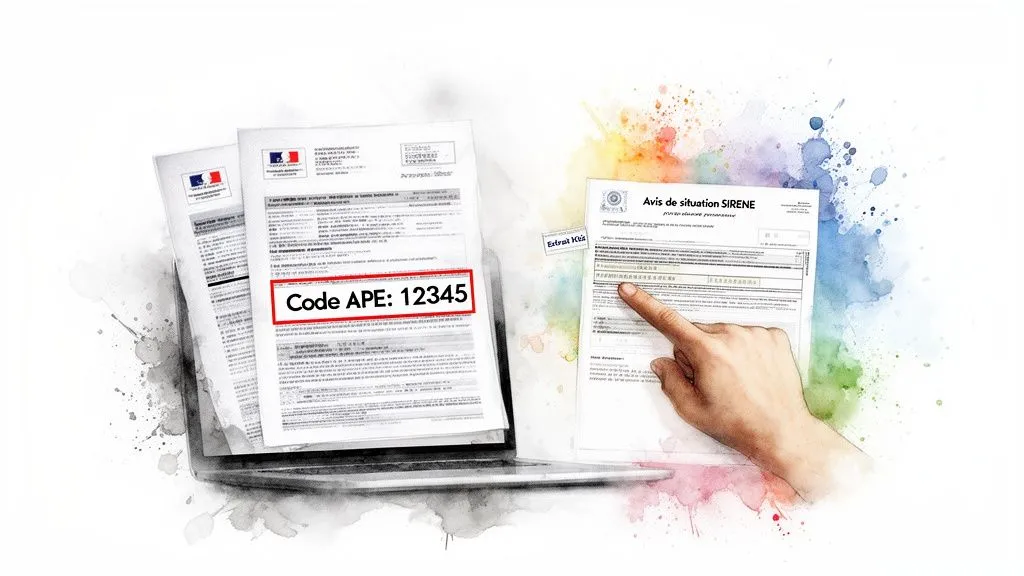
- On your SIRENE status notice: This is essentially your business’s ID card. You can download it for free from the INSEE website, and the APE code is clearly indicated there.
- On your Kbis extract: If you run a commercial activity, your Kbis (or K extract) states your APE code in black and white.
- On the D1 extract: This is the equivalent of the Kbis for craftspeople, issued by the Chamber of Trades and Crafts (CMA).
- On URSSAF letters: Take a look at your certificates or contribution notices; the APE code appears there most of the time.
Keep these documents handy or know where to find them online in just a few clicks. It’s a huge time-saver for all your business dealings.
The real-world impact of your APE code
This small code might seem like just another administrative detail. Yet it has very real, direct consequences on how you run your sole proprietorship day to day. Think of it as a switch: it shapes your obligations, your rights, and even some of your opportunities.
Far more than just a number for INSEE statistics, the APE code shapes the legal and regulatory framework you’ll operate within. Understanding its role is therefore essential from the start. It tells the administration whether you’re a trader, a craftsperson, or a professional in a liberal profession, and that distinction is far from trivial.
Your affiliated organization
The first very concrete consequence of your APE code is that it determines your Centre de Formalités des Entreprises (CFE). And believe me, it’s not just a matter of a logo on a letter.
- Commercial activities? You’ll be attached to the Chamber of Commerce and Industry (CCI).
- Craft activities? Your main point of contact will be the Chamber of Trades and Crafts (CMA).
- Liberal professions? You’ll fall directly under URSSAF.
Why does this matter? Because the support available, the training programs, and even certain parafiscal taxes differ from one organization to another.
Calculating your social security contributions
Here’s a point that directly affects your wallet. The nature of your activity, and therefore your APE code, has a direct influence on your social security contribution rate.
The simplified micro-social regime makes many things easier, but it doesn’t treat everyone the same. There are distinctly different withholding rates depending on whether you sell goods (commercial activity) or provide services (liberal or craft activity). An incorrectly assigned APE code could therefore make you pay more contributions than necessary, or vice versa, which would create problems down the line.
For more clarity, I recommend taking a look at our complete guide on calculating charges as a sole trader, which breaks it all down.
Access to grants and professional insurance
Your sole trader APE code can also be a real gateway… or a closed door. Many public grants, subsidies, or even tenders are reserved for specific business sectors, identified by their code. Having the right code is therefore crucial so you don’t miss out on financial support.
It’s the same story with insurance. To set the price of your Professional Liability Insurance (RC Pro), the insurer largely relies on your APE code to assess the risks of your trade. An inaccurate code can drive up the premium or, worse, leave you with inadequate coverage the day you really need it.
Having the right code isn’t a minor detail — it’s an essential condition for ensuring your business’s compliance and optimizing its day-to-day management.
It’s worth remembering that this APE code (also called the NAF code) is the cornerstone of your administrative identity. Issued by INSEE, this code made up of four digits and one letter primarily serves to classify your main activity for statistical purposes. To go further on this topic, feel free to read the detailed explanations about the APE code on Portail Auto-Entrepreneur.
Some common APE codes for sole traders
The APE code can seem a bit abstract at first glance. Yet it’s what puts an official name on your trade. To make it more tangible, let’s look at some concrete examples in the sectors most popular with sole traders.
Whether you’re a consultant, a developer, an online seller, or a craftsperson, a specific code awaits you. Knowing these examples will help you accurately describe your activity when you launch, and thus get the right code from INSEE on the first try.
The star APE codes in services and consulting
The services sector is undoubtedly the favorite playground of independent workers. It’s home to a wide range of intellectual and consulting trades, often carried out from a simple computer.
Here are the most common ones:
- 62.01Z - Computer programming: The go-to code for software developers, mobile app creators, and experts who build custom websites.
- 70.22Z - Business and other management consultancy: This is something of a “Swiss army knife” code for consultants. It covers consulting in strategy, marketing, management, or human resources.
- 74.10Z - Specialized design activities: The APE code for creatives! It covers graphic designers, web designers, and all designers who craft visual identities or interfaces.
These trades are at the heart of the digital economy. To give you an idea, digital services jumped 18% in 2024, and the average monthly revenue of a sole trader in this field reaches €3,850. If you’re interested in the topic, you can take a look at this comprehensive analysis of entrepreneurship in France.
APE codes for retail and e-commerce
Selling products, whether online or at a market, is another major path chosen by micro-entrepreneurs. Here, the APE code will mostly depend on how you sell.
Some typical examples:
- 47.91A - Mail order and internet retail via general catalogue: This is the classic code for an e-commerce store that sells a bit of everything, without a clear specialization.
- 47.91B - Mail order and internet retail via specialized catalogue: If your store focuses on a niche (clothing, handmade jewelry, organic cosmetics, etc.), then this is the right code.
- 47.19B - Other retail sale in non-specialized stores: This code is perfect if you sell at markets, in pop-up stores, or at trade fairs.
How do you choose between “general” and “specialized”? It’s simple. If a single product category accounts for more than 50% of your revenue, INSEE considers your activity specialized.
To get a better sense of the diversity of trades hiding behind these codes, take a look at some concrete examples of service provision. It will help you better define your own offering.
To sum up and give you an overview, here’s a selection of APE codes commonly found among sole traders.
Common APE codes for sole trader activities
This table presents a selection of frequent APE codes for sole traders in the services, retail, and craft sectors, with examples of trades for each code.
| APE code | Activity title | Examples of trades concerned |
|---|---|---|
| 62.01Z | Computer programming | Web developer, mobile app creator |
| 70.22Z | Business and other management consultancy | Marketing consultant, strategy consultant, business coach |
| 74.10Z | Specialized design activities | Graphic designer, web designer, illustrator |
| 85.59A | Adult continuing education | Independent trainer, professional coach |
| 96.02B | Beauty treatment | Mobile beautician, nail technician |
| 47.91A | Mail order and internet retail via general catalogue | Generalist e-tailer, dropshipping |
| 47.91B | Mail order and internet retail via specialized catalogue | Online jewelry seller, niche clothing store |
| 43.32A | Wood and PVC joinery work | Carpenter, window fitter |
| 96.09Z | Other personal service activities n.e.c. | Pet-sitter, home organiser, life coach |
This list is of course not exhaustive, but it gives a good idea of the most commonly assigned codes and can serve as a starting point for identifying the one that best matches your project.
Changing your APE code in case of an error or a change in activity
Life as a sole trader is rarely a smooth ride. Your activity evolves, diversifies… or sometimes the administration simply got it wrong from the start. If the APE code you were assigned no longer matches your day-to-day activity at all, know that it’s not only possible but essential to have it corrected.
Why does it matter so much? An incorrect APE code can quickly become a headache: you could end up attached to the wrong Centre de Formalités des Entreprises (CFE), take out unsuitable professional insurance, or even have a collective bargaining agreement applied that has nothing to do with your sector.
Fortunately, there are solutions. The process depends on your situation: is it simply an error by INSEE at setup, or has your activity changed direction?
Correcting an INSEE assignment error
You open your mail, excited to receive your SIRET number, and then… surprise! The APE code doesn’t match what you declared at all. This happens more often than you’d think. A slightly vague activity description on the registration form, and INSEE’s interpretation can end up off the mark.
No need to panic. In this case, you need to go straight to the source: INSEE. You must contact the regional office responsible for your department to request a correction.
The request is made via a specific form, sent by email or post. The most important part of your file will be your justification. Be convincing:
- Describe your main activity in simple terms with concrete examples of what you sell or the services you provide.
- Provide evidence: a copy of an invoice or quote, your business brochure, a printout of your website… anything that can clearly prove the nature of your work.
The goal is to show INSEE that there’s been a misunderstanding and to steer them toward the right code.
Declaring a change in main activity
This is the classic scenario of the sole trader who reinvents themselves. You may have started a small e-commerce activity, but over the months, consulting has taken over and now generates the bulk of your revenue.
Your APE code should always reflect the activity that earns you the most money. If your main activity changes, your APE code should follow.
Here, the logic is different. It’s no longer about an administrative error, but about your own project evolving. The change must therefore go through an official channel.
Everything is now done on the Guichet unique des formalités d’entreprises (the single business formalities portal). You’ll need to fill out an “activity change” declaration there. This simple process updates your file with all the relevant organizations at once (INSEE, URSSAF, tax authorities, etc.).
This simple decision tree illustrates how the nature of your activity is the first thing the administration looks at to classify you.
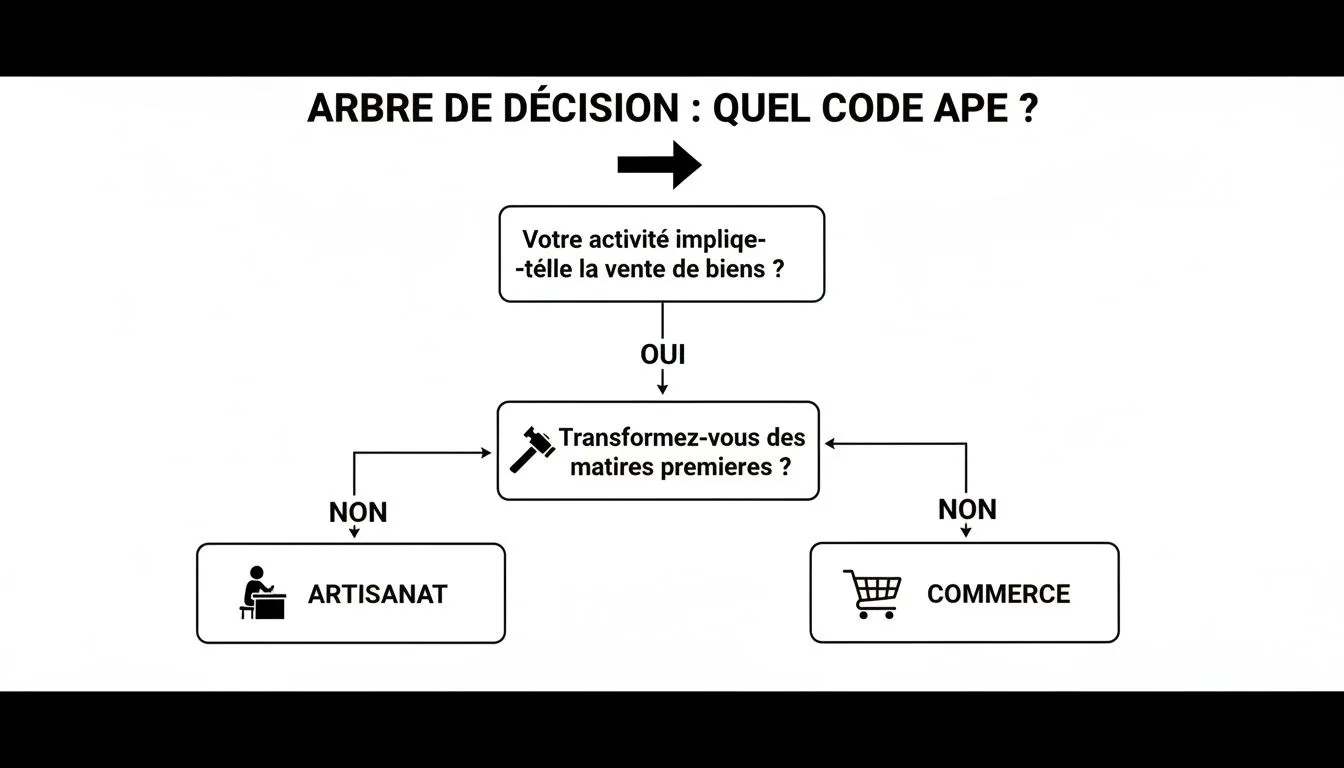
It’s clear that the choice between services, trade, or craft is the starting point for obtaining the right APE code.
Whether you’re correcting a mistake or acting on a new direction, keeping your APE code up to date is simply common sense. It’s a small administrative effort that guarantees you stay compliant and gives you much greater peace of mind going forward.
The big APE code overhaul planned for 2025
The world of work is evolving at breakneck speed, and the way professional activities are classified has to keep pace. That’s why a major overhaul of the French activity classification system (the well-known NAF) is in the pipeline for 2025.
This update, called NAF 2025, aims to better reflect today’s economic reality. Think of all the new digital trades, professions linked to the ecological transition, or services that didn’t exist ten years ago. It’s time to make room for them! It’s therefore very likely that your sole trader APE code will be automatically updated to reflect this new map of trades.
The idea is also to speak the same language as our neighbors. This harmonization at the European and global level will make it easier to compare economic statistics from one country to another.
How will the transition to NAF 2025 actually happen?
No need to panic, you won’t have to do anything on your end. The administration will handle everything behind the scenes, “translating” your current APE code into the new one that best matches your activity.
The key thing is to know this change is coming. That way, there’ll be no unpleasant surprise if you see a new APE code appear on your official documents in the coming months. You’ll know exactly why, and you’ll better understand any INSEE letters on the subject.
The rollout will begin in January 2026 with the gradual introduction of the new classification. That year will serve as a transition period, during which the old and new systems will coexist peacefully. The final switchover is planned for 2027.
To dig deeper into the topic, feel free to read the details of this change for sole traders on Capital.fr.
The APE code is a bit of administrative jargon that can quickly give you a headache. To spare you the aspirin, we’ve gathered the questions that come up most often among sole traders.
Can you have several APE codes for a single sole proprietorship?
The answer is simple and direct: no. One micro-business = one single APE code. This code is always tied to your main activity, the one that brings in the most money, plain and simple.
Does my APE code stop me from doing anything else?
Absolutely not, thankfully! Your APE code doesn’t box you in. You’re fully entitled to carry out and invoice work that falls a bit outside that framework.
The one golden rule? The activity tied to your APE code must remain the one that generates most of your revenue.
Let’s take a concrete example: a web developer with code 62.01Z can happily invoice a digital strategy consulting assignment (which would fall more under code 70.22Z). As long as web development remains their main source of income, everything’s fine.
What are the real risks if my APE code is incorrect?
Having an APE code that doesn’t match the reality of your trade can quickly become a source of problems. Think of complications with your professional insurance possibly not covering you properly, issues with regulations specific to your sector, or even being attached to the wrong Centre de Formalités des Entreprises. It’s best to make sure everything is in order.
Does my APE code affect what I pay in taxes and contributions?
Yes, but indirectly. It’s the sole trader APE code that determines the broad category of your activity: commercial, craft, or liberal profession.
And it’s this classification that then sets the revenue thresholds you must not exceed and your social security contribution rates. Ultimately, a simple code has a real influence on your wallet.
Don’t let paperwork slow you down any longer. With Bizyness, invoicing and bookkeeping become child’s play, leaving you more time for what really matters. Discover how to simplify your daily life on Bizyness.fr.
