

 Français
The guide to balance sheet accounts for e-commerce
Master the balance sheet accounts of your e-commerce business. A complete guide to assets, liabilities and accounting automation to secure your growth.

Balance sheet accounts are far more than a simple list of numbers. They tell the story of your business at a given moment, much like a financial health check. On one side, you have assets, meaning everything your e-commerce business owns. On the other, liabilities, which represent everything it owes. The balance between the two reveals the true value of your business.
Why are balance sheet accounts so important for your e-commerce business?

For an online seller, juggling balance sheet accounts isn’t just an administrative constraint. It’s a genuine management lever. Whether you sell on Shopify, Amazon, or offer digital products, every decision directly impacts this financial balance: a stock purchase, an ad spend, the choice of new software… everything has a consequence.
In today’s economic climate, mastering this has become a matter of survival. The numbers speak for themselves: France reached a historic peak in business failures in 2025, with 68,574 insolvency proceedings opened, up 3.5% from 2024. These statistics, detailed in the news on business failures in France for 2025, show just how essential a solid balance sheet is, especially for an online seller.
Driving growth and anticipating tough times
In concrete terms, regularly analyzing your balance sheet gives you the keys to:
- Secure your growth: You know exactly what resources you have available to buy new products or launch an ambitious marketing campaign.
- Anticipate cash flow problems: By keeping an eye on the balance between your debts (suppliers, taxes) and your receivables (payments pending from marketplaces), you avoid unpleasant surprises.
- Optimize your financing: A well-kept balance sheet is your best ally for convincing a bank to grant you a loan or for reassuring investors.
The table below summarizes the key elements of the balance sheet for an online seller.
Overview of e-commerce balance sheet components
This table summarizes the two pillars of the balance sheet for a quick understanding of their role and the components specific to e-commerce.
| Category | Simplified definition | Concrete examples for an online seller |
|---|---|---|
| Assets | What the business owns | Product inventory, bank account balance, accounts receivable (money owed by Stripe, PayPal…), equipment (computers, printers). |
| Liabilities | What the business owes | Trade payables (invoices to pay), bank loans, share capital, tax and social liabilities (VAT to remit, contributions). |
Keeping this structure in mind is fundamental. The balance sheet is the common language you share with your accountant. The better you understand it, the more relevant your conversations will be and the more informed your decisions. To go further on this topic, feel free to check out our complete guide on how to analyze a balance sheet.
Watch out: manually entering this data is a frequent source of error that can distort your view and weaken your balance sheet. Automation tools like Bizyness are designed to eliminate this risk by translating every sale into an accurate, reliable accounting entry, directly from the source.
Breaking down the assets of an online seller’s balance sheet

To properly understand the financial health of your e-commerce business, you first need to look at what it owns. That’s the role of the assets side of the balance sheet: it lists all the economic resources you control and that are expected to generate money for you in the future. For an online seller, the nature of these assets is quite specific, and properly valuing them is essential to get an accurate picture of your business’s worth.
In accounting, balance sheet accounts on the asset side are split into two main groups: fixed assets (your long-term holdings) and current assets (your short-term resources). Knowing how to identify and track these two categories is truly the cornerstone of good management.
Fixed assets: your foundation of value
Fixed assets are everything you’ve purchased to keep your business running over the long term, meaning for more than a year. An online seller won’t necessarily have the same fixed assets as a physical store, but they’re no less important.
Here are the most common items for an e-commerce business:
- Intangible fixed assets: These are all your assets that have no physical existence. Think, for example, of the development cost of your website if it was custom-built. It can also be the purchase of specific software, expensive plugins for Shopify or WooCommerce, or even goodwill if you bought an already-running store.
- Tangible fixed assets: Here, we’re talking about very concrete assets. This includes your IT equipment (computers, servers), your storage equipment if you handle logistics yourself (shelving, packing machines), or office furniture.
- Financial fixed assets: This is a bit less common when starting out. It mainly concerns security deposits or guarantees you pay, for example to rent a warehouse.
Be careful: the value of these assets decreases over time. This is called depreciation, an expense that accounts for their wear and tear and that will have a direct impact on your income statement.
Current assets: the heart of your daily activity
If fixed assets are the foundation, current assets are the engine of your e-commerce business. It includes all the resources that will convert into cash over the course of your operating cycle, generally in less than a year. Good management of these assets is absolutely vital for your cash flow.
Rigorous tracking of current assets is non-negotiable. A poor inventory valuation or overlooked receivables can quickly lead you to make decisions based on incorrect figures, and put your liquidity at risk.
For an online seller, the three pillars of current assets are:
- Inventory (Account 3): This is often one of the most significant items on your balance sheet. It represents the value of all the products you own and that are waiting to be sold. This includes both merchandise at your own premises and stock held by a logistics provider like Amazon FBA.
- Accounts receivable (Account 411): Here’s an e-commerce specificity! This account represents money your customers have paid, but that payment platforms like Stripe or PayPal, or marketplaces (Amazon, Etsy), haven’t yet transferred to your bank account.
- Cash (Account 512): This is simply the money that’s actually available, “in cash,” in your business bank accounts. It’s crucial never to confuse cash with receivables.
Understanding this nuance changes everything. When a customer buys from your Amazon store, it increases your receivables, but not your cash. It’s only when Amazon makes its transfer that this receivable turns into real cash, thereby changing the structure of your balance sheet accounts.
Analyzing the liabilities side of the e-commerce balance sheet

If assets show you what your e-commerce business owns, liabilities tell a different story: that of the origin of the funds financing it all. It’s essentially the source of your financial firepower.
Liabilities bring together all the resources of the business, whether they come from you (equity) or from third parties (debts). Understanding this balance is absolutely fundamental, as it reveals your store’s financial structure and, above all, your future commitments.
Equity, the pillar of your financing
Equity (account class 1) is the true financial foundation of your business. It represents the book value of your company and serves as the main guarantee for your partners and creditors.
Concretely, it includes several key elements:
- Share capital (Account 101): This is the starting stake. It consists of the contributions in cash or in kind that you and your partners injected to get things going.
- Reserves (Account 106): These are the profits from past fiscal years that you wisely decided to keep in the business to fund its future growth, rather than distributing them.
- Net income for the year (Account 12): This is the current year’s score. A profit boosts your equity, while a loss, logically, weakens it.
Solid equity is a very positive signal for banks and investors. It’s proof that your e-commerce business has the capacity to self-finance, at least in part, and that it doesn’t rely solely on debt.
Debts, obligations to keep under control
Debts are everything your business owes to outside parties. For an online seller, the list can quickly grow, and constant monitoring is necessary to avoid jeopardizing cash flow.
Here’s an overview of the most common debts in an online seller’s balance sheet accounts:
- Financial debts (Account 164): These are typically bank loans, often taken out to finance a large stock purchase or a significant technology investment.
- Trade payables (Account 401): Simply the invoices from your suppliers (products, packaging, services…) that you haven’t yet paid.
- Tax and social liabilities (Accounts 44 and 43): This is an extremely sensitive item in e-commerce. This includes VAT collected on your sales to be remitted to the state, as well as social contributions to be paid.
- Other operating liabilities: This catch-all category includes deposits from your customers on pre-orders, or commissions you owe to marketplaces like Amazon or payment platforms like Stripe.
Managing tax debts, and VAT in particular, is a major challenge. With international sales and the complexity of the OSS/IOSS one-stop shops, things can quickly become a real headache. A simple error in rate or declaration can create a surprise tax debt, and often a substantial one.
Studies on French business balance sheets for 2025 warn of growing pressure on liquidity, with payment terms tending to lengthen. In such a context, poor management of international VAT can quickly distort the reading of your balance sheet’s liabilities and threaten the stability of your business. To learn more, feel free to consult these perspectives on business failures.
Tools like Bizyness help avoid exactly this kind of pitfall. The software is able to identify the destination country of each order to automatically apply the correct VAT rate. This automation eliminates unpleasant surprises and guarantees the reliability of your balance sheet accounts.
E-commerce accounting entries that impact your balance sheet
Every action on your store, from the smallest sale to a stock purchase, translates behind the scenes into a set of accounting entries. These entries change the balance of your balance sheet accounts. Grasping this mechanism is fundamental to connecting your daily operations to the true financial health of your business.
Let’s get practical. Let’s see together how e-commerce financial flows actually materialize in accounting. Through numbered examples, we’ll break down the impact of each transaction on your balance sheet’s assets and liabilities.
Scenario 1: Sale on Shopify and Stripe payment
Let’s take a very classic case: a sale of €120 including tax (including €20 of VAT) on your Shopify site, with payment collected via Stripe. For its service, Stripe charges a commission of €2. This single transaction, seemingly simple, will generate several accounting movements.
In reality, this transaction has several immediate consequences:
- A receivable appears: Your business now has a receivable of €118 (€120 - €2) from Stripe. This is money owed to you but not yet in your account.
- A tax liability arises: You owe €20 of VAT to the state.
- Your revenue increases: The income statement records an increase of €100 excluding tax.
- An expense is recorded: The €2 in Stripe fees is an expense for your business (also impacting the income statement).
The impact on the balance sheet is therefore direct: your assets increase (with the Stripe receivable) as do your liabilities (with the VAT debt). To get these entries right, you need to master their logic well. If this topic interests you, this complete guide to posting entries in accounting is an excellent resource to deepen these concepts.
Scenario 2: Bulk payout from Amazon
Another frequent situation: Amazon pays you €5,000 into your bank account. This overall amount actually corresponds to a multitude of sales, once commissions and various marketplace fees have been deducted. The resulting entry is simple, but it symbolizes a key transformation for your cash flow.
In accounting terms, here’s what happens:
- Debit the
512 Bankaccount by €5,000. - Credit the
411 Accounts Receivableaccount (or a sub-account dedicated to Amazon) by €5,000.
Your total assets don’t change, but their composition does. A receivable (the money Amazon owed you) has turned into cash (money directly available).
Scenario 3: Purchasing stock from a supplier
Let’s imagine you purchase €2,000 excluding tax of new merchandise. You pay your supplier immediately by bank transfer.
This transaction directly modifies two items in your current assets:
- Debit the
38 Purchases in stockaccount by €2,000 (this account will then be cleared in favor of the37 Merchandise inventoryaccount). - Credit the
512 Bankaccount by €2,000.
Again, the total value of assets stays the same. It’s their nature that has changed: cash has turned into inventory, another type of asset intended to be sold. Rigorous tracking of these constant movements between the different balance sheet accounts is crucial. For an overall view, feel free to check out our article on organizing your chart of accounts.
These few examples clearly illustrate the complexity and volume of entries an e-commerce business generates daily. The risk of manual error is therefore very high, especially in today’s economic climate.
Despite a record number of business creations, failures reached 68,564 cases, a figure that underscores the vital importance of impeccable balance sheet management. For sellers on Amazon FBA or Etsy, where international sales complicate VAT management, Bizyness automates the application of OSS/IOSS rules. For D2C brands in full growth, an automated balance sheet — covering expenses, VAT reports and the FEC — is no longer optional, but a necessity to ensure that every sale turns into a compliant, well-managed cash flow.
Common balance sheet mistakes in e-commerce and how to prevent them
Keeping your balance sheet accounts up to date is one thing; making sure they reflect the actual financial reality of your e-commerce business is another. In the heat of the moment, a few classic mistakes can quickly creep in and completely distort your view. These mistakes aren’t trivial: they can lead to poor decisions, attract the attention of the tax authorities and, ultimately, weaken your business.
The two most common pitfalls for an online seller concern asset valuation and proper accounting of liabilities. Think, for example, of a poor estimate of inventory value, which can artificially inflate the balance sheet and mask an unsold-stock problem. Another classic mistake is confusing money actually in your bank account with funds pending payout from marketplaces.
This simple diagram illustrates the journey of a sale, from the click on Shopify to its final impact on your balance sheet.
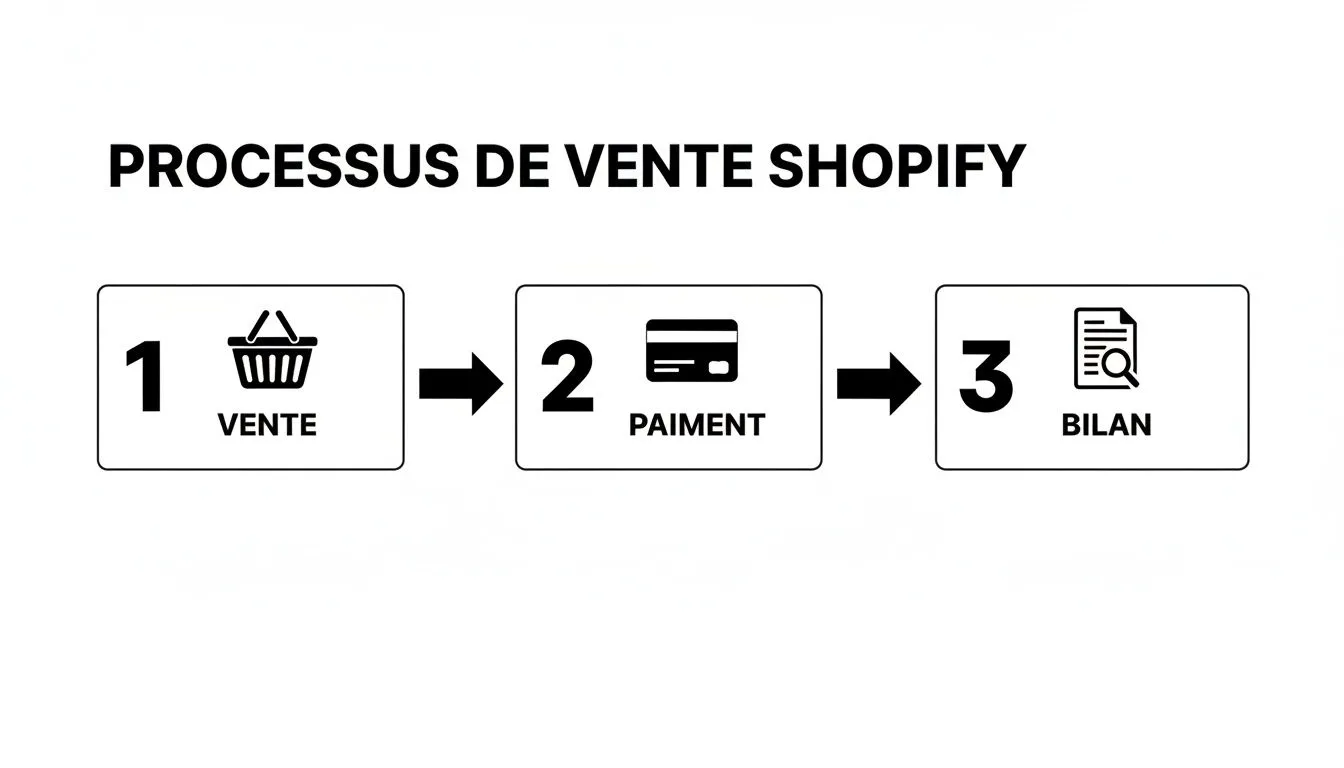
Each step in this flow is a potential source of errors, especially when it comes to correctly translating these financial movements into your balance sheet accounts.
Forgetting to provision for returns and disputes
In e-commerce, returns are part of the game. Not anticipating them by creating a dedicated provision is a beginner’s mistake that can be costly. Without this provision, your balance sheet shows a result and equity that are much more flattering than reality.
The problem arises when you actually have to refund your customers. This cash outflow then eats into cash you thought was available to pay your suppliers or invest. To avoid this cold shower, it’s essential to estimate an average return rate and record this probable liability on your balance sheet.
Underestimating the complexity of international VAT
Selling beyond your borders opens up new markets, but also a fiscal Pandora’s box: VAT. Between the different applicable rates and the rules of the OSS (One-Stop Shop) and IOSS (Import One-Stop Shop) one-stop shops, it’s very easy to get lost.
An error in the applied VAT rate isn’t just a simple risk of a tax audit. It’s above all an invisible debt that builds up with every sale and weighs down your liabilities without you even realizing it.
The day you have to settle the situation, the impact on your cash flow can be brutal.
Preventing balance sheet errors with automation
Accounting automation isn’t a gimmick — it’s real insurance against these mistakes. By connecting directly to your data sources (CMS, marketplaces, payment solutions), a tool like Bizyness makes the underlying information reliable.
The table below summarizes how automation addresses the most common mistakes.
| Common e-commerce mistake | Direct consequence for the business | Solution provided by automation (Bizyness) |
|---|---|---|
| Poor inventory valuation | Overvalued assets, distorted view of product profitability, poor restocking decisions. | Synchronization of purchase and sales flows for precise cost tracking and the most accurate inventory valuation. |
| Confusion between receivables and cash | Illusion of liquidity, risk of default on current expenses (suppliers, salaries). | Connection to payment platform APIs (Stripe, Amazon) to clearly distinguish funds received from funds in transit. |
| Missing provisions for returns | Overvalued equity and net income, unexpected cash flow shock during return waves. | Facilitates recording provision entries, allowing the impact of returns on cash flow to be smoothed. |
| International VAT errors (OSS/IOSS) | Risk of tax audit, buildup of hidden VAT debt, negative impact on margin. | Automatic identification of the destination country and application of the correct VAT rate for each sale, eliminating the risk. |
Ultimately, automation does much more than secure your figures. It transforms the management of your balance sheet accounts from an anxiety-inducing chore into a genuine dashboard for calmly steering your business’s growth.
Automating the management of your balance sheet accounts with Bizyness
For an online seller, managing balance sheet accounts can quickly become a headache. Fortunately, manual management, with its share of errors and stress, is no longer the only option. The idea is simple: directly connect your business operations to your accounting so that everything happens automatically, or almost.
This is precisely what Bizyness offers. The platform integrates with your everyday tools, whether that’s your Shopify store, your Amazon seller account, or your payment solutions like Stripe and PayPal. It’s this direct connection that changes the game when it comes to reliability.
From transaction to accounting entry, effortlessly
The process is both simple and remarkably effective. Every operation — a sale, a customer return, a commission payment — is captured at the source by Bizyness.
But the tool doesn’t just retrieve raw data. It analyzes it and automatically translates it into accounting entries, in compliance with the French General Chart of Accounts (Plan Comptable Général).
- Sales and receivables: An order on your site? The entry is immediately generated to record the revenue (class 7 accounts) and the customer receivable (account 411).
- Commissions: Fees charged by marketplaces are directly recorded as expenses (class 6 accounts). Your profitability is thus calculated as accurately as possible, with nothing overlooked.
- VAT: Bizyness handles the complexity of VAT, especially with the OSS/IOSS one-stop shops for international sales. It applies the correct rates and allocates amounts to the dedicated accounts (account 445).
The result is immediate. Your balance sheet accounts are updated in real time. You have a clear view of your assets (what you own, such as your receivables and cash) and your liabilities (what you owe, such as VAT or trade payables).
The Bizyness interface gives you a centralized overview to manage your business with more peace of mind.
This dashboard lets you track your financial flows and verify that every transaction is properly recorded where it should be.
Saving time and securing your compliance
The first obvious benefit is the time saved. It’s huge. No more endless manual entry and never-ending bank reconciliations. You get back precious hours to devote to growing your store.
But beyond the time saved, it’s the peace of mind that’s priceless. By eliminating human error, you secure your tax compliance. Your balance sheet becomes a reliable foundation for making the right strategic decisions.
Bizyness goes even further by generating an impeccable Fichier des Écritures Comptables (FEC, the French statutory accounting entries file) for you. This file is essential in the event of a tax audit and is directly usable by your accountant. To fully understand the stakes of this document, feel free to read our full article on the Fichier des Écritures Comptables (FEC).
Of course, alongside all-in-one solutions like Bizyness, other tools can help. An AI Excel assistant, for example, can save you time on data analysis if you’re still working with spreadsheets. However, to guarantee flawless accounting from A to Z, a natively integrated solution remains the safest and most robust approach.
Frequently asked questions about e-commerce balance sheets
When you’re starting out in e-commerce, the balance sheet can seem quite abstract. Yet it’s an essential management tool. To help you see things more clearly, here are the answers to the questions that come up most often.
What’s the difference between the balance sheet and the income statement?
This is THE basic question, and it’s crucial not to confuse the two. Their roles are quite distinct, even though both are essential to understanding the health of your business.
Think of it this way: the balance sheet is a snapshot of your store’s assets at a specific date. On one side, there’s everything you own (your assets), and on the other, everything you owe (your liabilities). It’s a status report at a given moment.
The income statement, on the other hand, is a movie. It traces activity over a given period, generally the year. It sets your revenue (turnover) against all your expenses (purchases, salaries, commissions, etc.) to determine whether, in the end, you generated a profit or a loss.
How should I account for funds pending on marketplaces (Amazon, Stripe)?
Here’s a major point of vigilance for any online seller. Money that platforms like Amazon or Stripe collect on your behalf isn’t yet in your bank account. You can’t use it yet.
In accounting terms, this is an accounts receivable (account 411). It’s money owed to you. Above all, don’t mix it up with your actual cash (account 512). It’s only when the marketplace makes the transfer that the transfer can be recorded: the receivable is cleared to record the arrival of cash in your bank account.
Should my inventory at Amazon FBA appear on my balance sheet?
Absolutely, and forgetting it is a common mistake. Even if your products are stored hundreds of miles away in an Amazon warehouse, they still belong to you. Legally, you’re the owner.
This stock is therefore part of your current assets. Its value must be recorded in a dedicated inventory account (account 37, for example). Omitting this stock or valuing it incorrectly completely distorts the value of your business as it appears on the balance sheet.
For this reason, an inventory count (physical or theoretical via platform reports) is mandatory at least once a year. This adjustment ensures that your balance sheet accounts reflect the actual value of the merchandise you hold.
How often should I analyze my balance sheet accounts?
For an e-commerce business, everything moves very fast. Flows are almost constant. Waiting for your accountant’s annual balance sheet to take the pulse of your business is far too late.
Monthly monitoring is really the bare minimum. This regularity lets you keep an eye on how your cash flow is evolving, see whether your accounts receivable aren’t ballooning, or whether your trade payables remain under control. It’s the key to making the right decisions and anticipating tough times, well before they become critical.
Don’t let accounting complexity hold back your growth any longer. With Bizyness, automate the management of your financial flows, from a sale on Shopify or Amazon to the generation of an accurate balance sheet. Discover how Bizyness can simplify your accounting today.
