

 Français
 Business Administrative Management: Simplify Your Processes with This Practical Guide
Discover concrete strategies to optimize your company's administrative management. Save time and reduce errors.

When we talk about business administrative management, we often think of paperwork, filings, everything that pulls us away from our core business. It’s a set of organizational, accounting and legal tasks, and yes, it can quickly become a burden. But in reality, it’s the nervous system of your company, the thing that guarantees its stability and growth.
Why mastering your administrative management is a matter of survival for a small business

For many entrepreneurs, admin work is a chore. The task we keep putting off because it takes us away from what matters most: developing a product, finding customers, innovating. Yet neglecting it is a bit like sailing blind through a storm. Chaotic administrative management almost always leads to crisis situations we unfortunately know all too well.
A simple delay in tracking unpaid invoices can quickly drain your cash flow. You end up juggling overdrafts, delaying your own payments and stressing at the end of every month. If this resonates with you, you’ll find practical advice in our guide on cash flow management.
The same goes for legal deadlines. A missed URSSAF filing, a VAT payment that slips through the cracks, and a penalty follows. These fines, small at first, add up and eat into an already tight budget, quietly weakening your business.
The concrete consequences of poor organization
The risks aren’t limited to the financial side. Sloppy client follow-up, quotes that drag on, or invoicing errors can seriously damage your reputation. Losing an important client because of a lack of organization is a far greater loss than a simple penalty.
The numbers confirm it. Cash flow difficulties, often the direct consequence of poor administrative management, are cited as the triggering factor in nearly 70 to 75% of insolvency proceedings opened since 2022. And the trend isn’t improving: with 67,613 proceedings recorded between September 2024 and August 2025, it’s becoming urgent to shore up your internal processes.
Rigorous administrative management isn’t a burden, it’s an investment. It turns a legal obligation into a competitive advantage that ensures the longevity and, above all, the peace of mind of your business.
Turning constraint into strategic advantage
Approaching your company’s administrative management in a structured way completely changes the game. No more being caught off guard by deadlines, you anticipate them. No more wasting time hunting for a document, you access it in a few clicks.
This proactive approach has very concrete benefits:
- Precious time freed up: By creating systems and automating what can be automated, you save hours every month. Hours you can reinvest where it really counts: your core business.
- Better financial visibility: Rigorous tracking means knowing where you stand in real time. It’s the basis for making informed decisions and running your business with peace of mind.
- Simply less stress: Knowing your obligations are up to date and your organization is under control is priceless.
In this guide, we’ll show you step by step how to lay solid foundations, define clear processes and choose the right tools to turn your administrative management into a real strength.
Before diving into tools and automation, let’s be clear: good administrative management first relies on healthy foundations. It’s a bit like building a house. If the foundations are shaky, everything else will eventually collapse, no matter how nice the paint job is.
The very first building block is choosing your legal structure.
Between a micro-entrepreneur (sole trader) and a SASU, for example, day-to-day administrative life has nothing in common. The micro-entrepreneur status is appealing for its simplicity, that’s true. But the SASU offers a clear separation between your personal assets and those of the company, which in turn requires much more rigorous accounting.
This initial choice isn’t trivial, it shapes everything that follows. In fact, the numbers speak for themselves: business creation is concentrated among sole proprietorships (38.26%) and SAS/SASU (33.71%). Each of these legal forms comes with its own set of obligations. To dig deeper into the topic, the barometer of business creation in France is a goldmine.
Setting up digital filing that actually makes sense
Once your status is set, the second foundation is organizing your documents. Gone are the days of overflowing binders and lost invoices. Go digital, but do it right. A simple Google Drive or OneDrive works perfectly to create a logical folder structure, accessible from anywhere.
The secret is adopting a file naming convention from the very start. That’s the guarantee you’ll never again spend ten minutes hunting for a crucial document.
- Client invoices:
YYYY-MM-DD_Invoice_ClientName_InvoiceNumber(e.g.: 2025-10-26_Invoice_ClientMartin_F2025-042) - Quotes:
YYYY-MM-DD_Quote_ClientName_QuoteNumber(e.g.: 2025-10-15_Quote_ClientMartin_D2025-038) - Receipts:
YYYY-MM-DD_Expense_Supplier_Nature(e.g.: 2025-10-21_Expense_OVH_WebHosting)
With this discipline, your storage space becomes a reliable database. Your accountant will thank you, and in the event of an audit, you’ll be at ease.
A clear filing system is the mirror of your business’s administrative health. A little rigor today means a lot less stress tomorrow.
Separating your finances and playing the anticipation card
The third pillar, often underestimated by those just starting out, is separating your finances. It’s non-negotiable. Open a bank account dedicated to your professional activity from day one. Mixing business and personal is the surest road to accounting chaos and trouble with the tax authorities.
Finally, the last foundation is anticipation. Take an hour to build a calendar of your administrative and tax deadlines. List all the important dates that apply to you:
- URSSAF filings and payments (monthly or quarterly)
- VAT return (if applicable)
- CFE payment (Cotisation Foncière des Entreprises, the French business property tax)
This calendar will not only help you smooth out your cash flow, but also avoid late penalties, which always sting. Of course, laying the groundwork isn’t limited to internal organization; you also need to comply with regulations. For example, make sure you know your legal obligations regarding your company’s legal notices.
With these four pillars in place — legal status, filing, business account, calendar — you build a solid working framework. Your administrative management then becomes an asset, ready to be optimized, rather than a source of anxiety.
Defining your administrative processes to gain efficiency
Having solid foundations is essential. But to really shift into a higher gear, you need to systematize repetitive tasks. That’s where the magic happens: by turning scattered actions into clear, well-honed processes, you turn your company’s administrative management into a well-oiled machine. The goal? Work smarter, not harder.
In practice, this means mapping out every recurring task and pairing it with a standard procedure. Who does what? When? How? With which tool? By answering these simple questions, you eliminate improvisation, drastically reduce the risk of errors and, above all, make your organization less dependent on a single person.
This diagram illustrates the logical flow of administrative pillars, from the legal framework to deadline management.
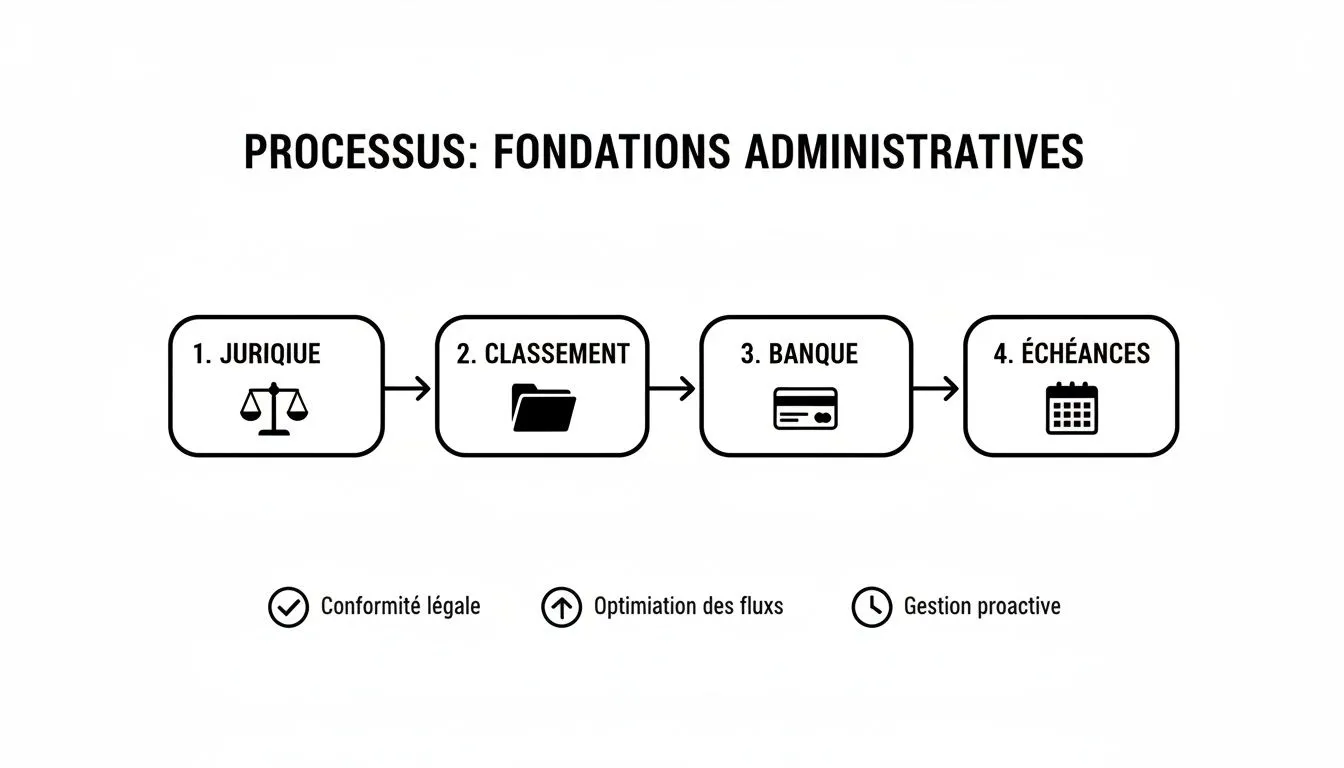
Each step builds on the previous one. It’s obvious, but without legal compliance and rigorous filing, bank tracking and meeting deadlines quickly become chaotic.
The invoicing process from A to Z
The invoicing cycle is the heart of your cash flow. A well-oiled process at this level simply isn’t negotiable. It’s not just about hitting “send invoice”, but mastering the entire sales lifecycle, from first contact to final payment.
To help you visualize this, here’s what a checklist for a monthly invoicing process might look like. It’s just an example, but it gives you a solid framework to build your own.
Example checklist for a monthly invoicing process
This table presents a sequential checklist for an effective invoicing process, from creating the invoice to tracking payment, to ensure healthy cash flow management.
| Step | Action to take | Suggested tool | Frequency / Deadline |
|---|---|---|---|
| Creation | Draw up the invoice from the approved quote or purchase order. | Invoicing software (Bizyness, etc.) | As soon as the service is confirmed |
| Verification | Check the legal notices, amounts, and client details. | Double-check by a colleague (if possible) | Before sending |
| Sending | Send the invoice to the client by email with a read receipt. | Email client / Invoicing platform | Same day it’s created |
| Tracking | Note the due date in a shared calendar or CRM. | Calendar / CRM / Management tool | Immediately after sending |
| Reminder 1 | Send a friendly reminder email 2 days before the due date. | Pre-written email template | D-2 |
| Reminder 2 | Send a more formal follow-up email if payment is late. | Specific email template | D+7 after due date |
| Archiving | Mark the invoice as “paid” once payment is received. | Software / Shared folder | As soon as payment is received |
With a checklist like this, every invoice follows the same path, which limits oversights and secures your cash flow.
The key to a good invoicing process is anticipation. Don’t wait until the due date to react. Proactive follow-up shows your professionalism and encourages your clients to pay on time, plain and simple.
Simplifying purchasing and expense management
Expense management is often the neglected side of admin work. Receipts pile up in a corner of your wallet, supplier invoices go unscanned, and you end up with a mountain of paperwork to sort through in a panic at month’s end.
To break out of this chaos, the solution is simple: centralize everything, from the very start.
Use a mobile app that lets you photograph your receipts the moment you make the expense. Many tools automatically extract key information (amount, VAT, supplier) and archive it digitally in the right place. No more piles of paper!
For your accountant, it’s a phenomenal time saver. For you, it’s the end of the stress and fear of losing an important document. Good document management within the company is actually a topic we’ve explored in depth, and it might interest you.
Preparing your VAT returns with peace of mind
VAT returns can seem intimidating. Yet, with a good process upstream, they become a simple formality. If you’ve followed the previous steps, most of the work is already done.
- Data collection: At the end of each period (month or quarter), simply export the list of all your sales and purchase invoices from your software.
- Calculation: Your invoicing tool should give you, in a few clicks, the amounts of VAT collected (on your sales) and deductible VAT (on your purchases).
- Verification: A quick reconciliation with your bank statement is always a good idea to make sure everything matches up. It’s a fast step that can save you a lot of hassle.
- Filing: All that’s left is to enter these amounts in the right boxes on the tax authority’s website.
By systematizing these three processes — invoicing, expense management and VAT — you build an incredibly solid administrative foundation. You stop reacting to tasks and start driving them.
Automating tasks to free up your time
Automation is a bit like your best employee. The idea isn’t to robotize everything, but to intelligently hand off repetitive, time-consuming tasks to tools that handle them for you. Every minute you don’t spend on admin work is a minute you can reinvest in what really matters: your core business and your growth.
The biggest time sink is often invoicing. Sending quotes, converting them into invoices, tracking payments, chasing late payers… It’s essential, but terribly repetitive. Tools like Bizyness change the game by scheduling recurring invoices or triggering automatic reminders. No more sticky notes on your screen and the nagging fear of missing a deadline.
Imagine a dashboard that centralizes everything, like this one.
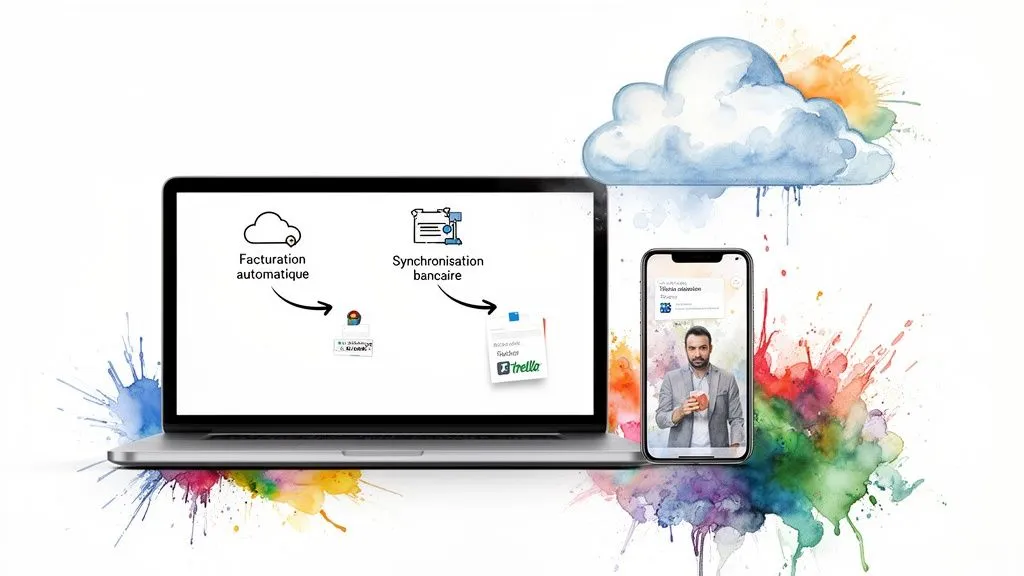
That’s exactly it: a clear, real-time view of your business, without having to manually compile dozens of files.
Connecting your tools to build a smart ecosystem
The real magic happens when your various software tools start talking to each other. That’s where platforms like Zapier become essential, acting as universal translators between your favorite apps.
A few concrete examples to picture the potential:
- For e-commerce: A customer places an order on your store? An invoice is automatically created in Bizyness, and a new “Prepare order” card appears on your Trello board.
- For client follow-up: An invoice is marked as paid? The contact is instantly updated in your CRM, and a personalized thank-you email goes out on its own.
- For lead management: Someone fills out a form on your site? Their contact is added to your mailing list, and a standard quote is sent to them right away.
The golden rule is simple: a piece of data should only ever be entered once. It’s then up to your ecosystem of tools to route it wherever it’s needed.
This approach doesn’t just save you precious time; it also drastically reduces the risk of data entry errors. If you’re interested in the topic, our full article explains how to automate your administrative tasks.
The concrete impact of digitalization on your efficiency
Bank synchronization is another one of these quiet revolutions that changes everything. Once your business account is connected to your management tool, every transaction is imported and pre-categorized without you lifting a finger. Your job? Validate the suggestions and attach the receipt in one click.
This shift to digital has a direct, measurable effect on performance. According to INSEE, digitalization has reduced administrative processing times by 20 to 35% between 2019 and 2023. For small businesses, the reduction in unit administrative costs is estimated at between 10 and 18% per file.
By building a well-designed automation system, you’re not just saving time. You’re building a reliable, efficient administrative machine that supports your growth instead of holding it back. To dig deeper into the topic, feel free to explore solutions for automating your tasks and boosting your productivity.
Knowing when and how to delegate your administrative management
Even with the best tools in the world and well-honed processes, there comes a moment when the paperwork ends up overflowing. The first warning sign, the most obvious one, is when admin work starts eating into your time. If you’re spending more time chasing unpaid invoices than developing your offer or taking care of your clients, there’s a problem. It’s time to look up from the grind.
Another telltale sign is stagnation. You feel like you’re holding yourself back. You turn down an interesting project or delay launching something new, not for lack of motivation, but out of fear of the administrative load it will create. That’s the clear symptom that you’ve become the bottleneck of your own growth.
And then there’s the fatigue, the mental load. If the mere thought of tackling your VAT return gives you cold sweats, that’s a sign you’re at your limit. Delegating isn’t an admission of weakness, quite the opposite. It’s a strategic, smart decision to preserve your energy and devote it to what you do best.
Who should you turn to for delegation?
Once the decision is made, several options are available to you. Each has its own specifics and cost.
-
The virtual assistant (VA): The ideal solution for one-off, well-defined needs. You can entrust them with specific tasks like audio transcription, calendar management or document formatting. It’s ultra flexible, often billed by the hour, and perfect for testing out delegation without a long-term commitment.
-
The freelance independent secretary or office manager: Here, you move to more regular, more integrated support. This person can become a real right hand and take over entire chunks of your management: invoicing follow-up, client reminders, supplier relations, and so on. It’s a partner who absorbs your methods over time.
-
The chartered accountant: This is the go-to specialist for everything related to tax and pure accounting. Their role goes well beyond simple data entry and preparing your annual accounts. A good accountant advises you on your financial strategy, helps you optimize your taxes and makes sure you always stay compliant with the law.
The most important thing is to hand the right task to the right person. Don’t ask your accountant to manage your calendar, and don’t hand your tax filings to a virtual assistant. Each profession has its own expertise.
Ensuring a smooth transition
For delegation to succeed, it needs a bit of preparation. Take some time to document your working habits, even if they seem obvious to you. A few notes or a quick guide explaining your invoicing process, how you organize your documents, or who your key contacts are, makes all the difference.
Also prepare secure access to the tools needed, such as your invoicing software or your online storage space. The clearer and more structured this handover is, the faster your new partner will become independent. It’s a small upfront time investment that will bring you invaluable peace of mind later on.
Answering your questions about administrative management
Diving into your company’s paperwork can quickly feel overwhelming. Especially at the start. To save you long searches and give you clear answers, I’ve compiled here the questions that come up again and again among entrepreneurs. Straight to the point, no fluff.
What are the first documents to carefully keep?
As soon as your business gets going, certain documents are simply vital. Think of them as the foundations of your company. You absolutely must keep your articles of association (if you’re incorporated), your company registration extract, and of course, all of your invoices, whether purchases or sales. Don’t forget your business account statements either, and all your tax and social filings.
The best habit to adopt? Scan everything immediately. Then store these files in a secure cloud folder. Keep in mind that most of these accounting records must be kept for 10 years. Better to be organized from the start.
As a sole trader, is invoicing software really useful?
Even if the law doesn’t always require it, invoicing software quickly becomes an indispensable ally. Think of it as a small investment that saves you major headaches and significant stress in the long run.
A good tool ensures your invoices are fully compliant, with all mandatory notices and consistent numbering with no errors. It can also automatically follow up with late payers and makes your revenue filings much simpler.
Going without invoicing software is a bit like trying to assemble furniture without instructions and without the right tools. You can always try, but the risk of making a mistake and wasting hours over it is huge.
What’s the mistake to absolutely avoid when starting out?
Without a doubt: mixing your personal and business finances. Using your personal checking account to collect payments from clients or pay suppliers is the perfect recipe for total accounting chaos.
This mix makes tracking your cash flow nearly impossible, turns every filing into a headache and, worse, puts you in a bad position in the event of a URSSAF or tax audit. Golden rule number one is to open a bank account dedicated to your business activity. This applies even for sole traders, where it’s not always mandatory below a certain threshold. Do it.
How can I track my cash flow without being an accounting expert?
You don’t need an accounting degree to see clearly. To start, a simple Excel or Google Sheets table works perfectly. Just create two columns: “Money in” and “Money out”.
Get into the habit of updating it once a week. On one side, note every invoice that’s been paid. On the other, all planned expenses: your rent, subscriptions, taxes, salaries… This simple exercise will give you incredible visibility and help you anticipate tight month-ends.
What if you radically simplified your administrative management? With Bizyness, you can automate your invoices, track your cash flow in real time and prepare your tax filings in a few clicks. Discover how Bizyness can lighten your daily workload starting today.
