

 Français
Business bank account comparison: find the best offer
Business bank account comparison: compare fees, services and offers to find the ideal business account for your activity.

To find the gem in a business bank account comparison, it’s not about looking for the “best” one in absolute terms, but the one that truly fits your reality as a sole trader. For many freelancers, solutions like Shine or Indy work wonders thanks to their simplicity and built-in management tools. Conversely, a growing SME will more readily turn to the solidity of Qonto or the human contact of a traditional bank.
Choosing the right type of business bank for your activity
Opening a business account is much more than a mere formality. Even though it’s a legal obligation for companies (SASU, EURL…), it’s above all a common-sense move for any entrepreneur. It lets you draw a clear line between your personal finances and those of your business. Trust me, your accountant will thank you, and you’ll spare yourself plenty of headaches with the tax authorities.
Today, the banking landscape splits into three main families, each with its own character:
- Traditional banks (think Crédit Agricole, BNP Paribas…): Their strength is human contact and their branch network. A dedicated advisor, the ability to negotiate an overdraft or a loan, and above all cash and cheque deposits… It’s often the safe choice for businesses with a physical storefront.
- Online banks (like BoursoBank Pro or Hello bank! Pro): They sit somewhere in between. Backed by large groups, they offer much more attractive rates than traditional banks while keeping some of their advantages, such as cheque deposits via the parent company’s network.
- Neobanks (Qonto, Shine, Revolut Business): 100% on your smartphone. They excel with rock-bottom pricing, ultra-intuitive apps and features designed for independent workers (invoice creation, expense report management…). Ideal for freelancers and digitally native businesses.

Traditional banks vs. neobanks: the showdown
So how do you pick a side? It all depends on your day-to-day. A craftsperson who regularly receives cash payments can’t do without a physical branch for deposits. Conversely, a freelance consultant billing clients abroad will love the minimal exchange fees and multi-currency accounts of a neobank.
The real question isn’t “which is the best bank?” but rather “which bank will simplify my daily life?”. Take the time to analyze your financial flows: how many transfers, card payments, cheque deposits? That’s the key to not getting it wrong.
This business bank account comparison is here to help you see things more clearly. The French market is highly dynamic, with specialized players like Hello bank! Pro, Qonto, Shine, or even N26, who have managed to build offers perfectly tailored for independent workers and small businesses. To dig deeper, feel free to check out the in-depth analyses available on recognized bank comparison platforms.
To give you a first idea, here’s a quick summary:
| Bank type | Ideal for… | The big strength | The main drawback |
|---|---|---|---|
| Traditional bank | Craftspeople, retailers, SMEs | Human contact and comprehensive services (credit, deposits) | Higher fees, less flexibility |
| Online bank | Freelancers, small businesses | The happy medium: attractive rates and physical services | Often dependent on the partner branch network |
| Neobank | Digital entrepreneurs, startups | Unbeatable rates and integrated management tools | More limited services (no credit, little to no deposits) |
Evaluating business account offers on the right criteria

To make a business bank account comparison that truly holds up, you need to look well beyond the monthly subscription price. An offer displayed at €9 per month could, in the end, cost you far more than one at €15 if the extra fees pile up. The key is to break down the entire pricing grid to get an accurate picture of the real cost of your business account.
This analysis starts with day-to-day operations. How much will an instant SEPA transfer cost you? What are the fees on direct debits? And if you work internationally, exchange commissions and fees on transfers outside the euro zone can quickly add up and represent a significant share of your expenses.
Beyond the monthly fees
Direct costs are one thing. But there are also all the indirect fees that can drain your cash flow if you’re not paying attention. Be especially wary of transaction commissions: a percentage taken on all debit operations on your account. Even when capped, they can be very costly if your business generates a lot of transactions.
Here are a few points to check carefully:
- The cost of bank cards: The first card is often included in the offer, but how much do additional cards or virtual cards cost for securing your online payments?
- Payment and withdrawal limits: Are they sufficient for your business? Limits that are too low can quickly become a headache, and raising them is often billed.
- Intervention fees: A payment incident, an unauthorized overdraft… These exceptional fees can rack up fast. Make sure they’re clearly stated.
A good business account isn’t just an affordable one. It’s above all a predictable one. The absence of hidden fees and full transparency on pricing are marks of trust just as important as the subscription amount itself.
The features that really make the difference
The value of a business account isn’t measured in euros alone. Built-in tools and services can save you precious time, and for an entrepreneur, time is money. A modern business account should be a genuine day-to-day management partner.
Your bank’s ability to integrate with your other tools has become essential. For example, automatic synchronization with invoicing software like Bizyness completely changes the game for your administrative management. Take a look at Bizyness’s plans to see how a well-designed integration can automate your bank reconciliation and simplify your life for your tax filings.
Certain features have now become must-have criteria:
- Built-in invoicing tools: Create and send quotes and invoices directly from your banking app.
- Expense report management: Simple processes so you or your team can manage business expenses hassle-free.
- Accounting exports: The ability to generate files compatible with your accountant’s software.
- Multi-user access: Grant secure, personalized access to your partners or your accountant.
These elements turn what was once a simple bank into a genuine dashboard for your finances. Finally, never overlook the quality of customer service. Its responsiveness and availability are criteria you should never underestimate, especially when facing an urgent situation.
A closer look at the best business banks on the market
To build a good business bank account comparison, you need to go beyond the glossy sales brochures. Here we’ll break down the offers of the main players, from agile neobanks to well-established traditional banks. The idea is to focus on concrete use cases so you can find the perfect fit.
The market broadly splits into two camps. On one side, the 100% digital players who built their experience around the smartphone. On the other, the historic banks that rely on their branch network and a very wide range of services. Each model has its pros and cons, and the best choice will really depend on the nature of your business.
Qonto: the reference for growing teams
Qonto quickly established itself as the obvious solution for startups, small businesses and SMEs. Its real strength isn’t so much the price of its base offer (starting at €9 excl. VAT/month), but rather the robustness of its platform, designed to manage a team and support growth.
Where Qonto really stands out is in access and card management. You can create tailored profiles for your team members, with specific payment limits and adapted permissions. A salesperson doesn’t have the same needs as a CFO, and Qonto handles that with disarming ease.
- Team expense management: Each member can have their own card (physical or virtual) and submit expense reports simply by taking a photo of the receipt.
- Advanced accounting integrations: The platform connects to dozens of accounting software programs, making bank reconciliation nearly automatic.
- Batch transfers: Paying several suppliers or running payroll in a single operation becomes child’s play.
What makes the difference: Qonto is a genuine collaborative financial management tool. If your business already has several people or you anticipate rapid growth, the finesse of its user management is an advantage few competitors can match.
Shine: an ecosystem built for independent workers
Shine, part of the Société Générale group, took a different angle. Instead of targeting SMEs with complex needs, Shine focuses on simplifying the administrative life of freelancers and sole traders. Its offer, starting at €7.90 excl. VAT/month, is designed as a true administrative co-pilot.
Shine’s strength lies in its ecosystem of integrated services. Beyond the simple business account, you get access to invoicing tools, a module to calculate your URSSAF contributions, and even legal assistance.
Here’s a quick summary to clearly see the difference between the two approaches:
| Criterion | Qonto | Shine |
|---|---|---|
| Main target | Small businesses/SMEs, growing startups | Sole traders, freelancers |
| Strength | Team and expense management | Ecosystem of administrative services |
| Flagship feature | Advanced multi-user access | Invoicing tools and URSSAF calculation |
| Entry price (excl. VAT) | €9/month | €7.90/month |
For a freelancer just starting out, the support offered by Shine can prove far more relevant. The idea is to centralize as many administrative tasks as possible in a single app, a huge time saver when you handle everything yourself.
Revolut Business: the Swiss Army knife for international business
Revolut Business targets a very specific, and growing, customer base: businesses that work internationally. Whether you’re an e-commerce seller selling abroad or a consultant invoicing clients in dollars, Revolut stands out for its multi-currency management.
Its major advantage is the ability to hold, receive and send money in more than 30 currencies at very attractive exchange rates. This helps avoid the often prohibitive commissions charged by traditional banks on international transactions.
- Multi-currency accounts: Open sub-accounts in different currencies to manage your international flows without the slightest friction.
- Payment cards with no fees abroad: Spend in the local currency at no extra cost.
- Powerful API: For tech companies, Revolut’s API lets you automate complex payment processes.
One caveat though: its IBAN isn’t always French, which can sometimes complicate things with certain administrations or local partners. It’s a point worth checking before signing up.
To help you visualize entry-level offers, here’s a summary table.
Comparative summary of business bank offers
This table gives an overview of the key characteristics of the main business banks, making it easy to quickly compare base rates, card types offered, and customer support.
| Bank | Base monthly fee (excl. VAT) | Card type included | Customer support (channels and hours) | Ideal for |
|---|---|---|---|---|
| Qonto | €9 | 1 Mastercard One (physical or virtual) | Chat, email, phone (7 days/week, 9am-6pm) | Small businesses/SMEs, growing teams |
| Shine | €7.90 | 1 Mastercard Basic (physical) | Chat, email (5 days/week, 9am-6pm) | Sole traders, freelancers |
| Revolut Business | €0 (limited free plan) | Virtual card, physical optional | Chat (24/7 for paid plans) | E-commerce sellers, international businesses |
| Crédit Agricole | Variable (often > €20) | Business card (Visa/Mastercard) | Branch advisor, phone, email (branch hours) | Businesses needing financing, physical deposits |
This quick overview clearly shows that each offer meets specific needs. The choice will depend above all on your profile and priorities.
Crédit Agricole: the strength of tradition and network
Facing these new digital players, a traditional bank like Crédit Agricole still has solid arguments. Its added value isn’t found in its mobile app or its rates, but in the human relationship and the depth of its financial services.
For a business that needs complex financing solutions (a loan for equipment, a lease) or that handles a lot of cash and cheques, the physical branch network remains an undeniable asset. Having a dedicated advisor who knows you can clearly tip the scales when negotiating a business loan or a lease.
Make no mistake, the business banking sector in France is still largely dominated by these large institutions. Crédit Agricole, for example, aims to reach more than 53 million customers by 2025. Other groups like BNP Paribas or Société Générale also serve tens of millions of customers, proof that many entrepreneurs still trust this model. To better understand the French banking landscape, you can consult the detailed statistics on the topic.
When should you choose a traditional bank? If your business involves frequent physical deposits, a regular need for credit, or if you simply prefer discussing your strategy in person with an advisor, a bank like Crédit Agricole remains a highly relevant and solid option.
To wrap up this business bank account comparison, it’s clear there’s no miracle solution. The right choice depends on an honest analysis of your needs: Qonto for collaboration, Shine for administrative simplicity, Revolut for international business, and traditional banks for financing and proximity.
Which bank should you choose based on your sole trader profile?
A business bank account comparison, even the most thorough one, remains just a list of rates and features. The real question is how these offers adapt to your daily life. The best business bank is the one that fits the contours of your business, not the other way around.
To help you see things more clearly, let’s step into the shoes of three entrepreneurs with radically different needs. Each profile highlights concrete issues and will guide you toward the most suitable solutions.
Scenario 1: The digital freelancer working internationally
Picture a web developer or consultant who bills clients in the United States, Canada or the United Kingdom. Their main headache isn’t expense report management, but rather receiving payments in foreign currencies without losing a fortune in exchange commissions.
For this profile, the selection criteria are clear:
- Having multi-currency accounts: Being able to hold balances in USD, GBP or CAD is a real plus.
- Getting competitive exchange rates: Look for players that apply the interbank rate (or come close to it).
- Minimizing fees on international transfers: Whether fixed or a percentage, fees on SWIFT transfers should be as low as possible.
Here, solutions like Revolut Business or Wise Business are almost essential. They were built for international business, with multi-currency accounts and very low conversion fees, whereas traditional banks often help themselves along the way with high commissions.
For this type of freelancer, choosing a traditional bank would be a strategic mistake. Cumulative fees on each international transfer could represent several hundred euros in losses per year. That’s far more than the cost of any neobank subscription.
Scenario 2: The craftsperson with fieldwork
Now let’s take the case of a plumber or an electrician who travels to clients’ homes. Their needs are the polar opposite of the freelancer’s. They regularly cash cheques, sometimes cash, and need to be able to buy materials quickly from their suppliers.
Their priorities are therefore quite different:
- Cash and cheque deposits: A feature often absent or very limited among pure online banking players.
- A payment terminal: The ability to easily get a mobile card reader is essential for taking card payments.
- Financing solutions: A need for an overdraft or a small loan for a new vehicle or tools is a reality of their trade.
This little decision tree perfectly summarizes the first criterion to evaluate: how will you collect payments from your customers?
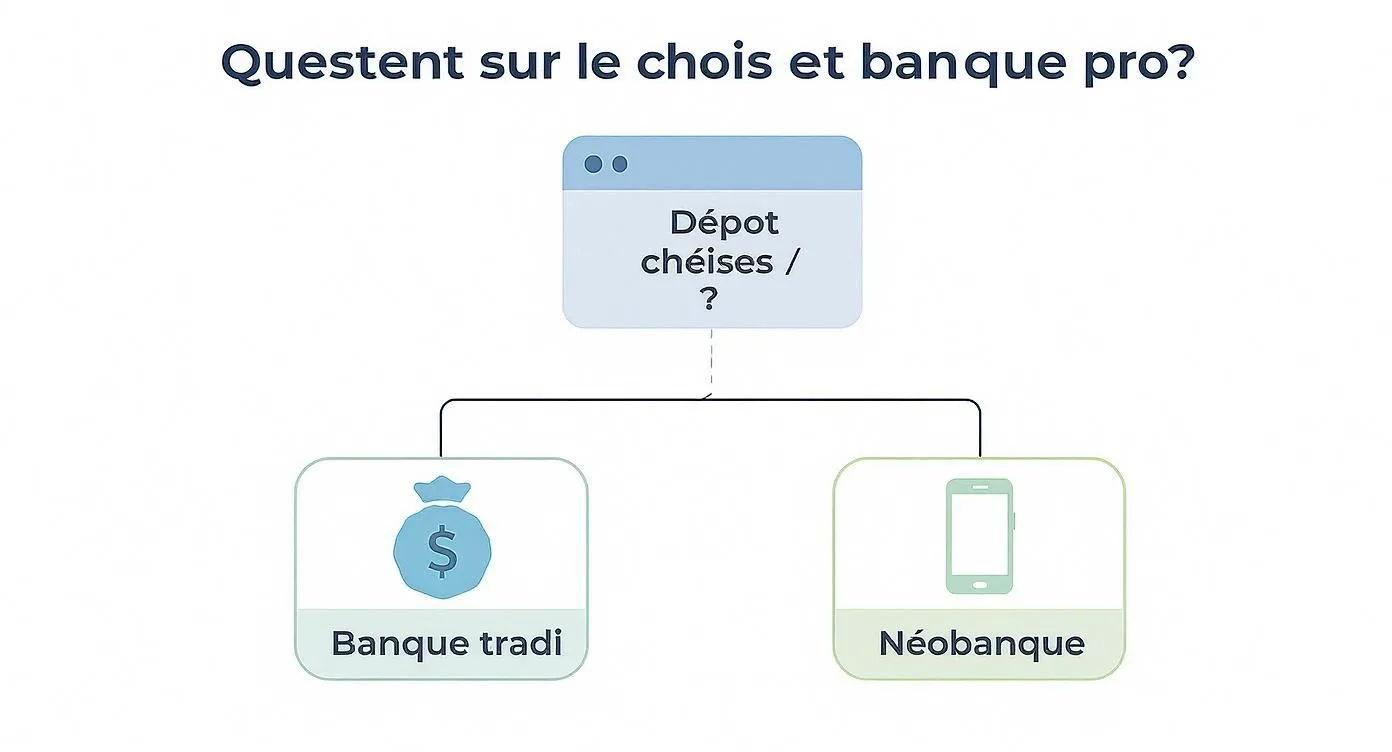
It’s clear: if physical deposits are a significant part of your business, a bank with a branch network remains the simplest option.
For this craftsperson, an online bank like Hello bank! Pro, which relies on the BNP Paribas network for deposits, or a traditional bank like Crédit Agricole with its Propulse offer, are relevant choices. They combine digital flexibility with essential physical services. To dig deeper, feel free to read our guide on the online business account for sole traders.
Scenario 3: The small business that’s growing and hiring
Finally, let’s look at a small communications agency or a startup with 3 to 5 employees. The owner is no longer alone at the helm. They need to delegate, track their team’s expenses and simplify their accounting.
The features that will change their life are:
- Multi-user access management: Grant specific permissions to a partner or their accountant.
- Bank cards for team members: Assign physical or virtual cards with personalized limits to control spending.
- Advanced accounting integrations: Perfect synchronization with accounting software to automate bank reconciliation.
On this front, Qonto clearly stands out. Its platform is entirely designed for teamwork, with very fine-grained permission and expense management. Shine is also an excellent alternative, especially if the business is looking for integrated administrative tools, such as invoicing. These solutions turn the business account into a genuine financial management tool, essential for supporting growth.
Connecting your business account to your management tools
A modern business account is no longer just a place where your money sits or passes through. Think of it instead as the cockpit of your business: a control tower connected to all your other tools to save you a huge amount of time. This is a criterion that may seem technical, but it’s absolutely crucial in any business bank account comparison.
The days of spending hours manually reconciling every line of your bank statement with a spreadsheet are well and truly over. Today, we expect a good business bank to automatically and seamlessly sync all transactions with our invoicing or accounting software. This connection is the cornerstone of well-oiled management.
Synchronization, your best ally for automating everything
The goal of this connection is simple: automate bank reconciliation. In practice, every payment you receive or every expense you make appears almost instantly in your management tool, ready to be linked to the right invoice or expense report.
The benefits are felt immediately:
- A clear, real-time view: You know exactly where your cash flow stands, at any moment. No more waiting until the end of the month.
- Fewer human errors: No more risk of forgotten entries or double entries. Automation makes your accounting more reliable.
- Much simpler VAT preparation: When your transactions are already categorized as they happen, your VAT returns become a breeze.
A well-designed integration transforms your bank. From a simple transaction tool, it becomes a genuine management assistant. It frees you from the most tedious administrative tasks so you can focus on what really matters: growing your business.
How to judge the quality of integrations?
Not all banks play in the same league on this front. While most neobanks like Qonto, Shine or Revolut Business offer direct connections with the leading software on the market, traditional banks often lag a bit behind.
To make the right choice, here are a few questions to ask yourself:
- Is the integration native? A direct connection offered by the bank is always more stable and reliable than a workaround solution going through a third-party service.
- Which tools are compatible? Check whether your bank communicates easily with your invoicing software, your e-commerce platform (like Shopify or Stripe) or your payroll tool.
- Is an API available? For those with more advanced needs, an open API (Application Programming Interface) is an excellent sign. It allows you to build custom connections and reflects the bank’s technical maturity.
For example, management software like Bizyness was designed to sync perfectly with banking flows. To check your bank’s compatibility and see how to simplify your daily life, take a look at Bizyness’s integrations.
Ultimately, your bank’s ability to communicate with your other tools is a direct investment in your own productivity. An entrepreneur who spends less time on admin is an entrepreneur who has more time to find new clients. Never underestimate this aspect.
Financing and add-on services: what really makes the difference
A business account isn’t just a place where your payments pass through. It is, or at least should be, a genuine co-pilot for your business. Beyond basic transactions, it’s often the financing solutions and the little extra services that separate a decent bank offer from a partner that truly helps you grow.
When building a business bank account comparison, access to financing is a crucial point. At first, a simple authorized overdraft may be enough to manage small cash flow gaps. But very quickly, the need to buy equipment or finance a vehicle can arise. And that’s where the differences between banks become obvious.
Getting a loan or an overdraft
On this front, traditional banks like Crédit Agricole keep a lead. They have decades of experience assessing applications and can grant much larger loans. Having a dedicated advisor who knows you can clearly tip the scales when negotiating a business loan or a lease.
By contrast, most neobanks like Qonto or Shine don’t directly offer traditional credit. They prefer to rely on partnerships with specialized fintechs, which can sometimes make the process a bit more complicated.
Your choice really depends on your medium-term vision. If you plan to invest heavily, the solidity of a traditional bank is reassuring. For a freelancer whose cash flow is stable and predictable, this criterion will matter much less.
Financing businesses is a central mission for banks in France. As proof, outstanding loans to non-financial companies grew by 2.1% year-on-year as of end of May 2025. This shows that financial institutions continue to support the economy. If you’re interested in the topic, this full analysis from the FBF offers a good overview of current dynamics.
The services that make your life easier
A good business account is also measured by the quality of its add-on services, the ones that save you time and secure your business. These little extras can well justify paying a few extra euros a month if they meet a real need.
Here are a few services worth keeping an eye on:
- Professional insurance: Offers like those from Shine or Blank often include basic Professional Liability Insurance, equipment coverage or legal assistance.
- Business creation support: Online capital deposit, offered by almost all neobanks, is a huge time saver when setting up your company.
- Cashback programs: Players like N26 or Revolut Business refund a small percentage of your card spending. It’s not much, but over a year it can add up to a nice little sum.
Also consider looking beyond pure banking offers. Other business financing solutions, such as long-term leasing, can be very relevant for preserving your cash flow. The goal is to choose not just a bank, but a complete ecosystem that supports your growth.
Your last questions before choosing your business bank
Making a decision after poring over a business bank account comparison always brings its share of very practical questions. Let’s go through the points that may still be holding you back, to help you make your choice with peace of mind.
Is a business account really mandatory?
It all depends on your legal status, there’s no single answer. If you’ve set up a company with share capital (like a SASU or an EURL), the answer is yes, without hesitation. It’s a legal obligation from the outset, to deposit your share capital and obtain your official company registration. There’s no way around it.
For sole traders and individual businesses, it’s different. The law is more flexible: you must open an account dedicated to your business only if your revenue exceeds €10,000 per year, two years in a row. Be careful, “dedicated account” doesn’t mean “business account”. A simple current account can suffice, even though a real business account will give you much more relevant tools.
Beyond the obligation, seeing the separation of accounts as a good management practice is essential. It radically simplifies your accounting, gives you a clear view of your cash flow, and protects you in case of an audit. Worth thinking about!
How long does it take to open a business account?
Here, the gap is huge between the different types of banks. If you’re in a hurry, neobanks like Qonto or Shine are unbeatable. Everything happens online, the application is wrapped up in 10 to 15 minutes, and your account is generally approved and active within 24 to 48 hours.
Conversely, a traditional bank operates on a different timeline. You’ll need to book an appointment with an advisor, gather your documents, then wait several days, sometimes even one to two weeks, before everything is fully up and running.
How can I deposit cheques and cash?
This is often THE deciding criterion. Most “pure” neobanks aren’t equipped to handle cash deposits and offer fairly convoluted, or even non-existent, solutions for cheques. If you regularly collect payments this way, you have two reliable options:
- A traditional bank, with its network of physical branches. It’s the simplest solution.
- An online bank backed by a large network, like Hello bank! Pro, which relies on BNP Paribas branches for deposits.
Once you’ve chosen your bank, the next step is to optimize your management. To automate your invoicing and accounting effortlessly, take a look at Bizyness. Our tool connects to your business account to save you a huge amount of time. Get started at https://www.bizyness.fr.
