

 Français
Business Digitalization Done Right: A Guide for Small Businesses
Discover our complete guide to business digitalization. Steps, tools and strategies for a successful digital transformation.

Far more than a buzzword, business digitalization is a concrete reality. It simply means moving from manual, often time-consuming processes to digital solutions to gain efficiency, nurture your customer relationships and, ultimately, improve your results. For a small business or a craftsperson, what does that actually mean? In practice, it means ditching the old paper order book for a mobile app, or automating your invoicing so you no longer spend your evenings on it.
Digitalization is about far more than just technology

Let’s set aside for a moment the technical jargon that can be intimidating. Digitalization isn’t a technological revolution reserved for large corporations. It’s above all a logical, accessible evolution of your working methods — an essential step to stay in the race.
Take a concrete example. Picture a plumber juggling handwritten quotes, invoices to chase up, and a schedule scribbled on a scrap of paper. Now picture that same craftsperson with a simple tool on their smartphone. In just a few clicks, they can create and send a clean quote, schedule their job in a connected calendar, and even get paid online as soon as the work is done. Their expertise and know-how remain the same, but they are multiplied by tools that genuinely make their life easier.
A strategic move, not an obligation
Digitalizing isn’t a goal in itself. It’s a powerful lever for reaching very real objectives: saving time, finding more customers, communicating better… You don’t adopt a technology just to look good, but to solve a concrete problem weighing on your daily operations.
The real starting point isn’t “how can I be more digital?” but rather “how can digital help me better serve my customers and lighten my administrative load?”
This mindset changes everything. Technology becomes an ally, a true right hand, rather than an added constraint. To better understand how we got here, a quick look back at the foundations of the Internet can shed light on how these tools came to be.
This shift has become unavoidable, because your customers have already figured it out. The numbers speak for themselves: by 2025, France is expected to have 63.4 million internet users (95.2% of the population!), spending an average of 5 hours and 23 minutes online every day. Given this reality, being visible and accessible online is no longer optional for a small or medium business; that’s where your future customers are. To dig deeper into these statistics, the data from Adrenalead on the key digital figures for 2025 is very telling.
In short, business digitalization means using digital technology to:
- Automate repetitive tasks and free up precious time.
- Streamline communication with your customers, as well as your partners and suppliers.
- Centralize your information to make better decisions, faster.
- Modernize your brand image to match today’s expectations.
The concrete benefits of digitalization for your business
Going digital isn’t just about being modern or having a nice online storefront. It’s a genuine growth lever, especially for small and medium businesses where every resource, every minute, is precious. In fact, the first and most direct gain you’ll notice is time.
Imagine being able to automate the tasks that eat up so much of your time: invoicing, creating quotes, or chasing late payments. Every hour you no longer spend on these chores is an hour you can devote to your real craft, to innovating, or simply to finding new customers. In short, it’s about working smarter, not necessarily longer.
Better organization and cost savings
Beyond the time saved, digital technology helps you streamline your expenses. Less paper, fewer ink cartridges, less space dedicated to archiving… Added together, these small savings end up significantly reducing your costs. For example, using good accounting software designed for sole traders doesn’t just automate data entry; it also reduces the risk of costly errors.
The benefit is also felt within your team. With tools like Google Drive or Microsoft 365, all your important documents are centralized and accessible anywhere, at any time. No more endless email back-and-forth to find the right version of a file. This fluidity makes your teams more responsive and cohesive.
Strengthening customer relationships and reaching new markets
The other major advantage lies in how you can manage your customer relationships. A simple CRM (Customer Relationship Management) tool turns your address book into a living, intelligent database. You track every interaction, anticipate your customers’ needs, and offer them a tailored service that genuinely makes them want to come back.
A customer who feels heard and recognized is a loyal customer. Far from dehumanizing the relationship, digital technology handles the administrative tasks on your behalf so you can focus on what matters most: the human connection.
Finally, digital technology breaks down borders. Thanks to an e-commerce site, a well-thought-out social media presence, or even video consultations, you’re no longer limited to your city or neighborhood. Your business can now reach customers across the whole country, and even internationally.
To help you with this, the French government portal FranceNum is packed with resources to support businesses.
This site is a real goldmine for finding financial support and very concrete advice. And the numbers make it clear: small and medium businesses have understood that the train is already moving.
According to the FranceNum barometer, more than 80% of French SMEs have already begun digitalizing. 85% of them have at least a website or a social media profile to be visible, and 56% use platforms to exchange documents. This proves that digital technology is now an integral part of their strategy for staying competitive. To explore the topic further, feel free to read the full analysis on SME digital transformation.
Building your digitalization strategy on 5 solid pillars
Succeeding at digitalization isn’t a technology arms race. Far from it. It’s more like building a house on solid foundations. Your approach needs to be coherent and well thought out. Think of it as a roadmap, built around five major workstreams that let you move forward step by step, without spreading yourself thin.
A good digital transformation is planned. Every tool you adopt should have a reason to exist, meet a specific need, and integrate smoothly with the rest. Let’s look together at these five pillars to structure your approach.
1. Visibility and customer acquisition
The very first workstream is simply about existing online. Your future customers need to be able to find you and, above all, your online presence needs to inspire immediate trust.
Your priorities here are fairly simple:
- An effective website. No need for anything overly complex. A clear showcase that explains what you do, who you are, and how to contact you — that’s the foundation.
- A well-polished Google Business Profile. It’s free and it’s your best local business card. For a small business or freelancer, it’s absolutely essential to be visible in your area.
- An active presence on the right social networks. No need to be everywhere. Choose the network where your customers actually are and take the time to engage authentically.
2. Operations and internal management
The second pillar tackles what happens “behind the scenes.” The idea is to eliminate manual, repetitive tasks that eat up precious time and are a source of errors. Business process automation is your best friend here.
Think about invoicing, appointment scheduling, project tracking… Anything that can be simplified with a tool will bring you more peace of mind and efficiency.
3. Customer relationships and retention
Acquiring a new customer is great. Keeping them is even better! This pillar is entirely dedicated to the tools that help you maintain the relationship, look after your customers, and build a lasting connection.
Technology never replaces human contact — it makes it simpler. By handing reminders and administrative tasks over to software, you free up time for the interactions that truly matter.
A good customer tracking tool (CRM) can, for example, remind you of a loyal customer’s birthday or let you send them a personalized offer. That’s the magic of well-managed customer relationships.
4. The sales process
This fourth pillar focuses on an essential question: how do your customers buy from you? It’s about making their purchasing journey as smooth and pleasant as possible, whether they’re on your e-commerce site or in your store.
This can involve setting up an online payment system, a simple booking module, or a quote configurator. The fewer the frictions, the more likely you are to close a sale. To go further, you can check out this complete guide to digital marketing strategy, which will help you structure your actions.
5. Data security
We arrive at the final pillar, often the great forgotten one… until it’s too late. Protecting your data (and especially your customers’ data) isn’t optional — it’s a responsibility.
Don’t panic: simple measures like strong passwords, regular backups, and a bit of common sense are often enough to avoid the worst.
This infographic sums up well the challenges you might encounter.
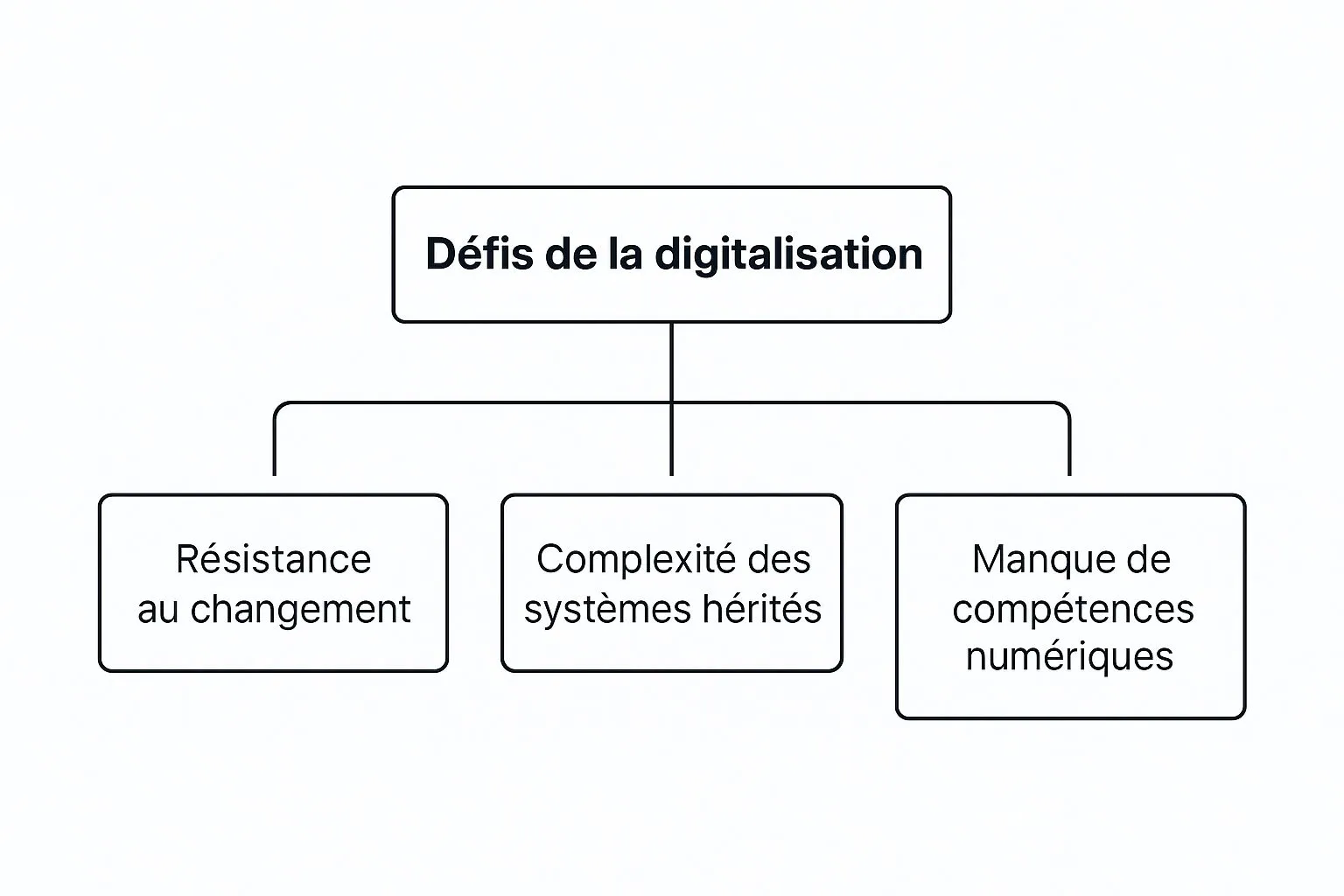
As you can see, the biggest obstacles are rarely technical. They are very often human and organizational. Hence the importance of having a clear strategy and properly supporting change.
Comparing digital tools by pillar
Choosing the right tool can seem complex. Should you go for a free solution or invest in a more comprehensive piece of software? To help you see things more clearly, here is a table comparing a few options for each pillar.
| Digitalization Pillar | Free / Simple Tool | Paid / Advanced Tool | Main Benefit |
|---|---|---|---|
| Visibility & Acquisition | Google Business Profile, Canva (for visuals) | WordPress site with premium themes/plugins, Semrush | Attracting qualified leads and building brand awareness. |
| Operations & Management | Google Workspace, Trello | Notion, Slack, Sellsy | Saving time, reducing errors, and collaborating better. |
| Relationship & Retention | Spreadsheet (to start), Mailchimp (free tier) | HubSpot CRM, Brevo | Building a lasting relationship and increasing customer value. |
| Sales Process | PayPal, Stripe (simple integration) | Shopify, PrestaShop | Simplifying the purchase and boosting the conversion rate. |
| Data Security | Password manager (Bitwarden), Google Drive | Dashlane, dedicated cloud backup solution | Protecting the business and customer trust. |
This table is just a starting point. What matters is choosing a tool suited to your current needs and budget, while keeping in mind that it can evolve alongside your business. Start simple, measure results, and adjust as you go.
How to build your own tailored roadmap
Now that we’ve covered the major pillars of digitalization, it’s time to move from theory to practice. Let’s be clear: a successful transition doesn’t happen by chance. It’s prepared with an action plan, a clear and realistic roadmap that truly fits your business.
Think of this not as a mountain to climb in one go, but rather as a hike, with well-defined stages. Every step brings you closer to the summit, without wearing you out.
Start with an honest assessment
The very first step, and arguably the most important, is an honest self-diagnosis. Take a moment to look your daily routine in the eye: where are the friction points? Where are you losing precious time? Which administrative tasks are dragging you down?
But don’t stop there. This audit should also look at your customers. What questions do they keep asking you? If they regularly ask whether they can book online or pay by card, these are strong signals not to ignore.
All these pain points, for you and for them, are actually your best starting points for launching your business digitalization.
Prioritizing is the key to moving forward efficiently
Once you’ve identified all these workstreams, you’ll need to make choices. You won’t be able to do everything at once, and trying to would be a mistake. The key to success is focusing first on the actions that will have the greatest impact, as quickly as possible.
To help you see things clearly, here are a few questions to ask yourself:
- What is the most urgent problem? If you’re drowning in outstanding invoices, an invoicing tool with automatic reminders is surely more of a priority than redesigning your logo.
- Where is the quickest win? Setting up an online calendar can free you from hours of phone calls right from the first week. That’s an immediate benefit.
- What will genuinely change my customers’ lives? Offering online payment can not only unlock sales, but also meet a strong expectation and improve their satisfaction.
By answering these questions, your priorities will naturally take shape. You’ll know whether it makes more sense to start with your internal management or with improving your online storefront.
What budget should you plan and how do you choose the right tools?
Let’s now address the question of budget. Setting up digital tools doesn’t necessarily mean spending a fortune. Digitalization can start with very reasonable investments.
The numbers speak for themselves: 39% of French businesses spent at least €1,000 on their transition, and 14% even spent more than €5,000. But what’s really interesting is that 24% spent no specific budget at all. Proof that it’s entirely possible to start small. To explore the topic further, feel free to check out the statistics on digital transformation in businesses.
The best tool isn’t the most expensive or the most complex one. It’s simply the one you’ll actually use every day. Always take advantage of free trial periods to test the usability and see whether the solution fits well with how you work.
Once your priorities and budget are clear, you can start listing potential tools. Compare their features, of course, but above all look at their simplicity. An intuitive interface is the guarantee that you won’t abandon the tool after two weeks.
An action plan, step by step
Your roadmap is almost ready! All that’s left is to organize the rollout over time.
- Phase 1 - Launch (1 to 3 months): Focus on your number one priority. For example, setting up invoicing software. Take the time to learn it and adopt it.
- Phase 2 - Consolidation (3 to 6 months): Time to measure the initial results. Are you genuinely saving time? Are your customers adopting the new tool (calendar, payment…)?
- Phase 3 - Expansion (6 to 12 months): Building on this first success, you can now confidently tackle the next priority on your list.
This progressive approach makes the project much more manageable and less stressful. It lets you learn along the way, adjust as needed, and build your digitalization on solid foundations, one brick at a time.
So, how do you get started without being scared off? Obstacles (and how to work around them)

Launching the digitalization of your business can be a little intimidating, that’s true. Between doubts and misconceptions, many entrepreneurs, especially solo business owners or small businesses, hesitate to take the leap. Yet every obstacle has its solution, often much simpler than you’d imagine.
The path to digital is often paved with a few classic obstacles. The good news? They’re far from insurmountable. By identifying them clearly, you can find effective workarounds to move forward, step by step.
Dealing with lack of time and fear of technology
“I don’t have time”: you hear it everywhere, and it’s probably excuse number one. The solution isn’t to want to change everything overnight. That’s the surest way to get discouraged. It’s far better to adopt a gradual approach.
Spending 15 to 20 minutes a day discovering a new tool is much more realistic and effective than trying to block off a whole week… which you don’t have anyway.
Similarly, the fear of technical complexity is an old reflex. The days when you had to be a developer to have a website are well and truly over. Today, a whole range of “no-code” or “low-code” solutions let you create powerful tools with very simple visual interfaces. If you know how to use a word processor, you’ll be able to manage.
Overcoming resistance to change (yours and everyone else’s)
The biggest challenge is often human: resistance to change. Whether it comes from you or your team, it’s at the heart of the problem. Some studies even show that 70% of transformation failures are linked to team resistance. The key is to communicate transparently, focusing on the concrete benefits.
Don’t impose a tool. Instead, show how it will simplify a tedious task or save precious time.
- No more manual data entry thanks to invoicing automation.
- No more missed calls with a shared online calendar.
- Smoother collaboration on documents accessible to everyone.
By putting the “why” before the “how,” what was seen as a constraint becomes an opportunity. Adoption then happens much more naturally.
Overcoming fear of investment
Money is often the crux of the matter. But the right question isn’t “how much does it cost?” but rather “how much will it earn me?” Think in terms of return on investment (ROI): if software costing €30 a month saves you 4 hours of work, the math is quickly done. It’s an investment, not an expense.
And don’t forget that many forms of support exist to lighten the bill. Schemes like the Chèque France Num can, for example, help fund part of your digitalization projects.
It’s also essential to explore every avenue to secure your cash flow, especially when starting out. For business founders, it’s crucial to be well informed about the support available. You can also find out how to optimize your situation if you’re a sole trader receiving unemployment benefits, in order to secure your income during this transition phase.
Frequently asked questions about digitalization for small and medium businesses

Even with a well-thought-out plan, a few questions often remain before taking the plunge. That’s completely normal. Here, we answer, straightforwardly, the most common questions entrepreneurs have about digitalizing their business. The goal? To clear away the last hesitations so you can get started with confidence.
Where do you start when the budget is tight?
A limited budget is the reality for many entrepreneurs. Far from being an obstacle, it can become a strength: the strength to focus on what really matters. Your absolute priority? The free actions that deliver the most visibility.
Start by creating your Google Business Profile. It’s free, and it’s your number one local storefront. Take care of it, complete it 100%. Then choose a single social network, but the right one: the one where your customers actually are. No need to spread yourself thin. A regular, authentic presence on one platform is worth far more than sporadic posts everywhere.
For your internal organization, free-tier (so-called freemium) tools are real gems. A tool like Trello to manage your projects, or the free version of an invoicing tool, can already change the game without spending a cent. The goal is simple: lay healthy foundations, see the first results, then reinvest wisely.
How do you choose the right tools without making a mistake?
The range of digital tools available is enormous. The risk of getting lost is very real, and the classic mistake is looking for the miracle solution that does everything. The right approach is much more pragmatic: look for the tool that will solve your most annoying problem, right now.
The perfect tool isn’t the most complete one, but the one you’ll enjoy using every day. If it’s too complicated, you’ll end up abandoning it.
To sort through the options, list the three tasks that weigh on you the most, the ones that waste the most time or money. Focus your search on these specific points. Then take advantage of free trials — that’s what they’re for! Test the usability, the simplicity, and trust your instincts. A simple, intuitive tool that you actually adopt will always be more profitable than an overengineered system nobody uses.
Will going digital dehumanize my customer relationships?
This is probably the biggest myth surrounding digitalization. In reality, when done well, digital technology does exactly the opposite: it strengthens and enriches the human relationship.
Think about it for a moment. By automating repetitive, soulless tasks (payment reminders, appointment reminders, order confirmations…), you free up precious time. That time, you can finally devote to what has real value: making a phone call to check in, giving personalized advice, paying special attention…
A good customer management tool (CRM), for example, can remind you of a customer’s birthday or their preferences. It’s a golden opportunity to build a more personal, stronger connection. Digital technology isn’t your replacement — it’s your best assistant.
Do you need to be an IT expert to digitalize your business?
Absolutely not. That idea is a holdover from the past. Today, the best platforms (like Wix for websites or Shopify for e-commerce) and online software (SaaS) are designed for users with no technical knowledge whatsoever.
Thanks to visual interfaces and drag-and-drop features, you can build a website, manage your sales, or handle your accounting without ever writing a line of code. Your most important skill isn’t technical — it’s strategic: knowing what you need. Knowing where you want to go matters far more than understanding how the technology works under the hood.
Ready to simplify your management and shift into a higher gear? Bizyness is the all-in-one tool designed for sole traders and small businesses. Automate your invoicing, track your cash flow, and finally focus on what really matters: your craft. Discover Bizyness and get started for free today.
