

 Français
The practical guide to cash basis accounting
Discover how cash basis accounting simplifies your bookkeeping. Our complete guide for small businesses explains its benefits and how to set it up.

When we talk about cash basis accounting, we’re talking above all about simplicity. The idea is to record expenses and income only when the money actually moves through your bank account. It’s a bit like managing your personal budget: what matters is the money coming in and going out, not the promises of payment.
Cash basis accounting: a faithful mirror of your available cash

Cash basis accounting gives you an instant, unfiltered snapshot of your company’s financial health. It differs from accrual accounting, which records invoices as soon as they’re issued, even if they haven’t been paid yet.
To make this clearer, let’s take a concrete example. You send a €1,000 invoice to a client in January. If they only pay you in March, with cash basis accounting, that amount won’t appear in your books until March. It’s the arrival of the money in your account that validates the transaction, nothing else.
This approach is particularly popular with small businesses and freelancers, and that’s no coincidence.
A direct view of your liquidity
The main advantage of this method is its clarity. By sticking closely to your bank account movements, you know exactly, down to the euro, how much you have available. This visibility is crucial day to day; it lets you make informed decisions without drowning in complicated projections.
For an entrepreneur just starting out, mastering your cash flow means keeping control of the helm. It’s a vital reflex to ensure the survival and growth of the business.
The core operating principles
The mechanics of cash basis accounting are fairly simple and rest on common-sense rules. The goal is to make sure your figures always reflect your real cash position.
Here are the fundamentals to keep in mind:
- Cash inflows: A sale is only recorded once the customer’s payment lands in your account.
- Cash outflows: A purchase or expense is only accounted for the moment the money leaves your account.
- Facts over promises: Debts (invoices you owe) and receivables (invoices awaiting payment) aren’t recorded until they’re settled.
- Less paperwork: Filing documents becomes much easier. Often it’s just a matter of following the chronological order of your bank statements.
This pragmatic view makes financial management much more intuitive. To go further and see how modern tools can automate all of this, feel free to take a look at our accounting solutions for the self-employed. It’s an excellent resource for understanding how to apply these principles without spending hours on it.
Choosing between cash basis and accrual accounting
Choosing between cash basis accounting and accrual accounting is a bit like choosing between a snapshot and an X-ray of your business. One shows you what’s immediately visible — the money in your account — while the other gives you a complete picture of your financial health, including what’s happening beneath the surface.
Let’s take a concrete example. You finish a project and send a €2,000 invoice in June. The client, however, only pays you in August.
With cash basis accounting, this €2,000 only appears in your books in August, when you actually receive the money. It’s simple, it’s direct. With accrual accounting, on the other hand, this sale is recorded as early as June, because that’s when the receivable was created.
The difference is significant. Cash basis accounting tells you what you really have in the bank to pay your expenses right now. Accrual accounting gives you a more accurate picture of your business’s performance over a given period, even if payments are delayed.
Cash flow: the heart of the engine
As its name suggests, cash basis accounting is directly wired to your money flow. You only deal with what actually enters and leaves your bank accounts. That’s it.
The three pillars of this approach are fairly easy to grasp.
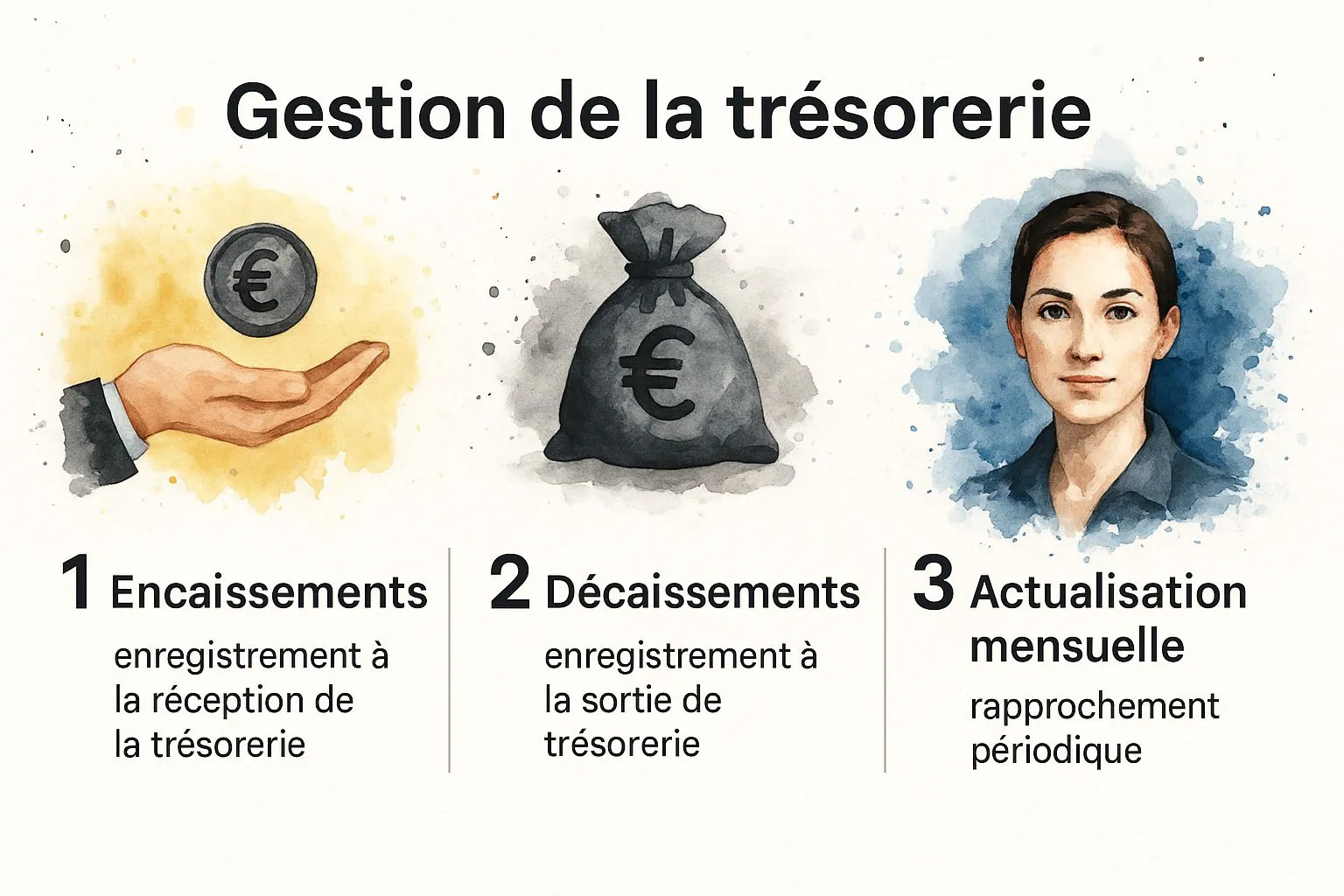
You focus on actual inflows and outflows, you check in regularly, and you make sure the figures match reality on the ground.
A choice that depends on your status and your ambitions
In France, cash basis accounting is defined by tracking monetary flows that have actually been received or paid. Interestingly, it’s a method widely used in the public sector to manage the state budget. The famous Organic Law on Finance Acts (LOLF) organized things by distinguishing payment appropriations (the cash going out) from commitment authorizations (spending promises). If you’re interested in the topic, you can dig into the intricacies of public accounting on the INSEE website.
For private companies, the choice is often guided by legal structure and tax regime.
Accrual accounting offers a precise economic picture, but cash basis accounting is the barometer of a small business’s survival. Knowing what’s left in the account at the end of the month isn’t optional, it’s a necessity.
So how do you find your way? To help you weigh the pros and cons, here’s a table comparing the two methods side by side.
Comparison between cash basis and accrual accounting
This table highlights the key differences, advantages, and disadvantages of each accounting method to help entrepreneurs choose the one best suited to them.
| Criteria | Cash basis accounting | Accrual accounting |
|---|---|---|
| Simplicity | Very simple, follows bank statements. | More complex, requires tracking receivables and debts. |
| Financial view | An instant snapshot of your liquidity. | A complete view of profitability and net worth. |
| Target audience | Ideal for sole traders, BNC filers, and micro-entrepreneurs. | Mandatory for most companies (SAS, SARL, etc.). |
| Decision-making | Perfect for short-term cash flow management. | Essential for financial analysis and long-term strategy. |
| Handling of debts | Debts and receivables don’t appear on the balance sheet. | Debts and receivables are recorded as soon as they arise. |
To sum up, if your top priority is managing your cash day to day and your status allows it, cash basis accounting is without a doubt your best ally. For more detailed financial analysis and if you have stricter legal obligations, accrual accounting then becomes essential.
The real benefits for your business’s growth

Choosing cash basis accounting isn’t just a technical matter. It’s above all a strategic choice that will change your daily life as an entrepreneur. Its main advantage? Disarming simplicity.
In practice, you just need to follow your bank statements to know where you stand. The time spent on administrative management shrinks dramatically. Less paperwork means more time to focus on what matters: growing your business, taking care of your customers, and innovating. You don’t need to be an accountant to find your way around, which makes you much more self-sufficient.
A perfect view of your available cash
The strength of this method is the immediate clarity it gives you on your liquidity. At any moment, you know exactly how much money you have available to operate, pay your expenses, or invest. It’s a bit like having a real-time dashboard of your financial health.
This visibility is crucial, not just to survive, but above all to grow. It helps you:
- Anticipate hard times and adjust your spending before it’s too late.
- Seize good investment opportunities without ever putting your cash flow at risk.
- Make sound decisions, based on concrete figures rather than risky estimates.
In short, you steer your business with an ultra-reliable financial GPS. Stress goes down, and your decisions become more relevant. This mastery lets you generate clear, precise financial reports to closely track your performance.
Knowing exactly where you stand financially, every day, changes everything. You’re no longer flying blind; you’re moving forward with a precise map of your economic terrain.
Lighter administrative and tax management
For many entrepreneurs, especially self-employed professionals (BNC) or small commercial businesses (BIC), cash basis accounting is a real breath of fresh air on the tax front. It simplifies filings and the calculation of what you owe in taxes.
This approach is, in fact, very widespread in France. The numbers speak for themselves: around 60% of French SMEs use it for the simplicity of tracking and managing their working capital.
Take the example of an independent consultant. At year end, they might decide to pay a large supplier invoice in order to immediately deduct it from their taxable income. It’s a simple, legal way to optimize their tax situation. Filing receipts chronologically, mirroring your bank statements, also makes preparing the annual balance sheet and any potential audits much less stressful.
Can your business use cash basis accounting?
Cash basis accounting is a handy method, but it’s not open to everyone. Access to it is regulated by law, based primarily on your legal status and tax regime. This is a crucial point to check before getting started, to avoid any unpleasant surprises with the authorities.
Simply put, this method is aimed above all at structures for whom cash is king. It was designed to lighten the administrative burden on small businesses, which don’t always have the means or the need for accrual accounting, which is far more complex.
So, before going any further, make sure your business ticks all the right boxes.
Who can opt for cash basis accounting?
Some businesses are required to use it, while others may be eligible under certain conditions. It often depends on your tax regime (income tax or corporate tax) and your taxation scheme (simplified actual or standard actual).
Here are the profiles that qualify:
-
Self-employed professionals (BNC): If your income is classified as Non-Commercial Profits, whether you’re a sole trader or even a micro-entrepreneur, cash basis accounting is the rule. It’s the everyday reality for most consultants, lawyers, doctors, and architects.
-
Businesses under the simplified actual tax regime (BIC): Commercial, craft, or industrial activities classified as Industrial and Commercial Profits (BIC) can choose this method, provided they’re under the simplified taxation regime and don’t exceed certain revenue thresholds.
A word of caution: companies subject to corporate tax, such as SARLs or SASs, must in principle keep accrual accounts. Eligibility is therefore a matter of legal status, not a simple choice.
The case of micro-entrepreneurs is even simpler: they keep a revenue ledger, which functions as an ultra-simplified version of cash basis accounting.
Adopting this method can seriously reduce your management costs. To get an idea of the potential savings, take a look at the pricing of management solutions like Bizyness, which handle automating a good chunk of the work for you.
Setting up your cash basis accounting step by step

Setting up effective cash basis accounting isn’t rocket science. It doesn’t require being an accountant, just a bit of discipline and the right tools. Think of it as a logical process that turns simple tracking of your financial flows into a real cockpit for running your business.
The goal is clear: build a reliable system that shows you, at any time, the reality of your available cash. And it all starts with choosing your best ally: your management tool.
Choosing the right tracking tool
The first step is to centralize everything. To do this, you generally have two options, each suited to a different stage in your company’s life.
- The trusty spreadsheet (Excel or Google Sheets): It’s free, accessible, and perfect for getting started. You create columns for dates, transaction descriptions, inflows (receipts), and outflows (payments). It’s an excellent first approach to visualizing your flows.
- Dedicated accounting software: Tools like Bizyness are designed to save you precious time. They connect directly to your bank, categorize transactions for you, and generate reports in a few clicks. It’s the ideal solution to avoid data entry errors and focus on your core business.
The final choice mainly depends on your transaction volume and the time you can devote to it. Let’s be honest, software quickly becomes essential to manage all of this smoothly and professionally.
Recording every movement with discipline
The key to solid cash basis accounting? Thoroughness. Every euro that enters or leaves your business account must be recorded. No exceptions. Whether it’s a customer payment, a purchase of equipment, a software subscription, or travel expenses.
Get into the habit of reconciling your bank statements at least once a week. This routine keeps you from getting overwhelmed and guarantees you always have a clear, up-to-date view of your financial situation.
Consistency is your best ally. Up-to-date books aren’t a burden, they’re a dashboard that lets you make informed decisions and react quickly.
And of course, don’t forget to carefully keep all your supporting documents: invoices, receipts, sales slips. File them logically, by date or category, so you can find them easily in case of an audit. Today, the simplest approach is often to digitize everything.
Categorizing for better analysis
Recording all your transactions is good. Sorting them into categories is much, much better. By assigning a label to each transaction (for example: “Service sales,” “Raw material purchases,” “Marketing expenses,” “Rent”), you turn a simple list of numbers into information that speaks.
This simple method opens up new possibilities:
- Spot your biggest expense items and identify ways to save.
- Analyze the profitability of your different offerings or activities.
- Simplify preparing your tax filings at year end.
In France, the structure of accounting has deep roots, but it was the first General Chart of Accounts (PCG) of 1942 that really laid the foundations. It notably organized third-party accounts in the famous class 4, which remains at the heart of cash accounting entries today. If you’re interested in the topic, you can explore the fascinating history of French accounting on Wikipedia.
By following these steps, you’ll build a solid system to run your business with confidence.
Answering your questions about cash basis accounting
Diving into cash basis accounting often raises very concrete questions. That’s normal! To help you see things more clearly and manage your business with confidence, we’ve gathered the questions that come up most often among entrepreneurs. The idea is to give you direct answers, without jargon, that you can apply right away.
Our goal is simple: clear up any remaining doubts so you can focus on what really matters, which is growing your business. Let’s get started and go through the key points.
Do I really need to keep all my invoices?
The answer is a resounding yes, without the slightest hesitation. Even though cash basis accounting relies on what enters and leaves your bank account, every transaction must absolutely be backed by an official document. We’re talking about purchase invoices, your sales invoices, receipts, or expense reports.
These documents are crucial for two reasons. First, they’re irrefutable proof of the nature of your expenses and income in the event of a tax audit. Second, they’re essential for correctly managing VAT and, if you ever change regime, for being able to reconstruct more traditional “accrual” accounting.
The golden rule is simple: one movement in your bank account = one matching supporting document. They’re like two sides of the same coin, inseparable.
Fortunately, digitization makes life much easier today. Tools exist to scan and archive your invoices online, automatically linking them to the right transactions. A huge time saver and real peace of mind.
How do I handle VAT with this method?
Handling VAT can seem a bit daunting at first with cash basis accounting, since we often think in terms of the invoice date. However, there’s an option that fits perfectly with this method: VAT on cash receipts.
If you sell services, you can choose this regime. In concrete terms, this means you only declare and pay VAT to the state once your client has paid you. And conversely, you only reclaim VAT on your purchases after you’ve paid your supplier.
This approach has real advantages:
- It protects your cash flow: No need to advance VAT for an invoice that’s still sitting unpaid with a client.
- It simplifies tracking: Your VAT return follows the rhythm of your bank account. It’s much more logical and intuitive.
- It limits risk: In the event of non-payment, you won’t have paid the state VAT on money you never actually received.
Of course, you need to check that you’re eligible for this regime and declare it properly to the tax authorities. Good organization is key to getting it right.
Can you switch back to accrual accounting later?
Absolutely! It’s not only possible but sometimes even mandatory to switch from cash basis accounting to accrual accounting. This change often happens when a business grows, exceeds certain revenue thresholds, or changes legal form to become a company (SARL, SAS, etc.).
This transition should ideally be prepared at the end of the accounting year. The process involves “reconstructing” your debts and receivables as of the closing date. In practice, you’ll need to list every invoice you still owe, and every one your clients haven’t yet paid.
This is where you see why it’s so important to carefully keep all your supporting documents. Without them, this exercise would become a real headache. Starting out from day one with management software makes this transition much smoother, since the tool already has all the information on file.
What pitfalls should you avoid?
The apparent simplicity of cash basis accounting can hide a few traps. The biggest risk is neglecting to track outstanding invoices. Since they only appear in your books once paid, it’s easy to forget to follow up with a client or underestimate large upcoming payments.
Another classic pitfall is confusing your bank balance with your profit. Your account might look healthy at a given moment, but if you have several large supplier invoices due the following month, your financial health is actually far more fragile than it appears.
Finally, if you don’t categorize your expenses and income with at least a minimum of precision, you’ll miss out on a fine-grained analysis of your profitability. Take a few minutes to properly sort each transaction; that’s what turns a simple list of numbers into real indicators for running your business.
To avoid these pitfalls and stay in control, a good tool is your best ally. Bizyness automatically retrieves your transactions, helps you manage your invoices effortlessly, and gives you clear reports so you can make the right decisions. Discover how Bizyness can simplify your life starting today.
