

 Français
 Cash Flow Management for Small Businesses
Master cash flow management with this guide for small businesses. Practical strategies to ensure the stability and growth of your company.

What exactly is cash flow management? It’s the steering of every inflow and outflow of money in your business. It means monitoring, analyzing and, above all, optimizing these movements to make sure you always have enough liquidity to operate. It’s the art of staying in control so you can pay your bills, your salaries and your taxes on time, while calmly preparing for the future. Good cash flow management is, quite simply, the foundation of your company’s stability and growth.
Why mastering your cash flow is a matter of survival

To really understand this, picture your company as a human body. If sales are the muscles and your strategy is the brain, then cash is the blood. It flows everywhere, feeds every department, carries the funds needed for every project and helps flush out unnecessary expenses. Without healthy circulation, even the best-performing athlete collapses. It’s exactly the same for a business: it can be swamped with orders and profitable on paper, but if the money doesn’t come in fast enough to cover expenses, it heads straight for financial asphyxiation.
Poor cash flow management is therefore not a simple administrative headache. It’s a direct threat to the survival of your business.
The concrete risks of poorly managed cash flow
A lack of visibility over your liquidity exposes you to very real dangers, capable of derailing your company in record time. Ignoring these signals is a bit like navigating blind through thick fog.
Here are the main perils you face:
- Inability to pay essential costs: This is the first symptom. You start struggling to pay salaries, rent or suppliers. Your reputation suffers, and team morale drops.
- Costly reliance on overdrafts: To make ends meet, you lean on cash facilities or bank overdrafts. The interest and fees that come with them then eat into your margins.
- The risk of bankruptcy: This is the worst-case scenario. A company, even if profitable, can be forced into insolvency proceedings if it can no longer meet its short-term debts due to a lack of cash.
The current economic climate only heightens these tensions. In France, over the past 12 months, close to 67,000 businesses have shut their doors, very often because of cash flow problems. Worse still, 1 in 3 small and medium businesses admits that managing its cash flow is difficult. These figures highlight the urgency of steering your finances more carefully amid uncertainty. If you want to dig deeper into the topic, feel free to check out this analysis of business cash flow.
The opportunities that healthy management can unlock
Conversely, proactive cash flow management can transform it: from a source of stress, it becomes a powerful strategic lever.
Well-managed cash flow isn’t just about survival — it gives you the means to thrive. It’s the fuel for your ambitions, letting you move from reacting to acting.
Mastering your money flows gives you a decisive edge. You can:
- Seize opportunities: Buying stock at a good price, investing in more efficient equipment or hiring rare talent all become possible, because you know the funds are available.
- Plan with peace of mind: By anticipating cash flow dips and peaks, you prepare your investments and make informed decisions, without fearing the unexpected.
- Strengthen your negotiating power: Paying suppliers upfront in exchange for a discount? Reassuring your banker with solid forecasts? All of this becomes easier and improves both your relationships and your financial terms.
Decoding your cash flow movements
To steer your business well, you need to know how to read the map. And when it comes to finances, that map is your cash flow. But be careful: cash flow management isn’t just about glancing at your bank balance at the end of the month. It’s far more nuanced than that.
The idea is to understand precisely where the money comes from and, above all, where it goes. To see clearly, we break down all these movements into three broad categories. Each tells a different part of your company’s story. By isolating them, you get an accurate picture of your financial health, far beyond the simple accounting result.
Operating cash flow: the heart of the engine
Operating cash flow is the true engine of your business. It simply represents the money your core activity generates… or consumes day to day. It’s the direct reflection of your core business.
This flow includes:
- Cash inflows: Essentially, the payments you receive from your customers.
- Cash outflows: All the everyday expenses needed to keep the business running. This means suppliers, salaries, social contributions, taxes or rent.
Positive and stable operating cash flow is the most encouraging sign there is. It means your business is profitable enough to fund itself. You don’t need external crutches to pay your bills.
Investing cash flow: building the future
Investing cash flow, on the other hand, is future-oriented. It tracks all the expenses and income tied to your long-term assets. This is where you can see whether you’re preparing tomorrow’s growth.
Examples include:
- Buying new equipment to increase production.
- Selling an old vehicle that’s no longer needed.
- Acquiring new offices or a strategic patent.
Here, a negative flow isn’t necessarily a bad sign — quite the opposite! It often shows that the company is actively investing to grow and stay competitive.
Financing cash flow: relationships with your financial partners
Finally, financing cash flow highlights how your business is funded. It shows the money exchanged between you, your shareholders and your lenders (such as banks). It’s the mirror of your financial structure.
Tracking this flow is essential. It tells you whether you need outside capital to sustain your activity or fund your investments.
It covers very concrete transactions:
- Capital contributions from partners who believe in your project.
- Taking out a new bank loan for a major project.
- The gradual repayment of your debts.
- Paying out dividends to reward shareholders.
By analyzing these three flows separately, you’re no longer just looking at a list of numbers. You’re reading a true story: that of your company’s performance and strategy. This clarity is the essential first step to regaining control of your cash flow.
Choosing the right tools to track and anticipate
Once you have a clear picture of where your money comes from and where it’s going, it’s time to set up a solid tracking system. Cash flow management shouldn’t be a late-night chore, but a powerful management habit. To get there, two main approaches are available to you: the good old manual method with a spreadsheet, or switching to dedicated software.
Each option has its merits, that’s true. But they don’t meet the same requirements at all in terms of efficiency and long-term vision. Your choice will depend on the size of your company, the complexity of your financial flows and, let’s be honest, the time you can devote to it.
The manual approach with a spreadsheet
The spreadsheet, whether Excel or Google Sheets, is often the first tool people turn to. It’s familiar, flexible and costs almost nothing upfront. You can easily build a simple cash flow plan by listing your projected receipts and payments, month by month.
However, this approach quickly shows its limits. Manual tracking is incredibly time-consuming and the risk of human error is everywhere. A simple typo in a formula can throw off all your forecasts and, ultimately, lead you to make very poor decisions. It’s worth knowing that, according to several studies, nearly 90% of spreadsheets are believed to contain errors. A chilling figure.
The shift to dedicated management software
Modern management software completely changes the game for cash flow tracking. It’s designed specifically to automate repetitive tasks and give you a clear, real-time view of your financial situation. It’s a bit like trading your old paper road map for a GPS: you gain precision and peace of mind.
These tools bring features that make all the difference:
- Bank synchronization: They connect directly to your bank accounts to automatically import all transactions. No more manual entry!
- Smart categorization: The software learns to classify your expenses and income, saving you precious time every week.
- Reliable forecasts: By analyzing your history, the tool can generate solid cash flow forecasts, helping you anticipate downturns several months in advance.
- Visual dashboards: Information is presented as simple, clear charts. You understand your financial situation at a glance.
The tracking process becomes far smoother and more rigorous as a result. This infographic illustrates the three key steps of healthy cash flow management, whether your tool is manual or automated.
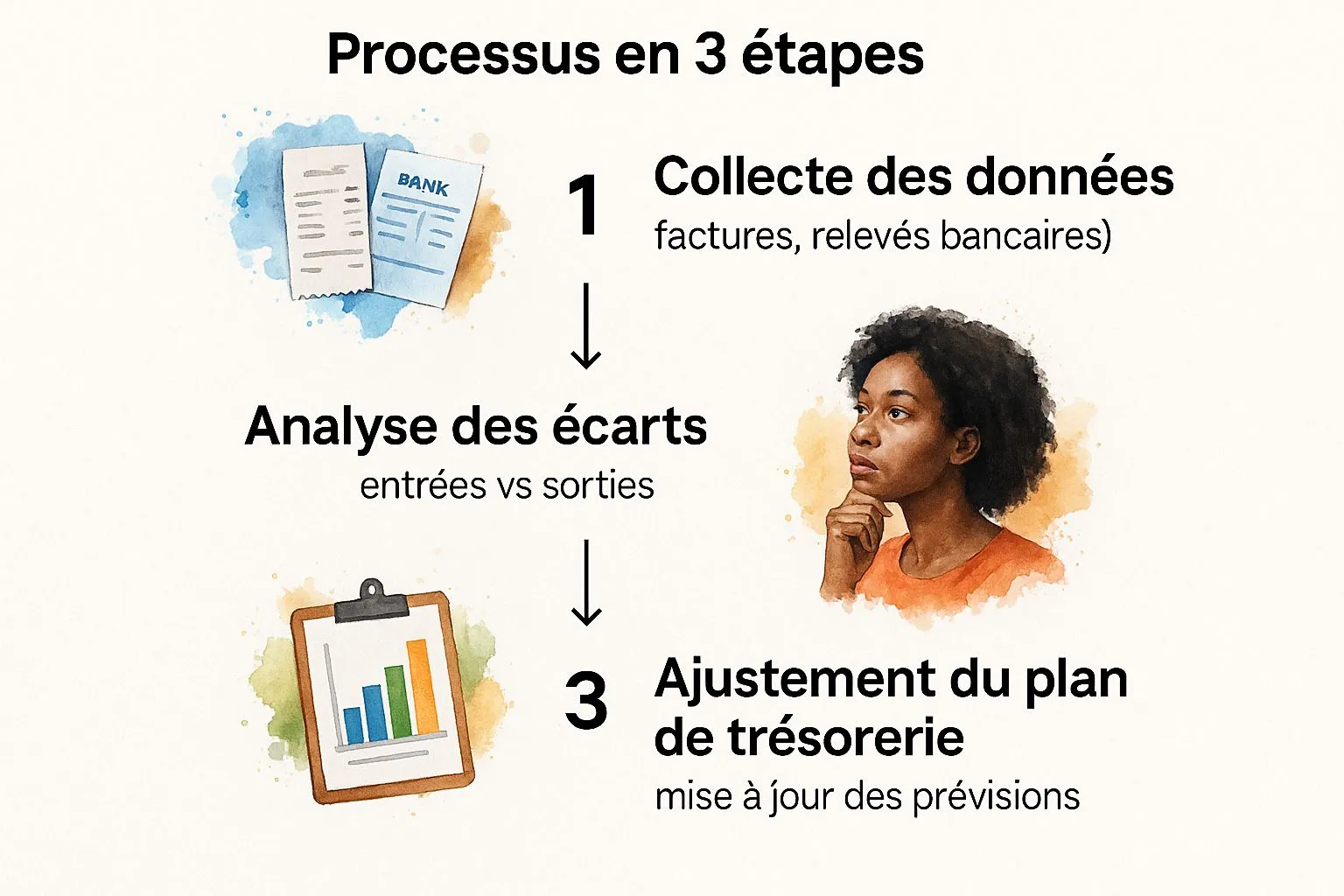
This cycle — from data collection to forecast adjustment — is considerably sped up and made more secure by software that handles the first, most tedious steps automatically.
Comparing the two methods
To better visualize the pros and cons of each method, this table highlights the fundamental differences between the manual approach and a dedicated tool.
Comparison of cash flow tracking tools
This table compares the manual spreadsheet approach with the use of dedicated management software for cash flow tracking.
| Criterion | Spreadsheet (Excel, Sheets) | Dedicated management software |
|---|---|---|
| Time spent | High (intensive manual entry) | Low (task automation) |
| Data reliability | Low (high risk of human error) | High (direct bank synchronization) |
| Strategic vision | Limited (static data, hard to analyze) | Clear (dynamic forecasts and dashboards) |
| Initial cost | Very low | Moderate monthly investment |
This comparison clearly shows that while a spreadsheet is an economical short-term solution, it quickly reaches its limits for serious, proactive management.
Ultimately, choosing your cash flow management tool means weighing the immediate cost against the value created over the long term. Good software is an investment that pays for itself very quickly through time saved, errors avoided and, above all, the quality of the decisions you’ll make for your business.
Actively improving your cash flow
Good cash flow management isn’t just about watching numbers on a chart. It’s above all about taking action so that money circulates better and faster within your business. It’s a bit like a gardener who doesn’t just watch the plants grow, but waters, prunes and feeds the soil to ensure a bountiful harvest.
For a business owner, this translates into a dual, ongoing mission: bringing money in faster and controlling how it goes out. By working on both of these levers, you build much stronger financial foundations.
Mission 1: Speed up your cash inflows
The idea is simple: minimize the delay between the moment you finish a job and the moment the money actually lands in your bank account. Every day gained is a small win for your cash flow.
Fortunately, a few very concrete strategies can produce almost immediate results:
- Invoice without delay: Is the job finished? Has the product been delivered? Don’t wait until the end of the month. Send your invoice right away.
- Ask for a deposit: For large projects, a deposit of 30% to 50% isn’t a luxury. It secures part of your cash flow, tests your client’s commitment and funds the start of the project.
- Make life easier for your clients: Offer online payments by card or direct debit. The easier and faster payment is for your client, the sooner you’ll get paid.
Of course, diligent follow-up on unpaid invoices is non-negotiable. Polite but firm reminders show that you run your business with rigor and professionalism. If you’d like to dig deeper into this topic, our guide on collecting outstanding customer invoices is an excellent resource.
Every late customer payment has a direct impact on your ability to pay your own bills. Optimizing collections is therefore the cornerstone of healthy cash flow.
Mission 2: Control your cash outflows
Controlling your outgoing payments doesn’t mean spending less. It means spending more intelligently. The goal is to make sure every euro that leaves the business brings real added value.
Here too, targeted actions can make a big difference:
- Negotiate with your suppliers: Don’t hesitate to discuss payment terms. Getting 15 or 30 extra days to settle an invoice can give you significant breathing room.
- Track unnecessary expenses: Take the time to audit your subscriptions and recurring costs. That software you haven’t used in months? That service that duplicates another? That’s money evaporating for nothing.
- Plan for major investments: Buying equipment, an IT fleet or a vehicle should be carefully planned in your cash flow forecast. This way you ensure that this outflow won’t jeopardize your company’s day-to-day operations.
This management discipline is all the more crucial in the current environment. In France, outstanding business loans total €1,376 billion, nearly half of which is allocated to small and medium businesses. Sound, rigorous management of your liquidity is the best signal you can send to your financial partners, especially banks. To learn more, you can consult this analysis of business financing.
Put your cash surplus to work
Has your cash flow management hit its stride, letting you build up a surplus? Congratulations, that’s excellent news! But be careful: letting that money sit idle in a checking account is a bit like having a talented, well-paid employee with no assignment. It costs you nothing, but more importantly, it earns you nothing either. So the idea is simple: put that surplus to work so it actively contributes to your company’s growth.
Fortunately, turning this liquidity into a profitable asset is nothing complicated. It’s all a matter of balance between three pillars: the safety of your capital, liquidity (in other words, your ability to get the money back quickly if needed) and, of course, return.
What short-term investment options are available?
To grow a cash surplus without taking undue risks, several solutions are particularly well suited to small and medium businesses. They allow you to generate passive income while keeping a degree of flexibility.
The most common are:
- Term deposit accounts: The principle is simple. You lock away a sum of money for a set period and at a known rate in advance. It’s a very safe option, with no surprises on the return.
- Money market funds: These funds invest in very low-risk, very short-term financial products. Their great advantage is their liquidity: you can generally get your funds back within just a few days.
So how do you choose? It all depends on your time horizon and your need for flexibility. A term deposit is perfect if you’re sure you won’t need the money before it matures. A money market fund, on the other hand, offers much more flexibility to react to the unexpected. To dig deeper into the topic, feel free to read our full guide on business cash management.
Adapting to a changing interest rate environment
The return on these investments is closely tied to central bank decisions. For example, cash flow management has been directly impacted by the European Central Bank’s recent rate changes. After a long period of hikes to fight inflation, a decline has begun, which changes the picture both for investment returns and for the cost of credit.
In this context, finance directors constantly have to adjust their approach to find the best trade-off between safety, visibility and profitability. To learn more, the Memo Bank article on the impact of rate changes on cash investments is well worth reading.
Ultimately, putting your surplus to work means moving your cash from a simple safety cushion to a genuine performance engine. It’s an essential step in consolidating your small business’s financial health.
Make your life easier with the right tool
Moving from theory to practice when it comes to cash flow management is above all a question of tools. The right software can turn a task perceived as complex and tedious into a real asset for running your business day to day.
Imagine no longer having to manually check off every expense. Thanks to automatic categorization, you could save precious hours every week. Also think about the ability to simulate, in just a few clicks, the impact of a new investment on your future balance. You could then make your decisions with full confidence, based on concrete data.
Good management software is far more than a fancy calculator. It acts as a true co-pilot. Its role isn’t to overwhelm you with numbers, but instead to give you a clear, synthetic view so you can navigate with confidence.
See clearly to decide correctly
A well-designed dashboard is absolutely crucial. It should let you grasp your financial situation in a single glance. That’s what gives you the ability to anticipate a potential cash flow dip in the months ahead and, above all, to react before it’s too late.
Here’s a concrete example of what an effective dashboard looks like with a tool like Bizyness.
This type of chart perfectly illustrates how your cash flow evolves, comparing actual figures to forecasts. This visibility is what gives you the keys to securing your business’s future.
You shouldn’t see such a tool as an added cost, but rather as a direct investment in your peace of mind and your ability to make the right decisions. In short, it hands control back to you.
Your questions about cash flow management
Even once you’ve mastered the big concepts, day-to-day cash flow management often raises very concrete questions. That’s perfectly normal. We’ve gathered here the questions that come up most often among small business owners, with direct, practical answers to guide you.
What’s the difference between working capital and cash flow?
This is a common source of confusion, so let’s use a simple image. Picture your company as a bathtub. Your cash, that’s the water level you have right now. It’s the money in your accounts, ready to be used.
Working capital requirement (WCR), on the other hand, isn’t money. It’s the mechanism that makes the water level change. It represents the ongoing gap between your outflows and inflows tied to your business: for example, the stock you buy (an outflow) and the customer invoices you issue but that won’t be paid for another 30 or 60 days (a future inflow).
A rising WCR means you’re funding more and more things before getting paid. That’s why a company that’s very profitable on paper can still run dry and go under. It funded its growth without keeping an eye on its WCR, and the bathtub emptied out.
How often should I really update my cash flow forecast?
For a small business, responsiveness is everything. A simple weekly glance at your cash position is an excellent habit. It lets you instantly spot a gap between what you had planned and reality, and correct course before a small gap becomes a real problem.
For your multi-month forecast plan, a monthly update is the bare minimum. That’s when you feed in the actual figures from the month that just ended to refine your future forecasts. This is what lets you make informed decisions, based on facts rather than impressions.
Cash flow management isn’t a sprint you run once a year for the annual accounts. It’s a marathon, a day-to-day management discipline. Consistency is the key to anticipating calmly instead of enduring hard knocks.
How should I react to an unexpected cash crunch?
The first rule: don’t panic, but act fast. Every day counts. Here’s an immediate action plan, to run on several fronts:
- Warn your banker: Don’t wait until you’re in the red to call. Explain the situation and discuss a cash facility or an authorized overdraft. Being proactive shows your seriousness and your grip on the situation.
- Switch to intensive follow-up mode: Drop the automated emails and pick up the phone. A direct call is far more effective at unblocking a payment. For a well-structured approach, our guide on effectively chasing unpaid invoices can be very useful.
- Talk to your key suppliers: Identify one or two large supplier invoices and ask for a payment schedule or a short extension. A business partner will always prefer this kind of honest conversation to radio silence.
Isn’t my accountant enough to manage my cash flow?
No, and that’s an essential distinction to understand. Your accountant is an indispensable partner who looks in the rearview mirror. They produce legal documents (balance sheet, income statement) that are a perfect snapshot… of your company’s past.
Cash flow management is real-time steering. It’s your GPS and your dashboard. It shows you where you are now and where you’re headed in the coming weeks. That mission belongs to the business owner. The accountant analyzes the past, the business owner steers the future. And for that, relying on a dedicated tool that gives a clear, instant view is no longer a luxury, but a necessity.
Discover how Bizyness can transform your financial management. Save time, gain clarity and peace of mind so you can focus on what really matters: growing your business. Try Bizyness for free and take back control of your cash flow today.
