

 Français
Chasing unpaid invoices: effective strategies to secure your cash flow
Chasing unpaid invoices: learn concrete methods to recover payments and secure your cash flow for the long run.
Behind the slightly formal expression “unpaid invoice collection procedure” lies a very concrete reality: a set of actions, first friendly and then potentially legal, that you need to trigger to recover money owed to you once the due date has passed. It’s not just an administrative formality, it’s a vital process. A single late payment can be enough to weaken your cash flow and, eventually, the survival of a small business.
Why good unpaid-invoice management is your best life insurance
A late payment isn’t just a line in a spreadsheet. It’s a direct, tangible threat to the financial health of your business. For a sole trader or a small/medium business, the repercussions are immediate and can quickly become critical.
You immediately think of the freelancer who struggles to pay their own social security contributions because of a client dragging their feet. Or the tradesperson who can’t order raw materials, effectively blocking their next job. This is the daily reality of thousands of entrepreneurs watching their working capital evaporate because of bad payers.
The concrete impact on your cash flow
The number one danger of an unpaid invoice is the unbearable pressure it puts on your cash flow. Without that liquidity, your ability to run day-to-day operations is undermined.
Concretely, here are the risks you face:
- Struggling to pay your own suppliers and salaries, which can seriously damage your reputation and your partners’ trust.
- Being unable to invest in new equipment or simply to grow your business.
- Having to resort to expensive banking solutions, such as overdrafts or short-term credit, which eat into your margins.
The phenomenon is far from marginal. A recent study revealed that 86% of French companies have faced late payments. That’s a record figure reflecting a rather worrying underlying trend. Worse still, for more than half of small businesses, the impact of these delays is considered “critical,” leading to a 37% increase in business failures compared to the pre-Covid period.
Don’t make the mistake of seeing collection as an administrative chore. It’s a strategic function that protects the core of your financial reactor: your cash flow.
A proactive approach is non-negotiable
Given this reality, waiting is simply not an option. Putting in place a structured and proactive unpaid invoice collection strategy is an absolute necessity. That means acting from the very first day of delay and following a well-defined process, ranging from a simple courteous reminder to a more formal formal notice if needed.
Rigorous management turns a potentially very stressful situation into a controlled process. This is precisely where tools like Bizyness come into play. By automating reminders and centralizing tracking, they save you precious time and help you maintain steady, always professional pressure on your debtors. Optimizing this process is a pillar of your stability, a topic we cover in detail in our guide on cash flow management.
How do you build a friendly collection plan that works?
Before pulling out the heavy artillery, a graduated, professional approach remains your best asset. The friendly collection phase is a bit of a balancing act: you need to recover your money, sure, but without blowing up the client relationship. The goal is to set up a pragmatic reminder schedule that guides you from the very first day of delay.
Here, the key is responsiveness. The longer you let it drag on, the slimmer your chances of seeing your money again. By acting fast, you show that you’re serious and well organized.
This infographic clearly shows the lifecycle of an invoice and how the risk to your cash flow rises dangerously over time.
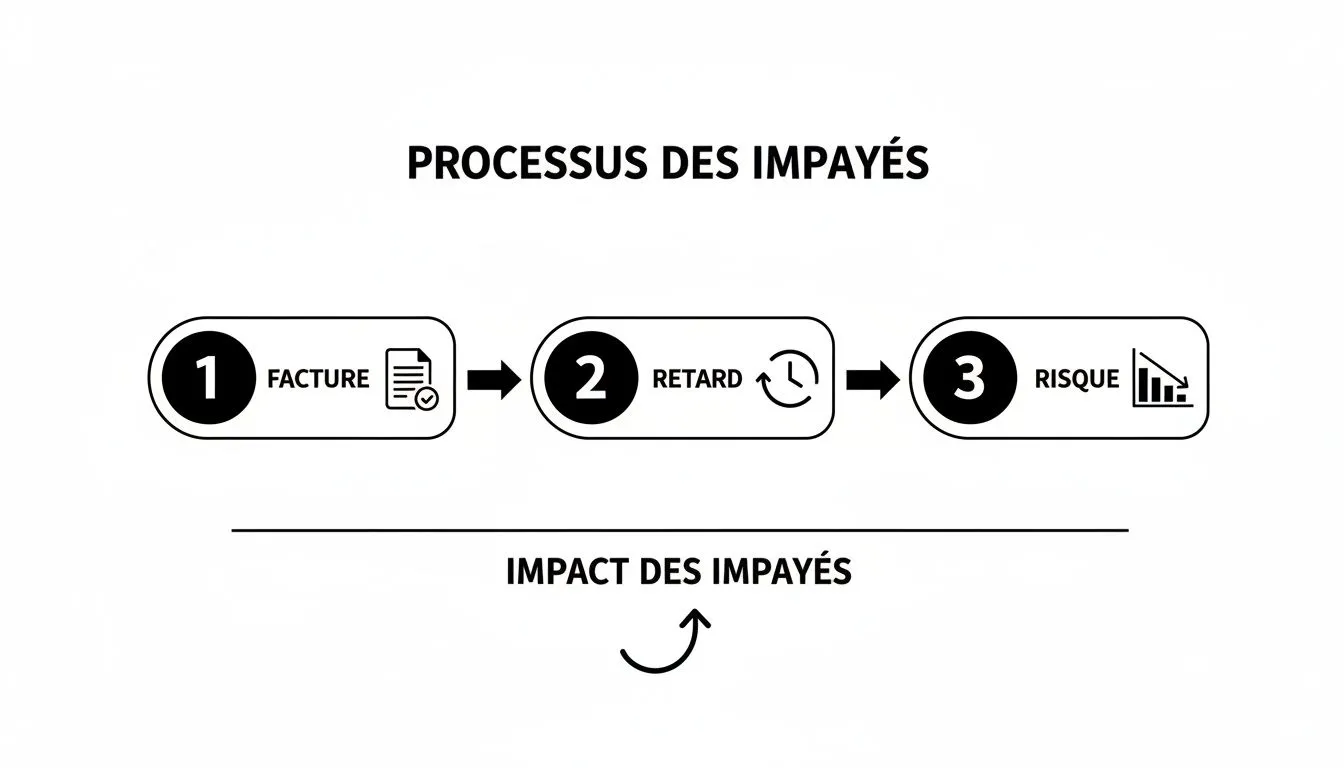
The key takeaway is that every day that passes is one more risk to your cash flow. Hence the importance of starting the collection process without delay.
Typical schedule for the friendly collection procedure
To make things clearer, here’s a timeline of actions I personally recommend. It’s a simple, effective framework that has proven itself for structuring friendly collection, before you have to move on to a formal notice.
| Step | Delay after due date | Communication channel | Main objective |
|---|---|---|---|
| Reminder 1 | D+2 | Courteously point out the due date (an oversight can easily happen). | |
| Reminder 2 | D+7 | Phone call | Get a direct explanation and a payment commitment. |
| Reminder 3 | D+15 | Email / Letter | Formalize the follow-up and signal a more serious stage. |
| Final notice | D+30 | Letter with acknowledgment of receipt | Warn of the imminent formal notice procedure. |
This schedule gives you a clear thread to follow. It lets you show persistence while still giving the client several opportunities to settle the matter amicably.
The first reminder: a courteous email right after the due date
The very first action should be simple, quick, and above all, non-accusatory. Mistakes happen, an oversight can happen to anyone. The goal isn’t to blame but to gently flag that the due date has passed.
A short email, sent one or two days after the deadline, is perfect for this. The tone should stay light and friendly.
Here’s a concrete example of a first-reminder email (D+2):
Subject: Quick reminder about our invoice [Invoice Number]
Hello [Client Name],
Unless I’m mistaken, it seems that invoice no. [Invoice Number] for [Amount] €, which was due on [Due Date], is still awaiting payment.
Could you take a look on your end? It’s most likely just an oversight.
I remain available of course if you have any questions.
Best regards,
[Your Name/Company Name]
This message works well because it gets straight to the point, gives all the key info (number, amount) and opens the dialogue. One tip: always remember to attach the invoice. Your client may have simply misplaced it.
The phone call for direct contact
If your first email has gone unanswered after a week, it’s time to pick up the phone. Nothing beats a direct exchange to unblock a situation.
Prepare a little for this call to stay in control. Have all the invoice information in front of you. The idea is to understand why it’s stuck and, if possible, get a firm payment date.
Stay calm and professional, even if the person on the other end is defensive. Your goal is to find a solution, not add fuel to the fire. Listen to what they have to say before proposing anything.
Sample phone script (D+7)
- Intro: “Hello [Contact Name], this is [Your Name] from [Your Company]. I’m calling about invoice no. [Number], I hope I’m not catching you at a bad time?”
- Context: “I’m following up on my email from last week. The invoice has been due since [Date]. Have you run into any particular difficulty with the payment?”
- Listen and solve: Let your client explain. If they mention difficulties, be understanding but stay firm on the need to pay.
- Conclusion and commitment: “I understand. When do you think you’ll be able to make the transfer? Great, so I’m noting your commitment for payment on [Agreed Date]. I’ll send you a quick email to confirm what we discussed.”
Always take notes after the call (date, time, contact person, summary, payment promise). This record could become essential if things get complicated.
The second written reminder, a firmer tone
About 15 days after the due date, if nothing has moved despite the call, you need to send a second written reminder. This time, the tone becomes a bit firmer, while staying perfectly professional.
This message shows that the delay is no longer seen as a simple oversight. It’s a more official step in your unpaid invoice collection process.
- Recall previous contacts: mention the email and your phone conversation.
- Repeat the debt details: invoice number, amount, due date.
- Request prompt action: use phrases like “we ask that you settle this situation without further delay.”
For detailed examples and drafting tips, feel free to check out our full guide on the unpaid invoice reminder letter.
This is where a tool like Bizyness becomes truly useful. By automating these reminders according to your own schedule, you ensure regular, flawless follow-up. It frees up precious time and guarantees that no invoice slips through the cracks, while keeping an impeccable record of every communication. This rigor is your best ally for keeping your cash flow healthy.
Drafting and sending the formal notice letter
If your friendly email or phone reminders have gone unanswered, it’s time to change tone and move to the next level. We now enter a more formal phase, with much greater legal weight: the formal notice letter.
This isn’t just one more reminder. It’s an official act that marks the end of amicable discussions and the very last warning before potentially launching legal proceedings. Its purpose is twofold: to signal to your client that your patience has limits and that you’re determined to get what you’re owed, but also, and above all, to build irrefutable legal evidence for what comes next.
The mandatory information for an airtight formal notice
For a formal notice to be legally valid, it must be drafted with absolute rigor. The slightest omission could weaken it, or even invalidate it entirely. Clarity and precision are your watchwords.
Here’s the checklist of essential elements to include:
- Complete contact details of both parties (your company and your debtor client).
- The date and place where you draft the letter.
- The phrase “Formal Notice” must appear in black and white, either in the subject line or in the body of the text. No room for ambiguity.
- A brief reminder of the context, mentioning your previous attempts at an amicable settlement.
- The details of the debt: unpaid invoice number, issue date, and total amount.
- A precise and reasonable payment deadline (generally between 8 and 15 days) for the client to settle the matter.
- A clear warning of the consequences if they fail to pay within the given time, notably recourse to the competent courts.
As the website Service-Public.fr points out, this information is the foundation of your approach.
A well-drafted letter, that spells out the obligation, sets an ultimatum, and mentions possible sanctions, is the key to a formal notice that hits home.
Calculating and applying late payment penalties
The formal notice is the ideal moment to remind your client that time is money. You can (and should) include late payment penalties. Be careful though: to be able to claim them, they must have been stated beforehand on your invoices and in your terms and conditions of sale.
The law governs how they’re calculated. The simplest and most common formula is:
(Invoice amount including VAT x interest rate) x (number of days late / 365).
Don’t forget the flat-rate compensation! The law allows you to add €40 for collection costs. It’s a right for any professional facing a late payment, so don’t hold back.
Unfortunately, this situation is far from isolated. Unpaid invoices are weighing more and more heavily on small businesses’ cash flow. A recent study showed that the average amount of overdue invoices among French small businesses climbed 8%, rising from €28,683 to €31,031. An alarming peak was even observed over the summer, dubbed the “black summer” for small businesses. To learn more, you can check out the details of this study on small business cash flow on informatiquenews.fr.
The crucial importance of sending by registered mail
For your unpaid invoice collection to be undisputable, how you send the formal notice is anything but a detail. Forget email or standard mail, they have no evidentiary value here.
The letter must absolutely be sent by registered letter with acknowledgment of receipt. This is the only method that gives you legal proof of the sending date and, crucially, the date your client received it.
This acknowledgment of receipt, once signed and returned, becomes a key piece of your file. If the matter goes further, your client won’t be able to claim they “never received anything.” It’s a small cost that secures your entire process and considerably strengthens your position. Don’t skip it.
When friendly reminders and the formal notice have gotten you nowhere, you have to face facts: the dialogue is broken. The next step, though often dreaded, becomes necessary to get paid: the legal route.
This prospect can seem intimidating, especially for a sole trader or a small business. Yet several procedures are specifically designed to be effective without requiring you to deploy a disproportionate legal arsenal.
The goal is simple: obtain a court decision, what’s known as an enforceable title. This is the official document that lets you force payment, for example by instructing a court bailiff (formerly “huissier”) to seize funds from your client’s bank account. Doing nothing at this stage means risking never seeing your money again.
And the current climate doesn’t forgive inaction. Recent figures show that 62.6% of French companies have faced unpaid invoices, an increase of 11.6% in one year. Most worrying, nearly a quarter of business failures are directly linked to late payments. You can find more details on the persistent threat of unpaid invoices on leanpay.io.
So, what are your concrete options?
The payment order: the fast track for undisputed debts
This is often the most direct solution. If your client has never expressed disagreement about the quality of your work or the invoice amount, the payment order (injonction de payer) is probably right for you.
The big advantage is that it’s a “non-adversarial” procedure. In practice, everything is handled on the basis of the file, with no hearing. Your client isn’t even summoned at this stage. It’s simple, fast, and effective.
- How does it work? You simply put together a file (a request) for the commercial court registry, including all your evidence: invoice, signed quote, email exchanges, and of course the formal notice.
- Why is it worth it? The procedure is fast (often just a few weeks) and inexpensive. You’re not required to hire a lawyer, although their help can be valuable for building a solid file.
If the judge grants your request, they issue a “payment order” (ordonnance d’injonction de payer). You’ll then need to have it served to your client by a court bailiff. Your client then has one month to file an objection. After that period, the order becomes an enforceable title, and you can move on to forced collection.
The interim payment order (référé-provision): when there’s financial urgency
The référé-provision is your weapon when the situation is critical. If this unpaid invoice endangers your cash flow and the debt is “not seriously disputable,” this is the procedure to consider.
Unlike the payment order, the référé involves a hearing, but a very fast one. The goal is to urgently obtain a “provision,” meaning an advance on the sum owed to you.
The major strength of the référé-provision is its speed. Getting a decision within a few weeks can literally save cash flow under strain.
For this to work, you need to prove that the debt is obvious and that your client has no serious argument for not paying. If the judge rules in your favor, they issue an order that is immediately enforceable, even if your client appeals.
The payment summons (assignation en paiement): for more complex disputes
Now, what if your client actively disputes the invoice? They cite a quality issue, a delay, or any other reason, even in bad faith… In that case, the fast-track procedures aren’t suitable. You need to move to a full payment summons on the merits.
Here, you enter a traditional legal procedure, necessarily longer and more formal. It involves written exchanges of arguments between lawyers (the “pleadings”) and several hearings for the judge to rule on the substance of the matter.
It’s a heavier route, that’s for sure, but it’s unavoidable when the disagreement runs deep. Legal assistance then becomes not just recommended, but usually mandatory.
To make things clearer, here’s a small table summarizing the key points of each option.
Comparison of judicial debt collection procedures
This table compares the three main legal options (payment order, référé-provision, summons on the merits) across key criteria to help entrepreneurs make the right choice.
| Procedure | Estimated cost | Average timeframe | Best suited for… | Requires a lawyer? |
|---|---|---|---|---|
| Payment order | Low (registry and bailiff fees) | 1-2 months | Clear, undisputed debts. | No (but recommended) |
| Référé-provision | Moderate (summons and lawyer fees) | 1-3 months | Debts that aren’t seriously disputable, urgent need for liquidity. | Yes, strongly recommended |
| Summons on the merits | High (significant lawyer fees) | 12-24 months | Complex disputes where the debt is contested. | Yes, mandatory |
Ultimately, choosing the right procedure for your unpaid invoice collection depends entirely on your situation. Analyze the context carefully: is the debt disputed? Is your cash flow at risk? And above all, never hesitate to seek advice from a legal professional to refine your strategy.
Take it to the next level: automate your reminders with Bizyness
Chasing unpaid invoices is a monumental waste of time and energy. Let’s be honest: between your core business, finding new clients, and day-to-day management, who really has the time to check every due date and draft reminders by hand? That’s exactly where oversights and delays pile up. Automation is no longer optional, it’s a necessity.
A tool like Bizyness lets you take back control. The idea isn’t to replace human contact, but on the contrary, to preserve it for the situations that truly deserve it. By systematizing reminders, you free up your mind to focus on what matters.
Create reminder scenarios that fit you
The real power of automation is its flexibility. You’re not locked into a rigid process. With Bizyness, you set the rules of the game. You can build custom scenarios that perfectly match your way of working and the tone you use with your clients.
Concretely, you set up a series of actions that trigger automatically based on an invoice’s status. Imagine a sequence like this:
- 2 days after the due date: a first reminder email goes out automatically. The tone is light, friendly. The assumption is that it’s a simple oversight, it happens to everyone.
- 7 days after the due date: if there’s still no response, a second email is sent. This time, the tone is a bit more direct. It gently recalls the first message and invites the client to settle the matter.
- 15 days after the due date: the third message is more formal. It clearly states that without payment, the next step will be sending a formal notice.
Each message is customizable. You can insert variables (client name, invoice number, amount…) so the message stays personal and professional, far from impersonal, cold reminders.
From the Bizyness interface, you keep an overview of all your invoices. An invoice automatically moves from “Sent” status to “Overdue” as soon as the due date has passed.
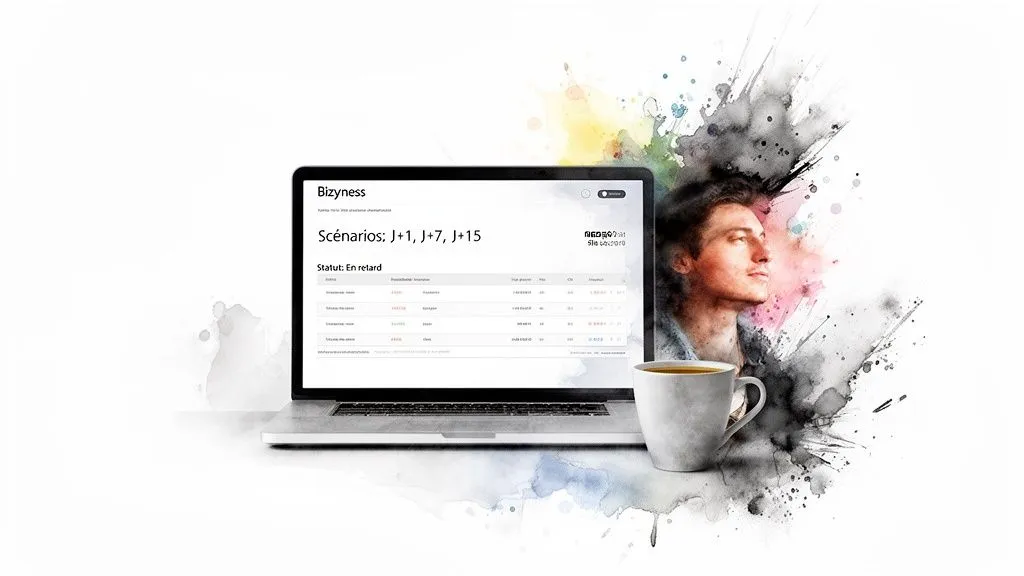
This dashboard is your control tower. No more juggling complex spreadsheets or sticky notes. At a glance, you know where your cash flow stands and what the next actions should be.
What are the concrete benefits for you?
Adopting an automated reminder system isn’t just a gimmick. It’s a strategic decision that will profoundly change your day-to-day management.
The first, most obvious benefit is the massive time savings. All those hours spent poring over due dates, drafting emails, and manually chasing clients, you can now devote to what really matters: growing your business, taking care of your loyal clients, or finding new opportunities.
Think of it this way: automating reminders isn’t an expense, it’s an investment. The time you recover and the cash flow you secure are the dividends of this decision.
Then there’s the mental load that disappears. No more that little end-of-day stress of thinking “I need to remember to follow up with so-and-so.” The system handles it in the background, with flawless consistency and professionalism. You can finally sleep easy.
Your brand image comes out stronger too. Tight, timely follow-up sends a strong message: you’re a serious, well-organized business. It strengthens the trust of your clients and partners.
To truly measure the impact of a solution like Bizyness, it’s helpful to know how to calculate the return on investment (ROI). This metric lets you precisely quantify what you gain by reducing payment delays and saving time.
Finally, Bizyness is designed to integrate with your other tools. To learn more, take a look at the integration options and discover how to connect your invoicing to the rest of your ecosystem. By centralizing everything, you give yourself the means to focus on your core business, with peace of mind.
Frequently asked questions about unpaid invoices
Facing unpaid invoices is part of everyday life for many entrepreneurs. Naturally, it raises quite a few questions. Let’s untangle the most common situations together so you have the right reflexes.
The idea here is to give you clear, directly actionable answers.
Can I charge penalties if they aren’t stated on my invoices?
The answer is no, and it’s an absolutely essential point to remember. To have the right to demand late payment penalties, as well as the €40 flat-rate compensation for collection costs, you must have clearly stated it beforehand. This must appear in black and white in your terms and conditions of sale and on each of your invoices.
It’s a legal requirement. If you omit it, you simply lose the right to claim them, even if the late payment is blatant.
Expert advice: Take literally five minutes, right now, to check your invoice templates and your terms and conditions. Adding that small line costs you nothing and secures your rights for the future. It’s a small step that can save you a lot of hassle.
What should I do if my client disputes the invoice?
Careful, this is a minefield. If a client disputes the quality of your work or the invoiced amount, you’re no longer in simple collection territory. You need to immediately pause the process. You’re no longer dealing with a missed payment, but with a commercial dispute.
The first thing to do is pick up the phone or send an email to understand what’s holding things up. Listen carefully to their complaints, gather all the elements on your side (signed quote, email exchanges, delivery notes…) and look for a way out.
- If there’s an error on your part, fix it without argument. Honesty always pays off.
- If the disagreement is more subjective, a commercial gesture can sometimes defuse the conflict and, above all, preserve a client relationship that has value.
- Whatever happens, keep a written record of every exchange. A simple summary email after a call can prove crucial.
If the dialogue is broken, solutions like the consumer mediator or the business mediator are excellent alternatives before considering legal action, which is often long and costly.
What is the deadline to claim an unpaid invoice?
Here we’re talking about statute of limitations periods, meaning the time you legally have to act. These periods vary depending on whether your client is a business or an individual. It’s vital to keep them in mind.
| Type of client | Limitation period |
|---|---|
| A business (B2B) | 5 years from the invoice due date |
| An individual (B2C) | 2 years from the invoice due date |
But let’s be clear: never wait until the last minute. That’s a major strategic mistake. The longer you wait, the slimmer your chances of seeing the money. A good collection strategy kicks off on the very first day of delay, not months later.
My client is undergoing court-supervised restructuring, what should I do?
Here, things change entirely. If you learn that a client has entered court-supervised restructuring or liquidation proceedings, you must immediately stop any collection or legal action attempt. It’s the law, designed to protect the struggling business.
Your one and only option is to file your claim. You must do this with the appointed receiver or liquidator. Pay very close attention to the deadlines: it’s generally two months after the judgment is published in the Bodacc official gazette. You need to be extremely responsive.
Will you get paid? Hard to say. It all depends on the remaining assets and your place in line among creditors. This situation is the perfect example of why it’s so important to manage unpaid invoices proactively, so you never end up in these extreme situations.
Don’t let unpaid invoices put your cash flow at risk any longer. With Bizyness, you can automate your reminders, track every payment in real time, and take back control. Simplify your daily routine and focus on your real job. Discover how Bizyness can secure your revenue starting today.
