

 Français
 Document retention period the practical guide
Master the document retention period for your business. Our practical guide details the legal timeframes to protect your activity.
The retention period for your business documents isn’t an exact science; it varies enormously depending on their nature, ranging from just a few years to several decades. For a sole trader, juggling these deadlines is a must. Remember these two key figures already: 10 years for accounting records and 6 years for tax documents. Mastering these timeframes will spare you a lot of legal and financial hassle.
Why respecting retention periods is an absolute priority
Let’s be honest, managing your company’s archives often feels like a chore. You stack, you file, you forget. Yet respecting the document retention period is far more than a simple administrative formality. It’s a genuine life insurance policy for your business. Think of your archives as a legal toolbox: each document is an instrument ready to defend you in a difficult situation.
This infographic gives you a quick overview of the main deadlines to keep in mind.
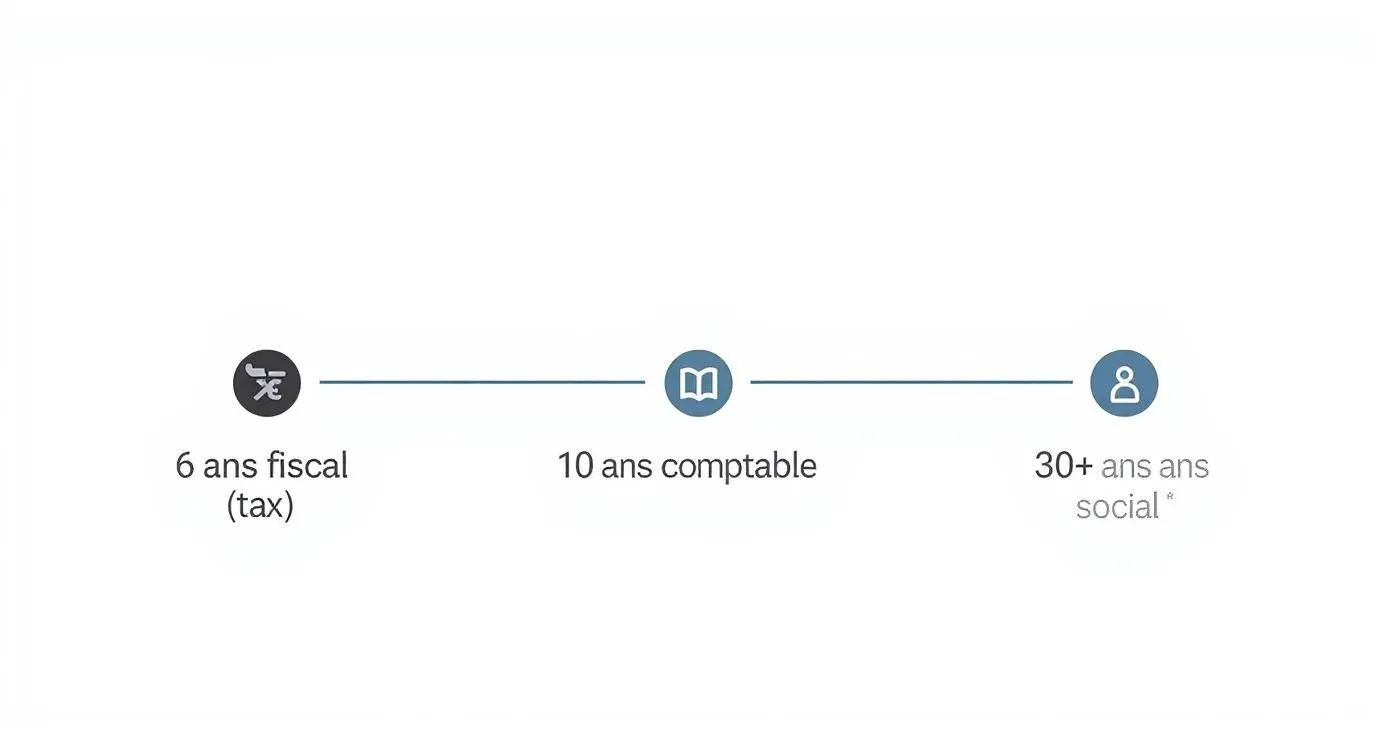
You can immediately see that timeframes range from 6 years for tax matters to sometimes much longer for other types of documents, which clearly shows the importance of a solid, well-thought-out archiving system.
The concrete risks of poor management
Ignoring these legal obligations exposes you to real and often costly risks. An unannounced tax audit, a client disputing a service, or even a claim from a former supplier… all of this can happen. Without the right supporting documents, proving your good faith becomes an almost impossible mission.
Being unable to produce a paid invoice or a signed contract can cost you dearly, far beyond financial penalties. It’s your company’s credibility and reputation that are at stake.
Rigorous document management is therefore not a constraint, but a genuine pillar for the security of your business. It’s what lets you sleep soundly and focus on what matters: growing your business.
If you’d like to dig deeper into the legal aspects of your day-to-day life as an entrepreneur, feel free to browse our articles dedicated to legislation for entrepreneurs.
Essential protection for the future
By applying these rules from the start, you build solid foundations for your business. You protect yourself against URSSAF audits, commercial disputes and tax reassessments. It’s a small investment of time for an immense gain in peace of mind and compliance.
To help you see things more clearly, here is a table summarizing the retention periods you absolutely need to know.
Quick overview of essential retention periods
This table summarizes the minimum retention periods for the most common documents, providing readers with a quick answer.
| Document type | Minimum retention period | Legal basis |
|---|---|---|
| Client and supplier invoices | 10 years | Article L123-22 of the French Commercial Code |
| Tax documents (income tax, VAT) | 6 years | Article L102 B of the French Tax Procedures Code |
| Commercial contracts | 5 years after the end of the contract | Article 2224 of the French Civil Code |
| Bank statements | 5 years | Practical recommendation for tracking |
| Corporate documents (bylaws, etc.) | 5 years after the company’s deregistration | Article L225-101 of the French Commercial Code |
Keep this table handy, it could well come in useful. By following these simple rules, you ensure sound and secure administrative management for your business.
Managing accounting and tax documents
Think of accounting and tax documents as the true financial backbone of your business. They are the ones that prove, in black and white, the health and reality of your company. It is therefore entirely normal for them to be particularly scrutinized by the authorities.
Finding your way around can seem like a real headache, but everything becomes clearer once you understand the logic behind it. The golden rule can be summed up in two key timeframes: 10 years for accounting documents and 6 years for tax documents. This difference is no accident; it simply reflects the different periods the authorities have to audit you.
As shown in this screenshot from the official Service-Public.fr website, the 6-year tax period is the baseline. But watch out, the Commercial Code often extends this obligation to 10 years for most accounting records.
The famous 10-year period for accounting records
It’s Article L123-22 of the Commercial Code that sets the rule: all accounting documents must be kept safely for 10 years. The countdown starts at the close of the relevant financial year. This long period has a simple purpose: to guarantee perfect traceability in the event of a commercial dispute or legal proceedings.
So, what documents are we talking about specifically?
- Mandatory accounting ledgers: the well-known journal and general ledger, which trace all transactions.
- Client and supplier invoices: they are irrefutable proof of every euro coming in or going out.
- Purchase orders and delivery notes: they confirm that transactions actually took place.
Think of this 10-year period as insurance. An invoice that seems 8 years old to you could suddenly become the only proof that saves you in a conflict with a former partner. If you’re interested in the topic, you can dig deeper with our dedicated guide on retaining accounting documents.
The 6-year period for tax documents
For its part, the tax authorities have what’s known as a right of reassessment. In plain terms, they can go back and check your returns. This right generally extends over three years, but can go up to six in certain cases. This is why the Tax Procedures Code (Article L102 B) requires you to keep documents for 6 years.
This period applies to all documents used to calculate your taxes:
- Your income tax or corporate tax returns.
- Your VAT returns.
- All supporting documents for the expenses you deducted.
An essential point not to forget: The calculation of the period starts from the date of the last transaction recorded in your books or the date the document was created.
For even smoother administrative organization, especially when preparing your accounts and tracking payments, it may be worth considering outsourcing administrative management.
How do you calculate the end date of retention?
Nothing like an example to make things clearer. Let’s imagine you have a supplier invoice dated June 15, 2023. Your financial year, meanwhile, ends on December 31, 2023.
- Accounting period (10 years): The count starts from the end of the financial year. So you must keep this invoice until December 31, 2033.
- Tax period (6 years): This period starts from the date the document was issued. You must keep it until at least December 31, 2029.
So, which date should you go with? It’s simple: always the longer one! To be safe, systematically apply the longer period, i.e. 10 years. By adopting this reflex, you’re guaranteed to always be compliant, without having to overthink it.
Mastering the archiving of corporate documents
Human resources management, even on a small scale, produces a pile of particularly sensitive documents. The retention period for corporate documents is therefore very strictly regulated, as it carries a dual responsibility for the employer.
On one hand, these archives are your best protection in the event of a URSSAF audit or a dispute with a former employee. On the other, they guarantee your employees’ rights, particularly everything related to their future retirement. It’s a balance to be respected scrupulously.
Key deadlines for personnel documents
Every document related to managing your employees has its own legal lifecycle. Knowing these timeframes isn’t optional, it’s a requirement to stay compliant and protect everyone.
Here are the main deadlines to keep in mind:
- Employment contracts: Keep for at least 5 years after the employee’s departure. This is the period during which a legal action related to wages can be brought.
- Payslips: Whether in paper or electronic form, the rule is 5 years. This period lets you respond calmly to any claim or verification.
- Single personnel register: This document, which lists all arrivals and departures, must be kept for 5 years after the last registered employee has left the company.
- Social security declarations: All your contribution declarations (URSSAF, retirement, etc.) must be archived for 3 years.
Rigorous organization is your best insurance against the unexpected. A well-filed contract can, years later, defuse a potentially conflictual situation in a matter of minutes.
The special case of electronic payslips
Going digital simplifies many things, but be careful, it comes with specific rules, especially for payslips. The law leaves no room for doubt.
When you issue electronic payslips, you must guarantee your employees access to these documents for either 50 years, or until they reach the age of 75.
This duration may seem staggering, but its purpose is clear: to ensure the employee will always have the supporting documents needed to assert their retirement rights. It’s a shared safeguard: the employee keeps an indelible record of their career, and you, as an employer, often delegate this long-term retention to a specialized provider.
Securing your legal and commercial documents
Beyond accounting and social obligations, your business generates a multitude of documents every day that directly involve your liability. These records, whether legal or commercial, form the basis of your relationships with your clients and suppliers. They must therefore be kept with the same rigor as your invoices.
Imagine a contract signed with a key partner. It’s not just a piece of paper: it’s the material proof of an agreement, the foundation of your collaboration. Keeping it safe is crucial to asserting your rights or defending yourself if a disagreement arises over the terms of a service.
The question that arises then is: how long do you need to keep all this? For commercial documents, the answer is largely dictated by an essential legal concept: the statute of limitations.
The basic rule: the 5-year statute of limitations
In commercial law, time erases debts and obligations… but not right away! The statute of limitations is the period beyond which legal action is no longer possible. And for most commercial obligations, this period is 5 years, as specified in Article L110-4 of the Commercial Code.
It’s this 5-year period that serves as a compass for a large part of your archives:
- Contracts with your clients and suppliers: Keep carefully for 5 years after the end of the contract. In the event of a dispute, this is your best insurance policy.
- Transport documents: Delivery notes, waybills… all these supporting documents must also be archived for 5 years.
- Important commercial correspondence: A decisive negotiation email, a formal notice letter? Keep them. The 5-year rule applies here too.
In short, respecting this 5-year period isn’t just an administrative constraint, it’s a protection. It’s the time needed to be sure that any potential dispute is behind you and that your business is safe.
Interestingly, this notion of retention period is a real balancing act for the state too. In France, archives related to Government deliberations are, for example, protected for 25 years, and those touching on private life for 50 years. A timeframe that may seem long, but is sometimes shorter than in neighboring European countries (60 or 75 years). To learn more about these trade-offs between transparency and protection, you can consult the information on the opening of public archives on culture.gouv.fr.
What about the documents that tell your company’s story?
Some documents are a bit like your company’s DNA. They don’t relate to a single transaction, but to its very existence. Naturally, these are kept longer.
Bylaws, for example, must be kept for at least 5 years after the company has been officially deregistered from the Trade and Companies Register (RCS). For management reports or minutes of shareholder meetings, the period is 3 years. Finally, remember to keep your insurance contracts for 2 years after their termination, just in case a late claim surfaces.
By understanding the logic behind each timeframe, you’re not just following rules. You become able to anticipate risks and better protect the interests of your sole proprietorship over the long term.
Choosing your physical or digital archiving method
Now that you know the legal retention periods, it’s time to put them into practice. Knowing how long to keep a document is one thing. Having an archiving system solid enough to find them again is even better! Whether you’re old school and stick to paper, or a fan of all-digital, the key is to choose a method and stick with it. Your documents must remain accessible, legible and secure.
The stakes are simple: a good archiving system turns this legal constraint into a mere formality. In the event of an audit, or if a client asks you for a supporting document, you should be able to put your hands on it within minutes, without stress.
Physical archiving: the tried-and-true traditional method
Good old paper filing still has a bright future ahead, on one condition: being rigorous. If you go with this solution, organization is your best ally. A logical, well-maintained filing system will keep you from turning your desk into an unmanageable pile of paperwork.
Think of your archiving system as your personal library:
- File by year: This is the simplest and often the most effective approach. One binder or archive box per financial year, and you’re done.
- Sort by document type: Within each year, create sub-categories: client invoices, supplier invoices, bank statements, social security declarations…
- Label clearly: A good label means information found. “Supplier Invoices - 2023” is infinitely clearer than a vague “Invoices”.
Where you store your archives is just as important as how you sort them. It must be protected from moisture, fire and prying eyes. The cupboard at the back of a damp basement is therefore to be avoided!
Digital archiving: the modern, secure solution
Going fully digital brings an obvious space saving and near-instant access to your documents. But be careful, for a scanned document to have the same legal value as a paper original, there are rules to follow to guarantee its reliability.
Scanning must be carried out under conditions that ensure the file is a perfect, unmodifiable copy of the original. The PDF/A format (where the “A” stands for Archiving) is designed for exactly this. It’s the standard for long-term retention.
Incidentally, in digital archiving, knowing how to manage and make use of data that isn’t always well structured (such as invoice scans) is a key skill. If this topic interests you, learn more about the transformation of unstructured data.
For bulletproof digital archiving, here are a few habits to adopt:
- Back up, again and again: The golden rule is the 3-2-1 rule. Always have 3 copies of your files, on 2 different media (e.g. external hard drive and computer), with 1 copy stored elsewhere (on a secure cloud service, for example).
- Create a logical folder structure: On your computer or cloud, reproduce the same logic as for paper. One folder per year, then subfolders by document type. Simple and effective.
- Name your files intelligently: Adopt a single naming convention for everything. For example: “YYYY-MM-DD_DocumentType_ClientName.pdf”. You’ll thank yourself later.
Whether you choose paper, digital, or a mix of both, the goal is the same: build a system you can rely on. To go further and optimize all your document workflows, take a look at our complete guide on document management for businesses.
Questions every entrepreneur asks about document retention

Managing archives can quickly become a headache. To help you see things more clearly and set up an organization that holds up, we’ve compiled the questions that come up most often among entrepreneurs. The idea is to give you clear, direct answers to clear up any remaining doubts.
What happens if I don’t respect the retention periods?
Ignoring the document retention period can cost you very, very dearly. And we’re not talking about theoretical risks: the consequences are very real and can hit hard, both your wallet and your peace of mind.
Imagine a tax audit. If you don’t have the right supporting documents on hand, the authorities can simply reject your accounts. What follows? An automatic tax assessment, often accompanied by hefty penalties.
But the danger doesn’t just come from the tax authorities. The risks are legal too.
- In the event of a commercial dispute: Without a contract or purchase order, how do you prove your good faith against a dissatisfied client or a supplier acting in bad faith? It’s almost impossible.
- In the event of a labor inspection: If you have employees, the absence of payslips or the single personnel register can trigger sanctions from the labor inspectorate or URSSAF.
In short, ignoring these rules exposes you to financial, legal and operational trouble. Your business would find itself weakened on all fronts.
Does a scanned document have the same value as the paper original?
Yes, absolutely! A digital document can have exactly the same evidentiary value as an original. But be careful, there are rules of the game to follow. A quick smartphone photo of an invoice won’t always be enough.
Article 1379 of the French Civil Code is clear on this point: to be valid, the digital copy must be deemed “reliable”. To achieve this level of reliability, your scanning process must guarantee that the document is a perfect copy, impossible to alter.
For a digital copy to be reliable, it must be an identical reproduction of the form and content of the original. The integrity of this copy must be guaranteed over time through secure processes, such as qualified timestamping or an advanced electronic signature.
Once you’ve produced this reliable copy, you’re entitled to dispose of the paper original. There are still a few exceptions, notably for certain very specific deeds such as notarized deeds.
How should a sole trader manage their archives?
Even though the sole trader (micro-entrepreneur) regime is simplified, it doesn’t exempt you from the same retention obligations as other companies, particularly for tax and commercial documents. The simplicity of the status is no excuse for a lack of rigor!
Specifically, here’s what you absolutely must keep:
- Your invoices (client and supplier): to be kept for 10 years.
- Your income ledger and purchase register: 10 years as well.
- Your revenue declarations to URSSAF: to be kept for 3 years.
A good habit to adopt is using an online invoicing tool. Most of these tools offer secure archiving features that are perfectly suited to the needs of a sole trader. It’s really the ideal solution for automating this task and sleeping soundly.
Don’t let paperwork slow down your momentum any longer. With Bizyness, automate your invoicing, keep an eye on your finances in real time and stay calm about your obligations. Try our tool for free and discover how simple an entrepreneur’s daily life can be at https://www.bizyness.fr.
