

 Français
Expense Report Accounting: The Practical Guide
Master expense report accounting. Our guide walks you through the journal entries, VAT handling, and the rules you need to follow.

Expense report accounting is far more than a simple line in a spreadsheet. It’s the operation that turns the business expenses your employees have advanced into genuine charges for the company. In plain terms, a simple receipt becomes a deductible expense that has a direct impact on your cash flow and your tax compliance. Rigorous management is therefore not optional — it’s a strategic necessity.
The core principles for managing expense reports

Behind expense report accounting lies a well-oiled process. Its purpose? To make sure every expense incurred by an employee for business purposes is correctly reimbursed and recorded, all while scrupulously respecting the legal framework.
For an expense to be approved without question, it needs to tick three boxes:
- Serve the company’s interest: A business lunch to close a deal? Fine. Dinner with friends? That won’t fly.
- Be proportionate: The expense must remain reasonable. A luxury hotel for a routine trip could be judged excessive.
- Have supporting documentation: This is the golden rule, the indispensable key. Without a proper invoice or receipt, there’s no reimbursing the employee or deducting the charge.
Don’t think of expense management as an administrative chore. It’s a genuine financial steering tool that protects your cash flow and shields you in the event of a URSSAF audit.
The impact on general accounting
Every approved expense report gives rise to a specific journal entry. In France, the framework is strict and requires using the right accounts to avoid getting things tangled up.
Concretely, an expense report is a document listing the expenses paid by an employee with their own money as part of their work. These expenses are always recorded as charges, mainly under the class 6 accounts of the French General Chart of Accounts (Plan Comptable Général). For example, account 6251 is used for travel expenses, and account 6256 for mission expenses such as restaurant meals or hotel nights. To dig deeper into the topic, feel free to consult dedicated resources on expense accounting.
Why the supporting document is the linchpin of the whole system
The supporting document is the cornerstone of the entire system. It’s not just there so the employee can be reimbursed. Its role is twofold:
- Prove the reality of the charge to the tax authorities so it can be deducted from your taxable income.
- Reclaim the VAT when the expense allows it, which can quickly add up to substantial savings for the company.
Be careful, a simple card payment slip is never enough. You need a detailed invoice specifying the nature of the purchase, the date, the amount excluding tax, and the VAT amount. The first step toward sound management is therefore training your teams to systematically request and keep complete supporting documents. It’s a habit that will save you time and money.
The journey of an expense report, from spending to reimbursement
Processing an expense report can quickly become a headache if you don’t have a well-oiled process. It’s a small mechanism that, if not properly maintained, can make the whole administrative machine grind. It always starts the same way: an employee spends money out of their own pocket for business needs.
From that moment on, a whole cycle kicks into gear. A simple receipt gradually turns, step by step, into a proper journal entry, then into a reimbursement to the employee’s account. This validation chain is absolutely crucial, not only for legal compliance but also to keep the company’s finances healthy.
First step: collecting and submitting the supporting documents
Everything starts with the employee. It’s their responsibility to gather all their original receipts. They then submit them, most often through dedicated software or by following the in-house procedure. What matters is that each expense is clearly itemized and justified by its business purpose.
To make life easier and avoid mistakes that waste everyone’s time, it’s best to provide the whole team with an expense report example. Standardizing the process from the start drastically reduces back-and-forth and questions.
It’s important to understand that a missing or incomplete supporting document isn’t just a small oversight. It’s a real risk for the company: the charge can’t be deducted, the VAT can’t be reclaimed, and the employee risks not being reimbursed.
Second step: internal review and approval
Once the expense report is submitted, it enters the approval workflow. This is where the manager, then the accounting or HR department, review it line by line. This review serves several specific purposes:
- Making sure everything complies with company policy (spending caps, allowed expense types, etc.).
- Checking that the supporting documents are valid: the company name must appear on them, along with the date, the details of the services, and the VAT amount.
- Checking the consistency between the expense and the employee’s assignment.
This infographic sums up the flow rather well, from the moment the employee submits their expense through to payment.
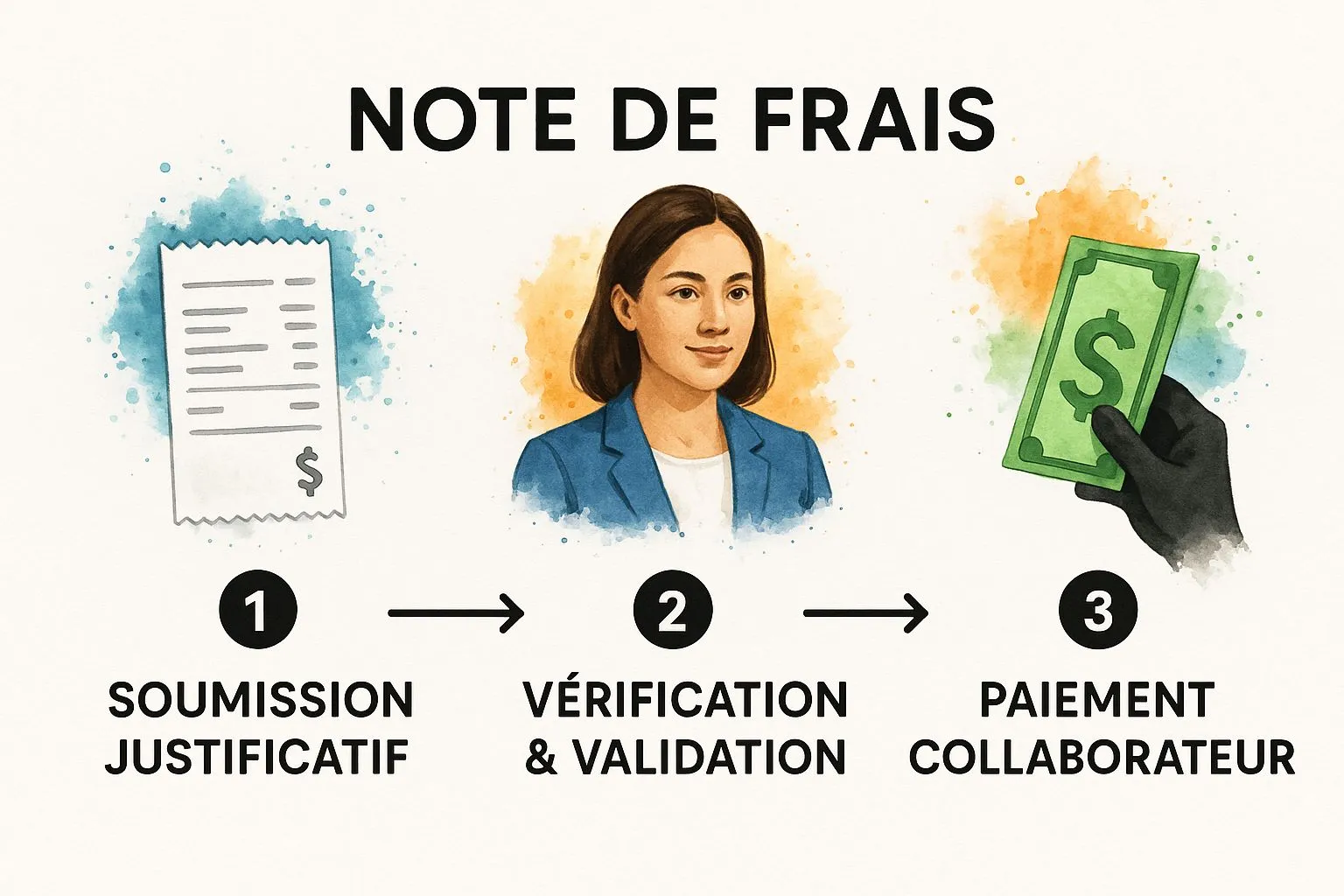
It’s clear that approval is really the key step that gives the expense its full legitimacy, whether from an accounting or a tax standpoint.
Final step: payment and archiving
Once everything is approved, the accounting department calculates the final amount to be reimbursed. The sum is then transferred to the employee, either as a separate payment or directly along with the following month’s salary.
Then comes the final phase, one that’s sometimes forgotten: archiving. All supporting documents, whether still on paper or already digitized with legal evidential value, must be carefully kept. The law is clear: 10 years. Well-organized archiving is the best insurance for staying at ease in the event of a URSSAF audit.
Mastering the journal entries for each type of expense
Now we get to the heart of the matter: turning a pile of receipts into flawless journal entries. This is where the expense incurred by an employee officially becomes a charge for the company. Each type of expense has its own rules, with specific accounts to debit and credit.
First reflex to have: forget the purchases journal. Unlike standard supplier invoices, expense reports belong in the miscellaneous operations journal (OD). It’s a detail that changes the whole processing logic.
The basic mechanics are always the same: you record the charge (debit) and recognize the debt owed to the employee (credit). Where it gets a bit more complicated is with the variety of expenses and, of course, the famous VAT handling.
Scenario 1: Mileage allowances
Imagine a sales rep who drove 300 kilometers in their personal vehicle for a client meeting. Your company applies the official tax scale, say €0.606/km. The calculation is simple: 300 km x €0.606 = €181.80 to reimburse them.
The journal entry is as straightforward as it gets, since these allowances are not subject to VAT.
- Debit account 6251 “Travel expenses” for €181.80 (the charge).
- Credit account 421 “Employees - Amounts owed” for €181.80 (the debt).
This is the perfect textbook case to get started. To navigate confidently between the different accounts, a good understanding of the French general chart of accounts is obviously a prerequisite.
Scenario 2: A business lunch with recoverable VAT
Your project manager takes a client to lunch to discuss a contract. The bill comes to €96 including VAT. This amount includes VAT at 10%, i.e. €8.73 (calculated on a pre-tax amount of €87.27).
Here, the VAT is recoverable. The lunch clearly served a business purpose and the invoice is properly issued. The entry therefore breaks down into three parts:
- Debit account 6256 “Missions” for the amount excluding tax: €87.27.
- Debit account 44566 “VAT on other goods and services” for the VAT amount: €8.73.
- Credit account 421 “Employees - Amounts owed” for the total amount including tax paid by the employee: €96.
This clearly shows how rigorous VAT management directly reduces the company’s tax burden.
Pro tip: To reclaim the VAT without risking a tax reassessment, the supporting document must be absolutely flawless. Require a proper invoice made out to the company, itemizing the pre-tax amount, the rate, and the VAT amount. A simple card payment slip is not enough for the tax authorities.
Scenario 3: A hotel night with non-deductible VAT
One of your developers travels to a conference and spends a night at a hotel. The bill comes to €120 including VAT. Be careful, this is a special case: in France, VAT on accommodation expenses is generally not deductible for employees or executives.
The accounting entry is therefore simpler, since there’s no need to isolate the VAT.
- Debit account 6251 “Travel expenses” for the total amount, i.e. €120 including VAT.
- Credit account 421 “Employees - Amounts owed” for the same amount of €120.
The full amount is recorded as a charge, full stop. This is a crucial tax subtlety to know in order to avoid costly mistakes.
To help you find your way around more easily, here’s a summary table of the most commonly used accounts.
Summary of accounting accounts for expense reports
This table gives you an overview of the main General Chart of Accounts entries to use for the different categories of expense reports.
| Expense type | Charge account (to debit) | Deductible VAT account (to debit) | Concrete examples |
|---|---|---|---|
| Transport | 6251 - Travel expenses | 44566 | Train ticket, plane ticket, taxi, toll |
| Mileage allowances | 6251 - Travel expenses | N/A | Use of a personal vehicle |
| Meals and entertaining | 6256 - Missions / 6257 - Entertaining | 44566 | Business lunch, client invitation |
| Accommodation | 6251 - Travel expenses | N/A (generally) | Hotel night, Airbnb rental |
| Other expenses | 626 - Postal and telecom expenses | 44566 | Phone bills, postage |
Knowing how to juggle these different scenarios is the guarantee of accurate accounting and an optimized tax position. It’s an exercise in rigor that always pays off.
Complying with URSSAF rules to avoid a reassessment
A management approach that’s a little too lax with expense reports opens the door to a real tax headache. URSSAF, which collects social security contributions, keeps a close eye on these reimbursements. Its objective is clear: to check that they don’t conceal disguised compensation, which would slip under the radar of social security contributions.
The line is sometimes blurry. An expense that isn’t judged 100% business-related, or that exceeds certain thresholds, can quickly be reclassified as a benefit in kind. If that happens, the reimbursed amounts are added back into the base used to calculate contributions. The bill can then become very costly for the company.
To avoid this kind of unpleasant surprise, URSSAF has set very clear exemption caps for the most common expenses. Following them to the letter is simply the cornerstone of your compliance.
Understanding the exemption caps
These caps aren’t there to restrict your employees’ spending, but to set a clear limit on what’s exempt from contributions. For meals, for example, URSSAF puts guardrails in place to prevent reimbursements from turning into benefits in kind. The cap for a meal taken away from the company is €10.10. If it’s taken at a restaurant, that amount rises to €20.70. Anything above this limit may be subject to contributions. To dig deeper into the topic, you can explore the finer points of this regulation on Cegid.com.
Staying vigilant is therefore essential, since these rules touch several types of expenses:
- Mileage allowances: the reimbursement is exempt, provided the official tax scale is followed scrupulously. This is calculated based on the vehicle’s horsepower and the number of kilometers traveled.
- Long-distance travel expenses: when an employee is on assignment far from home, daily allowances are set for meals and accommodation. Staying within these limits is the key to exemption.
It’s clear that good expense report management necessarily requires a thorough understanding and rigorous application of these scales.
The accountant’s role isn’t just to record numbers. It’s to be the guardian of compliance. Every supporting document they validate, every cap they enforce, is a shield against the risk of a reassessment.
Hot spots during an audit
When a URSSAF auditor opens your books, certain points immediately catch their eye. Above all, they’re looking for proof that every euro reimbursed served the company’s interest, not a personal expense.
Here’s what they’ll scrutinize:
- The nature of the expense: is it logical and consistent with the employee’s role and assignments? A sales rep taking a client to a restaurant is normal. A developer doing the same thing every day at lunch is more suspicious.
- The quality of the supporting documents: a detailed invoice made out to the company will always be more credible than an illegible card payment slip.
- The frequency of the expenses: consistently inviting the same people to a restaurant can raise suspicion.
- Compliance with the caps: if an overage is found, it must be handled on the payslip and subjected to the appropriate social security contributions.
By documenting every expense with surgical precision and applying the rules without exception, you turn your expense report management into a genuine fortress. And auditors don’t much like fortresses.
What if we went digital to optimize all of this?

Let’s be honest, manual expense report management is often a nightmare. Between receipts getting lost at the bottom of a bag, endless data entry into spreadsheets, and approval workflows that never seem to end, the process can quickly become a source of frustration. For everyone: employees waiting for their reimbursement and accounting teams chasing after supporting documents.
Fortunately, technology today offers solutions to turn this chore into a much simpler and more efficient process. It’s no longer just an option, but an almost unavoidable step forward for any company looking to be more productive. The idea is simple: ditch the paper for entirely digital workflows, from capturing the receipt all the way to the journal entry.
The concrete benefits of going paperless
Adopting a digital solution for expense report accounting delivers almost immediate results. The most obvious one? Time saved. It’s the end of hunting for receipts; all it takes is a photo with a smartphone to submit an expense in a few seconds.
But the benefits go much further:
- Fewer errors, guaranteed. Automation drastically reduces the typos and miscalculations that are so common with manual entry.
- Faster reimbursements. Approval workflows are sped up, which is a real plus for your employees’ satisfaction.
- A clear, real-time view. You know at all times where you stand on incurred expenses, which makes budget tracking much easier.
To really grasp what’s at stake, it helps to be aware of the hidden cost of the traditional method. A GBTA study showed that processing a single paper expense report costs a company an average of 50 euros, once you factor in the time spent by everyone involved. A figure worth pausing on.
How to choose the right tool to get started?
The success of this transition rests entirely on choosing the right tool. Good software should fit naturally into your working habits and make every step simpler, not more complicated. That’s the whole point of moving from paper documents to a management tool.
So, what should you look for in a solution? Here are the truly essential features:
- Optical character recognition (OCR): This is the magic technology that reads your supporting documents and automatically extracts the key information (amount, VAT, date, merchant). No more manual entry.
- Legally-compliant digital archiving: This is crucial. It ensures your digital supporting documents carry the same legal weight as the paper originals in the eyes of the tax authorities in the event of an audit.
- Accounting integration: The tool must be able to export the journal entries directly to your accounting software. This is the key to avoiding re-entering everything a second time.
- A simple, intuitive mobile app: For your teams to actually adopt the solution, it needs to be effortless to use on their smartphone.
By choosing a solution that ticks all these boxes, you’re doing far more than just scanning receipts. You’re setting up a smart system that secures your data, optimizes your costs, and, above all, frees up precious time so everyone can focus on what really matters.
The questions everyone asks about expense reports
Even with the best process in the world, expense report management generates its share of questions and edge cases. That’s entirely normal. A misplaced receipt, an unusual expense… and doubt creeps in.
This section is here to answer the most frequent questions head-on. The idea is simple: give you clear reference points to secure your practices, avoid costly mistakes, and, ultimately, make sure you’re fully compliant. Good information is the foundation of peace of mind.
How long do supporting documents need to be kept?
This is THE big question. The answer is simple and clear-cut: from an accounting standpoint, the law requires you to keep all your supporting documents for 10 years.
Why so long? Even though the tax authorities generally focus on the last three fiscal years, this ten-year period is your best insurance in the event of an in-depth audit or a dispute. Obviously, no one wants to turn their offices into a warehouse. That’s where legally-compliant digital archiving comes in. It’s the solution for guaranteeing the integrity of your documents over time, while freeing up valuable physical space.
Moving to digital archiving is no longer optional — it’s a strategic decision. In the event of an audit, finding an invoice several years old becomes child’s play. You preserve your evidence and protect yourself from any dispute.
What should you do if an invoice or receipt is missing?
The golden rule is inflexible: no supporting document, no reimbursement for the employee, and no charge deduction for the company. This is the principle that protects your company on both the tax and social security fronts.
So what should you do when an employee has lost a receipt? Their first move should be to contact the merchant or service provider to get a duplicate. This is often simpler than it seems, especially for expenses like a hotel night or a train ticket.
As an absolute last resort, there’s the sworn statement. But let’s be clear: it carries almost no weight in the eyes of the authorities. It in no way replaces a genuine supporting document. The best approach remains preventing the problem in the first place:
- Regularly remind your teams how important it is to keep every little receipt.
- Adopt a mobile app that lets them scan their supporting document the moment the expense is made. No more forgetting!
Do an executive’s expense reports follow different rules?
Fundamentally, no. The basic principles remain the same for everyone, executives and employees alike. The expense must serve the company’s interest, be a reasonable amount, and, of course, be justified by a properly issued invoice.
However, there is a major difference in practice: executives’ expenses are scrutinized very closely during a tax audit. The authorities are looking to make sure no personal expense has been disguised as a business one. Rigor must therefore be absolute.
There’s also a small accounting subtlety to know for self-employed executives (TNS - travailleurs non-salariés):
- An employee’s reimbursement is credited to account 421 “Employees - Amounts owed”.
- A self-employed executive’s reimbursement generally goes through a debit to account 455 “Partners’ current accounts”.
This distinction is more than a technical detail; it’s essential for keeping your accounting clear and avoiding any risk of reclassification as a benefit in kind.
Radically simplify your administrative management. With Bizyness, invoicing, expense tracking, and accounting preparation become effortless, leaving you more time to grow your business. Discover how Bizyness can lighten your daily workload.
