

 Français
Expense Report Management: Tips to Simplify Everything
Discover how to optimize your expense report management with practical tips, URSSAF rules and automated tools. Save time starting now!

Let’s be honest, expense report management is often the bane of administrative departments. We tend to see it as a simple accounting formality, but in reality it’s a process that weighs heavily on day-to-day operations: it eats up precious time, wears down team morale and, ultimately, affects the company’s financial health.
The real cost of expense reports: much more than a simple sum
Old-school expense report management, with its spreadsheets and stacks of receipts, is a real money pit. On one side, you have employees frustrated by drawn-out reimbursement delays. On the other, accounting teams on the verge of a breakdown from repetitive data entry. Behind this picture lie hidden costs that, added up, end up weighing very heavily. This administrative burden isn’t a minor detail — it’s a genuine strategic issue.

What we see, and above all what we don’t see
The cost of an expense report isn’t limited to the amounts reimbursed. The real price to pay lies in the heaviness of the process itself. Every step, from the moment your employee picks up their restaurant receipt to the final validation in accounting, generates indirect costs. The time a salesperson spends filling out their Excel file is time they’re not spending finding new clients.
The same goes for the accounting team. Checking every line, chasing missing receipts, correcting the inevitable data-entry errors… all of this represents an enormous productivity loss. Now multiply that lost time by the number of employees and the frequency of their expenses. The bill climbs very, very quickly.
The numbers speak for themselves. A recent study showed that in France, more than 8 out of 10 executives are required to submit expense reports. The catch? Processing a single expense report costs the company an average of 53 euros. Add to that a reimbursement delay that often stretches between 20 and 30 days, and you quickly understand why this creates tension. If you’d like to dig deeper into these statistics, this comprehensive guide to expense report management is an excellent resource.
The impact on productivity and workplace well-being
A slow, outdated reimbursement process is never without consequences for team morale. Waiting weeks to recover advanced money, sometimes significant amounts, can be a source of stress and give the impression that the company doesn’t care about its employees.
Optimizing expense report management isn’t just about improving an administrative process. It’s a concrete way to build trust, improve the employee experience and free up time for tasks that truly create value.
Conversely, implementing a simple, fast system sends a strong message: the company respects its teams’ time and investment. It’s a powerful lever to:
- Speed up reimbursements, which directly improves employee satisfaction.
- Limit data-entry errors, which are costly in correction time.
- Let accountants focus on financial analysis rather than tedious tasks.
- Guarantee legal compliance and protect against a potential URSSAF audit adjustment linked to poorly managed receipts.
Modernizing this process is therefore not a luxury. It’s an essential investment to better control costs, but also to build a calmer, more effective work environment.
Navigating URSSAF rules without stress
Managing expense reports isn’t just about stacking up receipts. For reimbursements to be properly exempt from social security contributions, you need to follow a very precise legal framework — that of URSSAF (the French social security contributions agency). A small oversight, a misinterpretation, and what should have been a simple reimbursement can be reclassified as a benefit in kind. And then you’re looking at contributions owed and the risk of an adjustment in the event of an audit.
Let’s be clear: mastering these rules isn’t optional, it’s an absolute necessity for the company’s financial health. The challenge is being able to prove, at any time, that every euro reimbursed corresponds to a real, justified expense incurred in the direct interest of the company.
Actual-cost reimbursement or flat-rate allowance: which to choose?
URSSAF gives you the choice between two main methods for reimbursing business expenses. Each has its own rules, advantages and drawbacks.
Actual-cost reimbursement is undoubtedly the most widespread. The principle is simple: the company reimburses, down to the last cent, what the employee spent. This requires iron discipline, since every expense must be backed by an original, detailed receipt, such as an invoice or receipt.
The flat-rate allowance, on the other hand, is a different story entirely. A fixed amount is paid to the employee to cover a certain type of expense, without them having to justify every euro. Amounts are governed by scales set by URSSAF, which vary depending on the expense (meals, extended travel, etc.). It’s administratively simpler, that’s for sure, but it’s also less flexible and doesn’t apply to every situation.
To see things more clearly, here’s a direct comparison of the two approaches.
Comparison of business expense reimbursement types
This table highlights the fundamental differences between the two methods authorized by URSSAF, to help you choose the one that best fits your situation.
| Criterion | Actual-cost reimbursement | Flat-rate allowance |
|---|---|---|
| Receipts | Mandatory and detailed for each expense. | Not required to justify the amount, but the reality of the situation must be proven (e.g., travel). |
| Accuracy | Exact reimbursement of amounts incurred. | Estimate based on a scale, potentially disconnected from the actual cost. |
| Administrative management | Heavier: collecting, checking and archiving receipts. | Simplified: less paperwork to process. |
| Flexibility | Total. Covers all justifiable business expenses. | Limited. Applicable only to situations covered by URSSAF scales. |
| Audit risk | Risk if receipts are missing or non-compliant. | Risk if the flat-rate application conditions aren’t met. |
| Example use | Business lunch with a client, purchase of small equipment, tolls. | Meal allowance for a traveling employee, mileage allowances. |
In short, the choice between actual-cost and flat-rate is never trivial. It has a direct impact on your administrative workload, your cost control and even your employees’ experience. Actual-cost reimbursement offers perfect control over expenses but takes time, while the flat-rate approach lightens management at the cost of lower accuracy.
Receipts: the crux of the matter
A reimbursement without a receipt is an open door to trouble with URSSAF. Every expense must be backed by a properly formatted accounting document. Watch out: a simple card payment slip isn’t enough, since it doesn’t detail the nature of the purchases.
To be valid, a receipt must include essential information:
- The supplier’s name
- The date of the expense
- The details of the products or services purchased
- The total amount including tax and the VAT breakdown
For certain expenses, you need to go further. A mileage expense report, for example, must state the reason for the trip, the location of the assignment, the number of kilometers traveled and the vehicle’s tax horsepower. Approximate management of receipts can be very costly, especially in the event of an audit. To fully understand the risks, feel free to read our article on false URSSAF declarations.
The infographic below speaks for itself when comparing a manual process to an automated system.
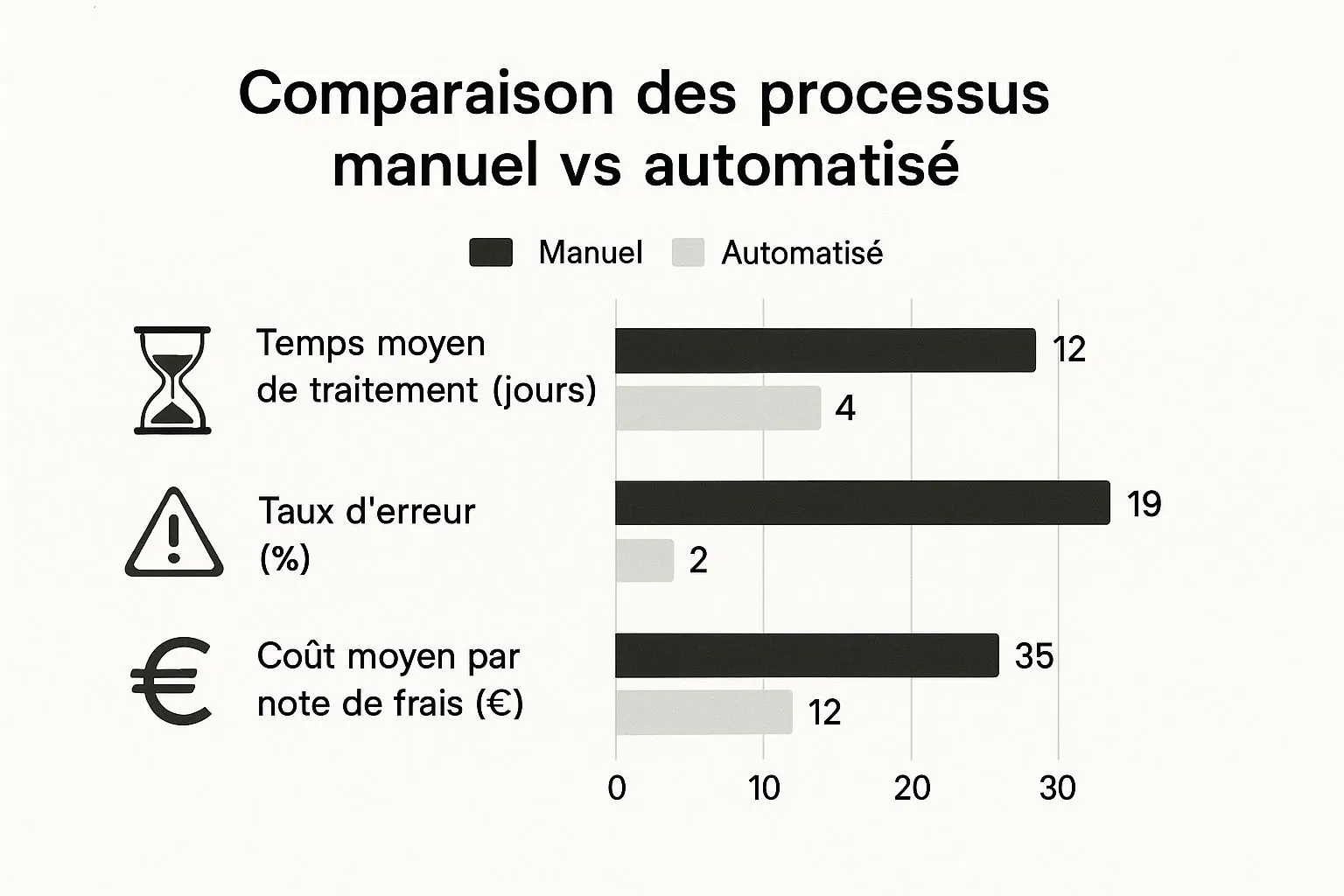
The numbers leave no room for doubt: automation saves a huge amount of time, cuts the error rate and drastically reduces the processing cost of each expense report.
Legally binding digital archiving, a now-essential safeguard
Since 2017, the law has taken a major step forward: it’s now possible to digitize expense report receipts. But careful — not just any way. Strict standards must be followed to guarantee their integrity and authenticity. This is known as legally binding digital archiving.
In practical terms, this means you can finally throw out those pesky paper receipts, provided your digitization process is certified. For this, the digital document must be:
- Authentic: the identity of the issuer can be guaranteed.
- Tamper-proof: the document cannot be modified once created.
- Intelligible: it must remain perfectly legible over time.
Today, choosing a management solution that includes this legally binding archiving is no longer a luxury. It’s genuine insurance against document loss, a way to radically simplify storage and, above all, a guarantee of compliance in the event of an audit. It’s the key to securing the entire chain, from the photo taken by the employee to final validation in accounting.
Building an expense policy that actually works
A clear expense policy is your best ally for sound, transparent expense report management. Forget long, tedious documents that no one ever reads. The goal is to set a framework of trust that’s simple and fair, so every employee knows exactly where they stand.
By clarifying the rules of the game, you control costs, of course, but above all you ensure that everyone is treated equally. And that defuses a lot of unnecessary frustration.

Set clear, logical rules
The first step is to list, in black and white, what’s reimbursable and what isn’t. Be precise so there’s no room for doubt. For example, a meal with a client is obviously covered, but the hotel minibar is not. This clarity avoids misunderstandings and simplifies life for managers who approve expenses.
Next, you absolutely need to set caps by category. These caps must be realistic and reflect the reality on the ground. A salesperson in Paris won’t have the same food costs as a technician traveling to a small provincial town.
Here are a few example categories to define:
- Meals: a cap for lunch (alone) and a different, separate one for a business dinner.
- Accommodation: a maximum amount per night, which can logically vary by city.
- Transport: you can encourage the most economical options, such as second-class train travel.
- Mileage allowances: the simplest approach is to align with the official URSSAF scale.
A good expense policy isn’t there to police, but to guide. It should be seen as a fair, practical tool that makes life easier for everyone, from the employee on the road to the accounting department.
Set realistic submission deadlines
Another essential pillar is timing. An employee shouldn’t wait six months to be reimbursed for their expenses, just as the company shouldn’t take weeks to pay them. Set a clear, firm submission deadline, for example 30 days after the date of the expense.
This time frame allows for much tighter financial tracking and avoids the avalanche of expense reports to process at year-end. For this to work, the validation and reimbursement process behind it must be just as fast and efficient.
Prevent abuse without falling into paranoia
Trust doesn’t rule out control, that’s certain. But this control needs to be smart. Setting strict rules is pointless if no one ever checks that they’re being applied. Without a minimum of rigor, abuses can be very costly. The example of France Télévisions, where overly lax management of corporate cards led to significant abuse, is quite telling. If you want to dig into the subject, you can read the details of this case which made a lot of noise at the time.
The idea isn’t to scrutinize every expense under a microscope, but to put in place a system that naturally discourages abuse. A modern management solution, for example, can automatically flag out-of-cap expenses or duplicates, which greatly simplifies the verification work.
Communicate to ensure buy-in
Let’s be clear: the best policy in the world is useless if no one knows or understands it. Once your rules are established, communication is absolutely crucial. And no, a simple email lost in the inbox won’t be enough.
To get everyone on board:
- Hold a short meeting to present the new policy and answer questions live.
- Create a concise, visual document (a single page is ideal) accessible to everyone, for example on the intranet.
- Illustrate the rules with concrete examples that speak to employees’ daily reality.
- Send regular reminders, particularly when onboarding new hires.
By involving your teams and explaining the logic behind each rule, you turn a simple administrative constraint into a genuine company project — one that serves healthier, fairer management for everyone.
Take it up a gear with the right tools
Technology is by far your best ally for putting an end to the expense report headache. Let’s be clear: abandoning manual processes for modern tools is no longer just an option. It’s a strategic decision that transforms what was once a frustrating cost center into a smooth, perfectly controlled process.
The most dramatic change? The end of manual data entry. Imagine your employees simply taking a photo of their receipt with their smartphone. In a few seconds, the magic happens.
Smart data capture, how does it work?
At the heart of this small revolution is OCR (Optical Character Recognition) technology. But today’s tools go well beyond that. They don’t just read the text; they understand its meaning. The amount, the VAT, the supplier’s name, the date… everything is automatically identified and sorted into the right fields.
Artificial intelligence plays a key role here. Solutions that integrate OCR have made tremendous progress and extract information with formidable accuracy. The data recognition rate now approaches 95%, which speeds up processing, limits human error and makes it easier to detect anomalies. If you’re interested in the topic of AI in expense management, this article tells you more.
In concrete terms, this automation eliminates a major source of frustration and errors, freeing up precious time for both your employees and the accounting team.
Faster approvals thanks to automated workflows
Once the data is captured, the real time savings come from automating approval workflows. No more expense reports getting lost on a desk or in an endless email inbox.
A good management tool lets you create custom approval workflows. For example:
- Multi-level validation: An expense is automatically sent to the direct manager. If it exceeds a certain threshold, it’s then escalated to the department head.
- Instant notifications: Managers receive an alert on their phone as soon as an expense report is awaiting their approval. They can approve it with a single click, wherever they are.
- Built-in expense policy: The system automatically applies the rules you’ve defined. An out-of-cap expense is immediately flagged, or even blocked.
This system brings unprecedented smoothness and traceability. Everyone knows exactly where the process stands, which considerably reduces reimbursement delays. It’s one of the pillars of business process automation, which aims to make workflows more efficient.
Detecting fraud and analyzing expenses
Automation doesn’t just speed up processing; it secures it too. The artificial intelligence built into these solutions is a genuine safeguard against fraud and costly errors.
A modern tool isn’t just a simple assistant, it’s a guardian. It monitors, alerts and analyzes, turning a stream of raw data into strategic information for your company.
These systems are capable of:
- Identifying duplicates: AI detects if the same receipt has been submitted multiple times, even on different dates or by different people.
- Spotting anomalies: An unusually high expense, a restaurant visited on a Sunday evening, or a purchase made outside working hours can trigger an alert for review.
- Analyzing trends: Thanks to real-time dashboards, you get a complete view of expenses. You can see at a glance which categories are the most costly, track budgets by team or project, and make decisions based on facts.
This screenshot of the Bizyness solution shows how a dashboard centralizes key information for effective oversight.
You can clearly see the breakdown of expenses and the key indicators, which makes it possible to react quickly and rely on reliable data.
By centralizing all this information, you can, for example, negotiate better rates with your most frequently used suppliers or adjust your expense policy to better match reality on the ground. Expense report management thus shifts from an administrative chore to a genuine lever for financial optimization. Investing in a suitable solution quickly pays for itself through productivity gains, fewer errors and better cost control.
Employees, managers: how do you streamline the process?
Even with the best software in the world, expense report management remains a human matter. For everything to run smoothly, there needs to be good collaboration between those who incur expenses and those who approve them. The idea is to turn this administrative chore into a simple, quick, painless habit for everyone.
And to get there, there’s no need to revolutionize your habits. A few good practices are often enough to make all the difference. By focusing on clarity and everyone’s sense of responsibility, reimbursement becomes a well-oiled process rather than a source of friction.

For employees: aim for approval on the first try
For those of you on the ground, the goal is simple: make sure every expense report goes through smoothly, without back-and-forth that wastes everyone’s time. It all starts with the quality of the information you provide.
The receipt is the foundation of everything. A blurry or poorly framed photo is the number-one cause of rejection. Take just one extra second to make sure the receipt is laid flat, ideally on a plain background, with good lighting. Absolutely everything must be legible: the amount, the VAT, the merchant’s name…
Next, be crystal clear in your description. A simple “Client meal” isn’t always enough. Prefer something more informative, like “Lunch with Mr. Dupont from company Y to finalize project X.” This small extra detail makes your manager’s job much easier and, logically, speeds up approval.
A few habits to adopt to make your life easier:
- Submit your expenses as you go. Don’t wait until the end of the month to send everything in bulk. By processing your expenses as they happen, you avoid forgetting anything and make life easier for accounting.
- Keep the company policy in mind. Knowing the caps and the types of allowed expenses helps you avoid unpleasant surprises.
- Make use of the tools available to you. If your company offers a mobile app, go for it! Capturing a receipt on the spot takes a few seconds and will save you a huge amount of time.
For managers: approve quickly and well
As a manager, you face a double challenge: being responsive so your teams aren’t left waiting for reimbursement, while ensuring company rules are properly followed. Think of yourself as a facilitator, not a gatekeeper.
A good tip is to block off dedicated time slots. Process expense reports in batches, for example every morning or twice a week. This will help you avoid being constantly interrupted while staying efficient. Modern management tools send automatic alerts — use them so nothing falls through the cracks.
Approving an expense report isn’t just an accounting act. It’s an act of management. By processing requests quickly, you show your team that you trust them and that you respect the money they’ve advanced.
And what if an expense isn’t compliant? Communication is key. Rather than a blunt rejection, take the time to explain why, constructively. For example: “Hi, I see this expense exceeds the set cap. Next time, make sure to check the limits defined in our policy.” This is a much more educational approach, which avoids frustration and helps people better internalize the rules.
Finally, know how to be flexible. An unforeseen situation can absolutely justify an expense that falls outside the usual framework. In that case, discuss it with the person concerned to fully understand the context. Fair, human management builds trust and engagement, making the whole process much more pleasant for everyone.
Frequently asked questions about expense reports
Even with the best organization in the world, expense report management always raises a number of questions. That’s completely normal. To help you see things more clearly, I’ve gathered here the answers to the questions that come up most often in practice.
The goal is to give you clear, directly usable answers to unblock everyday situations.
How do you calculate mileage expenses without getting it wrong?
Calculating mileage allowances is a classic source of errors. To avoid it, there’s no secret: the only reliable method accepted by the authorities is to rely on the official URSSAF scale, which is also updated every year.
This scale cross-references two key pieces of information: your vehicle’s tax horsepower (the famous “chevaux fiscaux,” or CV) and the total number of kilometers you traveled for work over the year.
For everything to be in order, your expense report must state the reason for the trip, the departure and arrival locations, and of course the exact distance. A simple tip: use a GPS app like Waze or Google Maps to record your trips. It’s reliable proof that’s hard to dispute.
It’s crucial to remember that this scale is a flat rate. It already covers everything: fuel, insurance, maintenance, and even the vehicle’s depreciation (wear and tear). You therefore cannot add other expenses of this type on top of it.
Is a photo of a receipt actually valid?
Yes, without a shadow of a doubt. Since a law passed in 2017, paper receipts are no longer mandatory. A simple receipt photographed with a smartphone can replace it, but watch out — there’s one non-negotiable condition: the digitization must guarantee what’s known as legally binding digital archiving.
In plain terms, this means your digital copy must be:
- Identical: a faithful reproduction of the original, without any alteration.
- Tamper-proof: the file cannot be modified once it’s saved.
- Durable: the document must remain perfectly legible over the years.
This is precisely why using a specialized management tool is more than a good idea. These solutions are designed to comply strictly with these legal requirements, giving you total peace of mind in the event of a URSSAF audit.
What are the deadlines for getting reimbursed?
On paper, the law is surprisingly flexible and gives employers a 5-year statute of limitations to reimburse an expense report. Needless to say, in reality, making an employee wait that long is simply unthinkable.
A good practice, shared by the vast majority of companies, is to aim for reimbursement within 30 days. This is a reasonable timeframe that’s often written into the expense policy in black and white.
Of course, this works both ways. The employee also has a duty to submit their expense reports within the deadlines set by the company. An employer is fully entitled to refuse reimbursement of an expense submitted six months after the deadline set by internal rules. The key is responsiveness on both sides.
I lost a receipt, what should I do?
Losing a receipt happens even to the most organized among us. The basic rule is simple: “no receipt, no reimbursement.” Fortunately, there are solutions for handling these exceptional cases.
The first instinct should be to try to get a duplicate from the supplier. If that’s truly not possible, most companies accept a sworn statement.
This document, which the employee must write and sign, must explain in detail the circumstances of the expense:
- The exact date and location.
- The exact amount.
- The nature of the purchase.
- And of course, the reason for the missing receipt.
Let’s be clear: this procedure should remain the exception that proves the rule. Overusing sworn statements is the best way to attract attention during an audit.
Stop wasting time on managing your expense reports and focus on your core business. Bizyness offers a simple, intuitive solution to automate everything, from photographing the receipt to reimbursement, while guaranteeing your compliance.
