

 Français
FEC file explained: a complete guide for 2026
Discover what the FEC file is, its role during a tax audit, and how to automate it for your e-commerce business to avoid common mistakes.

The Fichier des Écritures Comptables, or FEC, is far more than a simple administrative document. Think of it as your company’s fiscal passport, an ultra-detailed logbook of your activity that the tax authorities can request at any time in the event of an audit.
Decoding the Accounting Entries File (FEC)

More than a bookkeeping export, the FEC has become the DGFiP’s (French tax authority) tool of choice for analyzing your accounts. Think of it as your business’s digital health record: it traces every transaction, every sale and every expense, letting a tax auditor make a quick and accurate diagnosis of your financial management.
Its role has become absolutely central since it was introduced on January 1, 2014. Based on Article L.47 A-I of the French Tax Procedures Code, it is mandatory for any company that keeps its accounts on software.
To help you understand what’s behind this file, here’s a summary of the key points.
The FEC at a glance
This table sums up the essential characteristics of the Fichier des Écritures Comptables for a quick understanding.
| Element | Description |
|---|---|
| Full name | Fichier des Écritures Comptables (FEC) |
| Requirement | For any company subject to computerized bookkeeping |
| Introduced on | January 1, 2014 |
| Purpose | Standardize and facilitate tax audits |
| Format | Text file (.txt) with specific separators |
| Content | Every accounting entry for a fiscal year |
| Structure | 18 mandatory fields in a precise order |
| Submission | On request from the tax authorities during an audit |
In short, the FEC is the standardized, complete transcription of your accounts, ready to be analyzed by the tax authorities’ tools.
Why a simple Excel spreadsheet isn’t enough
Make no mistake: a simple spreadsheet export will never do the job. The FEC must follow an extremely rigid, fixed structure, with 18 well-defined columns, in a precise order. This standardization is exactly what lets the tax authorities automate their checks and detect anomalies at scale.
Each line in this file represents an entry, and to properly grasp it, you need to understand concepts like account allocation in accounting, which determines how each transaction is recorded. The slightest formatting error, a misplaced separator or wrong encoding, and your file is guaranteed to be rejected.
The FEC isn’t a mere formality, it’s an exhaustive snapshot of your activity, subject to close scrutiny. For an online seller, this means every sale on Shopify or Amazon must translate into a perfectly formatted accounting entry.
It’s precisely this requirement that makes native marketplace exports or homemade spreadsheets so risky. Understanding what’s at stake with the FEC is therefore the first step toward securing your business and calmly facing any tax audit.
Who is required to produce a FEC?
The obligation to provide a Fichier des Écritures Comptables (FEC) doesn’t apply to everyone. So how do you know if you need to prepare for it? Put simply, as soon as your bookkeeping is managed on software or a computerized system, there’s a good chance you’re affected.
This requirement applies to most companies, whether they pay corporate tax (IS) or income tax (IR). It therefore covers a very broad range of businesses, regardless of size or industry.
Businesses subject to the FEC requirement
During a tax audit, the authorities will expect a FEC from certain clearly identified taxpayers. If your company falls into one of these categories, you must be able to produce it.
- Commercial companies (SAS, SARL, SA, etc.) subject to corporate tax.
- Sole proprietorships whose income falls under industrial and commercial profits (BIC) or non-commercial profits (BNC), if they are under the actual taxation regime.
- Real estate investment companies (SCI), depending on their tax regime.
- Individuals declaring farming profits (BA) under the actual taxation regime.
In short, if you’re not under the micro-tax regime, producing a FEC is an obligation to be taken very seriously.
The special case of micro-entrepreneurs
We’re often asked about micro-entrepreneurs (the status that replaced auto-entrepreneur). The good news: as long as they stay within the limits of the micro-tax regime (micro-BIC or micro-BNC), they are exempt from providing a FEC. Their bookkeeping obligations are much lighter.
Be careful, though, this peace of mind has its limits. If a micro-entrepreneur’s revenue exceeds the authorized thresholds, they automatically move to the actual taxation regime. From that point on, the obligation to generate a FEC applies.
The FEC isn’t a periodic filing like VAT, but a one-off requirement triggered only during a tax audit. For an online seller on Shopify or Amazon, this means being permanently ready, since an audit can happen at any time.
Knowing whether you’re affected is the first step. For an online seller, that means having a perfectly clear view of your tax regime. Peace of mind comes from knowing your tools can generate this file on demand, without stress and without delay.
What does a compliant FEC file look like?
The Fichier des Écritures Comptables, or FEC, is far more than a simple Excel table. Think of it instead as your accounting’s flight plan, a standardized document that the tax authorities can read and analyze in the blink of an eye with their tools. It’s an extremely rigid format.
The structure is always the same: 18 columns, not one more, not one less, in a precise order. The file itself must be a plain text file (.txt), with columns separated by tabs. Forget commas or semicolons, that’s one of the most common technical mistakes and it can invalidate the entire document.
The 18 columns that decode your accounts
Each column has a well-defined role in reconstructing the trail of your transactions. Think of it as an ID card for every accounting movement.
Here are the essential fields to understand:
- JournalCode: A short code identifying the type of transaction (e.g.
VTfor sales,ACfor purchases). - JournalLib: The full name of the journal, such as
Sales Journal. - EcritureNum: The number that links all the lines of a single transaction. Think of it as the entry’s file number.
- EcritureDate: The date of the transaction, in
YYYYMMDDformat. - CompteNum: The account number from the chart of accounts (e.g.
707100for merchandise sales). - CompteLib: The clear label of the account (
Merchandise sales). - CompAuxNum and CompAuxLib: Fields to detail a third party, such as a specific customer or supplier.
- PieceRef: The reference of the supporting document, for example the invoice number. This field is essential for traceability.
- PieceDate: The date of the supporting document, always in
YYYYMMDDformat. - EcritureLib: A description of what the entry represents.
- Debit and Credit: The amounts. For each line, only one of these two columns can be filled in.
- And 6 other, more technical fields (
EcritureLet,DateLet,ValidDate,Montantdevise,Idevise) complete the file.
This diagram gives a clear picture of the structure and the companies concerned.
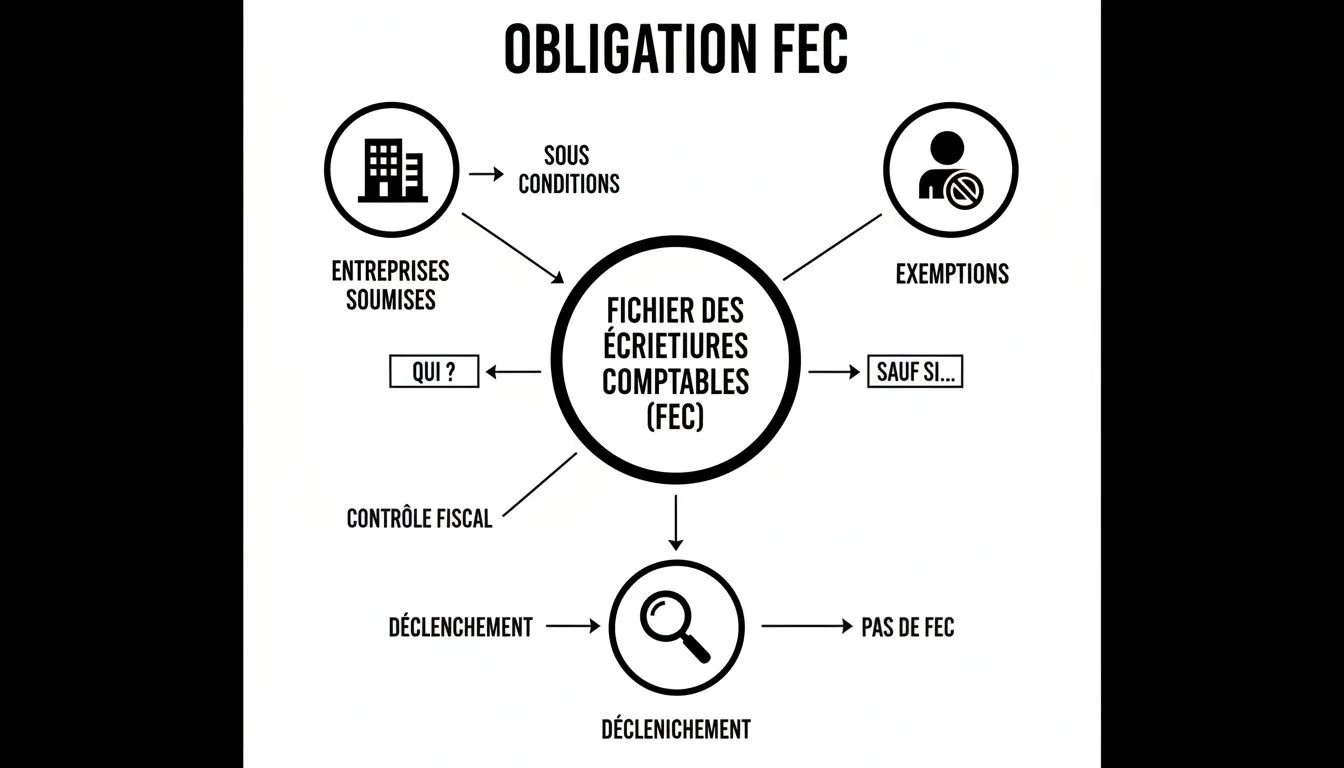
You can see that every piece of information has its own dedicated slot. It’s this meticulous organization that lets the tax authorities’ algorithms check everything automatically.
A concrete example for an online seller
Let’s take a case you know well: a sale on your Shopify store, paid by a customer via Stripe. A single order doesn’t translate into a single line in the FEC, but into a whole set of entries.
First there’s the entry for the sale itself (credit to the revenue account, credit to the VAT account), offset by a receivable from your customer (debit to the customer account). Then, the Stripe payout settles this receivable and records the fees charged by the payment platform.
All these lines, though distinct, must be linked by the same document reference (PieceRef) so the auditor can reconstruct the transaction’s full history.
The real challenge isn’t just recording every sale or refund. You need to know how to translate them into the strict language of accounting and the FEC, correctly linking marketplace commissions, payment fees and financial flows.
To dig deeper into the topic, feel free to read our complete guide to the Fichier des Écritures Comptables. Mastering this structure is the first step toward calmly facing a potential tax audit.
Identifying common FEC mistakes in e-commerce
For an online seller, generating a compliant FEC often feels like an uphill battle. The problems aren’t the same as for a traditional business. They’re closely tied to the very nature of e-commerce: a multitude of intermediaries, scattered financial flows and fees piling up at every step.
Let’s be clear: native exports from platforms like Shopify, Amazon or WooCommerce are not FEC files. They’re management files that list your orders, but they don’t reflect the accounting reality of these transactions at all. Trying to manually turn them into a FEC is almost guaranteed to produce costly errors.
The challenge of marketplace commissions and fees
The first, and most common, headache is breaking down revenue. A €100 sale on Amazon never means you’ll receive €100 in your bank account. The amount paid out to you has already been reduced by numerous intermediary fees.
- Sales commissions: The well-known percentage taken by the marketplace (for example, 15% on Amazon).
- Shipping fees: If you use a service like Amazon FBA (Fulfilled by Amazon), these costs are deducted at the source.
- Transaction fees: Those charged by payment processors like Stripe or PayPal.
- Advertising fees: Your PPC campaign budget is often deducted directly from generated revenue.
Each of these items must be recorded as a dedicated accounting entry in your FEC. Settling for a single “Amazon sale” line for the net amount received is a serious mistake. It amounts to hiding your true revenue and concealing expenses, something the tax authorities do not appreciate.
The complexity of payment reconciliation
And it doesn’t stop there. Another major point of friction is linking an order to its payment. Payment platforms often bundle the funds from several orders into a single transfer. How do you match that single transfer to dozens, or even hundreds, of separate sales?
The non-negotiable requirement for a valid FEC is traceability. An auditor must be able to take any order and follow its financial journey from start to finish: from the shopping cart on your site to the transfer into your bank account, including every commission deducted along the way. Doing this by hand, guaranteeing this reliable audit trail is nearly an impossible mission.
Add to that the handling of refunds, whether partial or full, and things get even more complicated. A partial refund on WooCommerce, for example, must be recorded as a new entry that reverses part of the original sale. It’s not simply a matter of editing the amount of the first transaction.
Breaking down international VAT
Since the arrival of the OSS (One-Stop Shop) and IOSS (Import One-Stop Shop) single windows, managing international VAT has become a critical issue. Every sale you make to an individual customer in another European Union country must be invoiced at that country’s VAT rate.
Concretely, for your FEC, this requires you to:
- Identify each customer’s country of residence.
- Apply the correct VAT rate for that specific country.
- Break down the VAT collected into separate accounting accounts for each country.
Your standard order export will never do this work. It will tell you a sale happened, but it won’t structure the tax information so it’s usable in the FEC. This is where manual processes or spreadsheets show their greatest limits, creating a huge tax risk in the event of a breakdown error.
How to generate and validate your FEC compliance
Spotting anomalies in your books is good. Knowing how to produce a compliant FEC file is even better. Let’s look concretely at how to generate this crucial file and, above all, how to make sure it’s fully in order before the tax authorities come knocking.
The simplest way to obtain your FEC is generally through your accounting software. Most tools on the market, such as Sage or Cegid, include a dedicated export function. In a few clicks, you select the fiscal year you’re interested in and the software generates the .txt file required by law.
If you work with a chartered accountant, chances are they’ll take care of it. They’ll use their own software to create the FEC from the information you provide them. This is a very reassuring option, but it doesn’t absolve you of responsibility: the quality of the file will always depend on the reliability and completeness of the information you send them.
Validating your file with the DGFiP’s official tool
Once you have the file in hand, how can you be sure it won’t be rejected during an audit? The tax authorities had the good idea of making a free testing tool available: Test Compta Demat. It’s a small piece of software you install on your computer that scans your FEC and checks its technical structure.
Note that this tool doesn’t check the substance of your accounts. Its job is to make sure the form is respected. It validates that:
- The file is indeed in
.txtformat with UTF-8 encoding. - The 18 mandatory columns are all present, in the right order.
- The separators (tabs) are used correctly.
- The dates and document numbers follow the expected standards.
Taking a few minutes to use Test Compta Demat is an excellent initiative. It’s a simple reflex that can save you a €5,000 fine for failing to present a valid file. You upload your FEC, and the tool gives you an instant verdict on its technical compliance.
Data accuracy, the real crux of the matter
Passing the technical test is one thing, but the true value of your FEC lies in the accuracy of your entries. To ensure the quality of your financial data well before you even think about the export, it’s worth mastering tools such as Excel’s financial functions to prepare and check your figures.
The Test Compta Demat tool confirms that the “container” is sound. But it’s up to you to guarantee the quality of the “content”.
A perfectly formatted file that contains incorrect or incomplete entries will cause just as many problems during an in-depth audit. For online sellers, the challenge therefore starts well upstream, with clean, well-structured source data.
Without this discipline, even the best accounting software won’t be able to work miracles. To better understand how to handle these data flows, feel free to check out our guide on how to export files in CSV format, a key format for transferring your information to your accounting tools. Mastering these fundamentals is how you’ll gain peace of mind when it comes to your tax obligations.
Automate your FEC generation with Bizyness
Managing bookkeeping and the FEC by hand as an online seller is a bit like trying to sort sand grain by grain. It’s slow, tedious, and the risk of error is enormous. Fortunately, there’s a solution designed specifically to spare you this headache: Bizyness. The platform was built as a direct answer to the difficulties we’ve just covered.
Today, automation is no longer a nice-to-have, it’s genuine insurance for your tax peace of mind. By connecting Bizyness to your stores (Shopify, Amazon) and your payment solutions like Stripe, every transaction is turned into a perfectly compliant accounting entry. No more manual entry, no more stress.
Bookkeeping finally suited to e-commerce
Where traditional accounting software waits for you to enter data, Bizyness fetches it directly at the source. This approach lets it automatically decode and process complex situations that are real error traps under normal circumstances.
- International VAT breakdown: The platform detects the destination country for each order and applies the correct VAT rate. The groundwork is already laid for your OSS/IOSS filings.
- Fee and commission management: Marketplace commissions or transaction fees are no longer buried in the mass. They’re automatically isolated and posted to the correct expense accounts. Your true revenue and real costs finally appear clearly.
- Foreign currency handling: Selling in dollars or pounds sterling? Bizyness handles the conversion and records transactions in euros, in line with French accounting rules.
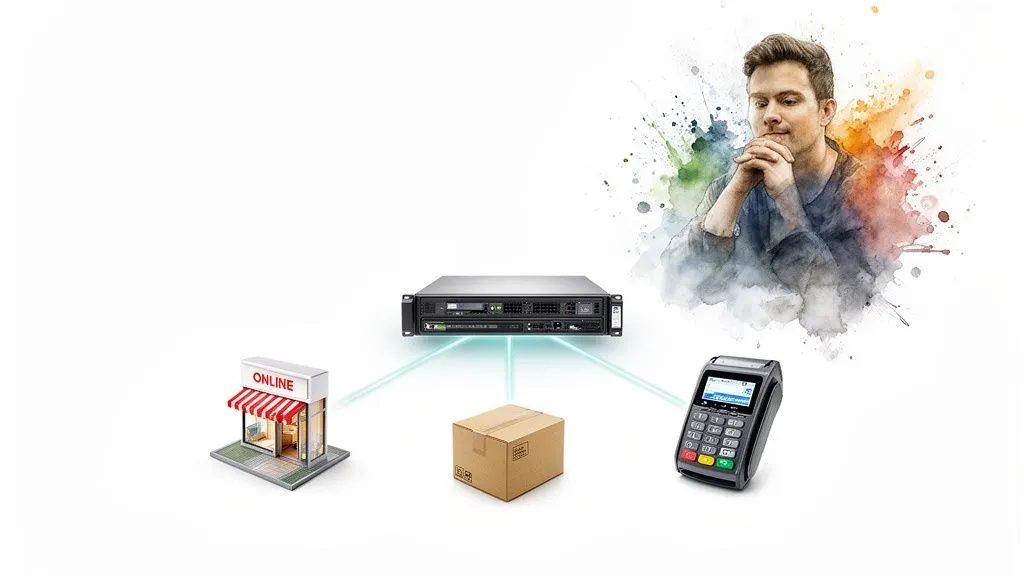
The image illustrates this idea well: Bizyness centralizes and interprets every financial flow of your business to produce clean, structured accounting, from invoicing to bank reconciliation.
The benefit is twofold. Not only do you save an enormous amount of time by saying goodbye to manual entry, but you also virtually eliminate any risk of human error. You can approach a potential tax audit with confidence, knowing your FEC is always up to date, compliant and ready to be exported in one click.
Your frequently asked questions about the FEC file
The Fichier des Écritures Comptables often raises plenty of questions. To help clear things up, here are direct answers to the questions we’re asked most often.
What happens if my FEC isn’t compliant?
On this point, the tax authorities don’t joke around. If you’re unable to present a FEC during an audit, or if the file provided is deemed invalid, the penalties are both swift and severe. You first face a €5,000 fine.
But the real risk, far more serious, is the outright rejection of your accounts. Concretely, if the authorities decide your accounts aren’t reliable, they can choose to recalculate your taxes themselves. And this reassessment rarely works in your favor.
Is my chartered accountant solely responsible for FEC compliance?
This is a fairly common misconception, but the answer is no. Responsibility is genuinely shared. Your chartered accountant’s job is to produce a technically correct file, that’s their profession. However, they can’t invent information.
They work from the raw data you provide them: your sales statements, your invoices, your expense reports… If these elements are incomplete, poorly organized or incorrect, the FEC will inevitably be too.
As a business owner, you are the guarantor of the quality and completeness of the source information. It’s by providing reliable data that you enable your accountant to build solid accounts.
Are micro-entrepreneurs affected?
In principle, no. Micro-entrepreneurs under the micro-tax regime (i.e. micro-BIC or micro-BNC) are exempt from this obligation. Their bookkeeping duties are indeed much lighter.
Watch out, though, for exceeding the revenue thresholds. If you move out of the micro-entrepreneur regime, you automatically switch to the actual taxation regime. From that point on, the obligation to generate a FEC in the event of a tax audit applies to you, just like any other company.
Does the FEC replace other accounting documents?
Absolutely not, and this is a crucial point to understand. The FEC is neither a balance sheet nor an income statement. Think of it instead as an inspection tool, a kind of digital magnifying glass the tax authorities use to zoom in on the entirety of your accounting entries.
It comes in addition to your usual obligations, such as preparing annual accounts. It doesn’t replace any existing document. For a refresher on this topic, feel free to read our article on retaining accounting documents.
Simplify your compliance and face the future with confidence. With Bizyness, automate the generation of your FEC and make sure your accounts are always up to date and compliant, effortlessly. Discover how Bizyness secures your e-commerce business.
