

 Français
Freelance invoicing: the complete guide to getting it right
The complete guide to freelance invoicing. Learn how to create compliant invoices, manage VAT, and get paid faster with our practical tips.

As a freelancer, an invoice is far more than a simple piece of paper. It’s the last impression you leave with your client, proof of your professionalism, and above all, the tool that guarantees you get paid. Careful invoicing is the key to securing your cash flow and building solid relationships.
Why your invoicing needs to be flawless

The freelancing world in France is exploding. This isn’t a minor trend — it’s a 92% increase in the number of independent workers since 2009. That’s huge! This increasingly fierce competition means every detail counts if you want to stand out. To get a sense of the scale of the phenomenon, take a look at the key figures on freelancing in France.
In this context, a well-crafted freelance invoice is not just a legal obligation. It’s a powerful communication tool that closes out your assignment and reinforces your brand image.
A matter of trust and professionalism
Imagine receiving a clear, well-presented document with not a single error. It inspires confidence, doesn’t it? That’s exactly the effect your invoice should have. It shows that you’re organized and reliable.
This isn’t just a minor detail. A professional invoice reassures your client that they made the right choice in trusting you, and encourages them to work with you again. From a well-placed logo to a crystal-clear description of services, every element helps build your reputation.
The best safeguard against late payments
We’ve all experienced it: the endless wait for a payment. The number one cause? An incomplete or unclear invoice. If your client’s accounting department has to get back in touch because information is missing, your payment gets put on hold. That’s a waste of time and energy for everyone.
A perfect invoice is one that raises no questions. It’s so clear that the accounting department can process it with their eyes closed, which guarantees a fast payment.
In short, mastering your invoicing means ensuring you can:
- Get paid faster by avoiding administrative bottlenecks.
- Maintain good relationships with your clients, without tense discussions over errors.
- Ensure the stability of your business with a regular cash flow.
It’s by getting these fundamentals rock solid that you’ll be able to grow your freelance business with peace of mind.
The essential elements on your invoice
For an invoice to be valid, both for your client and for the tax authorities, it must contain a certain number of crucial pieces of information. This is non-negotiable. A simple omission can not only delay a payment, but also expose you to a hefty fine, which can climb up to €75,000 for an individual. Suffice to say, it’s not worth the risk.
So let’s go through, point by point, what absolutely must appear on this document to protect your business.
Who’s billing whom? Your information and your client’s
This is the logical starting point: clearly identifying both parties. There should be no room for doubt about who is issuing the invoice and who is receiving it.
Information about you (the freelancer):
- Your full name or your business’s registered name.
- The address of your registered office.
- Your SIRET number, which is your business’s identity card.
Information about your client:
- Their full name or company name.
- Their address (registered office or billing address, if different).
Think of this information as the official header of your transaction. It proves the legal existence of both parties and anchors the exchange within a formal framework.
A tip from experience: always take a minute to double-check your client’s details. A typo in the company name or an address error can be enough to stall the entire payment process, especially in large companies where everything is very compartmentalized.
The identity of the invoice itself
Once the parties are clearly identified, the document itself needs its own identity. This is what guarantees its traceability and compliance. Rigor here is your best ally.
Here are the elements that must appear without fail:
- The word “Invoice”: it must be written in plain sight, impossible to miss.
- A unique invoice number: it must follow a logical, chronological, gap-free sequence. We’ll come back to this in detail shortly.
- The issue date of the invoice.
- The date of the service or sale, if it differs from the issue date.
These details are fundamental for the tax authorities. If you want to dig deeper into each aspect, our complete guide to mandatory invoice details has you covered.
The heart of the matter: the details of your services
This is where your client will pay the closest attention. They want to understand exactly what they’re paying for. The more transparent and detailed you are, the less room you leave for discussion or questions.
For each service or product, the invoice must list:
- A clear description: Avoid generic terms like “Marketing consulting.” Prefer something concrete like “SEO audit of the website and 25-page report.”
- The quantity: The number of hours, days, items delivered…
- The unit price excluding tax (net of VAT): This is your rate per unit (hourly, daily, per word…).
- The applicable VAT rate: If you’re subject to VAT, clearly state the rate (for example, 20%).
- The total amount excluding VAT.
- The total VAT amount.
- The total amount including all taxes (gross of VAT), the amount the client owes you.
A special note is needed if you’re a micro-entrepreneur (sole trader) under the VAT exemption scheme. In this case, you don’t charge VAT, but you’re required to state this. The legal wording is: “VAT not applicable, art. 293 B of the French General Tax Code”. This is what justifies the absence of VAT to anyone reviewing the invoice.
To make your life easier, here’s a handy checklist to keep on hand.
Quick checklist of mandatory details
Use this table as a checklist before every send-off, to make sure you haven’t forgotten anything.
| Element | Description | Example or Practical Tip |
|---|---|---|
| Issuer identity | Your name, address, SIRET number. | Put this information in the header or footer of your template. |
| Client identity | Your client’s name and address. | Ask for confirmation by email to avoid errors. |
| Invoice number | Unique, chronological, and without gaps. | Format: YEAR-MONTH-XXX (e.g. 2024-05-001). |
| Issue date | The day you create the invoice. | Don’t confuse it with the date of the service. |
| Service details | Clear line items for each service/product. | Be precise: “Article writing” becomes “Writing of article X (1,200 words)”. |
| Price (net, VAT, gross) | Breakdown of amounts. | Double-check your calculations, especially with multiple VAT rates. |
| VAT statement | The rate, or the exemption notice. | For micro-entrepreneurs: “VAT not applicable, art. 293 B of the French General Tax Code”. |
| Payment due date | The deadline for settlement. | E.g. “Payment on receipt” or “Payment within 30 days”. |
Keeping this structure in mind will save you precious time and spare you a lot of administrative hassle.
VAT and invoice numbering: the two pillars of your compliance
Let’s tackle two topics that often seem a bit scary at first: VAT and invoice numbering. Yet once you understand the logic, everything becomes much simpler. Managing these two aspects well means real peace of mind when it comes to the tax authorities.
Most freelancers just starting out, especially as micro-entrepreneurs (sole traders), benefit from what’s known as the VAT exemption scheme (franchise en base). What does that mean in practice? Simply that you don’t collect VAT on behalf of the state. Your invoices are therefore issued net of VAT.
In return, you must add a specific statement to every invoice: “VAT not applicable, art. 293 B of the French General Tax Code.” This is non-negotiable.
This simplicity naturally has limits, defined by revenue thresholds you must not exceed. For services, the reference threshold in 2024 is €36,800 per year. If you go above it, you switch over and must charge VAT starting the following year.
Managing VAT thresholds like a pro
Watch out, there’s a subtlety: an “increased” threshold set at €39,100. If you cross this second threshold during the year, things move faster. You become liable for VAT immediately, from the first day of the month in which you exceeded it. It’s therefore crucial to keep a close eye on your revenue at all times.
Anticipating the switch to VAT is a key skill. Imagine you cross the increased threshold in October. You’ll then not only need to start charging VAT on all your new assignments, but also issue a corrected invoice for the service that pushed you over the threshold. It’s better to prepare for it!
Once you become liable for VAT, the way you present your invoices changes. They must clearly show:
- The amount excluding VAT (net)
- The VAT rate applied (most often 20%)
- The total amount of VAT collected
- And of course, the final amount including all taxes (gross)
The upside is that you can also deduct the VAT on your own business expenses. To fully master the topic, our complete guide to calculating VAT is here to help.
Setting up bulletproof numbering
Now let’s move on to numbering. On this point, the law is strict: every invoice must have a unique number and be part of a continuous chronological sequence, without a single gap. The goal is simple: to prevent any fraud, such as deleting an invoice or creating a fake document.
Forget simplistic numbering like “1, 2, 3…” right away. It’s the best way to make mistakes and it lacks professionalism. It’s better to adopt a more solid system from the start.
A widely used and particularly effective format is based on the date: YEAR-MONTH-NUMBER.
- For example, your very first invoice in May 2024 would carry the number 2024-05-001.
- The next one, even if issued the same day, would logically be 2024-05-002.
This method has several advantages:
- Intuitive: it simply follows the passage of time.
- Reliable: the risk of creating a duplicate is virtually nonexistent.
- Professional: it conveys an image of organization and rigor to your clients.
Another equally valid option is the YEAR-NUMBER format (for example, 2024-001, 2024-002…). What matters most is choosing a clear rule and never changing it again. Tools like Bizyness fully automate this process, guaranteeing perfect numbering without you having to think about it.
Perfecting your invoice template
Far more than a simple piece of paper (or a PDF), your invoice is often the last contact you have with your client at the end of an assignment. It’s the finishing touch, the final impression you leave them with. A well-designed, professional freelance invoice doesn’t just claim payment — it reaffirms the quality of your work.
Think of it as an extension of your brand image. A clear design that reflects your visual identity (logo, colors) turns this administrative obligation into a real communication tool. It’s a subtle way of showing that you’re organized, detail-oriented, and proud of what you do.
Which tool should you choose to create your invoices?
Even before thinking about design, the question of which tool to use comes up. Everyone has their preferences, but here are the most common options, with their pros and cons.
- The trusty spreadsheet (Excel, Google Sheets): This is often where people start. It’s free, flexible, and most of us are more or less used to it. The trap? Data-entry errors, calculation formulas that break, and above all, numbering management that can quickly turn into a nightmare.
- Online invoice generators: Handy for a one-off need. They’re fast, often free for basic use, and have the merit of automatically including all the mandatory details. The downside is that customization is often very limited.
- Dedicated invoicing software: This is the solution for comfort and peace of mind. Tools like Bizyness are designed for independent workers. They handle everything for you: automatic numbering, VAT calculations, polished template creation… A significant time saver and a priceless peace of mind.
The secrets of an invoice template that hits the mark
A good invoice template must strike the perfect balance between aesthetics and functionality. The goal is simple: your client should be able to spot the key information at a glance.
The French freelancing world is becoming increasingly demanding. A recent study found that 77% of freelancers hold at least a bachelor’s-level degree, and 54% a master’s-level degree. This rise in qualifications naturally comes with an expectation of professionalism at every level, invoicing included. To learn more, you can check out the figures on the evolving profile of freelancers on tool-advisor.fr.
Your invoice should reflect your expertise. A spacious layout, a legible typeface, and a clear visual hierarchy (with the total amount standing out immediately) aren’t minor details. They’re what makes life easier for your client’s accounting department and, ultimately, speeds up your payment.
A few concrete tips:
- Your logo first: Place it at the top, clearly visible, but without letting it take over the page.
- Keep the font simple: Skip overly original typefaces. A safe choice like Arial, Helvetica, or Lato does the job perfectly.
- Structure the information: A table with well-defined columns (description, quantity, unit price, total net) is the clearest way to present things.
- Make the final amount stand out: Put the total gross amount in bold or with a slightly larger font size. It should be impossible to miss.
Taking a little time to fine-tune this template will make your life easier for months and years to come, while reinforcing a solid, trustworthy brand image.
Best practices for sending and tracking your invoices
Having a flawless invoice is one thing. Making sure it gets paid on time is another — and far more crucial for your cash flow. Sending and follow-up aren’t mere formalities; they’re a strategic part of your work as a freelancer.
Forget postal mail. Today, everything happens by email: it’s instant, traceable, and far more eco-friendly. The golden rule? Always attach your invoice as a PDF. It’s a universal, non-editable format that instantly establishes your professionalism.
But the attachment isn’t everything. The body of your email is your first point of contact regarding payment. A clear, polite, and personalized message makes all the difference.
Perfecting your sending email
To stack the odds in your favor, your email should get straight to the point. No room for ambiguity. Here’s what it should contain to be perfectly clear:
- A subject line that speaks for itself: Your client should know what it’s about without even opening the message. For example: “Invoice no. 2024-07-012 - SEO writing services”. Simple and effective.
- A brief reminder of the assignment: A short sentence to provide context is enough. “Please find attached the invoice for our collaboration on the [Project name] project for the month of July.”
- The total amount including tax: Display it clearly in the email. You make life easier for your contact, who won’t need to open the PDF to get the key information.
- The due date: Clearly restate the payment deadline you agreed on.
This email sets a professional tone from the outset. It minimizes the risk of oversight or confusion and shows that you’re organized.
Setting up a tracking system
Without a minimum of tracking, you’re flying blind. At first, you don’t need anything elaborate. A simple spreadsheet, in Excel or Google Sheets, does the job perfectly. What matters is capturing the essential information: invoice number, client name, amount, date sent, due date, and status (sent, paid, overdue).
The secret is consistency. Block out 15 minutes every Friday to update this spreadsheet. This simple habit will give you clear visibility over your cash flow and let you anticipate follow-ups.
As your business grows, spreadsheets show their limits. Considering integrated management software like Dolibarr can then become a significant time saver.
This decision tree can help you see more clearly which tool is right for you.
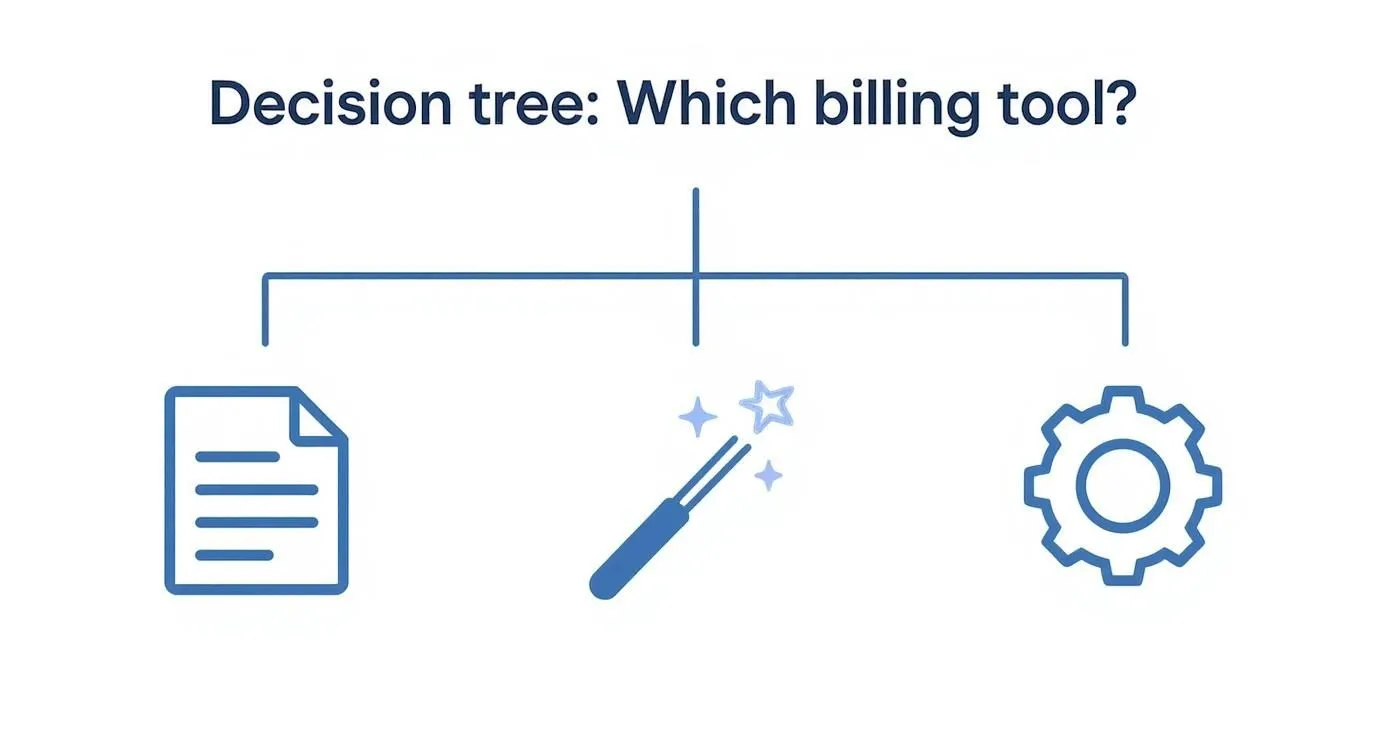
It’s clear that switching to dedicated software is often driven by the need to automate and gain professionalism.
The art of the follow-up: polite but firm
Nobody enjoys chasing payments. Yet it’s sometimes a necessary step to protect your cash flow. The trick is to escalate gradually, while always staying courteous.
A first reminder can be sent a day or two before the due date. It’s a simple, friendly nudge, often seen as good follow-up rather than a complaint.
If payment still hasn’t come through, a second message, a few days after the deadline, is warranted. The tone should be a bit more direct, but always respectful.
Unfortunately, sometimes that’s not enough. You then need to move on to more formal steps. To learn how to handle these situations without damaging your client relationship, our complete guide on following up on an unpaid invoice is here to help.
Frequently asked questions from freelancers about invoicing
To wrap up this guide, let’s go through the questions that come up most often. It’s normal to have doubts about certain details, and my goal here is to give you clear, direct answers so that invoicing is no longer a source of stress.
Mastering these few rules will help you avoid common mistakes, but above all, it will reinforce your image as a reliable, organized professional.
Can you modify an invoice that’s already been sent?
The answer is very simple: no. Once an invoice has left your outbox and reached your client, it becomes an official accounting document. Untouchable. It can neither be modified nor deleted.
So what should you do if you made a mistake on an amount or misdescribed a service? The legal procedure is very precise. You need to issue what’s called a credit note. This new document cancels out, partially or fully, the original invoice. Once that’s done, you can then create a brand-new invoice, this time correct, with a new number. It may seem a bit rigid, but it’s the only way to keep flawless accounting records and stay at ease in the event of an audit.
What should you do if a client doesn’t pay?
This is the situation every freelancer dreads. Fortunately, there’s a method you can follow to handle unpaid invoices without immediately triggering a conflict.
- The friendly reminder. A few days after the due date, a simple, polite email is often enough. In most cases, it’s simply an oversight, and the matter is resolved within the day.
- Direct contact. If the email goes unanswered, a phone call is often the best solution. Talking things through in person can unblock the situation and help you understand what’s going on.
- The formal notice. If dialogue leads nowhere, it’s time to move up a level. A formal notice letter, sent by registered mail with acknowledgment of receipt, is an official document with legal weight. It’s the first formal step before considering more serious debt-collection proceedings.
Do you need to invoice a deposit?
Yes, absolutely. Every euro that comes into your account from a client must be justified by an invoice, and deposits are no exception. You must therefore issue a deposit invoice.
It must contain all the mandatory legal details, just like any other invoice. Later, when you issue the final invoice (known as the balance invoice), you’ll of course need to mention the deposit already received and deduct it from the total amount.
How long do you need to keep your invoices?
In France, the law is very clear on this point. You must keep all your invoices, whether issued by you or received from your own suppliers, for a period of 10 years. This period starts from the closing date of the relevant accounting year.
And be careful, this retention obligation applies just as much to paper invoices as to electronic ones. A friendly tip: opt for a reliable digital storage system, such as a secure cloud or management software. It’s the best way to archive your documents safely and find them easily whenever you need them.
Don’t let paperwork hold back your growth any longer. With Bizyness, automate your invoicing, track your payments in real time, and stay compliant effortlessly. Discover how Bizyness can simplify your freelance daily life.
