

 Français
How to calculate your company's revenue easily
Find out how to calculate your company's revenue (turnover). Our practical guide breaks down the pre-tax/VAT-inclusive formulas with concrete examples.

Calculating revenue (turnover) is often the first thing people look at to take the pulse of a business. In its purest form, the formula is simple: multiply the selling price of your products or services by the number of units sold over a given period.
This indicator measures the total volume of your business, before any deduction of expenses. It’s the essential starting point for assessing the financial health of your business.
Mastering the basics of revenue
Revenue, or turnover, is a direct reflection of your commercial momentum. It represents the sum of all the sales you’ve invoiced to your customers, whether over a month, a quarter, or a full year. Think of it as the thermometer of your performance: it shows whether your offer is appealing and whether you’re managing to generate income.
Knowing how to calculate your revenue is a fundamental skill, whatever your status: freelancer, small business owner, or craftsperson. This figure is your ally for:
- Measuring your growth by comparing results from one period to another.
- Building solid financial forecasts to guide your decisions.
- Positioning yourself against the competition and understanding your market share.
- Talking with your partners (bankers, investors) using tangible data.
The crucial difference between pre-tax and VAT-inclusive revenue
When talking about revenue, one distinction is essential from the outset: the difference between the pre-tax amount (excluding VAT) and the VAT-inclusive amount. It’s a nuance that changes everything.
VAT-inclusive revenue corresponds to the total amount your customers pay you. This amount includes Value Added Tax (VAT), a tax that you merely collect on behalf of the State. This money therefore does not belong to you.
Pre-tax revenue, on the other hand, is the amount that remains once VAT has been deducted. This is the figure that represents the wealth your business has actually created. It’s on this basis that you should analyze your performance and keep your books.
The right reflex to adopt: Always steer your business by relying on your pre-tax revenue. It’s the only figure that truly reflects your real income.
A simple example to help you understand
Let’s imagine a craftsperson selling one of their creations for €120 VAT-inclusive. In France, the standard VAT rate is 20%.
- The VAT-inclusive revenue collected for this sale is €120.
- The amount of VAT to be paid to the State is: €120 / 1.20 x 0.20 = €20.
- Their pre-tax revenue is therefore: €120 - €20 = €100.
It’s on this basis of €100 that they’ll need to calculate their margin and profitability. Calculating revenue really is the cornerstone of any economic analysis.
To help you see things more clearly, here’s a summary of the key formulas to keep on hand.
Key formulas for calculating your revenue
This table summarizes the essential calculations for converting between pre-tax and VAT-inclusive amounts, with concrete examples so you never have to hesitate again.
| Type of revenue | Calculation formula | Concrete example |
|---|---|---|
| Calculating pre-tax revenue | Pre-tax selling price x Quantity sold | A consultant invoices 10 days at €500 pre-tax. Their pre-tax revenue is €5,000. |
| Converting VAT-inclusive to pre-tax | VAT-inclusive amount / (1 + VAT rate) | A product is sold for €240 VAT-inclusive (20% VAT). Pre-tax revenue is 240 / 1.20 = €200. |
| Calculating VAT | Pre-tax amount x VAT rate | For pre-tax revenue of €200, VAT at 20% is 200 x 0.20 = €40. |
| Converting pre-tax to VAT-inclusive | Pre-tax amount x (1 + VAT rate) | For pre-tax revenue of €200, VAT-inclusive revenue is 200 x 1.20 = €240. |
Keeping these formulas in mind will save you precious time and help you avoid many mistakes.
To deepen your knowledge of revenue calculation and other business indicators, resources such as the Lucid Metrics blog can offer relevant analysis and advice.
Calculating your pre-tax and VAT-inclusive revenue precisely
Knowing the basic revenue formula is good. But to truly steer your business, you need to dig a bit deeper. The key distinction, the one that changes everything, is between pre-tax (excluding VAT) and VAT-inclusive amounts. This is where you separate what truly belongs to your company from what you merely collect for the State.
The VAT-inclusive amount is what your customer pays in the end. It includes the famous VAT (Value Added Tax), which merely passes through your bank account. Your real income, the one that serves as the basis for all your profitability analyses, is always the pre-tax amount. Believe me, misreading this nuance can completely distort your perception of your business’s health.
This visual sums up the basic idea perfectly:
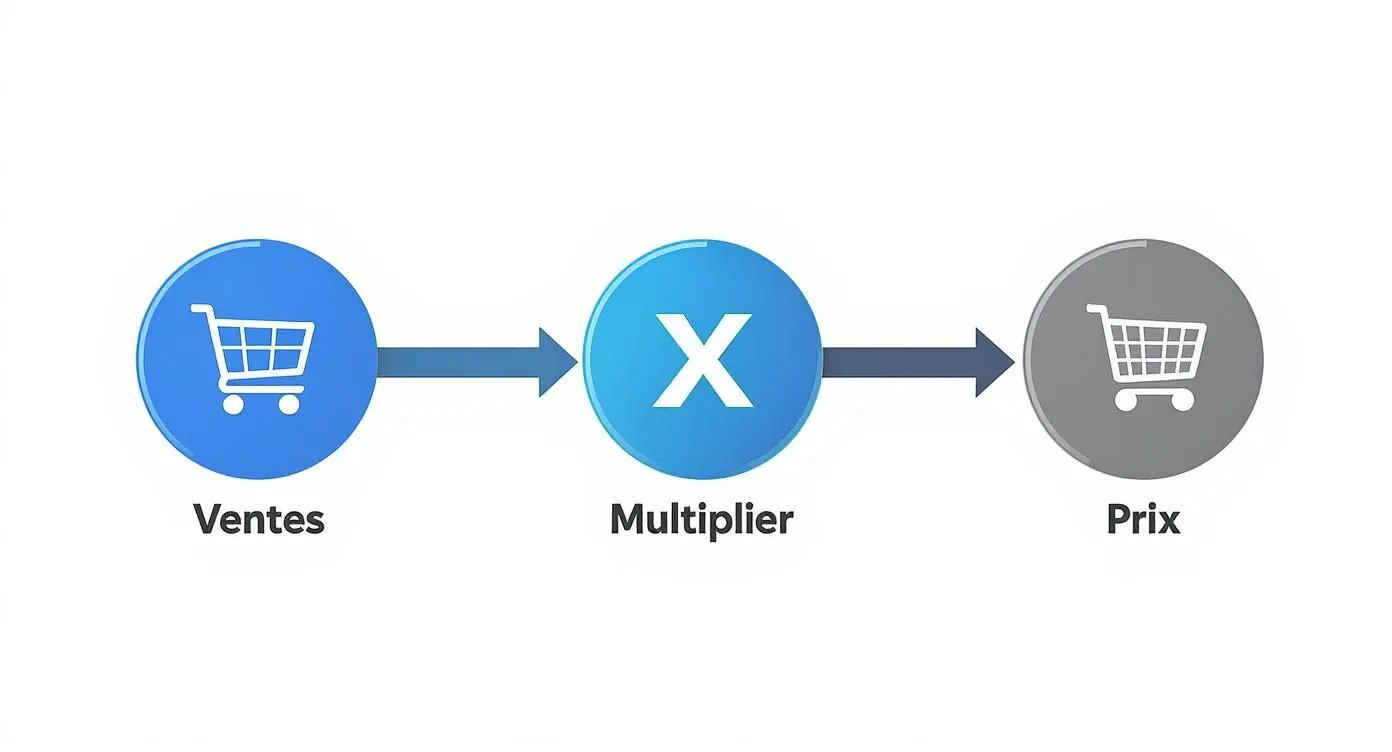
Your revenue is simply the result of your commercial activity: the volume of what you sell multiplied by the selling price.
Navigating the different VAT rates
To complicate things a little, France doesn’t have just one, but several VAT rates. The most common is 20%, but there are reduced rates for certain specific products and services.
- Standard rate at 20%: This is the general case for the vast majority of sales and services.
- Intermediate rate at 10%: Often found in restaurants, passenger transport, or certain renovation work.
- Reduced rate at 5.5%: This applies to products considered essential, such as food, books, or energy.
Identifying the right rate for your business is crucial for issuing correct invoices and, consequently, calculating accurate pre-tax revenue. To help you navigate this without a headache, there are tools available. In fact, our online VAT converter is here to save you time.
The impact of discounts and rebates on your revenue
Another point to watch: the discounts you grant. Whether it’s a discount, a rebate, or an early-payment allowance, this commercial gesture directly reduces the amount of the sale. And therefore, your revenue.
Let’s take a concrete case. You invoice a service for €1,000 pre-tax. To thank a loyal customer, you decide to offer them a 10% discount.
The amount to be recorded will no longer be €1,000, but rather €900 pre-tax (€1,000 - €100). It’s on this amount, known as the “net commercial amount,” that your revenue is based.
What to remember: Revenue is always calculated after deducting all commercial discounts (rebates, allowances, refunds) shown on the invoice.
Forgetting this adjustment means artificially overestimating your revenue. You then risk making decisions based on figures that don’t reflect the economic reality of your sales. Precise tracking of these commercial gestures is therefore essential.
Adapting the revenue calculation to your business
Calculating revenue isn’t an exact science applied the same way everywhere. It needs to match the reality of your business. Income isn’t recorded the same way whether you sell physical products or offer services. This distinction is crucial so that your revenue is a genuine performance indicator, and not a misleading figure.
For product sales: when is a sale really finalized?
If you sell goods, revenue is generally recorded at the moment ownership is transferred to the customer. This is an important detail: it’s not necessarily the moment you receive the money, but rather the instant the sale is considered complete from an accounting standpoint.
In practice, this can correspond to two moments:
- At invoicing: This is the most common case. Revenue is recorded as soon as the invoice is issued, even if the customer hasn’t paid you yet. This is the accrual accounting principle.
- At delivery: In some cases, particularly in e-commerce, the sale is only considered completed once the package arrives at the customer’s location.
For services: the art of smoothing revenue
For service-based businesses, things are often a bit more subtle. An assignment can span several months, a contract may include staggered payments, or you may operate on a subscription basis. Recording the full amount when the contract is signed would be a classic mistake, artificially inflating your performance in one month and leaving subsequent months at zero.
The right approach is to spread revenue recognition over time as the service is delivered. This is known as the percentage-of-completion method. It gives a much more accurate and stable view of your business by matching revenue to the effort delivered each month.
The case of a web agency
Imagine an agency signs a €6,000 pre-tax contract to build a website over three months. Instead of recording €6,000 in revenue in the first month, it will recognize €2,000 pre-tax in revenue each month. This makes sense: expenses (salaries, tools) are also spread over the duration of the project.
The special case of subscriptions
Is your business model based on subscriptions? This is the case for many software companies (SaaS), coaches, or maintenance services. Here, the calculation becomes simpler again. Revenue is recognized on a recurring basis, most often each month, equal to the subscription amount.
A consultant offering a monthly follow-up package at €500 pre-tax will therefore record revenue of €500 each month for that client, as long as the subscription remains active. It’s a model that offers excellent predictability and greatly simplifies management.
Taking the time to properly understand these nuances isn’t a luxury. A poor accounting method can distort your perception of your business’s health and even cause tax issues. Adapting the calculation to your business model is therefore an essential step in steering your business with confidence.
Calculating revenue for sole traders (micro-entrepreneurs)
If you’re a sole trader (micro-entrepreneur), a golden rule applies to your revenue: only money actually received counts. This is the cash accounting principle. Forget about invoices sent; what matters is what arrives in your bank account.
Specifically, if you invoice a service in March but the client pays you in April, that income must be declared for the April period. It’s this gross amount, before any deduction of business expenses, that serves as the basis for calculating your social security contributions and your tax. Simple, but you need to be rigorous.

Watch out for revenue thresholds
The sole trader status is very attractive for its simplicity, but it’s conditional on staying within annual revenue caps. Exceeding them can push you into a much more complex regime.
These thresholds vary depending on your business activity:
- €188,700 for commercial activities (selling goods, catering, accommodation).
- €77,700 for services (professional, artisanal activities).
Do you have a mixed business, for example graphic designer (service) and print seller (commercial)? Your total revenue must not exceed €188,700, and the share from your services must stay below €77,700. If you exceed these thresholds for two consecutive years, you automatically leave the sole trader regime.
A word of caution given current inflation: an increase in your revenue doesn’t necessarily mean you’re selling more. With inflation of 4.9% in 2023 (INSEE figures), your prices may have gone up, masking stagnation or even a decline in your sales volume. Be sure to analyze both aspects to get an accurate picture of your business’s health.
Declaring to URSSAF: an appointment you can’t miss
When you set up your status, you had to choose between monthly or quarterly declarations. This choice sets the rhythm of your business’s life and your obligations to URSSAF.
Everything happens online on the autoentrepreneur.urssaf.fr website. You simply report the total of your pre-tax receipts for the relevant period. Be sure to break down the amounts if you have several types of activity.
Expert advice: Even if you haven’t collected anything, the declaration is mandatory. Forgetting to file, even for zero revenue, can lead to a penalty. In that case, simply enter “€0.”
To avoid unpleasant surprises, meticulous tracking is your best ally. A simple spreadsheet or a good invoicing tool will let you list every payment received and its date. To master this step, feel free to check out our complete guide on declaring revenue as a sole trader. Building good habits from the start is the key to peaceful management.
Using your revenue to make decisions
Calculating your revenue is good. Using it to steer your business is even better. This figure, taken in isolation, doesn’t say much. It’s by analyzing it, breaking it down, and tracking it over time that it becomes a genuine dashboard for making the right strategic decisions.

In short, you need to make it talk. It’s by breaking down your revenue that you’ll uncover valuable insights into where to focus your efforts and your money.
Segmenting revenue to identify your growth drivers
Sticking to overall revenue is a bit like looking at a forest from a distance. To really understand what’s happening, you need to get closer and examine the trees one by one. That’s exactly the purpose of segmentation: precisely identifying where each euro comes from.
Here are a few concrete angles to start digging:
- By product or service: Which one is your real best-seller? Which service earns you the most once costs are deducted? The answer will tell you where to focus your marketing energy.
- By customer: Familiar with the Pareto principle? It very often applies here. There’s a good chance that 20% of your customers generate 80% of your revenue. Identify them, and take good care of them!
- By acquisition channel: Do your customers find you via your website, social media, or good old word of mouth? Knowing which channel performs best is key to allocating your ad budget wisely.
This analysis is all the more crucial for internationally-oriented businesses. For example, in 2022, exports accounted for nearly 29% of the total revenue of French industrial companies. For them, a country-by-country analysis is essential to manage currency risk and adjust pricing. To go further, the data published by INSEE on this topic is a goldmine.
A dashboard, even a simple one, can change everything. It lets you quickly visualize where the money comes from and how things are evolving.
Example of a dashboard for tracking your revenue
This table illustrates a simple method for tracking and analyzing monthly revenue by category in order to identify your growth drivers.
| Month | Revenue Product A | Revenue Service B | Total Revenue | Trend vs M-1 |
|---|---|---|---|---|
| January | €5,000 | €2,500 | €7,500 | N/A |
| February | €5,500 | €2,000 | €7,500 | Stable |
| March | €6,500 | €3,000 | €9,500 | +26.7% |
| April | €6,000 | €2,800 | €8,800 | -7.4% |
At a glance, you can see that Product A is the mainstay of the business and that March was exceptional, likely thanks to a successful promotional campaign. The slight dip in April calls for caution.
Tracking revenue trends to anticipate
Your revenue is the pulse of your business. Tracking it regularly means setting up an early warning system. By comparing it month to month, or against the same period the previous year (Y-1), you immediately spot trends, good or bad.
Is your revenue down 15% this quarter compared to the previous one? That’s a clear signal to dig deeper. Is it simple seasonality, or the symptom of a deeper issue, such as a new competitor or a less appealing offer?
This analysis over time also helps you spot the cycles of your business. This lets you anticipate slow periods to prepare special offers, or conversely, get ready for peak activity so you’re not overwhelmed. It’s an essential point for managing your cash flow, inventory, and even your teams effectively.
Still, be careful: strong revenue doesn’t necessarily mean the business is profitable. To get an accurate picture of your financial health, it’s essential to grasp the distinction between revenue and profit, which takes all your expenses into account. It’s this understanding that will let you steer the real profitability of your business.
Frequently asked questions about calculating revenue
In practice, calculating revenue always raises its share of questions. That’s normal, especially when you’re starting out. Let’s clear things up with direct answers so you can lock in your calculations once and for all.
Invoiced revenue or collected revenue: which should you choose?
This distinction is crucial, because it all depends on your legal status.
Invoiced revenue is simply the total sum of the invoices you’ve created over a given period. It doesn’t matter whether the customer has already paid or not. This is known as accrual accounting, and it’s the standard for most companies (SAS, SARL, etc.).
Conversely, collected revenue only takes into account money that has actually landed in your bank account. This is the calculation method used by sole traders to declare their income to URSSAF. Easy and straightforward.
In simple terms: A “traditional” company bases itself on the invoice date. A sole trader bases themselves on the date the payment is received.
What about credit notes and refunds?
Yes, they absolutely must be taken into account. A credit note or refund is a correction to a past sale. It must therefore logically be deducted from your revenue.
Let’s take a concrete example. You invoiced a service for €500 pre-tax in May. The following month, in June, you issue a credit note of €100 pre-tax to that same customer. This credit note will reduce your revenue for June. If you forget it, you artificially inflate your income and risk paying more in contributions or taxes than necessary.
How should a deposit be handled in the calculation?
Managing deposits is a tricky point, especially for long projects or services. A deposit is an advance payment the customer makes before the assignment is complete.
The rules change depending on your status:
- For a company using accrual accounting, a deposit is not yet revenue. Revenue will only be recorded once the assignment is complete and the final invoice issued.
- For a sole trader, it’s the opposite. Since only money received counts, the deposit you receive is immediately considered revenue. It must be declared for the period in which you received it.
Rigorous tracking of deposits is therefore essential to avoid any declaration errors, regardless of your business structure.
Does shipping count as part of revenue?
The answer is yes. Shipping fees that you charge your customers are an integral part of your revenue. Tax authorities consider them a supplement to the main sale. In fact, they’re subject to the same VAT rate as the product you’re selling.
For example, if you sell an item for €50 pre-tax and add €5 pre-tax in shipping fees, your revenue for that sale is indeed €55 pre-tax. Note that this doesn’t apply to disbursements (a simple advance of costs on behalf of the customer), but rather constitutes part of your service.
With a tool like Bizyness, tracking your revenue becomes much simpler. The software automatically distinguishes between invoiced and collected amounts, factors in credit notes, and gives you a clear dashboard of your performance. You can focus on your craft while the tool handles the numbers. Discover how to simplify your management today at bizyness.fr.
