

 Français
The practical guide to issuing a credit note without errors
Learn how to issue a credit note in full compliance. Discover the use cases, mandatory details and key steps for sound bookkeeping.

Issuing a credit note is far more than a simple accounting line. It’s the essential tool for correcting course after a sale. Essentially, it’s a “negative” invoice that cancels, in whole or in part, an invoice already sent. It’s also called a credit memo. It’s the only legal way to correct a transaction without ever deleting the original invoice, which is strictly forbidden.
Whether it’s for a returned item, a small invoicing error, or a last-minute goodwill gesture, the credit note is your ally for keeping your books clean and accurate.
Why and when should you issue a credit note?
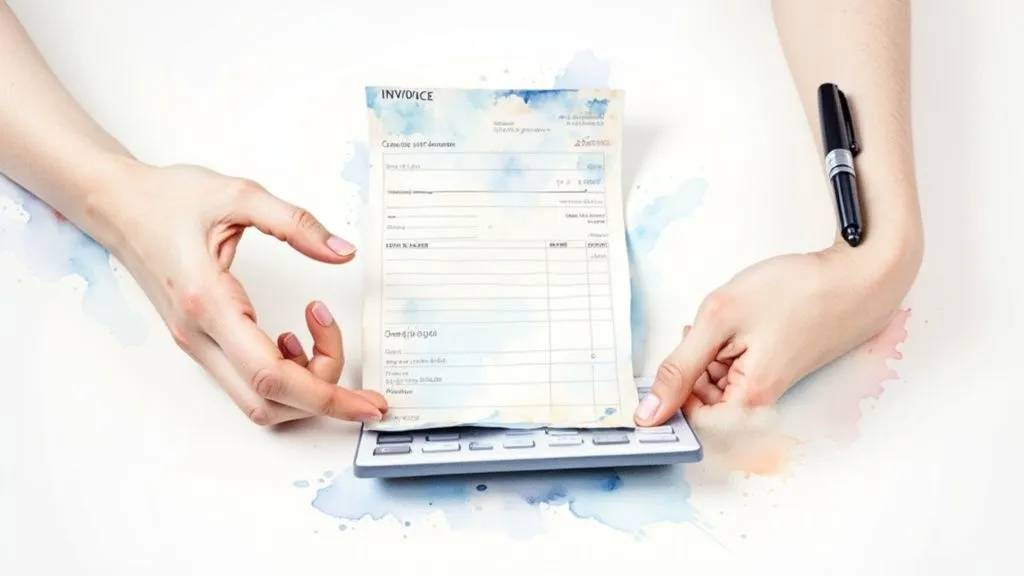
Far from being a simple administrative paper, a credit note is a bookkeeping and tax obligation in many cases. Think of it as the mirror image of an invoice. Its purpose isn’t to create new revenue, but to correct a financial flow that’s already been recorded. That’s what keeps your accounts consistent.
Thanks to this operation, your declared revenue matches exactly what you actually collected. And for the tax authorities, everything is clear, traceable, and beyond dispute.
The most common scenarios
In practice, several situations will inevitably lead you to create a credit note. Each scenario has its own logic, but the end goal is always the same: keeping impeccable accounting records.
Here are the cases where you’ll need to issue a credit note:
- Returned goods: The classic case. A customer returns a defective or non-conforming product, or simply changes their mind. The credit note then settles this cancelled sale.
- Error on the original invoice: It happens even to the best of us. A typo in the price, an incorrect quantity, or a forgotten discount that was promised.
- After-the-fact goodwill gesture: You want to thank a loyal customer or make up for a minor inconvenience, like a late delivery, but the invoice has already gone out. The credit note is the perfect solution for applying this discount.
A credit note is a correction tool, not an eraser. Once an invoice has been validated and sent, deleting it is illegal. The credit note is the only compliant procedure for cancelling it, whether for the full amount or just part of it.
In France, this practice is very common, particularly in retail. It’s estimated that around 12 to 15% of transactions can lead to a credit note following a return or complaint. To dig deeper into the accounting rules governing this, Sage’s official documentation is an excellent resource.
The mandatory details for a rock-solid credit note
To be valid in the eyes of the tax authorities, a credit note is more than just a title. It must follow formal requirements just as rigorous as those for an invoice. In fact, a single missing piece of information can weaken your bookkeeping and cause trouble during an audit.
Think of the credit note as the mirror image of the original invoice. It follows the same structure, the same logic, the same rigor. This symmetry is what guarantees perfect traceability and allows the original transaction to be cancelled in the books without any ambiguity.
The key information you must never forget
Clarity is your best weapon. A well-crafted credit note will save you back-and-forth with your customer and secure your bookkeeping. The most critical detail, the one that gives the whole document its meaning, is the reference to the invoice the credit note corrects or cancels. Without this link, your credit note loses all its legal value.
To make sure you don’t miss anything, here are the elements you cannot skip:
- The words “Credit Note” or “Credit Invoice” must be visible at a glance, in the header, leaving no room for doubt.
- A unique, sequential numbering, continuing on from your invoicing. If your last invoice is F2024-105, your credit note might be A2024-012, for example.
- Your full details (name, address, business registration number, VAT number) as well as your customer’s, of course.
- The detail of the products or services concerned, with quantity and unit price, just as on the original invoice. It should be possible to match them up instantly.
The rule of thumb is simple: the formal requirements for a credit note mirror those of an invoice. If a piece of information is mandatory on an invoice, it’s just as mandatory on the related credit note.
For a full refresher, our guide on mandatory details on an invoice covers every point in detail.
The breakdown of amounts and VAT
The figures section of the credit note is obviously crucial. You need to clearly state the total amount of the discount or cancellation, making a clear distinction between the amount excluding VAT and the amount including all taxes.
VAT treatment deserves particular attention. The credit note must specify the amount of VAT you’re “recovering” on this transaction. This is what justifies the reduction in the VAT you owe to the state. A credit note that omits VAT, when the original invoice included it, will systematically be rejected by the tax authorities. It’s a classic but costly mistake.
To help you not forget anything, here’s a handy summary of the essential information to include. Think of it as your checklist before sending any credit note.
| Checklist of mandatory details for your credit note |
|---|
| A summary of the essential information to include on every credit note to ensure legal and accounting compliance. |
| Required Element |
| Why it’s crucial |
| ”Credit Note” label |
| Avoids any confusion with a regular invoice. Identification must be immediate. |
| Unique numbering |
| Ensures chronological continuity and flawless traceability of your accounting documents. |
| Issue date |
| Allows the transaction to be attached to the correct accounting period. |
| Issuer and customer details |
| Guarantees clear identification of both parties involved in the transaction. |
| Reference to the original invoice |
| The essential legal and accounting link that justifies the credit note’s very existence. This is the most important point! |
| Detail of products/services |
| Specifies exactly what is being cancelled or refunded, with quantity and unit price excluding VAT. |
| Amounts excluding VAT, VAT, and including VAT |
| Clarifies the financial impact of the credit note and ensures a correct adjustment of the VAT collected. |
| Total amount to deduct |
| Clearly states the sum (in figures and sometimes in words) that the customer can deduct or have refunded. |
By following this structure, you ensure that every credit note you issue is not only clear for your customer, but also fully compliant with legal and accounting requirements. It’s a guarantee of peace of mind for your day-to-day management.
Using invoicing software to create a credit note
Gone are the days of juggling complex spreadsheets or Word templates to create a credit note. Let’s be honest, this administrative task is often a source of stress. Fortunately, with the right tool, issuing a credit note becomes a matter of seconds. Modern invoicing software turns this chore into a simple, fast, and above all error-proof process.
The main benefit? Automation. Instead of manually re-copying every piece of information from the original invoice, the software handles it all. You just need to find the relevant invoice, and the tool instantly generates a credit note draft. All the key data — items, quantities, prices, VAT rates — is already there, ready to use.
This approach eliminates practically all data-entry errors, such as a typo on an amount or a forgotten mandatory detail. Even better, the credit note numbering follows your accounting’s logical sequence, ensuring perfect traceability without you having to worry about it.
An extremely simplified creation process
With dedicated software, creating a credit note comes down to a few clicks. It’s genuinely intuitive.
Here’s how it works in practice:
- Select the invoice to cancel: In your history, simply find the invoice you need to correct.
- Generate the credit note: A “Create credit note” button is usually clearly visible. With one click, the software prepares a credit note, already linked to the original.
- Adjust if needed: If the credit note is partial (for example, for the return of just one item out of an order of three), simply remove the lines that aren’t concerned.
- Validate and send: After a quick check, you validate the credit note. It’s immediately recorded in your books and ready to be sent to your customer by email, directly from the interface.
This visual illustrates just how simple and secure the process is.
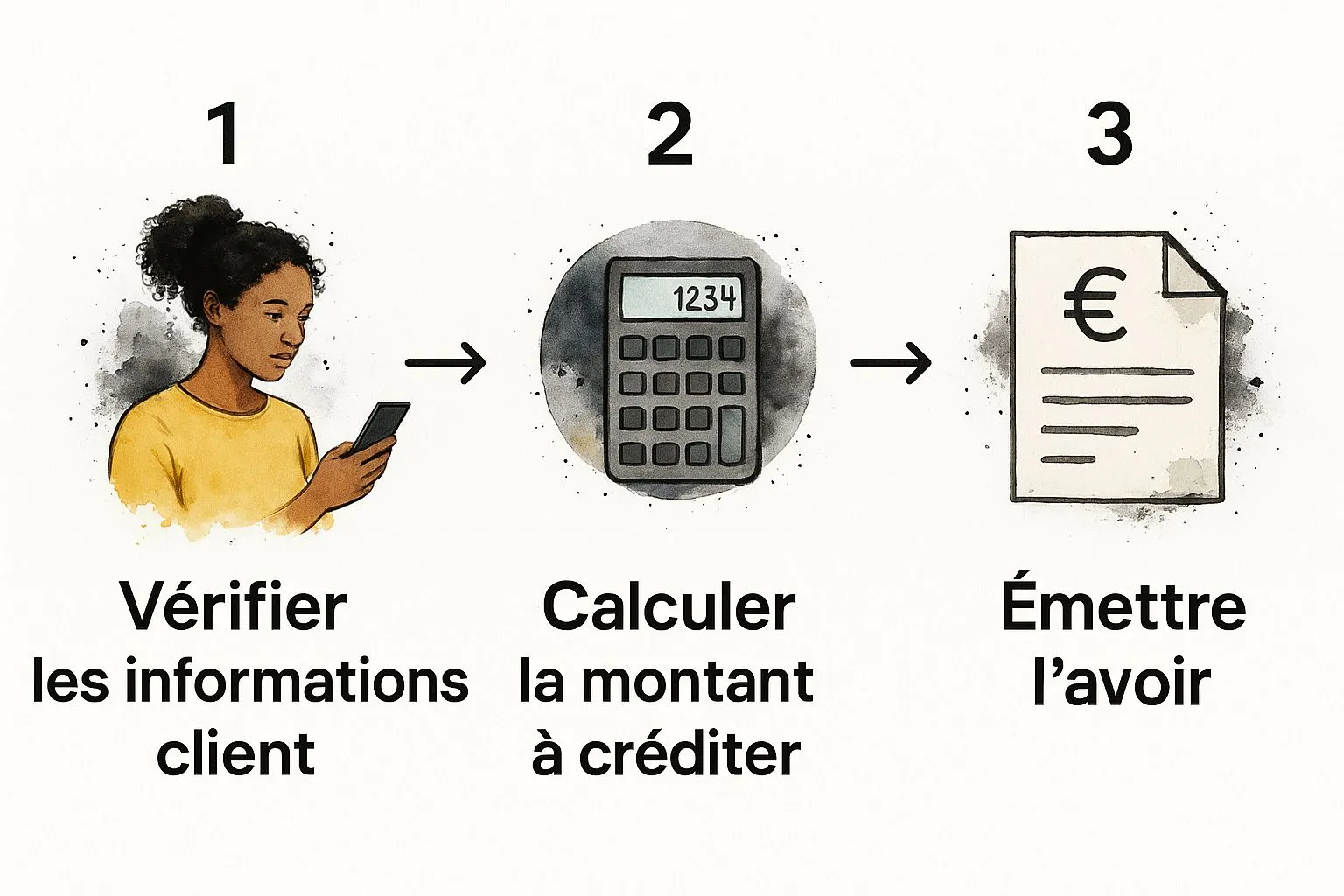
Here you can clearly see how the technology takes care of the most critical points, such as calculations and data verification.
The real magic of invoicing software is its intelligence. It doesn’t just generate a PDF. It updates your bookkeeping in real time, adjusts your revenue, and recalculates the VAT you’ll need to declare. It’s a true copilot for your management.
An interface designed for efficiency
Good software is above all a clear interface. At a glance, you should be able to see the status of every document, including pending credit notes or those already used to settle another invoice.
Smooth navigation between invoices, quotes, and credit notes saves you precious time on administrative tasks. For freelancers, this simplicity is a game changer. If you’re interested in the topic, our guide on the best invoicing software for sole traders covers the essential features for running your business with peace of mind.
Ultimately, choosing a dedicated tool means choosing peace of mind. You save time, make your bookkeeping more reliable, and project a professional, responsive image to your customers, even when handling a small hiccup.
The impact of a credit note on your bookkeeping

Issuing a credit note isn’t just a formality. It’s a management action with direct consequences on your finances. The biggest impact? It reduces your declared revenue. That makes sense: by cancelling a sale, the credit note ensures your revenue matches what your business actually collected.
This correction is crucial for sound management. Imagine having to pay taxes and social contributions on money you never actually received… The credit note is precisely the tool that saves you from this kind of situation by guaranteeing the accuracy of your balance sheet.
VAT adjustment: a key step
When you invoice, you collect VAT on behalf of the state. But what happens if the customer cancels or returns the goods? That’s where the credit note comes in to reset the counters.
By issuing a credit note, you cancel the VAT you originally charged. In practical terms, you no longer have to remit that amount to the tax authorities. This is an absolutely essential point so you don’t pay tax on a transaction that, in the end, never happened.
A well-drafted credit note is your best guarantee for a compliant VAT return. It justifies the decrease in VAT collected by providing a written, legal record of the cancellation. It’s irrefutable proof of your good faith in the event of an audit.
Moreover, this practice has become widespread with the boom in e-commerce. According to the DGFiP (French tax authority), in 1995, only 8% of international invoices involving French companies included credit notes. By 2020, that figure had climbed to nearly 18%, largely due to return policies becoming much more flexible.
How a credit note translates into your books
In concrete terms, how does all this get recorded in your accounts? The accounting entry follows a fairly simple logic:
- The customer account (account 411) is credited for the amount including VAT. Their debt to you is thus reduced or settled.
- The revenue account (class 7) is debited for the amount excluding VAT, which reduces your declared revenue.
- The VAT collected account (account 44571) is also debited, cancelling the tax you owed to the state.
Fortunately, you don’t have to do all this by hand. Accounting software like Bizyness automates these entries. As soon as you validate a credit note, it immediately adjusts all the relevant accounts. This ensures the consistency of your accounting documents to keep, with no effort on your part.
Common mistakes to stop making
Managing credit notes can quickly become an accounting headache if you’re not careful. One small mistake, and your entire bookkeeping can be compromised, not to mention the tax implications. In practice, I’ve seen many businesses make life harder for themselves over oversights that could easily have been avoided.
Let’s look together at the most frequent pitfalls to help you avoid them and secure your practices.
Mistake number one, the one we unfortunately still see far too often, is deleting the original invoice. It’s tempting to want to make the error disappear, but it’s strictly forbidden. An invoice that has been issued and sent becomes a final accounting document. It must never, under any circumstances, be deleted from your records. The one and only legal way to correct it is to create a credit note.
Omissions and inconsistencies to avoid
Beyond this golden rule, other pitfalls await you. Omitting the reference to the original invoice is a classic mistake. Without this clear, explicit link, your credit note has no legal value and cannot justify the accounting correction. It’s like a check with no payee.
Here’s a short list of other mistakes to never make again:
- Disorganized numbering. Your credit notes must follow a chronological, continuous sequence, just like your invoices. For example: A2024-001, A2024-002, and so on. Chaotic numbering or gaps in the sequence are an immediate red flag for the tax authorities.
- VAT calculation errors. The credit note exists to cancel out the VAT originally charged. An error in the VAT amount, even a small one, will distort your tax returns and could cost you dearly in penalties.
- Creating a credit note without a valid reason. Every credit note must be justified by a legitimate reason: a returned item, a pricing error, a negotiated goodwill gesture… Without this justification, it could be interpreted as an attempt to understate your revenue.
The biggest risk isn’t the mistake itself, but the trail it leaves. A poorly drafted credit note is an open door to questions during an audit. Rigor isn’t optional, it’s your best protection.
Finally, one last practical tip: don’t wait to send the credit note to your customer. The more responsive you are, the more you show your professionalism. It clarifies your customer’s accounting situation and turns a small hiccup into an opportunity to prove the quality of your service.
By avoiding these few pitfalls, you not only ensure your legal compliance, but above all you give yourself peace of mind in running your business.
Answering your questions about credit notes

Even with a detailed guide, certain practical questions keep coming up. That’s normal! The idea here is to clarify the last few points so that managing your credit notes becomes a simple, stress-free reflex.
Think of this section as your cheat sheet for everyday, real-world situations.
Can I put an expiry date on a credit note?
Yes, absolutely. It’s not only legal, it’s actually excellent practice. Setting a usage deadline gives you much better control over your cash flow. It prevents a credit note from lingering indefinitely.
For the customer, it’s also an incentive to come back to you sooner. Simply state this date very clearly on the document so there’s no ambiguity whatsoever. Generally, a period of 6 months to 1 year is considered a fair balance for everyone.
Is it better to offer a credit note or a refund?
Now that’s the big question! The choice depends on your business policy and, of course, the context.
From a purely financial standpoint, a credit note is often the better option for you. The money doesn’t leave your business, which preserves your cash flow. It’s also a great opportunity to turn an awkward situation into a future sale.
On the other hand, if the product is defective or the mistake is on your end, a refund is a powerful goodwill gesture. It shows that you take responsibility and can save a customer relationship that could have gone sour. Also keep in mind that for distance selling, the law protects consumers with a right of withdrawal that often requires a refund.
The key difference to remember: A credit note is not a refund. The first is a credit toward a future purchase, the second is a return of money. This distinction is crucial, both for your bookkeeping and for the clarity of your communication with the customer.
Ultimately, the most important thing is to be transparent. Having a clear return policy that’s well explained and easy to find builds trust and demonstrates your professionalism.
Stop juggling administrative complexities. With Bizyness, you can create fully compliant invoices and credit notes in seconds. Focus on your core business, we’ll take care of the rest. Discover how Bizyness can simplify your daily routine.
