

 Français
 Instant transfer risks and how to protect your e-commerce business
Discover the risks of instant transfers for your e-commerce business. Our guide explains how to secure your payments and prevent fraud effectively.
Instant transfer is the promise of receiving payment in under 10 seconds, 24/7. For any seller on Shopify or Amazon, it’s a small revolution in cash-flow management. But be careful, this speed hides new challenges. While the technology itself is bulletproof, the real risk shifts elsewhere: to the human side and internal processes.
Instant transfer: a real revolution for online sellers
Make no mistake, instant transfer is far more than a simple speed boost for transactions. For an e-commerce merchant, it’s the entire cash-flow management that gets rethought from the ground up. Receiving the money from a sale in a few seconds instead of waiting several days changes everything.
This immediate availability of funds gives you a flexibility you never had before. You can reinvest faster, pay your suppliers without delay, and better anticipate your cash needs. It’s a genuine strategic asset for online stores looking to optimize every euro.
The central dilemma: speed versus security
The main advantage of instant transfer is also, paradoxically, its greatest risk: its blazing speed. A transaction is completed in under 10 seconds, which makes it irrevocable. Unlike a classic transfer that can sometimes be cancelled in an emergency, here it’s final. One error, one fraud, and the money is gone for good.
This irreversibility puts businesses in front of a real dilemma. How do you benefit from the power of this tool without exposing yourself to outright losses? The solution isn’t found in the technology, but in the procedures you put in place around it.
The security of instant transfers doesn’t rely on the ability to undo a mistake, but on the art of preventing it from happening in the first place. It’s a complete mindset shift that requires constant vigilance and stronger controls.
For online sellers, this means human attention and automated checks become crucial. The most frequent risks aren’t technical flaws, but rather well-known scenarios:
- Social engineering: a fraudster poses as a supplier and convinces a member of your team to pay into a fraudulent IBAN.
- Data-entry errors: a payment goes to the wrong recipient because of a typo, with no way to reverse it.
- The complexity of accounting reconciliation: tracking hundreds of micro-transactions arriving in real time becomes a real headache.
Turning risk into a strategic advantage
To navigate this new financial reality, you need the right tools. Managing payments and accounting by hand quickly becomes unmanageable, if not outright dangerous. This is precisely where automation platforms like Bizyness come into play.
By connecting your sales channels (Shopify, Amazon, Stripe) to your accounting, Bizyness monitors, reconciles, and records every transaction in real time. This automation makes it possible to immediately spot the slightest anomaly, verify the consistency of flows, and guarantee perfect traceability. To dig deeper into the topic, our guide on e-commerce accounting will give you all the keys.
The goal is clear: turn a potential threat into a genuine competitive advantage. By mastering the risks of instant transfer, you’re not just protecting your business. You’re building an agile, solid financial infrastructure ready to support your growth.
How instant transfer really works
To fully grasp the risks associated with instant transfer, you first need to understand what it actually is, without unnecessary banking jargon. Think of the SEPA instant transfer (or SCT Inst) as a financial email: you click “send,” and it lands in the recipient’s inbox in under ten seconds. No more waiting for a sorting center that takes days.
Unlike a classic transfer that pauses on weekends, this one never sleeps. A Sunday at 11pm, New Year’s Day… it doesn’t matter, the money moves without interruption, 365 days a year. For an e-commerce merchant’s cash flow, that’s a small revolution.
But this lightning speed hides its most formidable feature: instant transfer is irrevocable. This is the crucial point to fully grasp.
Speed and irrevocability: two sides of the same coin
The mechanism of instant transfer relies on a few principles that set it radically apart from its older sibling, the classic transfer. For an e-commerce merchant, understanding these differences is the key to adopting this tool without putting your cash flow at risk.
- Extreme speed: Funds arrive in the recipient’s account in under 10 seconds. This is the end of waiting periods that can sometimes strain business relationships.
- Full availability: The service is active 24/7, including weekends and public holidays. The concept of a “business day” for payments becomes obsolete.
- Absolute irrevocability: Once you’ve confirmed the order, that’s it. The money is gone, and there’s no way to recall it. There’s no dispute procedure like there is for card payments.
Imagine sending a parcel by express delivery, but with no return address on the label. Once it’s in the truck, there’s no way to intercept it. If you got the address wrong, the parcel will be delivered to the wrong person, and all you can do is hope they’ll be kind enough to return it.
This irrevocability completely changes the game when it comes to managing errors and fraud. A simple typo in an IBAN or validating a payment a little too quickly following a scam can result in an outright, immediate, and final financial loss.
What the new regulations mean for you
Faced with the growing popularity of this payment method, a new European regulatory framework is bringing some order and strengthening security. The flagship measure, being rolled out progressively, is the mandatory verification of the match between the IBAN and the beneficiary’s name (known as “IBAN Check”). In practice, banks will have to offer this service free of charge to prevent careless mistakes and identity-theft fraud.
This development comes alongside a real push toward free access. By 2025, free-of-charge will become the norm. Starting January 9, 2025, receiving instant transfers will be free, and sending them will follow suit before October 9, 2025. This measure will eliminate the average cost of €1 per transaction, which will undoubtedly boost its use. Instant transfer already accounts for 10% of transfers in 2024, and this is only the beginning. For online sellers, this means more transactions to manage and, logically, greater exposure to risk. To learn more, you can read this article on the implications of free instant transfers on meilleurescpi.com.
With these basics covered, we can now tackle the concrete risks with confidence. Because while the technology itself is highly reliable, with a tiny technical fraud rate of 0.046%, the real danger almost always comes from where you’d least expect it: human error or psychological manipulation.
Identifying the 5 major risks for your online store
Instant transfer is fantastic. Fast, available 24/7… but this immediacy also opens the door to very real dangers for your business. These aren’t theoretical risks, but concrete problems that can affect any merchant on Shopify, software vendors on Stripe, or sellers on Amazon FBA.
Let’s dive into the five main threats you absolutely need to anticipate.
1. Social engineering fraud: the falsified IBAN trap
This is the classic scenario, but a terribly effective one. A scammer poses as one of your regular suppliers. They send you an email that looks entirely legitimate, asking you to update their bank details with a new IBAN.
With the pressure of daily business, a moment’s inattention is enough. You make the instant transfer and… the money is gone. Within seconds, it’s too late to reverse it.
A number worth thinking about: A recent study showed that 60% of online sellers have already been targeted by this type of phishing attempt.
Fortunately, a simple phone call to confirm the IBAN or a solid verification process (KYC) is often enough to thwart these attempts. But for a seller, skipping this simple step can cost thousands of euros.
2. Irrevocability: when disputes become a nightmare
This is the defining feature of instant transfer: once the order is given and executed, it’s impossible to cancel. The funds are gone, permanently.
Imagine a customer who pays for a large order by instant transfer. You ship the product, and then, acting in bad faith, they contact their bank claiming they never authorized the transaction. Without solid proof on your side, the dispute can quickly become a headache.
To protect yourself:
- Always wait for confirmation that funds have been received in your account before shipping the goods.
- Meticulously archive all transaction evidence (confirmations, timestamps, communications).
These simple habits can save you a lot of trouble and protect your cash flow.
3. Human error: a costly mistake
We’ve all done it: a typo, two digits swapped in an IBAN, a misplaced decimal point in an amount. With a classic transfer, you often have a few hours, or even a day, to catch it and request a cancellation.
With instant transfer, there’s no margin for error. A moment’s carelessness can send €10,000 into the account of a complete stranger, with very little chance of getting it back.
To limit this risk, solutions exist. Enable verification options that match the IBAN to the beneficiary’s name. For large amounts, set up a dual-validation rule requiring two different people.
4. The cash-flow paradox: paying fast, being paid slowly
Here’s a side effect we don’t always think about. You pay your suppliers and service providers in under ten seconds, which is excellent for your business relationships. But on their side, your customers sometimes pay you with longer delays, via payment methods that take a day or two to reach your account.
This gap between immediate outflows and delayed inflows can quickly create a hole in your cash flow, especially if you handle a large volume of orders. It’s the opposite of the good old supplier credit that used to help finance the operating cycle.
To stay in control, you need to:
- Track your balance in real time, ideally with an automated solution.
- Plan your supplier payments to better align them with your incoming payments.
5. The accounting reconciliation headache
Every instant transfer creates a new line on your bank statement, in real time. If you process dozens, or even hundreds, per day, manual reconciliation simply becomes impossible.
The risk? Missing an error, a duplicate, or a suspicious transaction. The higher the volume, the greater the risk that your accounts no longer reflect reality.
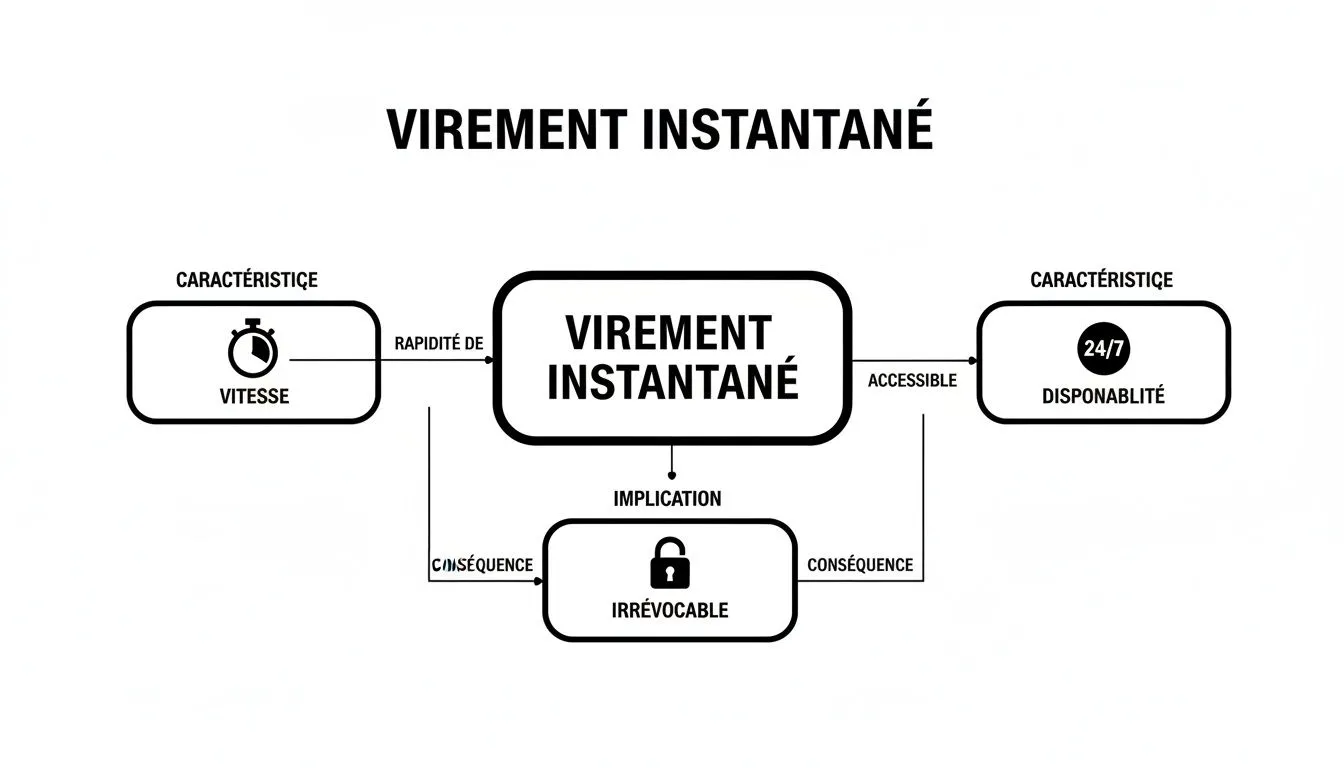
This diagram perfectly illustrates the problem: speed and 24/7 availability, which are strengths, become threats if your control processes can’t keep up. Without automation, your financial reports quickly lose their relevance. This is where tools like Bizyness come into play, extracting and categorizing every transaction as it happens.
To better visualize the differences, here’s a simple comparison table.
Risk comparison between classic transfers and instant transfers
This table highlights the differences in risks and characteristics between a classic SEPA transfer and an instant transfer for an e-commerce merchant.
| Characteristic | Classic SEPA Transfer | Instant Transfer |
|---|---|---|
| Irrevocability | Recall possible within a very short window | Absolute and immediate |
| Processing time | 1 to 3 business days | Under 10 seconds |
| Availability | Business days only | 24/7, including weekends and holidays |
| Human error risk | Low (correction possible) | High (no margin for error) |
| Reconciliation needs | Periodic (weekly, monthly) | Constant and real-time |
This table makes it clear: switching to instant transfer requires rethinking your habits and strengthening controls at every level.
The key to mastering these risks isn’t distrust, but anticipation and automation. Vigilance must become a permanent reflex.
Here are a few best practices to put in place today:
- Systematically confirm any new IBAN through another channel (phone, video call) before registering a payment.
- Train your teams to recognize the most common social engineering techniques.
- Set up a validation workflow for payments above a certain amount (e.g., manager approval).
- Automate your bank reconciliation with a dedicated solution to get a clear, up-to-date view of your cash flow.
How to effectively secure your instant payments
Identifying the risks of instant transfer is good. Putting concrete actions in place to protect yourself is even better. The idea isn’t to distrust this technology, but rather to build a real fortress of rigorous processes around your financial flows.
Let’s look together at how to turn this vigilance into a solid, effective defense system. The goal is simple: make sure every outgoing payment is legitimate, verified, and validated, without paralyzing your business. The solution lies in the right balance between human controls and smart automation.
Set up strict validation processes
The first line of defense against fraud and errors is people. Your teams need to develop security reflexes that become second nature. When thousands of euros can vanish in seconds, there’s no room for improvisation.
Think of your payment process as a security airlock. Before funds leave your account, they must clear several mandatory checkpoints.
-
The dual-validation principle: This is the ABC of the matter. For any payment above a certain threshold (say, €500), a second person must give their approval. This eliminates the risk of a single employee, perhaps under pressure or manipulated, committing a significant sum on impulse.
-
Systematic verification of any new IBAN: This is the ultimate safeguard against the infamous fake-supplier scam. As soon as a partner sends you new bank details, the rule must be clear: a phone call to a known number (and definitely not the one in the suspicious email) is essential to confirm the change.
Your company’s financial security cannot rest on blind trust in an email. A two-minute call to verify an IBAN is probably the most cost-effective investment you can make to avoid an outright loss.
This rigor needs to be written down in a clear procedure, known and applied by everyone involved in the payment chain.
Use multi-level authorization workflows
For growing businesses, simple dual validation can quickly show its limits. It’s time to move to more structured authorization workflows. The principle is simple: match the level of control to the financial stakes. A €100 payment doesn’t carry the same risk as a €20,000 transfer.
For example, you could set up rules like these:
- Payments under €500: Simple validation by the person who initiated the purchase.
- Payments between €500 and €5,000: Validation required from the department manager.
- Payments above €5,000: Mandatory validation by the CFO or the business owner.
Platforms like Bizyness let you integrate and automate these validation circuits. The system simply blocks the payment until all approvals have been obtained. It’s a foolproof safety net.
Define a clear refund policy
The irrevocability of instant transfer also has consequences for your customers. If a customer pays you this way, they can’t cancel the transaction on their end. It’s therefore crucial to establish and communicate a clear refund policy to handle any disputes.
This policy should clearly state:
- The conditions for requesting a refund (defective product, order error, etc.).
- The exact procedure to follow to start a request.
- The processing times and the refund method you’ll use (which could, ironically, be another instant transfer).
Having a well-defined policy reassures your customers and protects you in the event of a dispute, by showing that you have a precise framework for handling these situations. On that note, knowing how to read a bank identity statement (RIB) is a key skill for your teams, to verify information and avoid errors during a refund.
By combining strict validation, authorization workflows, and a clear refund policy, you’re not just reacting to threats. You’re building a proactive environment where risks are managed at the source. You can then enjoy the speed of instant transfer with complete peace of mind.
How to automate the accounting management of instant transfers
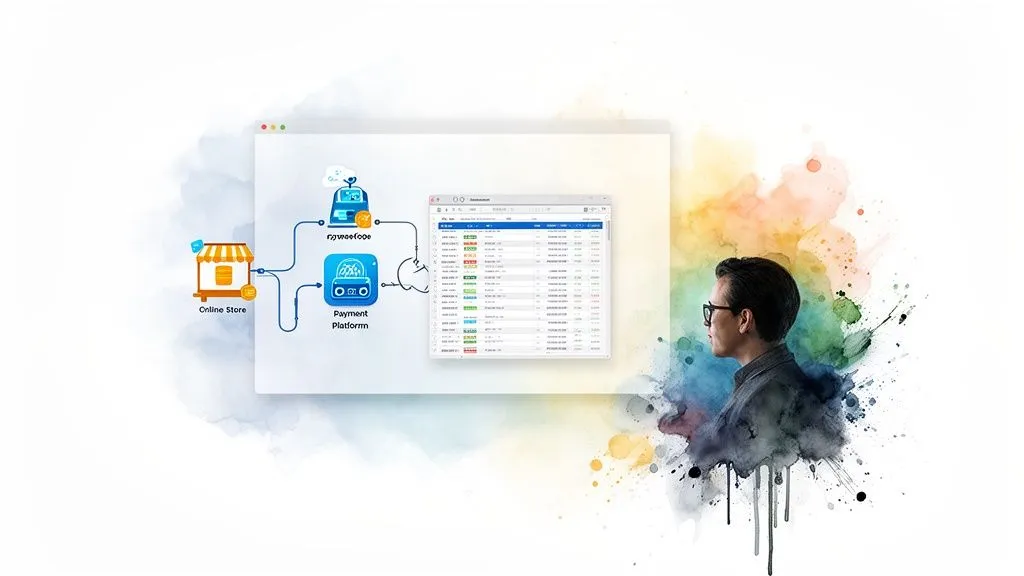
Receiving a payment in ten seconds is fantastic. But integrating it correctly into your accounting? That’s a whole different story. With instant transfers, transactions flow in without interruption, 24/7. For an e-commerce merchant, this relentless pace can quickly turn accounting management into a real headache.
Every sale must be linked to an invoice, with the correct VAT rate, and then carefully recorded. Imagine having to do this manually for dozens, or even hundreds, of payments coming in every day. It’s simply unsustainable. You open the door to errors, oversights, and ultimately, an FEC (Fichier des Écritures Comptables, France’s mandatory accounting-records file) that doesn’t hold up.
The challenge of real-time reconciliation
The main friction point is bank reconciliation. This work involves matching every line on your bank statement with an accounting entry (an invoice, an expense report, etc.). When transfers arrive at all hours of the day and night, including weekends, trying to reconcile it all by hand at the end of the month is sheer madness.
You end up drowning in a flood of small transactions. Who paid? For which order? Was VAT correctly calculated for that sale in Germany? Without an automated system, you spend more time playing financial detective than growing your business. To dig deeper into the topic, our article on automatic bank reconciliation explains the ins and outs of this process in detail.
Why automation is the only way forward
Given this volume and speed, let’s be clear: automation isn’t a luxury, it’s a pure necessity. It’s the only way to guarantee accurate figures, regulatory compliance, and your peace of mind. A platform like Bizyness was designed precisely to address this challenge.
Accounting automation turns the chaos of instant transactions into a clear, reliable stream of information. It doesn’t just save you time; it strengthens your company’s financial foundations.
Here’s concretely how a well-integrated solution changes the game:
- Direct connection to the source: Bizyness connects directly to your sales platforms (Shopify, Stripe, Amazon) and your bank accounts. Not a single sale escapes the radar.
- Automatic identification and invoicing: The tool identifies each transfer, links it to the correct order, and instantly generates the corresponding invoice, with the correct VAT rate, even for your international customers.
- Ready-to-use accounting entries: Every transaction is pre-categorized and translated into a clean accounting entry, ready to be included in your FEC. No more manual data entry.
This systematic approach eliminates the risk of human error and ensures perfect traceability of every euro coming in. If you want to broaden your perspective, our guide on task automation offers more general advice on optimizing your processes.
Reliability of flows and management of new risks
The adoption of instant transfer is skyrocketing. In 2024, it already accounts for 10% of transfers in France, a success largely driven by its progressive move to free access. The good news is that the purely technical fraud rate on these transactions is minimal (0.046%). The flip side? Fraud through human manipulation has exploded, reaching €382 million in 2024.
These figures, from the 2024 report of the French Payment Security Observatory (Observatoire de la sécurité des moyens de paiement), show one thing: for platforms like Bizyness, the reliability of the flows to reconcile is strengthened, but anomaly detection becomes crucial.
Automation plays a dual role here, both improving reliability and acting as a safety net. By continuously monitoring flows, Bizyness can flag suspicious transactions or thresholds being reached. This is a major asset, especially with the announced removal of the €100,000 cap in October 2025, which will inevitably increase the risks of instant transfer for high-value payments.
Turning risk management into a competitive advantage
Throughout this guide, if there’s just one thing to remember, it’s this: instant transfer is a fantastic tool, but it remains a tool. Its true value for your e-commerce business doesn’t come from its technology, but from how well you master its subtleties… and its dangers.
Too often, managing the risks associated with instant transfer is seen as an administrative chore, a simple box to tick to avoid problems. What if we changed our perspective entirely? See this management instead as a genuine strategic lever.
Proof of maturity for your business
A business that manages its instant payment flows with precision sends a very strong signal to its partners, suppliers, and even investors. It’s proof of operational maturity and financial rigor that inspires confidence. In concrete terms, it’s a mark of reliability that goes well beyond the simple transaction.
This mastery translates into very tangible benefits:
- Healthier cash flow: You pay at the right time, without rushing, and you collect payments faster. Your working capital requirement improves directly as a result.
- Stronger relationships: Your partners know your processes are solid and secure. Trust builds more easily.
- Greater agility: When an opportunity arises, you can seize it without hesitation, because you know your financial back is covered.
Rigorous risk management isn’t a brake, it’s a genuine growth accelerator. It turns uncertainty into competitive advantage, giving you the ability to act with more confidence and speed than less-prepared competitors.
The message is clear: with the right processes and the right tools, you don’t just endure the risks of instant transfer. You turn them into assets.
Take action today
The time for reaction is over; it’s time for anticipation. Take a moment to audit your current payment processes. Ask yourself, honestly, where your weak points are. Where could a simple human error cost you dearly?
Now imagine how a financial automation platform like Bizyness can not only secure these flows, but also actively support your growth. By automating controls, validations, and bank reconciliation, you free up your teams. They can finally focus on value-creating tasks, rather than chasing after payments.
You’re no longer at the mercy of speed, you’re using it to your advantage.
Instant transfer: your questions, our answers
As an online seller, instant transfer probably raises quite a few questions. That’s normal. When money moves this fast, you need certainty.
Let’s dive into the most common questions to clear things up. We’ll look at why cancelling a transfer is nearly impossible, who’s liable in the event of fraud, and how tools like Bizyness can become genuine safeguards.
- Can you undo a transfer?
- Fraud: who’s responsible, me or the bank?
- How can I spot a problem before it’s too late?
- What tools can help me keep an eye on everything without spending hours on it?
- Who has the final say in validating a payment?
Can an instant transfer really be cancelled?
The short answer? No. The very principle of instant transfer is its irrevocability. Once you’ve given your approval, the order goes through and the funds reach the recipient in under 10 seconds. There’s no “stop” button.
The only glimmer of hope is a procedure called a “recall request” (or SEPA recall), but let’s be realistic: its success is far from guaranteed, and cases where it works are very rare.
A banking expert likes to say that “instant transfer is like a train running at full speed with no brakes. Once it’s left the station, there’s no stopping it.”
In practice, a recall can only be attempted in very specific situations:
- A technical glitch that caused a duplicate payment.
- A clear error that isn’t your fault.
- The transfer hasn’t yet been processed by the beneficiary’s bank (an extremely rare case with instant transfers).
In the event of fraud, will my bank cover me?
This is the touchy question. Liability is defined by the French Monetary and Financial Code, and the rule is fairly strict. If the error is on your end — a mishandled action, validating a fraudulent email a bit too quickly — the loss is generally yours to bear.
The bank’s liability is only engaged if it failed in its own obligations, such as a lapse in identity verification or a flaw in its security system.
Imagine a scammer poses as your supplier and gives you a new IBAN. If you validate the transfer, the bank isn’t required to reimburse you. It’s then up to you to turn to your insurance or attempt the well-known SEPA recall procedure.
To put it simply:
- If you make a mistake or are negligent, you bear the responsibility.
- The bank will only compensate you if it’s at fault.
- Carefully keep all evidence and proof of your validations.
Concretely, how does Bizyness help limit these risks?
The best defense is anticipation. This is exactly the ground on which Bizyness positions itself, integrating safeguards to spot and block problems before the transfer is even sent.
| Feature | Its role in your security |
|---|---|
| Real-time reconciliation | Every transfer is automatically matched against the corresponding invoice. No invoice, no payment. |
| Custom alerts | An anomaly detected? You receive an immediate notification so you can react right away. |
| Full traceability | A clear history of every operation is kept. Who validated what, and when? It’s all there. |
Let’s take a concrete example. It’s 5am, and a suspicious transfer is initiated from your account. Bizyness spots it, sends an alert to your team, and puts the transaction on hold pending verification. This immediate responsiveness changes everything if you later have to handle a dispute.
- Define control thresholds suited to your business.
- Set up a verification process (KYC) for every new supplier.
- Centralize and archive all your exchanges and supporting documents in one secure place.
Thanks to this automation, your team no longer spends hours checking, but only seconds reacting.
By automating these security locks, Bizyness gives you a clear view and lasting peace of mind.
Ready to turn instant transfer into a genuine asset for your cash flow, without the cold sweats? Discover how Bizyness can secure your flows today: https://www.bizyness.fr
