

 Français
The complete guide to the intra-community VAT calculator
Use our guide to the intra-community VAT calculator to validate a number, understand the reverse charge mechanism, and secure your EU invoices.
When people talk about an intra-community VAT calculator, they often think of a simple tool for checking a VAT number. That’s true, but it’s much more than that. It’s actually your safeguard for invoicing tax-free, entirely legally, when doing business with a commercial partner in Europe. This system is not a mere administrative formality; it sits at the heart of the trade in goods and services that drives the European Union’s single market.
Intra-community VAT, fully explained

Intra-community VAT can seem intimidating at first, but its purpose is very concrete: to make trade between businesses in different member states as simple as possible. Think of it as a “tax passport.” This passport lets your products and services travel across European borders without being taxed at every step.
Without this mechanism, an entrepreneur’s life would be far more complicated. Imagine a French company selling to a customer in Germany. It would have to register for VAT in Germany, collect the local tax there, and remit it. A real administrative and financial headache! Fortunately, the intra-community system spares us all that thanks to one key principle: the reverse charge.
A closer look at the reverse charge mechanism
The reverse charge is the engine of the whole system. The concept is clever and relies on a mirror-image accounting effect. Specifically, when you sell to a business in another EU country:
- You invoice excluding tax (net of VAT). Simple and direct.
- Your customer, on their end, declares the VAT in their own country, as if they had collected it themselves on the transaction.
- But, and here’s the trick, they immediately deduct it on the same return.
The result? The transaction is entirely neutral for their cash flow, and for yours. The tax is properly recorded in the country where the good or service is consumed, but with no actual cash outflow. This mechanism is what prevents double taxation and considerably lightens the administrative load.
The reverse charge turns what could be an administrative nightmare into a simple bookkeeping exercise. It makes cross-border trade as smooth as a local sale, protecting your cash flow and your customers’.
Why is the VAT number so important?
For this whole mechanism to work, one condition is absolutely essential: both companies — yours and your customer’s — must have a valid, active intra-community VAT number. It’s the key that unlocks the exemption.
In France, this number is assigned to every business liable for VAT. Its structure is always the same: the country code “FR”, a two-digit computer key, and finally your 9-digit SIREN number. This key isn’t random; it comes from a precise mathematical formula: VAT key = [12 + 3 × (SIREN modulo 97)] modulo 97. This guarantees that every number is unique. If you’re curious about the details of this calculation, you’ll find plenty of resources on the VAT number formula.
You now understand why systematically checking your customer’s VAT number before issuing an invoice isn’t just a recommendation. It’s a requirement to secure your transactions. This is where an intra-community VAT calculator or a verification tool becomes your best ally.
To help make things clearer, here’s a table summarizing the essential concepts.
Key concepts of intra-community VAT at a glance
This table sums up the pillars of intra-community VAT for an instant understanding.
| Core Concept | Simple Explanation | Benefit For Your Business |
|---|---|---|
| Intra-community VAT number | Your European “tax passport,” unique to your business. | Lets you invoice net of VAT to your European business customers and proves your taxable status. |
| Reverse charge | The customer pays and deducts the VAT at the same time in their own country. | Simplifies invoicing, avoids double taxation, and protects your cash flow. |
| Systematic verification | The habit of checking your customer’s VAT number is valid before the transaction. | Secures your operations, guarantees your tax compliance, and protects you in case of an audit. |
Once you’ve mastered these three points, you’ve already done the hard part. Intra-community VAT is no longer an obstacle, but a genuine tool for growing your business across Europe.
How does an intra-community VAT calculator work?
An intra-community VAT number doesn’t appear out of thin air. Behind this string of digits lies a precise mathematical logic, designed so that every identifier is unique and, above all, verifiable. It’s exactly this mechanism that intra-community VAT calculators use to make our lives easier.
Far from being assigned at random, your VAT number is built directly from your SIREN number. In France, the structure is always the same: the country code FR, followed by a two-digit control key, and finally the nine digits of your SIREN. It’s this famous key that guarantees the reliability of the system.
This algorithm-based approach ensures perfect consistency across the European Union, where each member state applies a similar formula to generate its own VAT numbers.
The formula behind the tool
To calculate this control key, tax authorities use a well-known formula: the “modulo 97” algorithm. In plain terms, this algorithm takes your SIREN number as a starting point and applies a series of operations to generate a unique two-digit key.
The exact formula for France is as follows:
VAT key = [12 + 3 × (SIREN modulo 97)] modulo 97
Put that way, it can sound a bit daunting. You’d first need to calculate the remainder of your SIREN divided by 97, multiply that result, add 12, then recalculate the remainder of the total divided by 97. Needless to say, one small calculation error and the number becomes completely wrong.
That’s where the advantage of an online tool becomes obvious. A calculator automates the whole process, eliminates the risk of human error, and gives you a reliable result in a fraction of a second.
Automation, your best ally for compliance
Given the complexity of this calculation, digital tools quickly became indispensable for entrepreneurs.
Starting in 2019, many websites began offering free calculators to generate this number from a simple SIREN. These tools apply the official method, which lets you know the structure of a number even before its formal validation by the authorities. Today, more than 90% of French SMEs rely on this kind of tool to manage their intra-community VAT and streamline their exchanges with European partners.
Here’s what a typical calculator interface looks like. Simple and straightforward.

As you can see, you just need to enter the SIREN number to immediately get the full intra-community VAT number.
Using an intra-community VAT calculator isn’t just about saving time. It’s about giving yourself real peace of mind. A somewhat stressful mathematical operation becomes a simple formality, which secures the compliance of your invoices and returns.
Whether you’re finding your own VAT number or checking the structure of a partner’s, this tool is essential. It gives you the certainty that the information used is correct — an indispensable prerequisite before entering into any transaction with a European business. To go further on the subject, feel free to check out our full guide on how to calculate VAT online.
Validating a VAT number with the VIES service
Have you calculated your customer’s VAT number? Great, that’s the first step. But the most important one, the one that will really secure your transaction, is checking that this number is actually valid. Think of it like a key: before you can open the door that lets you invoice without VAT, you need to be sure it’s the right one.
This check is crucial, not only for your customer’s number, but also for your own. It’s a simple habit to build, but one that can save you from major financial and legal trouble. Fortunately, the European Commission has set up an official tool that’s free and very easy to use.
What is the VIES service?
The VIES (VAT Information Exchange System) service is simply the database linking the tax authorities of every European Union country. It’s a kind of giant, official directory of all European businesses liable for VAT. In a matter of seconds, it confirms whether a VAT number is active and correctly assigned to the business you think it belongs to.
Why does this matter so much? Imagine you issue a tax-free invoice to a German customer. If their VAT number turns out to be invalid, the French tax authorities may consider that you should have charged French VAT. In that case, they won’t hesitate to claim the amount of that VAT from you, plus penalties on top.
How to use VIES step by step
Checking a number on VIES literally takes only a few seconds. Here’s how:
- Go to the official website: Head to the European Commission’s VIES validator page. The service is available in every EU language, so there’s no language barrier.
- Choose the country: In the drop-down menu, select the member state of the business you’re checking (for example, “DE” for Germany, “ES” for Spain).
- Enter the VAT number: Type in the business’s intra-community VAT number, without the country prefix (which you’ve already selected just before).
- Run the search: Click the button to query the database.
The system gives you an almost instant response, drawn directly from the source — that is, from the tax registers of the country in question.
The VIES check isn’t just a formality. It’s irrefutable proof of your good faith in case of a tax audit. Get into the habit of taking a screenshot or printing the result. It’s your insurance policy.
Understanding VIES responses
VIES will return one of two verdicts, and each one has a direct consequence for your invoicing.
- Valid: The number is active and matches a taxable business. You can invoice tax-free with peace of mind. Often, the company’s name and address will also be displayed, letting you check that everything matches.
- Invalid: The number isn’t recognized. Either you made a typo, your customer gave you the wrong number, or their business simply isn’t liable for VAT.
If the result is “invalid,” do not, under any circumstances, invoice tax-free. The first thing to do is contact your customer to double-check the number with them. If they can’t provide a valid number, you have no choice: you must invoice applying French VAT, as if you were selling to an individual.
Ignoring this warning means taking on an almost certain risk of a tax reassessment. For sole traders, this is even more critical; our dedicated article explains how to obtain and manage your VAT number as a sole trader. This small check is a huge protection for the health of your cash flow.
The reverse charge mechanism explained simply
The reverse charge is the cornerstone of intra-community VAT. While the term can sound a bit intimidating at first, the principle is actually flawlessly logical and aims to simplify life for businesses trading in Europe.
Think of it as a simple bookkeeping exercise. Instead of the seller collecting VAT to remit it to their tax authority, the responsibility is simply “reversed” and transferred to the buyer. It’s the buyer who handles the VAT in their own country, which spares the seller from having to register in every EU country where they find customers.
This simplification is far from a minor detail. In 2023, the volume of trade between France and its European partners exceeded €700 billion. The reverse charge lets French businesses buy tax-free from their EU suppliers, directly easing their cash flow. What’s more, tax data shows that 78% of these transactions rely on rigorous verification of the intra-community VAT number. To dig deeper into the topic, the latest analyses on intra-community trade flows are very insightful.
How does it work in practice?
In practice, the reverse charge is a process that unfolds in a few key steps, whether you’re buying goods or services.
For the mechanism to apply, two conditions are essential:
- Both businesses are liable for VAT and each holds a valid intra-community VAT number.
- The trade takes place between two European Union member states.
If both boxes are checked, the seller issues an invoice with no VAT (net of tax). They simply need to include their VAT number and their customer’s, along with a legal mention explaining the exemption.
On the other side, the buyer receives this net invoice and carries out a purely declarative operation. On their VAT return, they will:
- Calculate the VAT at the rate in force in their country (for example, 20% in France).
- Enter this amount in the “VAT collected” box.
- Immediately deduct it in the “deductible VAT” box on the same return.
In the end, the operation is neutral. The VAT is declared and deducted at the same time, meaning the impact on cash flow is zero. It’s a bookkeeping entry that simply ensures traceability of the tax in the destination country.
The reverse charge is a brilliant tax mechanism: VAT is paid and recovered simultaneously by the buyer, with no actual cash flow. European trade becomes as simple as a local purchase, while still ensuring the tax goes to the country of final consumption.
Buying goods versus supplying services
The reverse charge principle applies in the same way whether you’re selling goods or providing services. The only slight nuance is the rule that determines where the VAT is due.
- For a supply of goods: VAT is due in the country where the goods arrive.
- For a supply of services (B2B): the general rule is that VAT is due in the country where the customer is established.
In every case, the pattern remains the same: the seller invoices tax-free and the buyer reverse-charges the VAT. The essential habit to build is always checking the validity of your business partner’s VAT number before the transaction, via the VIES online service.
This table sums up nicely the difference in VAT treatment between a standard domestic sale in France and a sale to a European partner.
Comparison between domestic and intra-community B2B invoicing
| Element | Domestic Sale (France > France) | Intra-community Sale (France > Germany) |
|---|---|---|
| Invoicing | Invoice including tax (with 20% French VAT) | Invoice net of tax (no VAT) |
| Seller’s role | Collects the VAT and remits it to the French state. | Invoices net of tax and declares an “intra-community supply.” |
| Buyer’s role | Pays the VAT and deducts it on their return. | Receives a net invoice, reverse-charges the German VAT (collection + deduction). |
| Cash flow impact | The buyer fronts the VAT. | No cash flow impact for the buyer (neutral operation). |
As you can see, the reverse charge mechanism considerably simplifies cash flow and administrative work for both parties.
The infographic below illustrates this validation step, an essential prerequisite for applying the reverse charge with complete peace of mind.
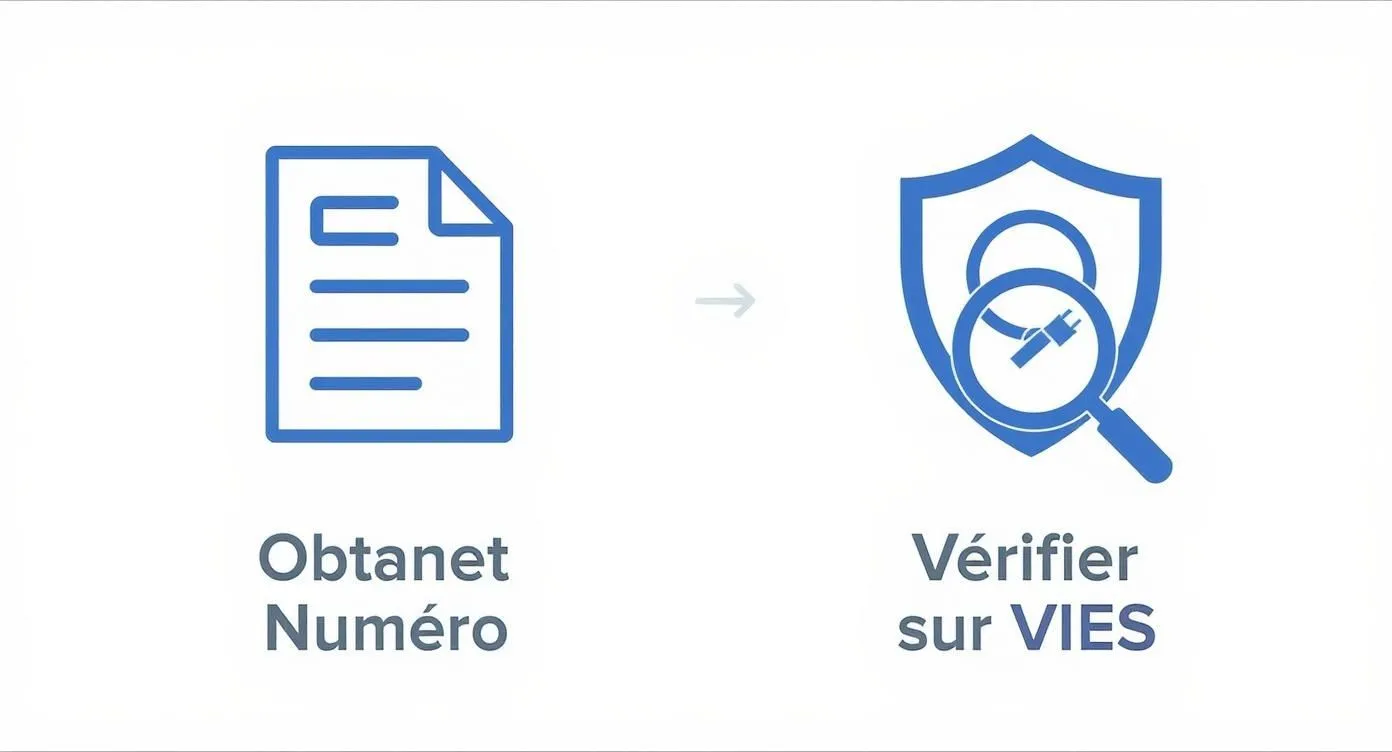
This process, simple but rigorous, is the key to securing every transaction and benefiting from the VAT exemption in full compliance with European regulations.
How to draw up a proper intra-community invoice

A properly drafted intra-community invoice is much more than just a piece of paper. Think of it as your legal and tax shield. It’s what authorizes you to invoice without VAT and proves that your dealings with your European Union partners are compliant.
The smallest error, one omission, and the whole reverse charge principle can be called into question, with a risk of tax reassessment on the line. To avoid this worst-case scenario, you need to have a firm grasp of the specific mentions required for these transactions. A flawless invoice is an unassailable invoice, one that secures your cash flow and your partners’ trust.
The crucial mentions you must never forget
In addition to the standard information you already know (date, number, identity, description…), an invoice addressed to a European business must carry a few mandatory specific mentions. Without them, in the eyes of the tax authorities, your invoice has no validity within an intra-community B2B transaction.
Here are the points to check systematically before every invoice you send:
- Your intra-community VAT number: It’s your tax “passport.” It proves you are a taxable person authorized to trade within the EU.
- Your customer’s intra-community VAT number: This is THE condition for being able to invoice tax-free. This number must be valid, and you must check it via the VIES online service before issuing the invoice.
- The mention “Amount Excluding Tax”: The invoice must be drawn up without VAT. The total amount due must therefore correspond to the net price.
The presence and validity of both VAT numbers is the true pillar of your invoice. Forgetting one, or failing to check your customer’s, is like building a house without foundations: the VAT exemption collapses and the tax risk becomes major.
The little magic phrase that justifies the exemption
For your invoice to be airtight, you need to add the legal mention that justifies why you haven’t applied VAT. This phrase is the clear signal sent to the tax authorities: the transaction does indeed fall under the reverse charge mechanism.
Several wordings exist. Consider also including an English version — it’s a professional touch appreciated by your international partners.
-
In French: “Exonération de TVA, article 262 ter I du CGI”
-
In English: “VAT exemption, article 138 of Directive 2006/112/EC”
-
In French: “Autoliquidation par le preneur, article 283-2 du CGI” or simply “Autoliquidation”.
-
In English: “Reverse charge”
These mentions are not optional. They explain why VAT isn’t on the invoice and officially transfer the responsibility for declaring it to your customer, in their own country.
Common mistakes that cost dearly
Intra-community invoicing demands rigor, plain and simple. Certain mistakes, even well-intentioned ones, can have very heavy financial consequences.
Here are the traps you absolutely must avoid:
- Charging French VAT: This is the basic mistake. Applying the French rate to a European business customer creates an accounting headache for everyone and cancels out the whole benefit of the reverse charge.
- Forgetting to check the customer’s VAT number: Blindly trusting the information given by your customer is risky. If their number turns out to be invalid, your net invoice is no longer justified. The VIES check must be systematic.
- Using incorrect or missing legal mentions: An invoice without the legal justification for the exemption is an incomplete document. In an audit, it will be rejected.
- Confusing B2B and B2C: Be careful, everything we’ve just covered only applies to sales between businesses (B2B). If you sell to an individual in Europe, the rules change: you must invoice with VAT (either the French rate or the customer’s country’s rate, depending on thresholds).
Mastering these rules is a must for any business growing across Europe. For a full rundown of all the documentation requirements, take a look at our detailed guide on mandatory mentions on an invoice. Flawless invoicing reflects your professionalism; it builds trust and secures your business.
Frequently asked questions about intra-community VAT
Intra-community VAT is a logical mechanism, but in practice it raises a whole host of concrete questions. A doubt about an invoice, a slightly unusual customer case… and the situation can quickly become a headache.
This section goes straight to the point. We’ve compiled the questions that come up most often in the field, to give you clear, directly applicable answers. The goal? To help you navigate your European dealings with much more peace of mind.
What should I do if my VAT number shows as invalid on VIES?
Don’t panic, this is a much more common situation than you’d think. Seeing your VAT number displayed as “invalid” on the VIES system doesn’t mean you’re at fault. Several reasons can explain this status.
Often, it’s simply an update delay. If you’ve just started your business, it can take a few days for your number to be fully activated and synced with the European database. A minor administrative error or an incomplete file can also be the cause.
Your first move? Contact your Business Tax Office (Service des Impôts des Entreprises, SIE). They are the only ones who can check the precise status of your file and, if needed, speed up the process. In the meantime, one rule applies: caution. Don’t carry out any intra-community transaction under VAT exemption until your number shows as “valid.” Otherwise you risk having to settle the VAT out of your own pocket later.
How do I invoice an individual customer in another EU country?
This is a key point never to confuse. The intra-community VAT reverse charge rules only apply to exchanges between businesses (B2B). When your customer is an individual (B2C), the mechanism is entirely different.
As a rule, you invoice your individual customer applying French VAT, exactly as if they were in France. But watch out, there’s a threshold to keep a close eye on: if the total amount of your distance sales to individuals across the whole EU exceeds €10,000 over the calendar year, the rules change.
Once this €10,000 threshold is crossed, you must no longer apply French VAT. It becomes mandatory to invoice using the VAT rate in force in the country where your customer lives.
To spare you the nightmare of having to register for VAT in every country where you sell, the EU has created a very handy solution: the VAT One-Stop Shop (OSS). This online portal lets you declare and pay, in one go, from France, all the VAT you owe to the various EU countries. A real time-saver and a real source of peace of mind.
My European customer doesn’t have a VAT number, what should I do?
Here, the answer is clear-cut. If your European business customer cannot provide you with a valid intra-community VAT number that can be checked on VIES, you must treat them as a non-taxable person. In plain terms: you invoice them like an individual.
In practice, this means you are required to apply French VAT on your invoice, generally at the 20% rate. Never agree to invoice tax-free on the mere promise of a number “that’s on its way.” In case of an audit, your only proof of good faith is a number validated on VIES at the time you issue the invoice.
Invoicing net of tax without this proof exposes you to an almost certain tax reassessment. The authorities will simply claim from you the VAT you should have collected.
Do I need to file a specific declaration for my European trade?
Yes, absolutely. In addition to your standard VAT return, your intra-community operations must be reported on dedicated declarations. This is what allows the tax authorities of different member states to cross-check information and make sure everyone plays by the rules.
There are two main declarations to know about:
- For supplies of goods: You must submit a VAT summary statement (which replaced the former Declaration of Trade in Goods, or DEB). Here you list all goods shipped to businesses in other EU countries.
- For supplies of services: If you provide a service to a business customer based in another member state, it’s the European Services Declaration (DES) that must be filed.
These declarations, generally monthly, are mandatory. They are the essential complement to your invoices for full compliance with the regulations.
Managing intra-community invoicing and VAT demands rigor, but the right tools can change everything. With Bizyness, you can automate your compliant invoices, track your declarations, and keep your peace of mind. Focus on growing across Europe — we’ll take care of the rest.
