

 Français
Invoice balance: manage your payments with ease
Master the invoice balance: calculate, track and optimize your payments for healthy cash flow.
When we talk about the invoice balance, what exactly does it mean? It’s simply the final amount a client still owes you, once you’ve deducted all payments already made, such as deposits or credit notes. In short, it’s the precise amount to be settled for the transaction to be considered closed.
Understanding the key concept of invoice balance
To picture it, imagine the bill at the end of a big group dinner. The total shown is the base invoice. But during the meal, some people have already paid their share (the deposits). The amount still to be settled on the final ticket, the one the rest of the group has to pay, is exactly that: the invoice balance.
For a sole trader, it’s exactly the same principle. Whether you’re a graphic designer, consultant or craftsperson, the invoice balance is a critical figure. It’s not the total amount of your service, but rather what the client still has to pay you for their debt to be fully cleared.
Why is this concept so important?
Understanding and managing the invoice balance properly is a pillar of your business. Rigorous management helps you to:
- Keep healthy cash flow by knowing precisely which sums are still due to land in your account.
- Prevent misunderstandings and disputes with your clients through clear, transparent financial communication.
- Simplify your bookkeeping, especially when reconciling your issued invoices with the movements on your bank account.
In short, the invoice balance is the key to a transparent client relationship and sound financial health for your business. It’s the figure that confirms a job is not only finished, but also fully paid.
Once this amount is settled, it’s crucial to know how to mark an invoice as paid properly in your accounting system. This is the action that officially closes the transaction and keeps your records up to date.
Calculating this balance without error, remembering to deduct deposits paid or discounts granted, is essential for your accounting documents to be a true reflection of reality. It’s a basic skill for any entrepreneur who wants to run their business with seriousness and professionalism.
Decoding the different types of balances: what your invoices really tell you
In invoicing, the word “balance” can hide several realities. Believing there’s only one type is a bit like thinking all boats sail in the same direction: a simplification that can quickly send you off course. Knowing how to tell them apart is the foundation of sound management and clear communication with your clients.
Each type of balance tells a precise story about how a transaction is progressing. By learning to read between the lines of your invoices, you’ll anticipate your cash inflows much better, handle special cases like credit notes without getting tangled up, and file your records with newfound peace of mind.
The outstanding balance: the final sprint before payment
The most common one, the one you keep an eye on, is of course the outstanding balance. It’s simply the sum your client still has to pay you after one or more deposits have been paid. It’s the final financial stretch before you can archive the project.
Let’s imagine a web developer who invoices the creation of a website at €2,500 excl. VAT. They logically ask for a 40% deposit to start the work, i.e. €1,000 excl. VAT. Once the site is live and approved, the final invoice will clearly show the calculation:
- Total amount of the service: €2,500 excl. VAT
- Deposit already paid: -€1,000 excl. VAT
- Outstanding balance: €1,500 excl. VAT (+ VAT if applicable)
This figure is your compass. It’s the cash inflow you need to actively track to keep your cash flow afloat.
The credit balance: when the situation reverses
Although less common, the credit balance is just as crucial to master. It appears when a client has overpaid, or more often, when you issue a credit note (following a returned product, for example). In practice, your business has a “debt” toward this client.
Let’s take an example. One of your clients returns a defective product worth €150. You issue them a credit note for this amount. On their next order of €400, this credit note will be deducted, leaving them only €250 to pay. A poorly tracked credit balance can quickly create misunderstandings and dent the trust your client places in you.
Don’t see the credit balance as a loss, but rather as a debt your client holds over you. It needs to be managed with just as much rigor as an outstanding invoice, since it directly impacts your business relationship and future cash flow.
The zero balance: the transaction is closed!
And finally, the holy grail of invoicing: the zero balance. This confirms the job is done. The full amount has been settled, deposits and credit notes have been deducted, and the transaction is officially over.
Reaching this zero balance means ticking off several important boxes:
- The client has fully honored their payment.
- You can finally set the invoice status to “Paid”.
- The sum is officially included in your revenue.
Mastering these three types of balances isn’t just a bookkeeping matter. It reflects your professionalism and organization. Clear, precise management is the best way to build a lasting relationship of trust with your clients.
How to calculate the invoice balance without getting it wrong
Calculating an invoice balance can seem a little daunting at first, but the logic behind it is actually very simple. The golden rule to always keep in mind: work with amounts excluding VAT, and only apply VAT right at the end. That’s the secret to avoiding calculation errors and guaranteeing spotless accounts.
To keep things simple, the magic formula is as follows:
(Total Amount excl. VAT - Deposits Paid excl. VAT - Credit Notes Applied excl. VAT) + VAT on the balance = Final Balance Due
To make everything perfectly clear, let’s break it down together with a few concrete examples, from the simplest to the most complex. You’ll see, once you get the hang of it, classic pitfalls like forgetting a deposit or misapplying a discount become a thing of the past.
Scenario 1: the simple case, no deposit or credit note
This is the most common situation. You’ve finished a job and you send the invoice for full payment. Nothing simpler.
- Service provided: €800 excl. VAT
- VAT at 20%: €160
- Balance calculation: €800 excl. VAT + €160 (VAT) = €960 incl. VAT
Here, the invoice balance is simply the total amount including VAT. Nothing complicated.
Scenario 2: calculation with a deposit paid
Let’s complicate things just a little. Your client has already paid part of the sum, so you need to remember to deduct it from the total.
Imagine a job invoiced at €1,500 excl. VAT. You had requested a 30% deposit when the quote was signed, which is €450 excl. VAT.
Here’s how to work out the balance:
- Calculate the balance excl. VAT: €1,500 (Total excl. VAT) - €450 (Deposit excl. VAT) = €1,050 excl. VAT
- Calculate VAT on this remaining balance: €1,050 x 20% = €210
- Get the balance incl. VAT: €1,050 (Balance excl. VAT) + €210 (VAT) = €1,260 incl. VAT
The client will therefore need to pay you €1,260 incl. VAT to settle everything.
The image below illustrates well the different stages in the life of a balance, from the amount due to full payment.
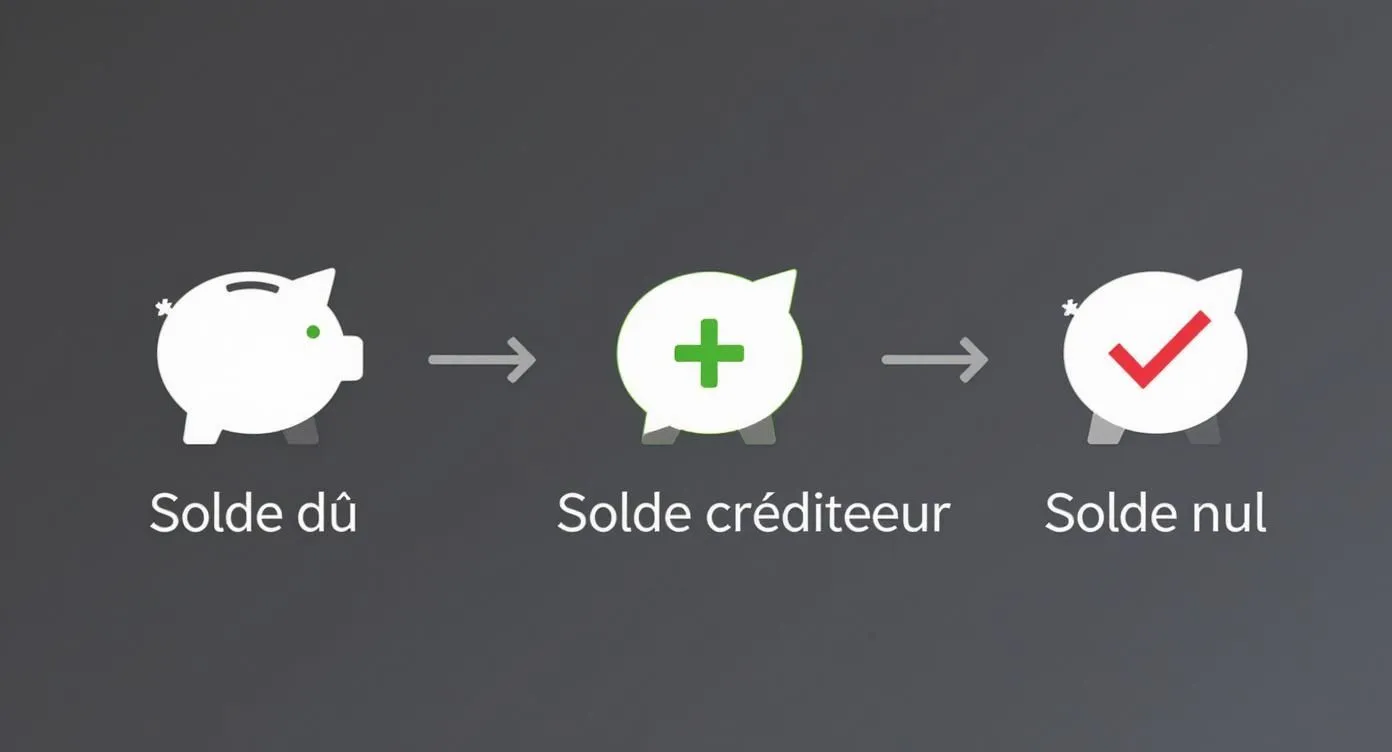
We can clearly see that the end goal is to move the status from “due” to “zero”, meaning the transaction is finished and everyone is happy.
Scenario 3: the complete example, with deposit and credit note
Now let’s move up to expert level. This is the scenario that requires the most attention, but you’ll see, the logic stays the same. Your client paid a deposit, but in the meantime, you had to issue them a credit note.
- Total service: €2,000 excl. VAT
- Deposit paid: €600 excl. VAT (i.e. 30%)
- Credit note issued: €100 excl. VAT (as a goodwill gesture)
We break down the calculation step by step so nothing gets missed:
- First, deduct the deposit and the credit note from the total excl. VAT:
€2,000 - €600 - €100 = €1,300 excl. VAT - Then, apply VAT to this new amount excl. VAT:
€1,300 x 20% = €260 - And finally, get the final balance to pay:
€1,300 + €260 = €1,560 incl. VAT
It’s as simple as that! By following this step-by-step method, you’re sure never to make a mistake.
To help you visualize this, here’s a summary table of these three examples.
Examples of invoice balance calculations
| Scenario | Total Amount excl. VAT | Deposit Paid excl. VAT | Credit Note Applied excl. VAT | Final Balance Calculation incl. VAT (20% VAT) |
|---|---|---|---|---|
| Simple case | €800 | €0 | €0 | (€800) x 1.20 = €960 incl. VAT |
| With deposit | €1,500 | €450 | €0 | (€1,500 - €450) x 1.20 = €1,260 incl. VAT |
| Complete | €2,000 | €600 | €100 | (€2,000 - €600 - €100) x 1.20 = €1,560 incl. VAT |
This table clearly shows that no matter how complex the situation, the formula stays the same. By adopting this rigor, you guarantee an invoice balance that’s always accurate, which is essential for sound bookkeeping and a relationship of trust with your clients.
The importance of the balance beyond your invoice
Rigorously managing an invoice balance isn’t just a box to tick on your administrative to-do list. It’s actually much more than that. On the scale of your micro-business, it reflects an economic principle that governs the financial health of the largest countries.
Thinking about it, the way you track every euro coming in and going out isn’t so different from the way France monitors its own economy. This perspective gives a whole new dimension to your day-to-day management: every invoice settled, every payment you chase, contributes to the strength of your own small economy.
Your management, a mirror of the national economy
A country like France constantly analyzes its accounts to know where it stands. The key indicator? The famous “current account balance”. This figure simply measures the balance between the money the country earns from abroad (exports, services) and what it spends there (imports).
When a country imports more than it exports, it ends up with a deficit. This is the national-scale equivalent of an “outstanding balance” on one of your invoices. This situation clearly shows that the basic principle - balancing what comes in and what goes out - is universal. The discipline you apply to your invoicing is the same discipline that ensures the stability of an entire economy.
By mastering the balance of each invoice, you’re not just doing good cash flow management. You’re actively applying a fundamental economic principle that determines stability, from the smallest business to the greatest world power.
Let’s take a concrete example. France’s current account balance is very sensitive to the cost of energy. Recently, this balance improved, going from a deficit of -€28.5 billion to -€8.5 billion a year later. Why? Mainly because the energy bill went down. To dig into these figures, the Banque de France statistics are a goldmine.
This analogy highlights just how vital good cash flow management is. Every euro that comes in or goes out of your business has an impact, just as every billion exchanged influences a country’s trade balance.
Ultimately, whether we’re talking about you or a nation, the goal is the same: ensuring that money coming in covers spending, to enable healthy, sustainable growth. Your rigor on the invoice balance is therefore much more than a simple accounting habit. It’s a genuine strategic reflex.
Ensuring payment and tracking your balances
Issuing an invoice with the correct invoice balance is one thing. Making sure the money actually lands in your account is another, equally crucial matter for the health of your cash flow. Once the invoice is sent, a second phase begins: tracking and accounting entry.
Everything starts with clear communication. To avoid any confusion, your invoice must clearly display the balance due and the due date. A client who knows exactly what they owe and by when is a client more likely to pay on time.

The reconciliation and follow-up process
There you go, you’ve received a transfer into your account! But the work isn’t quite finished. This is where bank reconciliation comes in. This step simply involves checking that the amount received matches, down to the cent, the balance shown on your invoice. It’s the only way to guarantee accurate, reliable bookkeeping.
But what happens if the due date has passed and you still haven’t received anything? Late payments are unfortunately common, especially for freelancers. It’s therefore smart to have follow-up templates on hand, both courteous and firm. For effective tracking, automating payment reminders can save you precious time and help secure your revenue.
Here’s a small roadmap for handling delays methodically:
- D+1 after the due date: A first reminder email, simple and friendly. To err is human!
- D+7 after the due date: Move on to a slightly more formal follow-up, gently mentioning any late payment penalties.
- D+15 after the due date: A quick phone call can unblock the situation. It’s a chance to understand what’s going on and find common ground.
Managing these financial flows can quickly become a headache. In fact, this balance management is an issue that extends well beyond your own business. On a national scale, trade balances have a huge impact. For example, France’s energy bill saw the deficit balance of its extractive industries widen by €1.5 billion and that of refined products by €5.4 billion over one year, weighing heavily on the national economy. (Source: INSEE).
Gain peace of mind with the right tools
Fortunately, you’re not alone facing this administrative mountain. Modern invoicing tools, like Bizyness, are designed to turn this chore into a simple, near-automatic process. Their secret? They connect your invoices directly to your bank transactions.
As soon as a payment lands in your account, the system links it to the relevant invoice, marks it as “Paid” and updates your cash flow tracking in real time.
The benefit is threefold: precision, time and, above all, peace of mind. No more stress from having to comb through your bank statements line by line. You can finally focus on what really matters: growing your business.
Automate your invoice management with Bizyness
After the theory, let’s move on to practice. Managing invoices can quickly become a real headache. Imagine for a moment: you create an invoice, add a deposit, and the invoice balance updates itself, as if by magic. That’s exactly what a good management tool does.
Gone are the days of spending time checking off each payment in an Excel file. A smart system takes care of everything for you. It sends automatic reminders, polite but effective, when a due date approaches. And as soon as the payment lands in your account, it handles the reconciliation. You know in real time where you stand, without even having to think about it.
The concrete benefits of automation
The impact on your daily life is immediate. By delegating these repetitive tasks to software, the benefits are clear:
- You eliminate errors. No more typos in calculations or missed follow-ups. Machines are far more reliable for this.
- You save a huge amount of time. This precious time can finally be devoted to what really matters: your craft, your clients, growing your business.
- You strengthen your brand image. Flawless invoices and rigorous follow-up exude professionalism. Your clients will notice.
This administrative optimization is much more than a simple convenience. It’s a very concrete way to secure your cash flow, the lifeblood of any business. Managing financial balances is, in fact, an issue at every scale. To give you an idea, France’s energy bill recently reached €55.6 billion. The slightest variation in this balance has a direct impact on the country’s trade deficit. To understand how these major balances work, you can take a look at the detailed analysis from the French Treasury.
Automation isn’t a luxury reserved for large organizations. For a freelancer, it’s a key investment to lighten the mental load and be able to focus on growth.
With Bizyness, you choose a solution designed for sole traders and micro-entrepreneurs that truly simplifies life. Our online invoicing platform is built to bring you clarity and, above all, peace of mind.
To get a broader view of the value of automation tools, even beyond invoicing, this article explaining what management software is is an excellent read. It clearly shows that efficiency comes above all from having the right tools.
Answering your questions about invoice balance
Even with all these explanations, it’s normal to still have a few questions running through your mind. This is a topic that can quickly get complex. Let’s untangle the most frequent questions together so the invoice balance no longer holds any secrets for you.
Can a client refuse to pay the balance?
The short answer is: yes, but not without good reason. If your client can prove you didn’t hold up your end of the contract (for example, poorly done work, an unjustified significant delay), they have the right to dispute payment.
On the other hand, if you delivered exactly what was agreed in the quote they signed, the law is on your side: they’re obliged to settle the balance. In case of disagreement, the best approach is always to talk it through. An amicable arrangement will save you a lot of trouble before considering legal action.
Do you need to issue a balance invoice if no deposit was paid?
No, not really. We talk about a “balance invoice” specifically when there have been one or more prior payments, such as a deposit. It’s the invoice that closes the loop.
If your client pays the full amount in one go, you simply issue a standard invoice. In that case, the balance due is simply the total amount of the invoice. Easy!
A balance invoice serves to sum things up: it recaps what has already been paid and clearly states what remains to be settled. Without a deposit, this recap loses all its purpose.
I made a mistake calculating the balance, what should I do?
It happens, even to the best of us! If you notice an error after sending the invoice, the golden rule is simple: never modify an invoice that has already been issued.
The right approach is to create a corrective invoice. This new document will cancel and replace the previous one. It must contain all the information from the original invoice, but with the correct calculation, and clearly mention the number of the invoice it corrects. It’s the only way to keep clean, transparent bookkeeping, both for you and your client.
To never get these calculations wrong again and automatically generate every invoice balance, Bizyness was designed for you. Try our tool for free and simplify your management today!
