

 Français
Invoice payment terms: The guide to mastering your deadlines
Everything you need to know about invoice payment terms — optimize your management and avoid late payments with our essential tips.

The payment term on an invoice is much more than a simple due date printed at the bottom of a document. It’s the amount of time you give your client to pay you once you’ve delivered your product or completed your service. Think of it as a financial pact that sets the rhythm of your business relationship.
Decoding an invoice’s payment term
To really understand it, think of the payment term as the pulse of your cash flow. Its regularity determines the financial health of your business.
For you, as the supplier, this term is crucial. It determines your ability to collect money on time to cover your own expenses: paying your employees, settling your suppliers, or paying your contributions. It’s the fuel of your business. For your client, this term offers welcome flexibility to organize their own cash flow.
A well-managed balance here is therefore fundamental. It’s what allows everyone to work with peace of mind and grow.
A business agreement before a constraint
Above all, the invoice payment term is a business agreement. Even though the law sets a framework, the exact duration is often the result of negotiation or is defined in your terms and conditions of sale, which your client accepts when signing the quote.
Getting things clear from the start is the best way to avoid misunderstandings and tension later on.
It’s a matter of trust. By granting a payment term, you’re extending credit to your client. By honoring it, they respect that trust and strengthen your business relationship for the future.
Legal deadlines, essential safeguards
Fortunately, this isn’t left to chance. French law regulates these terms quite strictly, particularly to protect small businesses from abuses of power by their larger clients. The French Commercial Code has therefore put rules in place so that the game is fair for everyone.
To make things clearer, here’s a summary of the legal deadlines in force in France. These are the basic rules every entrepreneur needs to know to invoice in full compliance.
Legal payment terms in France
| Situation | Default term | Maximum negotiated term | Specific term |
|---|---|---|---|
| Business-to-business relationship (B2B) | 30 days after receipt of goods or completion of the service. | 60 days net from the invoice issue date. | 45 days end of month from the invoice issue date (terms to be specified in the contract). |
| Specific sectors (transport, food, etc.) | Varies by sector. | Shorter caps may apply (e.g., 20 days for livestock). | Refer to sector-specific regulations. |
| Public contracts | 30 days for the State, local authorities and their agencies. | Non-negotiable, except in very limited exceptions. | 50 days for public health institutions. |
This table gives you the fundamental benchmarks. Mastering them is not only a legal obligation but also proof of your professionalism. It’s the first step toward turning invoicing into a real lever for steering your cash flow, rather than a mere administrative chore.
The legal framework for payment terms in France
Going into business without mastering the rules on payment terms is a bit like sailing blind through a storm. Fortunately, French legislation has stepped in to bring order and make things fairer and more predictable, protecting the cash flow of businesses, particularly the smallest ones.
This regulation didn’t appear overnight. France has gradually strengthened its legislative arsenal to clean up business relationships. One of the first building blocks was laid by the New Economic Regulations Act (NRE) in 2001, which set a default payment term of 30 days. The Economic Modernization Act (LME) of 2008 then drove the point home further. The result? The average invoice payment term dropped from 55 days in 2000 to around 44 days in 2018 — a real breath of fresh air for many businesses.
The infographic below gives you a good picture of these developments, which shape your obligations today.
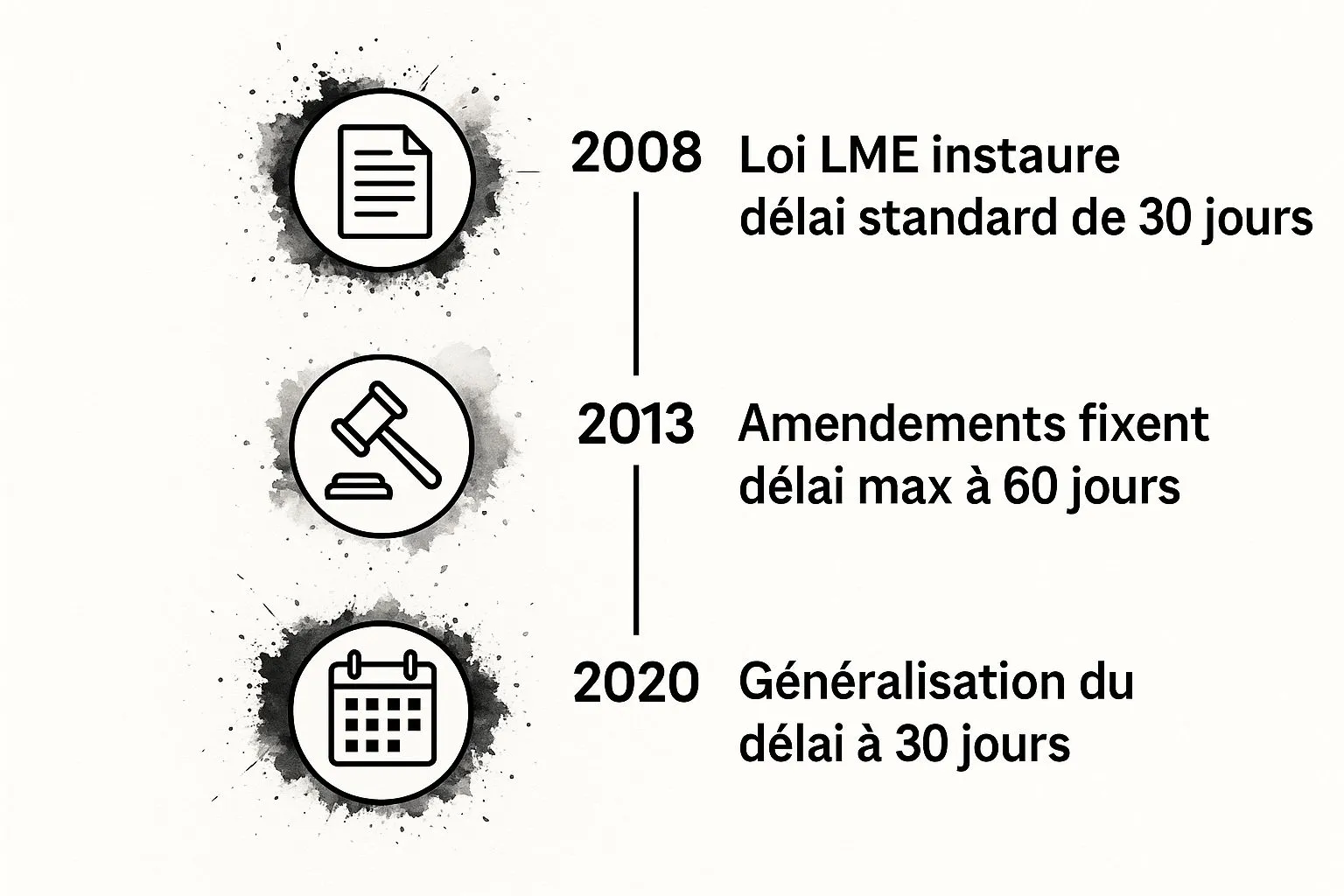
You can clearly see how the law has progressively tightened the screws to protect suppliers, particularly SMEs, who are often the most vulnerable to late payments.
The caps you must never exceed
The Commercial Code couldn’t be clearer. If nothing is specified between you and your client, the default payment term is 30 days after receipt of the goods or completion of the service. That’s the basic rule.
Of course, it’s possible to negotiate other terms with your clients, but be careful — there are limits that cannot be crossed:
- 60 calendar days maximum, counted from the invoice issue date.
- 45 days end of month, a possible alternative but one that must be written in black and white in your contract and must never unduly disadvantage the creditor.
Let’s be clear: these terms are not mere suggestions. They constitute a legal obligation, and the DGCCRF (the French Directorate General for Competition Policy, Consumer Affairs and Fraud Control) keeps a close watch. Non-compliance can cost you dearly.
For these conditions to apply, they must appear explicitly on your business documents. This includes not only the due date, but also the calculation of late-payment penalties. To make sure you’ve got everything right, take a look at our guide on mandatory information on an invoice.
What if my client doesn’t respect the deadline?
If your client goes past the invoice payment term you had set, the law gives you tools to react. You are entitled to demand late-payment penalties starting from the very first day after the due date. Good news: you don’t even need to send a reminder for this right to apply.
The rate of these penalties is normally defined in your terms and conditions of sale. If you haven’t specified one, don’t worry — the legal rate takes over: it’s the European Central Bank’s (ECB) refinancing rate, increased by 10 points.
On top of that, a flat-rate compensation of €40 for collection costs is automatically owed by the late-paying client. This is a fixed amount added on top of the penalties. These tools aren’t just there for show; they compensate for the harm you suffer and the time you lose. Using them simply means asserting your rights and actively protecting your cash flow.
The impact of late payments on your business

A late payment is never just a minor administrative hiccup. It’s much more than that. Think of it as a domino effect: a single invoice paid late can be enough to destabilize your entire financial balance, especially if your business is still young or small.
This situation puts immediate pressure on your cash flow — the fuel that keeps your engine running day to day. Without that money coming in, paying your own bills, your suppliers, or even your team’s salaries can quickly become a real headache.
The hidden cost of unpaid invoices
Beyond the hole in your cash reserves, late payments carry an enormous hidden cost: the time you spend on them. Every hour spent chasing a client by phone or email is an hour you’re not spending growing your business, innovating, or landing new contracts.
This lost time adds up and weighs heavily on morale. The stress of not knowing when the money will come in can cloud your decision-making and put the brakes on your projects.
An investment project put on hold, a growth opportunity missed, a hire postponed… The consequences of a late invoice payment go well beyond the amount shown on the document.
The numbers speak for themselves. In France, even though the situation has improved somewhat, late payments remain a real scourge. A 2023 Altares study shows the average delay stands at 12 days. The problem is that a significant share of businesses, particularly the smallest ones, experience delays exceeding 30 days, which weakens them considerably.
When chasing payments becomes a strategic necessity
Given these risks, managing unpaid invoices can’t be a task you handle whenever you have spare time. It needs to be an integral part of your strategy. Putting in place a clear, systematic reminder process is the best insurance for protecting your cash flow.
Follow-up that’s a bit too lax can quickly lead to cascading consequences:
- Pressure on cash flow: You struggle to cover day-to-day expenses.
- Stalled projects: You can’t invest in the new equipment or software you need.
- Loss of precious time: Your energy is drained by collections instead of growth.
- Deterioration of client relationships: Rushed reminders can strain business relationships.
Rigorous invoice tracking is therefore a guarantee of your peace of mind and the sustainability of your business. Knowing how to react is essential, which is exactly why we’ve put together a complete guide to help you master the art of chasing an unpaid invoice.
Ultimately, proactively managing payment terms isn’t a constraint — it’s a genuine survival and growth strategy. It’s what lets you secure your revenue, maintain good relationships with your clients, and focus on what really matters: growing your business.
Setting up effective invoice tracking

Now that we’ve covered the risks, it’s time to take action. Let me be direct: setting up efficient invoice tracking isn’t optional — it’s an absolute necessity to protect your cash flow. The idea is to turn what’s often seen as an administrative chore into a real lever for your business.
To get there, it all starts with solid foundations, well before the invoice is even sent. A well-crafted quote or invoice, with no room for interpretation, is your best insurance against late payments.
The goal is to build a system that works for you, not the other way around. A system that helps you anticipate cash inflows, react quickly to any issue, and above all, free up time to focus on what you do best: your craft.
Clarifying the rules from the start
It all starts with clarity. Your business documents must be flawless. Your client must understand what they owe you, and by when, without needing to ask a single question.
To anticipate and stay on top of the invoice payment term, here are the points to check systematically on every quote and invoice:
- A precise due date: Forget vague phrases like “payment within 30 days.” Prefer a clear, specific date, such as “Payment due on 10/30/2024.” It’s direct and unambiguous.
- Clearly visible payment terms: Make sure the deadlines, late-payment penalties, and the flat-rate compensation of €40 stand out. Don’t hide them in fine print at the bottom of the page.
- The payment methods offered: Make life easier for your client. Clearly state how they can pay you: bank transfer, card, direct debit… The easier it is for them, the faster you’ll get paid.
This upfront rigor defuses most disputes that arise from a simple misunderstanding. It’s also a mark of professionalism that builds trust.
Automation: the key to effortless tracking
Let’s be honest, tracking invoices by hand in a spreadsheet is a waste of time and an open door to errors. Fortunately, modern tools like Bizyness are here to take over and give you incredible peace of mind.
Automating invoice tracking doesn’t replace the human element. On the contrary, it frees people up to focus on what matters most: client relationships and growing the business.
A good invoicing tool gives you an instant view of the status of every invoice: sent, viewed by the client, overdue, paid. This dashboard lets you steer your cash flow with precision and avoid unpleasant surprises.
See for yourself how an interface like Bizyness’s gives you a clear, actionable view of your payments.
All the important information is centralized. At a glance, you know which invoices need your attention.
The real power of this approach is proactivity. No more discovering an unpaid invoice by chance while checking your bank statement. You’re alerted automatically. You can then trigger reminders that are both personalized and automated, sent at key moments you’ve chosen (for example, on day 1, day 7, and day 15 after the due date). This systematic method drastically increases your chances of being paid on time, without you having to think about it every day.
How do you handle complex payment situations?
In the real life of a business, things aren’t always as simple as a standard invoice. The classic payment term doesn’t suit every situation, and as a business owner, you need to be ready to navigate slightly murkier waters to protect your cash flow.
Certain scenarios — such as requesting a deposit, setting up recurring invoices, or negotiating with large groups with endless approval chains — call for a tailored approach. The key is always to keep a written record and formalize every agreement.
The key here isn’t rigidity, but well-managed flexibility. Every exception should result from a mutual, documented agreement, never a concession imposed on you.
By being well prepared, you’ll approach these special cases with confidence, without putting your business’s financial health at risk.
Adapting your terms to your sector and region
The payment term you can set isn’t an exact, universal science. It can vary widely depending on your industry, and even your geographic location. Construction, for example, has its own rules, with mechanisms like retention guarantees that directly affect cash flow.
Regional differences are also very pronounced. A report from the Observatoire des Délais de Paiement (Payment Terms Observatory) highlighted that businesses in French overseas territories face delays averaging 25% longer than those in mainland France. In some cases, particularly with local public authorities or hospitals, delays can become critical and heavily penalize entire sectors, such as construction. To dig deeper into the topic, feel free to consult the full report from the Observatoire des Délais de Paiement.
Managing deposits and staggered payments
For projects that stretch out over time or large orders, requesting a deposit isn’t optional — it’s a necessity. It’s a sound practice that’s strongly recommended to secure the business relationship. A deposit, which often ranges between 30% and 50% of the total, lets you cover your initial expenses and confirm your client’s commitment.
In practice, how does this work?
- State it on the quote: The deposit, its amount, and its conditions must be written in black and white on your quote. The client must accept it before you begin any work.
- Issue a deposit invoice: This document is the accounting record that formalizes your request for partial payment even before final delivery.
- Deduct the deposit from the final invoice: On the balance invoice, clearly show the total amount of the service, the deposit already received, and, of course, the remaining balance due.
This system is particularly vital for freelancers and independent workers. Our guide on invoicing for sole traders covers these very practical aspects in detail. By mastering these special cases, you strengthen the financial resilience of your business.
Frequently asked questions about payment terms
Even with all the information at hand, questions often remain when it comes to juggling invoice payment terms. That’s perfectly normal. This section is here to clear up any remaining doubts with clear answers drawn from real-life situations. The goal is to give you every key you need to secure each transaction.
Between legal obligations and special cases, it’s easy to feel a bit lost. So we’ve gathered here the most frequent questions asked by entrepreneurs like you. Think of this section as your personal cheat sheet for reacting quickly and effectively, whatever the situation.
With these straightforward answers, you’ll be able to tighten up your processes, discuss terms more confidently with your clients, and ultimately keep full control over your cash flow.
How do you calculate the starting point of a payment term?
The starting point is the crux of the matter, since everything else follows from it. The rule is simple: it’s always the invoice issue date. That’s what starts the countdown.
To make this crystal clear, let’s look at two concrete examples:
- For a “30 days net” term: Payment is due exactly 30 calendar days after your invoice date. If you issue it on May 10, the due date falls on June 9.
- For a “45 days end of month” term: Here, the calculation is a bit more subtle. You add 45 days to the issue date, and the due date is then pushed to the end of that month. For an invoice dated May 10, adding 45 days brings you to June 24. The due date is therefore June 30.
Clarity is your best ally. Make sure the issue date and due date stand out clearly on your invoices. It’s the best way to cut short any dispute from a client acting in bad faith, and to demonstrate your rigor.
What should I do if a client refuses to pay late-payment penalties?
This is a tricky situation, but one that happens more often than you’d think. If a client disputes or refuses to pay late-payment penalties, above all, don’t back down. The law is on your side: these penalties are a legal obligation, not a favor.
Start with a diplomatic but firm approach. A simple follow-up email is often enough to remind the client of their obligations. Be sure to mention that these penalties are provided for by the Commercial Code.
If dialogue breaks down, it’s time to step things up. Send a formal notice by registered letter with acknowledgment of receipt. This document carries real legal weight. It’s the final step before considering judicial debt-collection proceedings, such as a payment order. It’s your most effective tool for recovering what you’re owed.
Can I require upfront payment from all my clients?
Yes, absolutely. You have every right to require payment upfront, meaning immediate settlement once the product is delivered or the service completed. For your cash flow, this is by far the safest option.
Be careful, though — this condition can’t be improvised at the last minute. To be valid, it must be written in black and white in your terms and conditions of sale and, above all, accepted by your client before the collaboration begins. A signed quote clearly stating this term is rock-solid proof of agreement.
Keep in mind, though, that while this is legal, it can be a deterrent for certain clients used to more flexibility. A good approach is to reserve upfront payment for new clients or those with whom you’ve already had late payments. It’s an excellent way to protect yourself without penalizing your most reliable partners.
Secure your cash flow and simplify your invoice management with Bizyness. Automate your payment reminders, track your payments in real time, and focus on what really matters: growing your business. Discover how Bizyness can transform your day-to-day.
