

 Français
Invoice Payment Terms: The Complete Guide
Master invoice payment terms in France. Discover the legal rules, how to calculate late payment penalties, and strategies to protect your cash flow.

The payment term of an invoice is simply the time you give your client to pay you once you’ve delivered a product or completed a service. In France, you can’t just do as you please: the law clearly regulates these terms, which generally range from 30 to 60 days. The goal? To protect companies’ cash flow, especially that of the smallest ones.
Why mastering payment terms is a matter of survival

Think of your company’s cash flow as the fuel that keeps your engine running. Every invoice you send is a promise of a full tank, but as long as the money isn’t in your account, the tank stays dry. A late payment isn’t just a minor administrative hassle — it’s a real leak that can slow you down, or even bring you to a complete stop.
That’s why managing payment terms goes well beyond simple bookkeeping. It’s a genuine strategic tool, essential to the survival and growth of your business.
The direct impact on your cash flow
When a client is slow to pay, it immediately affects your ability to meet your own obligations: salaries, suppliers, taxes, rent… all of it. A dangerous gap then opens up between what goes out and what comes in, driving up your working capital requirement (WCR).
If this need isn’t covered, financial tension sets in. You might be forced to turn down new projects or, worse, scramble for expensive emergency financing.
Mastering your payment deadlines turns a constraint into a real asset. It gives you the financial stability to pay your own bills without stress, and also to invest and hire in order to grow.
An issue that goes beyond your own business
And this problem is far from isolated. In France, the impact of late payments is considered critical by 86% of business leaders. A 2018 study even put the average delay at 10.7 days. This situation puts real strain on small and medium-sized businesses, creating a devastating domino effect across the entire economy. To dig deeper into the topic, the analysis of company payment behavior on Upflow.io is very insightful.
By being proactive on this front, you’re not just securing your own business. You’re also contributing to a healthier, more reliable business ecosystem for everyone. Ultimately, managing your invoice payment terms well simply means running your company with better visibility and far more peace of mind.
The legal framework for payment terms in France
In France, invoice payment terms are a serious matter, tightly regulated by law. It’s the French Commercial Code, and more specifically the Law on the Modernization of the Economy (LME), that sets the rules of the game. The goal is simple: protect businesses, and especially their cash flow, against payments that drag on.
Think of these rules as the foundations of your business. If they’re solid, your business relationships will be too. Ignoring them means risking your cash flow and exposing yourself to penalties. Understanding them well is therefore the key to running your business without stress.
The infographic below gives you a quick overview of the essential payment terms and what happens in case of a delay.
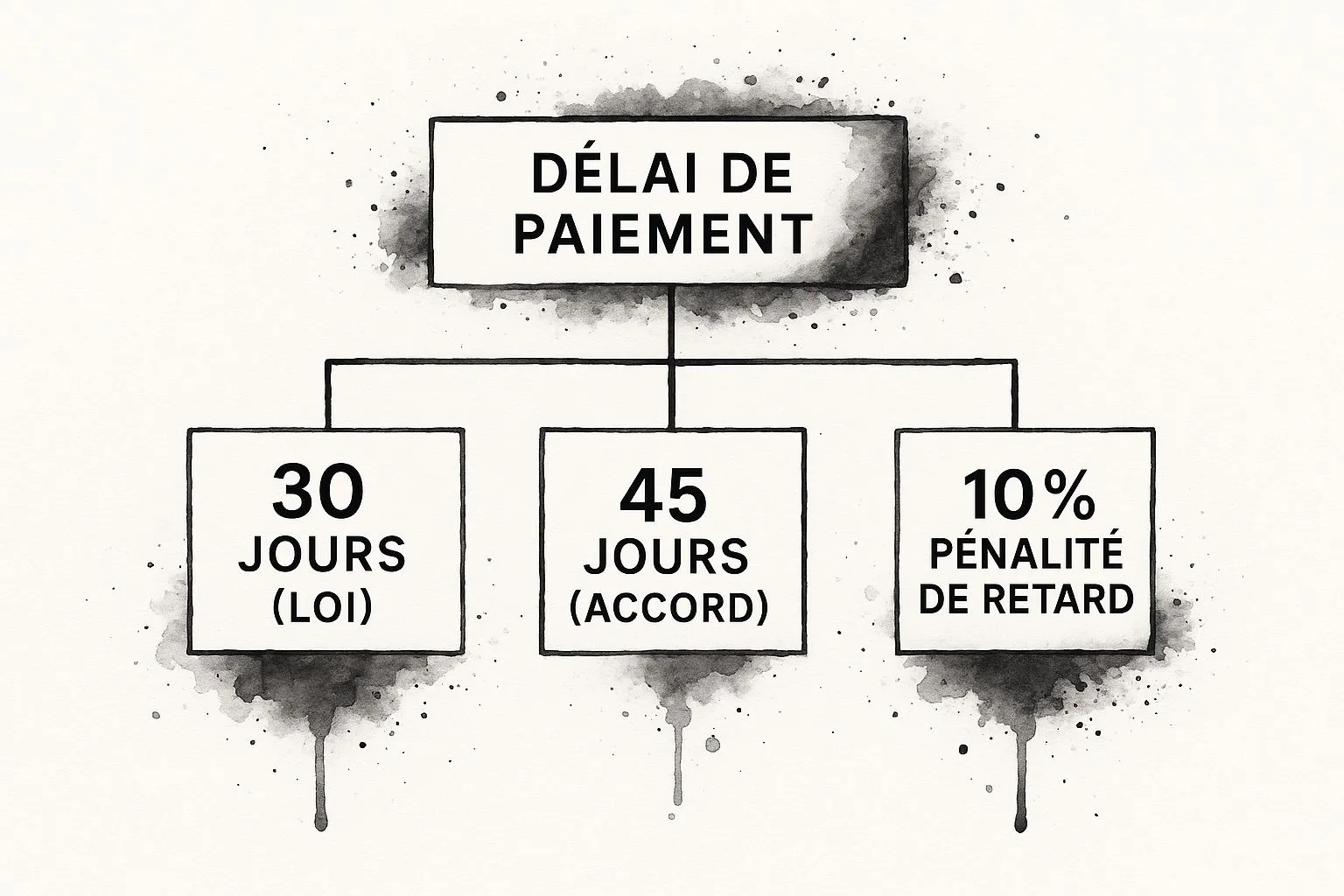
This visual clearly shows the hierarchy: the default legal term, the terms you can negotiate, and the penalties that apply if the rules aren’t followed. It’s a simple, effective reference for any business.
The default rule: 30 days, not one more
If you haven’t specified anything in your general terms and conditions of sale or directly on your invoice, the law has already thought of everything. A rule applies automatically.
The standard term is set at 30 days after the date the goods are received or the service is completed. That’s the baseline. If no specific agreement has been signed with your business client, this is the term that applies.
Negotiated terms: some flexibility, but with limits
The law does allow businesses to agree between themselves to extend payment terms. But be careful — this flexibility is strictly regulated to prevent abuse.
Two main options are available to you:
- The 60 calendar-day term: This is the absolute maximum. Payment must arrive no later than 60 days after the invoice issue date. No negotiating beyond that.
- The 45-day end-of-month term: A bit more technical, but often convenient for bookkeeping purposes. Payment must be made no later than 45 days after the end of the month in which the invoice was issued.
A concrete example for “45 days end of month”
Imagine you issue an invoice on March 5. Or on March 28. Either way, the due date is the same. You take the end of the month (March 31), add 45 days, and land on May 15. This method really simplifies tracking when you’re juggling a lot of invoices.
Mastering these calculations is essential to staying in control of your cash flow. It’s a topic we cover in more depth in our guide on how to manage invoice payment terms.
For clarity, here’s a table summarizing these different options.
Summary of legal payment terms between businesses
This table summarizes the main legal terms applicable in France to make them easier to understand and apply.
| Type of term | Calculation rule | Condition of application |
|---|---|---|
| Default term | 30 days | Applies if nothing is specified in the contract or terms of sale. |
| Negotiated term (max) | 60 calendar days | Must be explicitly agreed between the parties. Legal ceiling. |
| Negotiated term (alternative) | 45 days end of month | Must be explicitly agreed. The count starts from the end of the invoicing month. |
These terms form the general framework, but it’s important to note that exceptions exist for certain sectors.
Sector-specific exceptions to know
Fresh produce and intellectual services aren’t treated the same way. The law recognizes this and has set specific rules for certain business sectors.
Here are a few telling examples:
- Perishable food products: Terms are logically shorter. Payment is expected within 30 days after the end of the ten-day delivery period.
- Transport sector: The term is capped at 30 days from the invoice issue date, with no possible exception.
These exceptions protect suppliers whose products have a limited shelf life or whose business model requires very fast cash inflows. It’s therefore essential to check whether your sector is subject to specific regulations to avoid any unpleasant surprises.
Calculating and applying late payment penalties

When a client misses an invoice’s due date, you have every right to apply financial penalties. This isn’t an aggressive move — it’s a legal tool designed to protect your cash flow and encourage compliance with payment deadlines. Knowing how to use this mechanism is therefore essential to respond fairly and professionally.
Note that mentioning these penalties is mandatory on all your invoices and in your general terms and conditions of sale. This is non-negotiable. Even if, in a spirit of goodwill, you choose not to claim them, they must still appear. This is the foundation of your protection in case of a dispute.
The penalty calculation formula
The calculation might seem a bit intimidating at first, but it’s based on a perfectly logical formula. It takes three factors into account: the amount owed, the number of days late, and a defined interest rate.
Here is the formula to apply:
(Invoice amount including VAT x Applicable interest rate) x (Number of days late / 365)
The crucial point here is the interest rate. If you haven’t specified anything in your terms of sale, the law requires using the European Central Bank (ECB) key rate, plus 10 points. In concrete terms, if the ECB rate is 4.5%, your penalty rate will be 14.5%.
A concrete example
Take an invoice of €1,200 including VAT unpaid for 20 days. With an ECB rate of 4.5%, the penalty rate works out to 14.5%.
The calculation is therefore: (€1,200 x 14.5%) x (20 / 365) = €174 x 0.05479 = €9.53.
The amount may seem modest, but it applies to every invoice, and its power is primarily a deterrent.
The flat-rate compensation for collection costs
In addition to these penalties, the law allows you to claim compensation to cover the administrative costs of chasing your client for payment. A measure that considerably simplifies things.
This is a fixed amount of €40. It is owed automatically from the first day of delay, with no need to justify it. Important point: this compensation applies to each overdue invoice, even if you group them all into a single reminder.
So, how does this work in practice?
- 1. Check the due date: Make sure the term has genuinely passed.
- 2. Calculate the penalties: Apply the formula with the correct rate and precise day count.
- 3. Don’t forget the compensation: Add the flat €40.
- 4. Issue a clear document: You can create a dedicated invoice solely for the penalties and compensation, or add them as separate line items on your client’s next invoice.
Applying these measures isn’t just exercising a right — it’s also a sign of good management. To see clearly how to present all this, feel free to check our guide with a detailed example of a late payment penalty on an invoice. You’ll turn a potentially tense situation into a clear procedure that reinforces your company’s professionalism.
The real economic impact of late payments
Penalties and laws are there to protect us, of course. But that’s just the tip of the iceberg. Behind every late-paid invoice lies a much harsher economic reality, especially for the small and medium-sized businesses that drive our economy. A delay isn’t just a minor administrative setback. It’s a genuine shockwave.
Take a concrete example: a craftsman has just finished a major job. He’s counting on this payment to order materials for his next project, pay his employees, and maybe even invest in a new tool. If his client, a large company, pays 30, 60, or even 90 days late, this whole fragile balance collapses.
The domino effect on cash flow
The first blow is direct, and it hurts: cash flow tightens. The infamous working capital requirement (WCR) explodes, because the company must keep paying its expenses, salaries, and its own suppliers well before it sees the money it’s owed.
This pressure on cash flow triggers a genuine chain reaction:
- Investments are frozen: Buying that new machine or launching a new service will have to wait. Growth and innovation are put on hold.
- The company’s own suppliers suffer: The business itself becomes a “bad payer,” dragging down other small businesses that had nothing to do with it.
- Reliance on bank overdrafts becomes necessary: A stopgap solution, but a costly one that eats into already thin margins.
In the most critical situations, this scenario leads straight to disaster. It’s estimated that one in four SME bankruptcies is a direct consequence of late payments. That figure is enormous. It shows just how much respecting invoice payment terms is simply a matter of survival.
France, the poor student of Europe?
The situation in France is particularly tense, and it isn’t improving. A recent study showed that the average payment delay has climbed to 13.6 days. The most worrying part? Only 46% of companies pay their invoices on time. The largest ones, those with more than 1,000 employees, are the worst offenders, with an average delay of 18 days. These figures put us far behind countries like Germany or the Netherlands, where delays are kept under 10 days. To gauge the pressure this puts on suppliers, the full analysis from Republik Achats is very insightful.
Every day of delay is a day a supplier’s cash flow weakens. Paying on time isn’t a commercial gesture — it’s an economic responsibility and an act of solidarity essential to the vitality of the whole ecosystem.
Ultimately, respecting payment terms goes far beyond a simple legal obligation. It’s the glue that binds trust and smooth exchanges together, allowing every link in the chain to grow with peace of mind.
Setting up proactive payment management
Suffering through late payments isn’t inevitable. Rather than passively waiting for deadlines to be missed before reacting, a proactive approach can completely transform how you manage your cash flow. It’s a bit like choosing between bailing out a boat that’s already taking on water and making sure the hull is watertight before you even set sail.
This preventive strategy relies on simple actions, but ones put in place well before the invoice is even issued. It’s a small investment of time that will earn you enormous peace of mind and financial stability.
Building solid foundations before the sale
Everything starts before the contract is even signed or the product delivered. This is the exact moment when you set the rules of the game to secure your business relationship and minimize the risk of unpaid invoices as much as possible.
Here are a few key habits to build into your routine:
- Check the creditworthiness of new clients: Before committing, take the time to look into the financial health of your future partner. Online services give you access to companies’ legal and financial information. It’s a simple precaution that can save you a lot of headaches.
- Write clear general terms and conditions of sale: Your terms of sale are your legal shield. Make sure they clearly state the invoice payment term, the applicable late payment penalties, and the flat-rate compensation. Well-drafted terms of sale leave no room for interpretation.
- Automate invoicing: Don’t wait until the end of the month to invoice. Has a service been completed or goods delivered? The invoice should go out immediately. A tool like Bizyness automates this task to guarantee speed and compliance, which in turn shortens processing times on your client’s end.
The screenshot below clearly shows how invoicing software like Bizyness lets you create and send a professional invoice in just a few clicks.
A clear interface, with all legal notices in place, immediately strengthens your credibility and professionalism.
Setting up a smart reminder plan
Even with the best preparation in the world, a delay can always happen. That’s where a well-structured reminder plan comes in, combining diplomacy and firmness. The idea is to automate a gradual process so you’re never caught off guard.
A good reminder plan is like a GPS: it guides you step by step, from a simple friendly nudge to a formal notice, without ever losing sight of your final destination — payment.
Here’s an example sequence you can easily automate:
- D-7 (before the due date): A friendly reminder email. “Hello, unless we’re mistaken, our invoice #XXXX is due in a week. Feel free to reach out if you have any questions.”
- D+3 (after the due date): First reminder, polite but direct. “Hello, our invoice #XXXX has reached its due date. Could you let us know a payment date?”
- D+15: Second reminder, firmer, mentioning the penalties. “Without a response from you, we will be forced to apply the late payment penalties set out in our terms of sale.”
- D+30: Sending a formal notice by registered letter with acknowledgment of receipt. This is the last formal step before considering legal action.
Management tools like Bizyness let you schedule these automatic reminders. You set up your scenarios once and for all, and the software takes care of the rest. To dig deeper into the topic, check out our complete guide on chasing an unpaid invoice, which details each step and provides ready-to-use templates. You free up valuable time while ensuring consistent, professional follow-up on your receivables.
Frequently asked questions about payment terms
Navigating the rules around invoice payment terms inevitably raises very practical questions. Let’s dive into the most common ones to give you clear, direct answers you can apply tomorrow in your day-to-day life as an entrepreneur.
The idea is simple: clear up the gray areas so you can manage your business relationships with confidence and professionalism. By mastering these points, you’ll avoid the classic pitfalls that can undermine your cash flow.
Can you negotiate a term longer than 60 days?
The answer is no, with very few rare exceptions. As a general rule, the law strictly prohibits agreeing on a payment term that exceeds 60 calendar days or 45 days end of month. This is a strict limit.
Even if you wrote it in black and white in a contract or in your terms of sale, such a clause would be deemed abusive. In case of a dispute, it would simply be voided.
Of course, a few exceptions exist for very specific sectors (agricultural equipment, holiday toys, etc.), but for the vast majority of businesses, these caps are impassable walls. Don’t push your luck!
What is the actual starting point of the payment term?
This is the crux of the matter, because without a clear starting point, the whole calculation becomes fuzzy. Fortunately, the law has set reference points so everyone speaks the same language.
Most often, the clock starts on the date the goods are received or the date the service is performed. That’s the moment that counts.
If your contract doesn’t specify anything, the default 30-day term after that date applies automatically. For negotiated terms (the famous 60 days or 45 days end of month), the invoice issue date is generally used as the reference. Hence the critical importance of always properly documenting the actual delivery date.
What if a client disputes an invoice just to avoid paying?
Ah, the classic delaying tactic… When a client suddenly pulls a dispute out of thin air right as the due date approaches, your responsiveness and method are your best weapons.
Take a structured approach:
- Demand details in writing: The first step is to ask your client to list precisely the grounds for their dispute. An email is enough. This forces them to move past vague claims and actually argue their case.
- Analyze and respond: Is their claim justified on a small point? Offer a partial credit note to unblock payment of the rest. Is it completely unfounded? Respond point by point, with supporting evidence (signed delivery note, email exchanges confirming the work, etc.).
- Step it up: If the client digs in, don’t wait. Send a formal notice by registered letter with acknowledgment of receipt. This formal letter is a required step before any legal action and signals that the game is over.
Is mentioning late payment penalties really mandatory on invoices?
Yes, absolutely. It’s an unavoidable legal obligation. You must state the conditions under which late payment penalties apply on every one of your invoices and in your terms of sale.
Even if you have no intention of applying them to a good client, simply mentioning them is mandatory. Forgetting to do so exposes you to an administrative fine. This mention serves a dual purpose: it informs your client of what they risk, and it strengthens your position if things go wrong.
Don’t let late payments threaten your cash flow any longer. With Bizyness, automate your invoices, schedule your reminders, and keep total control over your finances in just a few clicks. Discover how Bizyness can simplify your management today.
