

 Français
invoice template for sole traders without VAT: a practical guide
invoice template for sole traders without VAT: create compliant invoices in a few steps and avoid common mistakes.
As a sole trader (micro-entrepreneur), your invoices will most often be VAT-free. This is one of the great advantages of the VAT exemption scheme (franchise en base de TVA): as long as you stay under certain revenue thresholds, you don’t collect it. This considerably lightens your day-to-day management and lets you offer more competitive prices.
The only catch? Mastering the rules of the game, especially the famous legal mention you must never forget in order to stay compliant.
The principle of the VAT exemption scheme for a sole trader
When you start out as a micro-entrepreneur, you quickly discover this mechanism that simplifies life: the VAT exemption scheme. In practice, you’re exempt from declaring and collecting this tax. Your invoicing is therefore “net of tax,” which leaves you more time to focus on your actual business.
How does this exemption work?
Quite simply: the price shown is the price paid. There’s no VAT to add. For your individual clients, this is a powerful selling point.
Let’s take a concrete example. A web developer operating as a sole trader invoices the creation of a showcase website at €1,500. That’s the exact amount the client will pay. A standard company, subject to VAT, would invoice €1,500 excl. VAT + €300 of VAT (at 20%), for a total of €1,800 incl. VAT. Your rate is therefore immediately more attractive.
This particularity is governed by Article 293 B of the French General Tax Code (CGI). This is why every sole trader invoice template without VAT must carry the following mention:
“VAT not applicable, art. 293 B of the CGI”
This short sentence is far from a detail. It signals to your client and to the tax authorities that your scheme justifies the absence of VAT. Forgetting it can create confusion, especially with business clients who, seeing an invoice without this mention, might expect to reclaim VAT that doesn’t exist.
This table summarizes the revenue thresholds not to exceed in order to benefit from the VAT exemption, depending on the nature of your business.
| Type of activity | Annual revenue cap | Tolerance cap (1st year of overrun) |
|---|---|---|
| Commercial activities (sale of goods, items, etc.) | €91,900 | €101,000 |
| Services (trade and professional) | €36,800 | €39,100 |
These caps, valid for the 2023-2025 period, are your main indicator. As long as you stay below them, everything’s fine. If you exceed them, you need to start thinking about VAT.
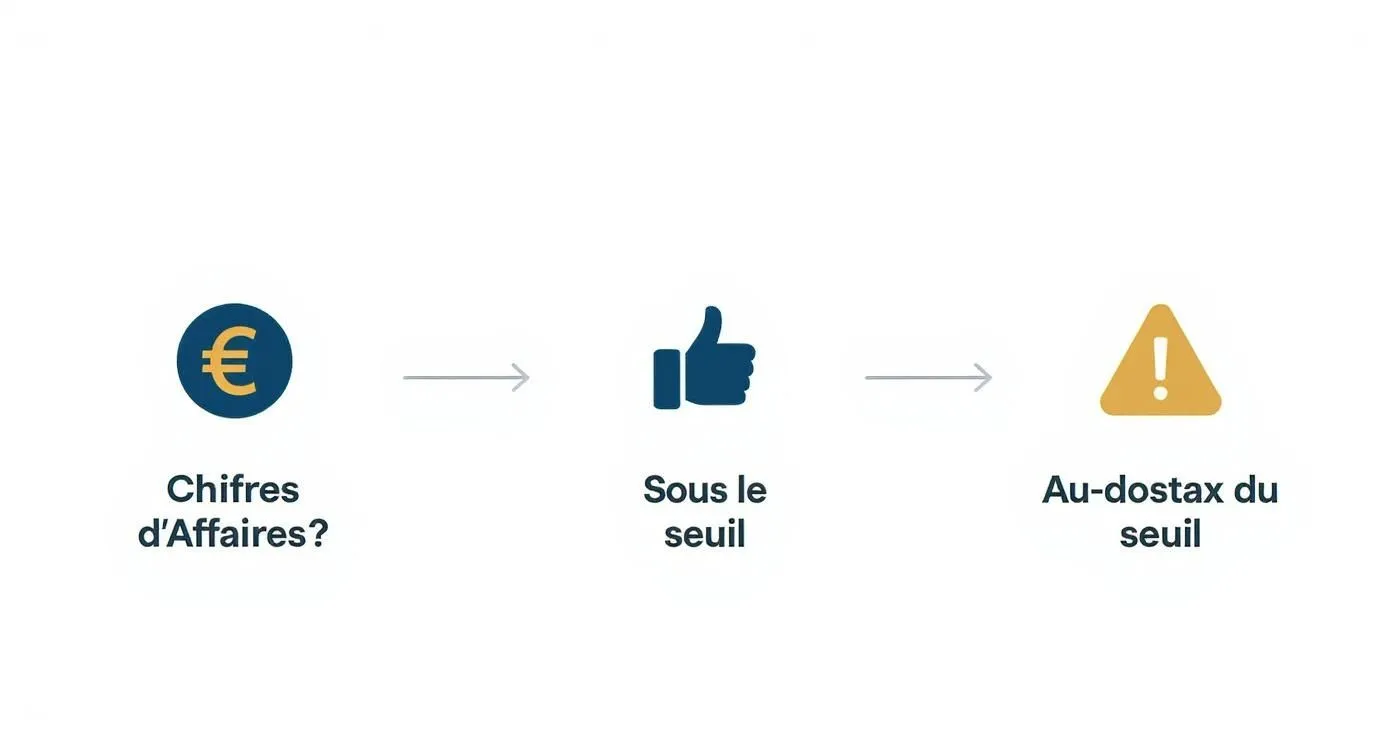
This visual sums up the situation well: tracking your revenue is the number one criterion for knowing whether you should stay under the VAT exemption scheme or whether a change of regime is needed.
The importance of monitoring your thresholds
Keeping a close eye on your revenue is absolutely crucial. If you cross the increased caps, you move into the VAT regime from the first day of the month in which the overrun occurred.
This change is not trivial and brings several new obligations:
- Requesting an intra-community VAT number from your local Business Tax Office (SIE).
- Updating your invoice templates to display VAT rates.
- Starting to file VAT returns (monthly or quarterly).
The best approach is to anticipate this transition in order to smoothly adjust your prices and your organization. To dig deeper into the subject, feel free to read our full article on the VAT not applicable mention, which gives you even more practical details.
The mandatory mentions for a flawless invoice
We often tend to see the invoice as a simple payment request. But in reality, it’s much more than that. Every invoice you issue is a legal document that not only attests to your professionalism but also engages your liability.
An omission, even a minor one, can have unfortunate consequences: a payment delay, a dispute with a client, or even a fine of €15 per missing mention in case of an audit by the authorities. Better to get it right from the start.
To create a sole trader invoice template without VAT that’s legally airtight, you just need to follow a precise checklist. Think of it as the foundations of your document: every element is crucial to its validity.
Who invoices whom? Identifying the parties
Every good invoice starts with something simple: clearly identifying who is selling and who is buying. That’s the essential basis of the transaction.
- For you: Your first and last name must be followed by the mention “EI” or “Entrepreneur Individuel” (Sole Trader). Don’t forget to add your business address (that of your registered office) and, above all, your SIREN number. That’s your official registration number.
- For your client: If it’s a business, indicate its company name and registered office address. For an individual, their name and address are enough. A quick check of the spelling or the address never hurts and avoids many disputes.
This information makes it possible to know, without a shadow of a doubt, who the parties to the transaction are. That’s fundamental.
The key information on the invoice
Once everyone is properly identified, it’s time to get to the heart of the matter with the details that give the document its meaning.
The issue date and the date of the sale or the end of the service must appear distinctly. Be careful, they’re not always identical! A service spread over several weeks will have an end date well after the invoice’s issue date, for example.
The invoice number is another critical point. It must be unique and part of a logical, continuous sequence. In other words, no gaps in the numbering. A simple and effective method is to use the Year-Number format, such as 2024-001, 2024-002, and so on.
Finally, clarity is king when it comes to describing your products or services. Each line must detail the service or product, the quantity and the unit price excluding tax. This breakdown is what justifies the total amount charged.
The mention that changes everything: the VAT-free regime
We’ve now reached the heart of the matter for a sole trader under the VAT exemption scheme. This is the legal mention that explains why VAT doesn’t appear anywhere.
“VAT not applicable, art. 293 B of the CGI”
This sentence is your golden ticket. It must appear on every invoice, without exception. It signals to your client and to the tax authorities that you benefit from this specific scheme. Its absence can sow doubt, especially among business clients used to reclaiming VAT.
Accordingly, the total amount must be labeled as “amount due” and correspond to the total excluding tax. Never use the term “incl. VAT.”
To make sure you don’t leave anything to chance, our full guide on the mandatory mentions on an invoice covers every point in detail. Flawless invoicing is the guarantee of peace of mind in your management.
Setting up an effective invoice numbering system
Numbering your invoices isn’t just an administrative formality, it’s a rule imposed by law. The tax authorities are very clear on this point: every invoice must have a unique number, in a logical sequence with no gap whatsoever.
Imagine a tax audit. If the inspector comes across numbers that jump around at random or missing invoices, that’s an instant red flag. The golden rule is therefore simple: a number that’s been assigned is final. You never delete an invoice, even if you made a mistake. To correct an error, you issue a credit note.
Choosing a simple numbering logic
No need to reinvent the wheel. The most important thing is consistency. One of the simplest and most effective methods is to use a prefix with the year, followed by a counter that increases.
The advantage is that you can start back at zero every January 1st. It’s perfectly legal and helps keep things clear.
Here are a few concrete examples you can easily adopt:
- Year-Month-Number format:
2024-10-001,2024-10-002, etc. Ideal for those who like to sort their documents month by month. - Year-Number format:
2024-001,2024-002, etc. This is the classic, simple and effective option. The counter increases throughout the year. - Format with a custom prefix:
INV-2024-001orCLIENTX-001. Adding a prefix can be smart if you manage several types of activities or if you want to quickly identify a client.
The most important thing? Pick a method and stick to it. Changing systems mid-year is a very bad idea that will just make your life more complicated.
Archiving, the key to administrative peace of mind
Once the invoice has been sent, your work isn’t over. The law requires you to keep a copy of all your invoices (the ones you send, but also those from your suppliers) for 10 years.
Why so long? Simply to allow the authorities to go back in time in case of an audit. Failing to respect this rule can prove costly in penalties.
Thinking about your archiving from the start is buying yourself priceless peace of mind. A simple “2024” folder on a secure cloud, with subfolders by client, can save you hours of panic on the day you’re asked to produce everything.
At the start, a simple spreadsheet may do the job for tracking your numbers. But you quickly run into its limits. Using an invoicing tool like Bizyness changes everything: the software generates the right number every time, with no risk of error, and archives everything for you securely. You can focus on your craft with peace of mind, knowing your paperwork is in order.
Concrete invoice examples: service provision vs. sale of goods
Nothing beats a few concrete examples to move from theory to practice. A good sole trader invoice template without VAT is really the key to invoicing with peace of mind and getting paid without a hitch.
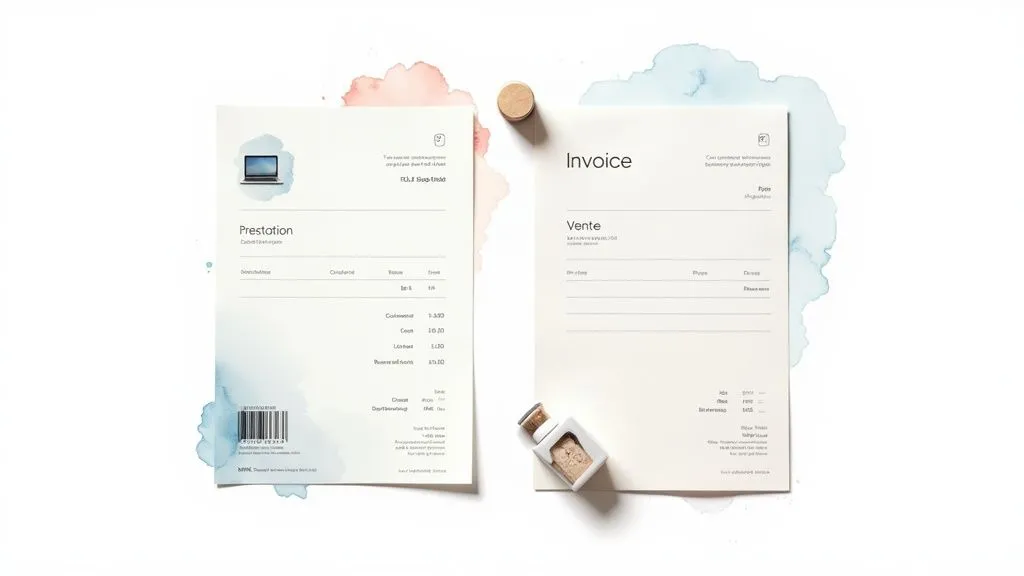
Let’s look together at the two most common scenarios for a freelancer or a craftsperson: invoicing a service and invoicing a product sale. The basis is the same, but a few small nuances in how the line items are described make all the difference.
The case of a service
Let’s set the scene. You’re a digital marketing consultant, and a client has just entrusted you with a full SEO audit of their website. For everything to be clear, your invoice must precisely describe the nature of your work.
Here’s how you might present things:
- Line 1: SEO audit and competitive analysis - Service performed from 10/10/2024 to 25/10/2024. Quantity: 1. Unit price: €850.
- Line 2: Writing and delivery of the detailed audit report (45-page PDF). Quantity: 1. Unit price: €350.
The total amount due is therefore €1,200, net amount due. Each line corresponds to a specific action, which justifies the total amount. It’s crystal clear for your client and fully transparent in case of an audit.
This rigor matters even more given that, according to various studies, the average income of a sole trader ranges between 590 and 670 euros net per month. Flawless invoicing is therefore crucial to securing every euro earned. To dig deeper into the subject, the latest statistics on sole traders’ income are quite enlightening.
The case of a sale of goods
Let’s change the setting. Now imagine you’re a maker of handcrafted jewelry. At a market, a customer buys several of your creations.
Your invoice will need to list each product sold. Ideally, add a reference to make it easier to track your stock and sales.
- Line 1: “Luna” silver necklace - Ref. C-LUNA-01. Quantity: 1. Unit price: €75.
- Line 2: “Éclat” earrings - Ref. BO-ECLAT-03. Quantity: 1. Unit price: €45.
- Line 3: Commercial discount on the order. Quantity: 1. Unit price: -€12 (i.e. -10%).
The total amount due here comes to €108. Note that the discount is shown on a dedicated line with a negative amount. This is the cleanest and most common accounting method.
A pro tip: If you sell products, using unique references (also called SKUs) isn’t a legal requirement, but trust me, it’s a huge time-saver for managing your stock and analyzing what sells best.
Even though a spreadsheet may seem sufficient at the start, you quickly hit its limits. To help you out, we offer a downloadable sole trader invoice template for Excel. But keep in mind that a dedicated invoicing tool will save you precious time and spare you plenty of headaches in the long run.
Comparison of service vs. sale invoice templates
Ultimately, as you’ll have gathered, the basic structure of the invoice stays the same. The real difference lies in the details of the description. This table highlights the slight differences in how line items are described between a service and a sale of goods.
| Invoicing element | Example for a Service | Example for a Sale of Goods |
|---|---|---|
| Description | You detail the nature of the work, the period it was carried out, the deliverables. | You list each product with its name and, if possible, its reference (SKU). |
| Unit | The unit is often a flat fee (per project, per day) or an hourly rate. | The unit is systematically the product sold, per item. |
| Quantity | Generally “1” for a flat fee, or the number of hours/days worked. | This is the exact number of products the client bought. |
Whether you’re selling your expertise or your creations, the golden rule doesn’t change: be precise and clear. A well-written invoice is the assurance of getting paid faster and projecting a professional image.
Invoicing mistakes to never make
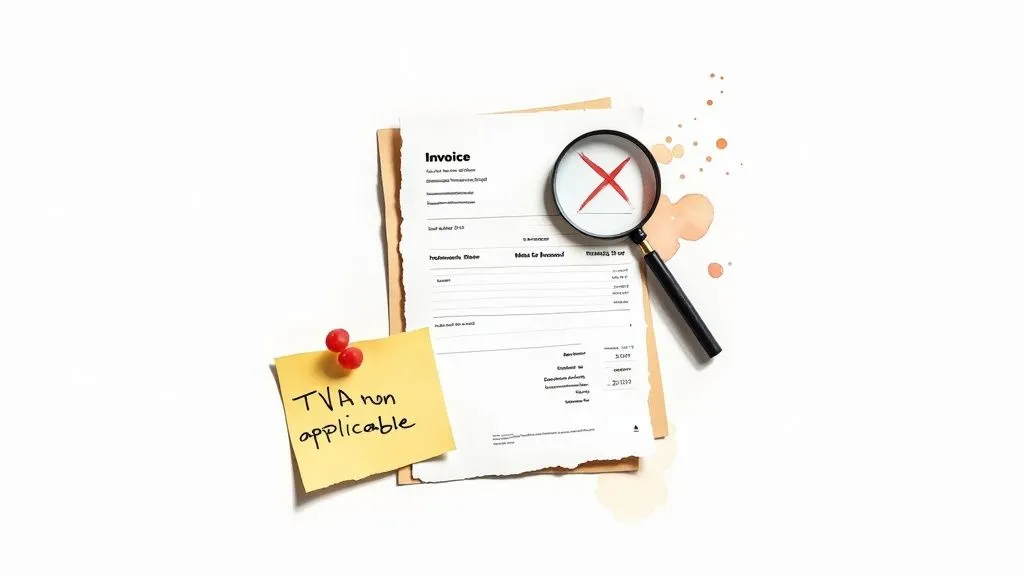
Even with the best of intentions, a small mistake can easily slip into an invoice. And unfortunately, some oversights can be costly: penalties, disputes with a client, or simply a professional image that takes a hit. Fortunately, most of these pitfalls are fairly easy to avoid with a bit of attention.
The mistake seen most often, and one that can have serious consequences, is forgetting the legal mention about VAT. The micro-entrepreneur status is booming in France, with nearly 2.9 million active sole traders expected in 2025. It’s a scheme popular for its simplicity, notably because you don’t manage VAT. But no VAT means an obligation to state it!
Forgetting to write the famous phrase “VAT not applicable, art. 293 B of the CGI” on your sole trader invoice template without VAT sows doubt and can put you in an awkward position with the tax authorities. To better understand the scale of the micro-entrepreneur phenomenon, the latest data on business creation is quite telling.
Another classic blunder concerns numbering. An issued invoice can never be deleted, even if you notice a typo right after sending it. The procedure is strict: you must create a credit note to formally cancel the first invoice, then issue a new one, with a new number.
Anticipating common pitfalls
To bulletproof your invoicing, it’s often just a matter of adopting a few good habits. For example, a service description that’s too vague opens the door to misunderstandings and disputes. Be as precise as possible, every euro must be clearly justified.
Here’s a short list of mistakes to banish from your daily routine:
- Incorrect VAT mention: Never add a VAT line, and especially never use the term “incl. VAT.” The final amount must always be labeled “Net amount due.”
- Unclear payment terms: If you don’t clearly state the payment deadline and the late-payment penalties that apply, you risk waiting for your money much longer than expected.
- Incorrect client information: A simple typo in the name or address can make the invoice invalid, or at best delay its processing at your client’s end.
Rigor in invoicing isn’t a mere formality, it’s the foundation of healthy cash flow and smooth client relationships. See every invoice as a mini-contract that protects both you and your client.
Ultimately, it’s all in the details. A good, well put-together sole trader invoice template without VAT is your best ally. By avoiding these mistakes, you spare yourself unnecessary stress and strengthen your credibility. Flawless administrative management is the sign of a professional who has full command of their business.
Frequently asked questions about invoicing without VAT
Even when you’ve mastered the basics of invoicing, you often run into practical cases that raise doubts. That’s entirely normal. Exceeding a threshold, a client abroad, an error on an invoice already sent… Let’s go through these situations so you can handle your invoicing with more peace of mind.
What should I do if I exceed the VAT thresholds during the year?
That’s a sign your business is doing well, but you need to react quickly! If your revenue crosses the tolerance cap of the exemption scheme, you move into the VAT regime. And be careful, this change is immediate: you become liable from the first day of the month in which the overrun occurred.
In practice, here’s what to do:
- Contact your Business Tax Office (SIE) without delay to obtain your intra-community VAT number. It’s essential.
- Immediately update your invoice template. The “VAT not applicable” mention must disappear.
- Apply VAT to all new invoices you issue from the month of the overrun onward.
A friendly piece of advice: keep an eye on your revenue, especially as you approach the thresholds. Anticipation is really the key to avoiding unpleasant surprises and complicated adjustments.
How do I invoice a client abroad?
Good news: whether your client is in the European Union or outside it, it changes absolutely nothing for you as long as you benefit from the VAT exemption scheme. Your invoices remain VAT-free, whether you’re selling to Paris, Berlin or New York.
You simply need to keep adding the famous mention “VAT not applicable, art. 293 B of the CGI” on your invoices. No special procedure is required on your part, which makes expanding internationally much simpler.
Does a signed quote have the same value as an invoice?
No, and it’s a fundamental nuance. A signed quote is a contract. It seals an agreement between you and your client on the services to be performed and their price. Legally, it’s very solid and proves the commitment of both parties.
On the other hand, the invoice is the only accounting document that formalizes the debt. It’s what records that the work has been done (or the product sold) and triggers the client’s obligation to pay. To put it simply, the quote is an accepted proposal; the invoice is a payment request.
A signed quote validates the agreement, but can never replace the invoice. You must always issue a corresponding invoice once the service or sale has been completed.
How do I correct an invoice already sent?
We’ve all made a small blunder at some point. But be careful: an issued invoice is considered a final document. The tax authorities forbid modifying or deleting it in order to preserve the integrity of the accounting records.
The only clean and legal way to fix things is to issue a credit note. This document cancels out the original erroneous invoice from an accounting standpoint. You can then create a new invoice, this time correct, with a new unique number. It’s the only way to guarantee perfect traceability and stay within the rules.
Issuing compliant invoices without the hassle is the best way to focus on what really matters: your business. With a tool like Bizyness, you can automate your invoicing, track your payments and sleep easy. Discover how Bizyness can simplify your daily life as a sole trader today.
