

 Français
 Invoices and Quotes: A Complete Guide to Effective Management
Learn everything about invoices and quotes: legal requirements, mandatory information, and tips for optimal management. Click to find out more!
Managing quotes and invoices is far from a mere formality. It is the true foundation on which every healthy, lasting business relationship rests. The quote lays the groundwork — it’s a detailed proposal that serves as an agreement in principle. The invoice, meanwhile, formalizes the transaction and triggers payment. Knowing how to juggle these two documents is simply vital for your company’s financial stability.
Invoices and quotes: understanding their exact role
In an entrepreneur’s daily life, invoices and quotes are far more than paperwork. They are the tools that frame and secure every sale, every service. To truly understand their importance, think of them as two sides of the same coin: the coin that officializes your work.
Think of the quote as a project’s roadmap. It’s your commercial proposal on paper, a document that precisely details what you’re going to do, at what price, and under what conditions. Its purpose? To get everyone — you and your client — on the same page before you even start. It’s the best way to avoid misunderstandings. Once signed, the quote becomes a genuine contract that binds you both.
The invoice, for its part, marks the arrival. It’s the legal and accounting proof that the work has indeed been done or the product delivered. This is the document that makes your client’s debt official and triggers their obligation to pay you.
A dual role: commercial and legal
These documents are crucial on two distinct but closely linked levels.
- From a commercial standpoint: They are a mirror of your professionalism. A well-crafted quote and a flawless invoice strengthen your clients’ trust and polish your brand image. It’s a detail that is anything but trivial.
- From a legal standpoint: They are your shield in case of a dispute. A signed quote is your best defense if a client questions the scope of the assignment. Likewise, a properly formatted invoice is essential to launch a debt-collection procedure if you don’t get paid.
Managing your quotes and invoices rigorously isn’t a constraint — it’s a strategy. It directly affects your cash flow, your clients’ loyalty and, ultimately, the sustainability of your business.
A direct impact on your cash flow
The slightest oversight, the smallest error in your invoicing, can cost you dearly. A poorly costed quote, and your margin evaporates. An invoice sent a week late, and your cash flow waits.
That’s why meticulousness matters. Impeccable management ensures you get paid for your work, at the right price and on time. It’s simply the fuel that keeps your business running and lets it grow. Every detail counts, from a small mandatory mention forgotten to a poorly indicated due date.
The quote: far more than a simple proposal, a genuine commercial commitment
The quote is often the first building block of your relationship with a client. Far from being a mere price estimate, it’s a founding document that shapes your future collaboration. Think of it as your project’s detailed blueprint, a formal proposal that, once accepted, contractually binds you to your client.
It’s essentially a contract ahead of its time. It precisely describes the nature of the services or goods, the planned timeline and, of course, the financial terms. This transparency is crucial for building trust and defusing potential misunderstandings upstream.
A well-crafted quote protects everyone. The client is assured that the price and services are set in stone. On your side, you have the guarantee that expectations are clear and the terms of your engagement are validated.
When is a quote mandatory?
In many situations, providing a quote isn’t just good practice — it’s a purely legal obligation. The goal is simple: protect the consumer by giving them all the cards in hand before they commit financially.
The law requires a quote notably in the following cases:
- For personal services as soon as the amount exceeds €100 including VAT.
- For all repair and maintenance work, whether plumbing, electrical, or masonry.
- For moving services or funeral services.
Even outside these situations, get into the habit of systematically drawing up a quote, regardless of the amount. It’s a real mark of professionalism that reassures your prospects and formalizes your offer.
This infographic summarizes the key points for a properly formatted quote.
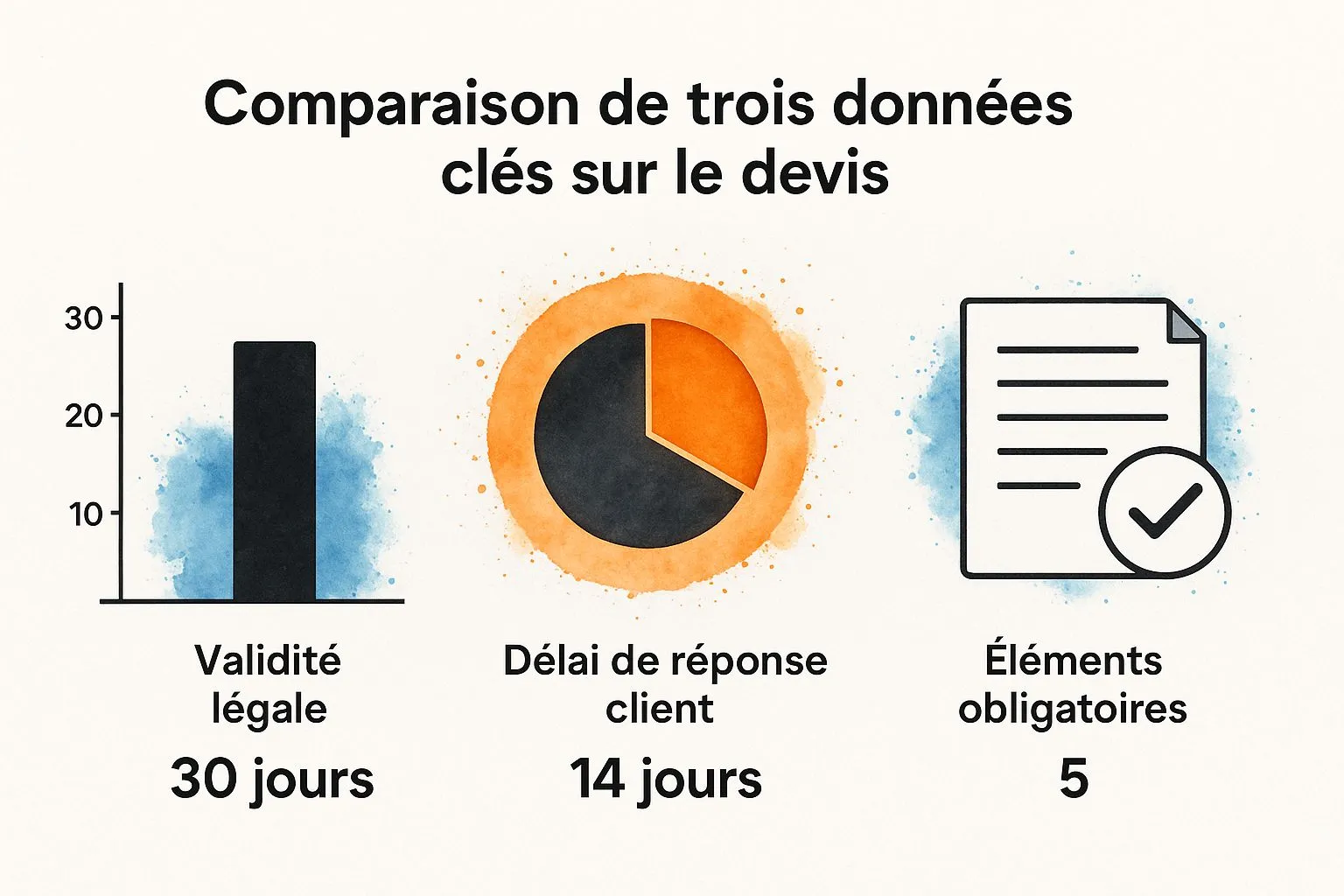
It puts into perspective the deadlines and the essential information that turns a simple proposal into a legally solid document.
The essential information needed to validate your quote
For a quote to have real legal value, it must contain a series of critical pieces of information. A single omission can render it void and weaken your position in the event of a dispute. Think of it as a checklist to follow to the letter.
Here are the elements you should never forget:
- A clear “Quote” or “Commercial proposal” label.
- The date it was drawn up and the validity period of your offer.
- Your full contact details (name, address, SIREN/SIRET number).
- Your client’s contact details.
- A precise breakdown of each service, with quantity and unit price.
- Any applicable travel costs.
- The total amount due, both excluding VAT (net) and including all taxes (VAT included).
A complete quote is a document that leaves no room for doubt. Every line should be designed to clarify the service and secure the transaction. It’s the best way to avoid future disputes.
To go further on each point, feel free to check out our detailed guide on the mandatory information on a quote.
The legal value of a signed quote: when everything shifts
The decisive moment is when your client signs. At that instant, the quote’s status changes radically: it’s no longer a proposal but a proper contract. The mention “Approved” or “Read and approved,” along with the date and signature, seals the agreement between both parties.
In concrete terms, what does this commitment involve?
- For you, the professional: You’re required to carry out the assignment exactly as described in the quote, scrupulously respecting the terms, timelines, and price announced.
- For your client: They firmly commit to paying you the agreed amount once the work is completed or the goods delivered.
A signed quote is your best insurance in the event of a problem. If a client refuses to pay or disputes part of your work, this document becomes irrefutable proof of the initial agreement. Tools like Bizyness simplify this entire process, helping you create, send, and track your quotes securely.
To make things even clearer, this table summarizes the fundamental differences between a quote and an invoice.
Quick comparison between a quote and an invoice
This table highlights the key differences in nature, purpose, and legal status between a quote and an invoice for an immediate understanding.
| Criterion | Quote | Invoice |
|---|---|---|
| Nature | Commercial proposal, contract offer | Accounting and legal document |
| Purpose | Inform the client and define the scope of a future service | Certify a debt and request payment for a completed service |
| Timing | Issued before the service is carried out | Issued after the service is carried out |
| Legal status | Becomes a binding contract for both parties once signed | Mandatory document that proves the transaction and serves as the basis for VAT |
| Main label | ”Quote” or “Commercial proposal" | "Invoice” |
In short, the quote lays the groundwork for the collaboration while the invoice concludes it on the financial and legal level.
The invoice: far more than a simple payment request
If the quote is the promise of a collaboration, the invoice is its fulfillment. It’s the official document that closes a transaction. Far more than a piece of paper demanding payment, it’s a cornerstone document for your business. It serves as legal proof, as the basis for your accounting, and as supporting evidence for your tax filings.
Where the quote is a proposal, the invoice is a statement of fact. It attests in black and white that you’ve fulfilled your side of the contract: the service has been performed, the product delivered. Issuing it is mandatory in most business-to-business exchanges, and it must follow very precise rules to be valid.
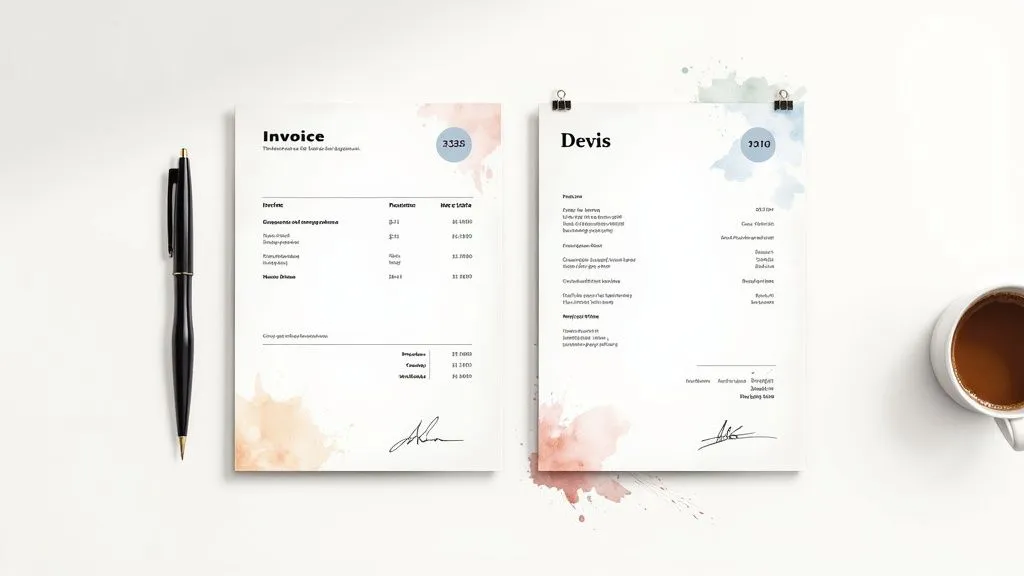
Neglecting these rules is taking a risk. A poorly drafted invoice can cost you dearly in penalties, complicate VAT recovery, and put you at a disadvantage in the event of a dispute with a client. Rigor isn’t optional — it’s a necessity.
Mandatory information: the checklist you should never forget
For an invoice to be recognized by the authorities, it must contain a series of very specific pieces of information. The slightest omission can render it invalid. Think of this list as a verification ritual to perform before every send.
Here are the elements that must absolutely appear on it:
- The word “Invoice”: No room for doubt — it must be spelled out clearly.
- A unique invoice number: It must follow a logical sequence with no gaps (for example, 2024-001, 2024-002…).
- The issue date: The day you create the document.
- Your full identity: Name, head office address, SIREN/SIRET number.
- The client’s full identity: Their name and address (or company name and registered office if it’s a business).
- The purchase order number: If your client has provided one.
- The details of the sale: A clear description of each product or service, the quantity, and the unit price excluding VAT (net).
- The amounts due: The total excluding VAT, the applicable VAT rate(s) with the corresponding amount, and of course, the total including all taxes (VAT included).
- The due date: The deadline for payment.
- Late-payment penalties: The rate you’ll apply if payment isn’t made on time.
A flawless invoice is a sign of seriousness that reassures your clients. It’s also your best weapon for claiming what you’re owed in case of a problem.
Deposit invoice, balance invoice, pro forma… How do you tell them apart?
Not all invoices are the same. Depending on how far your project has progressed or the nature of the exchange, the document to issue will differ. Each has a well-defined role.
- The deposit invoice: You create this one when you request a partial payment before starting the work or during the project. It formalizes this initial payment.
- The balance invoice: This is the final invoice. It recaps the total amount of the service, then deducts any deposit(s) already paid to show the remaining balance due.
- The pro forma invoice: Careful — this one looks like an invoice but has no accounting value. It’s a kind of “preliminary quote” that often helps the client obtain financing or authorization before committing.
- The credit note: This is the document used to cancel or correct an invoice already sent. Perfect for handling a return of goods, a pricing error, or a goodwill gesture. It records that you owe money (or a credit) to your client.
Mastering these different facets of invoicing will help you keep your accounting sound and adapt to any business situation.
Invoice numbering: an unbreakable golden rule
If there’s one rule the tax authorities take very seriously, it’s numbering. The law is clear: your invoices must follow one another in chronological order, without interruption. No gaps, no going back.
Why such rigidity? Simple: to guarantee perfect traceability of your sales and fight fraud. Each number is unique and must follow the previous one.
A few examples of valid numbering systems:
- With an annual prefix:
FACT-2024-001,FACT-2024-002, etc. - With the date embedded:
20240715-01,20240716-01, etc.
The most important thing is to choose a system that works for you and stick with it. If you make a mistake on an invoice you’ve already issued, never delete it! The procedure is clear: you must issue a credit note to cancel it, then create a new one with a new number.
What are the risks of non-compliance?
Invoicing errors are not taken lightly, and the penalties can be severe. There are two types of risk to distinguish:
- Tax fines: For each missing or incorrect item, you risk a fine of €15. This can quickly add up, even though the total is capped at 25% of the invoice amount.
- Administrative fines: Forgetting to issue an invoice at all is even more serious. The fine can climb up to €75,000 for a sole trader and €375,000 for a company.
These amounts are a reminder of just how crucial rigorous management of your invoices and quotes is. This is exactly where a tool like Bizyness proves its worth: it automates the creation of compliant documents, ensures flawless numbering, and helps you stay compliant with the law, protecting you from these financial and legal risks.
E-invoicing: what’s changing for you
Forget paper invoices and PDFs sent by email. The way you manage your commercial documents is about to undergo a genuine revolution. France is progressively shifting to mandatory e-invoicing for all businesses subject to VAT. Far more than a simple technical adjustment, it’s a profound transformation of our administrative habits.
The idea behind all this? On one hand, to simplify life for businesses with pre-filled VAT returns. On the other, to give the government better tools to fight fraud more effectively. For you, it’s above all a golden opportunity to modernize your processes, save precious time, and make your exchanges more reliable.
The new reform timeline to keep in mind
Originally planned for 2024, the reform has been pushed back to give everyone time to get to grips with these new tools. Rollout will be gradual, which is good news.
The principle itself doesn’t change: before long, an invoice between businesses will no longer travel directly from your inbox to your client’s. It will have to go through a certified platform.
Here are the new dates to circle on your calendar:
- September 1, 2026: Large companies and mid-sized enterprises (ETI) will be required to issue their invoices in electronic format.
- September 1, 2026: This is also the date by which all businesses, without exception (SMEs, micro-businesses, sole traders…), must be able to receive electronic invoices.
- September 1, 2027: It will then be the turn of SMEs, small businesses and sole traders to be required to issue their invoices in this new format.
Even though the final deadline may seem far off, don’t wait until the last minute. It’s better to plan ahead so the transition goes smoothly.
PPF, PDP… who are these new players?
For this whole system to work, two new types of players come into play. It’s essential to understand their role in order to make the right choice.
The Portail Public de Facturation (PPF), France’s Public Invoicing Portal, is the free solution developed by the government. It’s the basic foundation that will allow everyone to issue, transmit, and receive their electronic invoices.
The Plateformes de Dématérialisation Partenaires (PDP), or Partner Dematerialization Platforms, are private companies (often software vendors) that will have received accreditation from the tax authorities. They will offer services far more comprehensive than the PPF, such as secure archiving, real-time payment tracking, or seamless integration with your accounting software.
So you’ll have a choice: use the basic public solution (PPF) or opt for a PDP that offers higher-value services. No need to worry — the system is designed to be interoperable. Whichever platform your client chooses, you’ll always be able to invoice them for your services.
The new mandatory information appearing on your invoices
A new standard also means new information to include on your documents. E-invoicing comes with a few additional mandatory items so that data can be processed automatically.
You’ll need to add your client’s SIREN number, the delivery address if it differs from the billing address, as well as the nature of the transaction (sale of goods, provision of services, or both).
These details aren’t there to complicate your life — quite the opposite. They will eventually allow the tax authorities to pre-fill your VAT returns, a significant time saver. For freelancers, these changes are especially structuring; our guide on e-invoicing for sole traders explains it all in detail.
Faced with these changes, relying on a tool like Bizyness becomes an obvious choice. It ensures that every invoice and quote you issue is fully compliant, without you having to become an expert in tax regulations.
How to optimize your management with invoicing software
Between theory and practice, there’s often a world of difference. Managing every invoice and quote by hand, on a spreadsheet for example, can quickly become a real headache. It’s not only a considerable waste of time, but also an open door to errors that can hurt your productivity and, worse still, your cash flow.
Adopting invoicing software is no longer a luxury — it’s a strategic decision. Imagine the difference between using an old paper road map and a GPS. Both get you there, that’s true. But one does it faster, with far less stress and no risk of taking a wrong turn.
These tools don’t just simplify an administrative chore. They turn it into a genuine advantage, letting you focus on what matters most: your core business.

A well-designed interface lets you centralize everything and say goodbye to repetitive tasks.
Save precious time with automation
The most obvious advantage of dedicated software is automation. No more spending hours copying information from a quote to generate an invoice, or frantically checking whether your numbering is correct and continuous.
A good tool does all this for you, and much more. Concretely:
- One-click conversion: Your quote gets accepted? One click is enough to turn it into a fully compliant invoice. No double entry, no risk of error.
- Foolproof numbering: The software ensures your invoice numbers follow one another with no gaps or duplicates. That’s the guarantee of always being in compliance.
- Professional templates: You create documents in your own style, personalized, with all mandatory legal information already in place.
- Automatic reminders: No more chasing payments. You can schedule reminders for overdue invoices, which dramatically improves your cash flow with no extra effort.
This automation frees up hours every month. Precious time you can finally devote to growing your business, prospecting, or looking after your clients.
Reduce errors and strengthen your image
To err is human, we all know that. But in invoicing, it can cost you dearly. A simple typo on an amount, the wrong VAT rate, a forgotten legal mention… and that’s the start of trouble, whether it’s a dispute with a client or sanctions from the tax authorities.
Invoicing software acts as a genuine safety net. It secures your entire process, validates information, and ensures every document sent is flawless.
This rigor has a direct impact on your brand image. Clear, professional quotes and invoices without a single typo build trust and demonstrate your seriousness. It’s this kind of detail that, in the end, makes all the difference.
Adapt to the market’s digitalization
Digital invoicing is no longer just an option — it’s become the norm. French businesses are already well on this path. It’s estimated that around 69% of small and medium-sized businesses already use invoicing software and that 20% of them process more than half their invoices in an automated way. To learn more, you can check the data on the France Num portal.
These figures prove it: failing to take the leap means risking falling behind. The imminent arrival of mandatory e-invoicing will only accelerate this trend further. For freelancers, this transition is a key moment. Choosing the right invoicing software for sole traders is essential to stay ahead of the game.
A tool like Bizyness was designed to support you through this change. It doesn’t just simplify your day-to-day management; it also gently prepares you for tomorrow’s requirements. All of which turns a legal constraint into a great opportunity to become more efficient.
Answering your questions about invoices and quotes
Even with the best of intentions, managing invoices and quotes always raises very practical questions. That’s perfectly normal! We’ve gathered the most frequently asked questions here to answer them simply and help you handle these situations with more peace of mind.
How long do I need to keep my invoices and quotes?
Keeping your business documents isn’t just good practice — it’s a genuine legal obligation. These papers are your safety net in the event of a tax audit or a dispute with a client. Think of them as your company’s history.
Retention periods aren’t the same for every document:
- Invoices (both client and supplier): You must keep them carefully for 10 years after the close of the financial year.
- Signed quotes: Once accepted, they become contracts. The law requires keeping them for 5 years after the service ends.
- Purchase orders: As with invoices, the retention period is 10 years.
A word of advice: go digital! Archiving your documents on a secure server or in the cloud is much safer, easier to organize, and frees up a huge amount of space in your filing cabinets.
How do I correct an invoice I’ve already sent?
To err is human: a wrong amount, a forgotten service, a small typo… it happens. But be careful, there’s an absolute golden rule: you must NEVER modify and NEVER delete an invoice that has already been issued. Your numbering must remain a logical, uninterrupted sequence — that’s non-negotiable.
So how do you fix it? The only clean and legal solution is to issue a credit note.
This document cancels the original invoice, either fully or partially. It must necessarily reference the invoice being corrected (by indicating its number) and specify the amount to be deducted. Once that’s done, you can issue a new invoice, correct this time, with a new number that logically follows the previous ones.
The credit note is the essential tool for keeping your accounting sound and transparent. It proves to your client and to the authorities that you corrected the situation by the book. It’s a genuine mark of professionalism.
What are the legal payment deadlines to respect?
Payment deadlines are a sensitive subject, tightly regulated by law to protect businesses’ cash flow. If you don’t specify anything particular on your invoice, the default deadline is 30 days from receipt of the goods or completion of the service.
Of course, you can agree on other terms with your client, but they absolutely must be stated clearly in writing on the quote and the invoice.
Whatever happens, there are caps you must never exceed:
- 60 days net from the invoice issue date.
- 45 days end of month from the invoice issue date.
Going beyond these limits is illegal and can cost you dearly in penalties. So be very clear about your payment terms from the outset.
What should I do if a client doesn’t pay my invoice?
An unpaid invoice is every entrepreneur’s nightmare. It can quickly strain your cash flow, so you need to act fast, but methodically. The first step is always an amicable reminder.
- A simple, courteous reminder: Start with a short email or phone call. Often it’s just an oversight. Stay professional and factual.
- A formal reminder letter: If nothing moves, step it up with a letter that clearly restates the debt and the missed deadline.
- A formal notice (mise en demeure): This is the final warning before things get serious. It must be sent by registered letter with acknowledgment of receipt. This document carries real legal weight. It sets a final payment deadline and warns that legal action will be taken if the situation isn’t resolved.
If, despite all your efforts, the invoice remains unpaid, you’ll then need to consider a debt-collection procedure through the courts.
In the current climate, keeping an eye on your costs is essential, including those tied to invoicing tools. Good news: production prices for services in France are tending to cool down. In the first quarter of 2024, their year-on-year increase was limited to +1.6%, marking a clear slowdown. This trend also affects administrative services, which could make management software like ours even more accessible. To dig deeper, you can check the INSEE statistics on this topic.
Make your life easier and ensure every invoice and quote is flawless. With Bizyness, you automate a good part of your management, save precious time, and can finally focus on what really matters: growing your business.
