

 Français
 Invoicing and Quoting Software: Transform Your E-commerce and Save Time
Invoicing and quoting software: optimize your e-commerce business. Automate invoices and quotes, ensure compliance, and save valuable time starting today.

Managing your e-commerce invoicing on a spreadsheet? It’s a bit like trying to run a hypermarket’s stock with a notebook and a pencil. At first, it seems to work. But very quickly, this approach becomes a real ball and chain that slows your growth, multiplies the risk of errors, and exposes you to compliance issues. Let’s be clear: invoicing and quoting software is no longer optional — it’s a strategic investment for any serious online seller.
Why your spreadsheet has become your worst enemy in e-commerce invoicing

If you launched your store with spreadsheets, you probably remember the small satisfaction of adding each new row. One sale, one line. A little win. But as orders pile up, this once-handy tool turns into a time-consuming monster and a constant source of stress.
Manual data entry is a monumental waste of time. Copying and pasting customer details, checking amounts, assigning a unique invoice number that follows the right sequence… These repetitive tasks aren’t just long and tedious. They’re a perfect breeding ground for human error. A simple typo on a VAT rate or an address can trigger a cascade of accounting complications and damage your customers’ trust.
The real limits of manual management
At the heart of the problem, your spreadsheet is a “dumb” tool. It has no business intelligence and isn’t connected to anything. It simply wasn’t designed for the complexities of today’s e-commerce. If you’re still juggling Excel quote templates, you know how tedious and error-prone it is — which makes real software essential to look professional and stay efficient.
Think about these very real challenges you face every day:
- International VAT management: A sale in Germany? One VAT rate. Another in Spain? A different rate. Calculating and tracking this manually for every order is a genuine tax headache.
- A glaring lack of automation: Your spreadsheet won’t generate an invoice on its own after a Shopify sale. Nor will it send a polite reminder for a late payment.
- The risk of legal non-compliance: Invoices made in Excel or Word don’t meet the legal requirements for data integrity and security imposed by the anti-VAT-fraud law.
The e-invoicing reform, fast approaching and becoming mandatory from 2026, will simply make spreadsheets obsolete for VAT-liable businesses. Anticipating this change is vital so you don’t get caught off guard and risk penalties.
In short, clinging to a spreadsheet means putting a handbrake on your own growth. Every hour spent fixing formulas or re-typing addresses is an hour you’re not spending refining your marketing, sourcing new products, or looking after your customers. Dedicated invoicing and quoting software, on the other hand, automates all of this, secures your legal compliance, and gives you a clear, real-time view of your business’s health.
Think of this article as your roadmap. We’ll guide you through choosing and setting up the tool that will turn this administrative chore into a real competitive advantage. To go further, feel free to check out our full guide on online invoicing and its benefits for online sellers.
Identifying the features that transform your management
Choosing quoting and invoicing software isn’t just ticking a box on your to-do list. For an online seller, it’s like hiring a financial co-pilot who works around the clock. The features that truly matter aren’t just lines on a pricing page; they’re real levers to automate your tasks, protect your cash flow, and, above all, give you back precious time.
Let’s set aside the technical jargon. Let’s focus on what will actually change your daily life as an entrepreneur. The idea is simple: move from a tool that merely executes to a system that intelligently drives your management.
From order to invoice, without lifting a finger
Imagine: a customer places an order on your Shopify or WooCommerce store, or via your Amazon account. Instantly, a compliant invoice bearing your brand’s colors is generated and sent. No more data exports, no more copy-pasting addresses, no more double-checking amounts. This is where the first major gain lies: full automation of your invoicing.
Not only is it faster, it also eliminates nearly 100% of manual entry errors. A real relief! For those who also sell to businesses (B2B), this same agility shows up in quote management.
- Turning a quote into an invoice in one click: Your B2B customer approves a proposal? A single click is enough to convert the quote into an invoice, without ever retyping anything. This speeds up the sales cycle and strengthens your brand image.
- Creating clear purchase orders: The software also helps you generate clean purchase orders that serve as a solid basis for invoicing once delivery is complete.
Good quoting-and-invoicing software doesn’t just create documents. It orchestrates the entire sales flow, from first contact through to payment, ensuring perfect, effortless continuity on your part.
The unified dashboard: your financial control tower
Selling across multiple channels is great for growth. But for bookkeeping, it can quickly turn into a headache. Software designed for e-commerce solves this problem by centralizing all your sales data in one place.
This dashboard becomes your single source of truth. It gives you a clear, real-time overview of your performance by consolidating information from:
- Your various online stores (Shopify, WooCommerce…)
- Your marketplaces (Amazon, Etsy, Cdiscount)
- Your payment processors (Stripe, PayPal)
This centralization lets you track key metrics like revenue by channel, average order value, or payment delays. To go even further, AI software for accounting can even analyze this data to spot trends and help you make better decisions.
Even the best invoicing tool can’t replace the power of a solution built for e-commerce. To understand the gap clearly, here’s a quick comparison.
Feature comparison: basic tool vs. specialized e-commerce software
This table highlights the difference in value between a generic invoicing solution and software like Bizyness, specifically designed for the challenges of online selling.
| Feature | Basic invoicing tool | Specialized e-commerce software (e.g. Bizyness) |
|---|---|---|
| Invoice creation | Manual or semi-automatic | 100% automatic from Shopify, Amazon, and other orders |
| Multi-channel management | None, manual entry required | Automatic centralization of all revenue sources |
| VAT management | Fixed rate, manually adjusted | Automatic country detection and correct rate application (OSS/IOSS) |
| Payment tracking | Manual status (paid/unpaid) | Bank reconciliation and real-time status tracking |
| Payment reminders | Manual (emails to draft) | Automatic, customizable reminder scenarios |
| Financial reports | Simple overall revenue | Detailed reports by channel, product, and period |
As you can see, specialized software doesn’t just save you time; it gives you strategic insight and a level of security you’ll never get from a basic tool.
Smart automation for VAT and payments
VAT management, especially with international customers, is one of the biggest headaches for online sellers. Modern software handles this complexity for you. It can identify each customer’s destination country to automatically apply the correct VAT rate, whether in France or across Europe via the OSS/IOSS one-stop shops.
This is a huge gain in time and peace of mind. But beyond taxes, the software becomes a true cash-flow assistant.
- Real-time payment tracking: Every invoice displays a clear status (paid, pending, overdue), giving you perfect visibility into what’s coming in.
- Automatic reminders: No more chasing payments by hand! You can set up polite, personalized emails that are automatically sent to customers with overdue payments. This simple feature alone can significantly reduce your collection times.
Adopting this kind of approach is all the more relevant as the market evolves quickly, particularly with the spread of e-invoicing. We see tools, often priced between €16 and €25 per month, pay for themselves as soon as they save you one to two hours of work per week.
Whether you’re just starting out or already handling large volumes, feel free to explore our guide on the best app for quotes and invoices to find the solution suited to your stage of growth.
Complying with tax rules, without pulling your hair out
Taxation, for an online seller, is often an obstacle course. Between piling-up acronyms, back-to-back reforms, and rules that change from one country to the next, it’s easy to feel overwhelmed. Fortunately, good invoicing and quoting software acts as a real lifeline, turning this regulatory maze into a clearly marked path.
Think of it as the GPS for your invoicing. You don’t need to memorize the entire European tax map. You simply enter the destination — a sale in Germany, another in Portugal — and it calculates the right route for you. That means the correct VAT rate and the legal notices that go with it.
The anti-VAT-fraud law and the 2026 reform: what to expect
In France, authorities have clearly tightened the rules to fight fraud. Since January 1, 2018, the anti-VAT-fraud law has required most professionals to use certified invoicing software. The idea is simple: guarantee that your invoicing data is tamper-proof, secure, and properly archived. Invoices cobbled together in Word or Excel? They don’t tick any of these boxes and expose you to real risk in the event of an audit.
And the trend is accelerating. Get ready for the major e-invoicing reform, which will come into force progressively starting in 2026. Soon, all French VAT-liable businesses will need to be able to receive and issue their invoices in a standardized electronic format, such as Factur-X.
The stakes are high. In 2021, out of 22 billion transactions per year, barely 10% were truly dematerialized. The remaining 90%, often simple PDFs or paper documents, leave the door wide open to fraud that costs the French state around €12 billion in VAT every year. To dig deeper, you can check out the challenges of invoicing software on the Deltic website.
Equipping yourself today with compliant invoicing and quoting software is therefore no longer just a matter of convenience. It’s an essential step to protect your business, anticipate tomorrow’s obligations, and sleep soundly, safe from a potential tax reassessment.
International VAT: OSS and IOSS finally explained
If you sell to individuals within the European Union, another headache awaits: VAT management. Since July 1, 2021, the rule is simple in theory: you apply the VAT of the customer’s country. A product priced at €100 excluding tax? You’ll need to charge 21% VAT in Belgium, 23% in Portugal, and 19% in Germany.
Trying to manage this by hand is almost a guarantee of mistakes. This is where the OSS (One-Stop Shop) and IOSS (Import One-Stop Shop) one-stop shops step in to radically simplify things.
- OSS (One-Stop Shop): For your sales of goods and services to individuals within the EU. You collect VAT at your customer’s country rate, then declare and remit the total via a single portal in France. No more VAT registrations in 27 countries.
- IOSS (Import One-Stop Shop): Covers sales of goods under €150 imported into the EU. It lets you collect, declare, and pay VAT upfront. The big advantage? Your customer has no unpleasant surprises (customs fees, etc.) upon delivery.
Specialized software like Bizyness automates this entire process for you.
A very concrete example:
- The scenario: Your Shopify store receives an €80 order from a customer living in Spain.
- What the software does: It reads the delivery address, instantly applies the correct Spanish VAT rate (21%), and generates a perfect invoice.
- The outcome for you: At the end of the quarter, the software produces a VAT-collected report, broken down by country. All you have to do is copy and paste these figures into your OSS return.
The software handles the calculations and sorting, turning what was once a dreaded tax chore into a simple formality. For a broader view of your obligations, our full guide on invoices and quotes is a resource worth keeping handy. Ultimately, the tool doesn’t just create documents; it becomes the guardian of your tax peace of mind.
How to unify your multi-channel sales ecosystem
Selling on your Shopify store, on Amazon, and on Etsy at the same time? Great strategy for growing your business. The catch is that, administratively, it often turns into a headache. Each platform lives in its own world, with its own sales data, commissions, and reports. It’s the surest path to completely fragmented information.
Picture the scene: you’re juggling three dashboards, manually copying and pasting orders into a spreadsheet, then trying to match them up with payments received via Stripe and PayPal. It’s the perfect recipe for wasting huge amounts of time, multiplying errors, and never having a clear view of your business’s financial health. Good invoicing and quoting software isn’t just a tool — it’s the glue that holds your entire sales ecosystem together.
Native integration: your number-one criterion
When choosing your solution, its ability to integrate natively with your tools is far more than a nice-to-have. It’s the single most important selection criterion. A “native” integration guarantees that the software communicates directly and automatically with your sales and payment platforms, with no workarounds or manual intervention.
Think of your quoting and invoicing software as the financial brain of your e-commerce business. It needs to effortlessly capture information flowing in from all your “antennas” (stores, marketplaces, etc.).
- Automatic order synchronization: A sale on WooCommerce or Amazon? It appears instantly in your software.
- Centralized customer data: No more scattered customer databases. Everything is gathered in one place.
- Payment reconciliation: The system itself links a specific order to the corresponding transfer into your bank account.
It’s this seamless communication that shifts you from reactive, forced management to genuinely steering your business.
The consequences of a disconnected system
Without an integrated solution, problems pile up fast, and manual entry is only the visible tip of the iceberg. The real danger is flying blind, without a fair, unified view of your performance.
For multi-channel sellers, these scenarios are unfortunately very common:
- Costly stock errors: You sell a product on Etsy, but the information isn’t reflected in time on your Shopify inventory. Result? You sell an item you no longer have. Unhappy customer, cancellation, bad review… the whole package.
- Distorted profitability figures: How do you know which channel is most profitable if you have to manually compile Stripe transaction fees, Amazon commissions, and advertising spend for each platform? It’s mission impossible.
- Time-consuming, approximate bookkeeping: Your accountant asks for your sales journals. You’re now in for days of assembling mismatched Excel files, with a huge risk of omissions or duplicates.
A disconnected system forces you to work in your business (handling admin) instead of working on your business (developing your strategy). Integrated software like Bizyness frees up exactly that precious time.
Building a unified financial brain
The solution is to place your invoicing and quoting software at the heart of your ecosystem. It doesn’t just receive data; it interprets it, organizes it, and gives it meaning. Think of it as a control tower that centralizes and unifies all financial information.
A system like Bizyness connects every touchpoint of your business:
- Sales platforms: Shopify, WooCommerce, Amazon, Etsy…
- Payment processors: Stripe, PayPal, Mollie, GoCardless…
- Bank accounts: For bank reconciliation that becomes child’s play.
By connecting all these elements, the software automates the entire financial flow. A sale on Amazon triggers the creation of an invoice, applies the correct VAT rate, records the marketplace commission, and prepares the accounting entry. All without you having to lift a finger.
This unified approach finally gives you what every entrepreneur dreams of: a 360-degree view of their performance. You can analyze your overall revenue, your profitability by channel, or your cash flow in real time, based on reliable, always up-to-date data. It’s the end of administrative fog, and the start of calm, clear-eyed financial management.
Calculating the real return on investment of automation
Still hesitant to invest in invoicing and quoting software? That’s normal. The monthly expense line is the first thing you see. But to truly understand what it delivers, you need to look beyond the subscription cost and ask: what’s my time worth?
The real return on investment (ROI) isn’t in the software itself. It’s in what it frees you up to accomplish.
Imagine gaining 8 to 10 hours a month. That’s not just free time — it’s the equivalent of a full workday you can reinvest where it really counts: fine-tuning your marketing campaigns, sourcing new products, or taking care of your customers so they come back.
Putting a number on the time saved
The math is simple. If you value your working hour at €50, recovering 10 hours a month is a net gain of €500. In most cases, that amount alone covers the cost of the tool. In other words, the software pays for itself and even starts putting money back in your pocket.
And that’s just the beginning. Good administrative management has positive ripple effects everywhere.
- Lowering your accountant’s bill: When you hand over flawless exports, like sales journals or the Fichier des Écritures Comptables (FEC — the French standard accounting file), you do a lot of the work for them. Fewer hours of entry and checking for them means a lighter invoice for you.
- Stopping costly mistakes: A simple VAT error, a forgotten invoice… These slip-ups can quickly add up to penalties or lost revenue. Automation acts as a safeguard, securing your processes and protecting your finances.
The direct impact on your cash flow
Beyond the savings, automation is a genuine breath of fresh air for your cash flow. One of the fastest and most satisfying effects? Faster payments thanks to automatic reminders for unpaid invoices.
For many online sellers, a well-configured reminder system reduces payment delays by an average of 15 days. If you have €30,000 in outstanding invoices, that’s €15,000 coming into your accounts two weeks earlier. Enough to pay suppliers or invest in stock without stress.
This optimization becomes even more strategic with the arrival of mandatory e-invoicing. Dematerialization goes well beyond simply saving on paper: it’s designed to streamline and speed up financial flows between businesses. For a sense of the government’s projections, you can check out the expected benefits of e-invoicing on Dext’s website.
Ultimately, the ROI of invoicing and quoting software is also measured in something even more valuable: peace of mind. Knowing your invoicing is compliant, your finances are under control, and you can finally focus on growing your store — that’s priceless. It’s the assurance of running your e-commerce business with confidence, without being constantly held back by admin work.
Your action plan for a successful transition
Switching invoicing and quoting software can be intimidating, a bit like moving your entire store’s stock overnight. You picture weeks of technical hassle and stress.
Yet with a solid plan, this mountain of work turns into a simple formality. Most modern tools are designed to get you up and running almost immediately. Forget migration projects that drag on forever. Here, we’re talking about a transition that can be wrapped up in under a day.
Laying the groundwork
Before connecting anything, take a small hour to lay everything out clearly. This is the most important step, the one that will make everything else incredibly simple. Good preparation is 90% of the work.
- Review your sales channels: Where does the money come from? Shopify, Amazon, direct sales? And how do your customers pay? Stripe, PayPal, bank transfer? Having this clear picture will let you configure everything in just a few clicks.
- List your priority needs: Do you absolutely need to manage European VAT via OSS? Or the ability to quickly create quotes for your B2B customers? Identify the 2 or 3 must-have features so you can focus on the essentials at launch.
The idea is to see how this investment will concretely translate for you: in time saved, better cash-flow management, and ultimately, peace of mind.
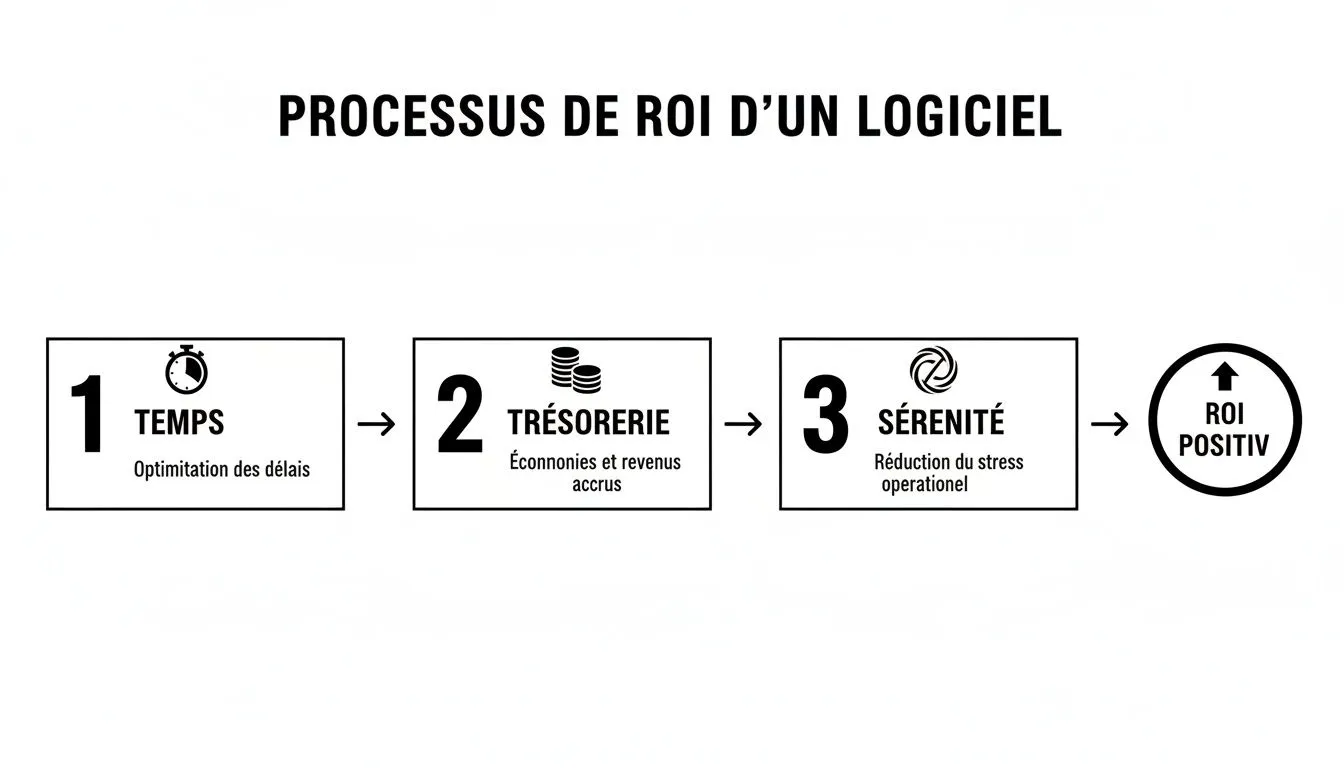
This diagram says it all: the time you stop losing on manual tasks turns directly into a better view of your cash flow, which gives you the peace of mind you need to truly steer your growth.
A simple 5-step rollout
Once this preparation is done, taking action is often faster than you’d think. Here’s a realistic roadmap to get up and running without a hitch:
- Choose the right plan: No need to go oversized. Pick a plan that matches your current order volume. You can always scale it up later.
- Connect your channels: Link your stores (Shopify, WooCommerce, etc.) and your payment processors (Stripe, PayPal) to the software. Most of the time, this takes just a few minutes thanks to ready-made integrations.
- Customize your documents: Add your logo and adjust the colors on your invoice and quote templates. It’s quick, easy, and it’s the foundation for keeping a professional image.
- Import your history (if needed): Already have a customer base? Most tools let you import a CSV file in just a few clicks. It’s an optional step, but a handy one.
- Give your accountant a heads-up: Grant them access or simply show them how to export the data. They’ll be delighted to receive clean, well-structured, error-free information.
Don’t aim for perfection on day one. The goal is for the system to work for every new incoming order. You’ll have plenty of time to explore advanced features and fine-tune the details later.
By following these steps, you turn a potential chore into a quick win for your e-commerce business. You make your management more reliable, become more efficient, and above all, free your mind to focus on what really matters: growing your sales.
Answering your questions about invoicing and quoting software
Even after a thorough overview, a few very concrete questions often remain. That’s normal. Here are direct answers, drawn from our experience with hundreds of online sellers, to help you see things more clearly.
Is invoicing software really mandatory?
The short answer: yes, in practice. As soon as you generate your invoices using computer software, the 2018 anti-VAT-fraud law is clear. Your software must be certified to guarantee that your invoicing data is impossible to alter and fully secure.
Of course, a micro-entrepreneur just starting out and not yet VAT-liable could technically do without it. But it’s a risky, short-lived bet. All the more so since the 2026 reform will roll out e-invoicing across all VAT-liable businesses. Equipping yourself today with good invoicing and quoting software isn’t just about ticking a legal box. It’s a genuine strategic choice to prepare for the future and professionalize your operations.
A word about Excel and Word: forget them for your invoicing. We still come across online sellers using them, but it’s a false economy. These tools offer none of the required legal guarantees, the risk of entry errors is huge, and they can’t communicate with your stores. It’s a weight dragging down your growth.
Concretely, how does it work for refunds and credit notes?
This is where the magic of a well-integrated tool kicks in. Imagine: a customer returns an item ordered from your Shopify store. You approve the refund in your back office.
Good invoicing software, connected to your store, takes over automatically. Without you having to lift a finger, it will:
- Create a compliant credit note in proper form, with the correct numbering and all mandatory notices.
- Link this credit note to the original invoice so everything remains perfectly traceable.
- Update your figures in the financial reports.
Your books stay accurate, up to date, and precisely reflect the reality of your business, including returns. Trying to do this by hand opens the door to omissions and costly mistakes.
Will my accountant be able to work with this data?
Absolutely, and they’ll love you for it. Modern software designed for e-commerce is built to make their life easier (and yours too). Its role doesn’t stop at creating invoices; it organizes all the information so it’s directly ready to use.
You’ll be able to provide accounting exports in formats they know by heart, such as the Fichier des Écritures Comptables (FEC). All they’ll need to do is import it into their own tool. Some software, like Bizyness, goes even further by offering secure access for your accountant. They can then view the figures and download the supporting documents they need, whenever they want. For them, it’s a valuable time saver, and for you, it often means lighter fees.
Ready to level up and automate your financial management? Bizyness is the platform built by and for online sellers. Connect your sales channels, let invoicing take care of itself, and sleep soundly on the compliance front.
