

 Français
Invoicing travel expenses to clients: a quick guide
Invoicing travel expenses to clients: learn how to calculate them, handle VAT and the required legal mentions for reliable, efficient management.
Invoicing your travel expenses to a client is much more than a simple line on an invoice. It’s an essential step in preserving your business’s profitability. In concrete terms, it means passing on the costs you incur for an assignment, whether that’s mileage allowances, train tickets or tolls.
But be careful: the method you choose will have a direct impact on your accounting and your VAT management. This is often referred to as rebilling or disbursements (débours), and the difference matters a great deal.
The ground rules for invoicing your travel
The way you invoice your travel can make all the difference. A poorly calibrated approach can either eat into your margins or scare off a client with a cost they consider excessive. The key? Transparency, right from the very first contact.

Disbursements or rebilling: a crucial difference
Before reaching for the calculator, you absolutely need to master the distinction between these two concepts. The tax and accounting implications are not the same at all.
- Disbursements (débours): Imagine you’re advancing money on your client’s behalf. That’s exactly what this is. The original invoice (toll, plane ticket…) must be in the client’s name. You are then reimbursed to the euro. This amount does not count toward your revenue and no VAT applies. It’s simply a cash advance.
- Rebilling: Here it’s different. You treat travel expenses as a service in their own right. These amounts are added to your revenue and are subject to VAT (the same rate as your other services).
The choice often depends on your business structure. A sole trader (micro-entrepreneur), for example, has every interest in favoring disbursements to avoid artificially inflating revenue and tipping over the applicable thresholds.
The mileage scale: your benchmark for calculation
When you use your personal vehicle, how do you set a fair price? There’s an official reference: the mileage scale (barème kilométrique), published every year by the French tax authorities. Even though it isn’t mandatory in a business relationship, it provides a credible, easily justifiable basis for calculation.
For example, for a 5-hp car, the 2024 rate is €0.636 per kilometer (for under 5,000 km driven per year). Using this scale demonstrates your professionalism. To dig deeper, feel free to consult detailed guides on invoicing mileage expenses.
The golden rule: A clear, written agreement from the quote stage onward is your best insurance against misunderstandings. The client should never be surprised to discover travel expenses on the final invoice.
By clearly stating your calculation method in your general terms of sale and on every quote, you lay the groundwork for a relationship built on trust. Whether you choose a flat rate, real-cost reimbursement or disbursements, what matters is that the ground rules are known and accepted before the assignment even begins.
Which method should you choose to calculate your travel expenses?
Deciding how you’ll calculate and invoice your travel expenses isn’t just a matter of numbers. It’s a strategic decision. You need to strike the right balance between simple management for you, a fair calculation for your cash flow, and total transparency for your client.
In practice, you have three main approaches available: invoicing actual costs, applying mileage allowances, or setting up a flat rate. Each has its strengths and weaknesses. The best method really depends on the nature of your assignments, your legal status, and the relationship you have with your clients.
Let’s go through them so you can make the right choice.
Invoicing actual costs: transparency above all
This is the most straightforward method: you bill the client for every euro you actually spent, with supporting receipts. Nothing could be more transparent, since the amount corresponds exactly to the expenses you incurred for the assignment.
Let’s take a concrete example. A consultant based in Lille travels to audit a client in Marseille for three days. Expenses can add up quickly:
- Round-trip train tickets: €350
- Hotel nights: €280
- Meals on site: €120
- Metro and taxi fares: €45
With the actual-cost method, they simply need to present the corresponding invoices to be reimbursed the full €795. This is an ideal approach for long, complex trips or ones with unforeseen costs, where a flat rate would be a real headache to estimate. The only downside is the paperwork: you have to be meticulous, collecting every receipt, keeping it all and presenting it.
Expert tip: use a mobile app to scan your receipts as you go. It saves you from losing a receipt at the bottom of a bag and makes preparing your expense report much less painful.
Large companies, used to this kind of process, often appreciate this level of rigor. It’s a genuine sign of professionalism that removes any ambiguity about the amounts billed.
Mileage allowances: a standard, recognized basis for calculation
If you use your personal car for business travel, mileage allowances (indemnités kilométriques, or IK) are often the most relevant solution. This method relies on the official scale published every year by the French tax authorities, which gives it a legitimacy no one can dispute.
This scale isn’t just a “price per kilometer.” It’s designed to cover all the costs associated with using your vehicle:
- General wear and depreciation
- Maintenance and repairs
- Tire replacement
- Fuel
- Your insurance premium
The calculation couldn’t be simpler: distance traveled (in km, round trip) x the mileage scale rate. That rate depends on your car’s fiscal horsepower (“chevaux fiscaux”) and the total kilometers you drive over the year.
An example to make it clear:
A freelance graphic designer takes their 5-hp car to visit a client 50 km from home. The round trip is therefore 100 km. Applying the current tax scale (for an annual total under 5,000 km), the calculation is as follows:
100 km * €0.636/km = €63.60
They simply need to add this amount to their invoice as a dedicated line item. For sole traders, this is a particularly attractive method. Our guide on mileage expenses for sole traders covers the specifics that make this approach so practical for that status.
Be careful, these scales aren’t set in stone! They’re regularly updated. For example, a 1.5% increase in road expenses was applied starting in March 2025 following an agreement in the road transport sector. This is a trend worth following closely if you want your travel expense invoicing to clients to stay accurate. For the curious, you can check the details of the 2025 road expense revaluation on truckonline.pro.
The flat rate: simplicity for predictable trips
On the administrative side, nothing is simpler than a flat rate. The principle? You set a fixed amount, agreed in advance with your client, to cover your travel. This is the ideal solution for local or recurring assignments, where costs vary little and are therefore easy to anticipate.
Picture a plumber who mainly travels within a 20 km radius. They could easily offer a single “Travel and diagnostic” flat rate of €50. Whether the client is 5 or 15 km away, the price is the same.
The advantages are obvious:
- Pure simplicity: no complex calculations, no receipts to track down.
- Total clarity: the client knows exactly how much it will cost before you even arrive.
- Predictability: no surprises, for you or for your client.
The pitfall? You need to estimate your costs accurately in advance. Set the flat rate too low, and you lose money. Set it too high, and you risk scaring clients away. The key is therefore to analyze your past trips to set a realistic, profitable amount.
A good tip is to create a system of flat rates by geographic zone:
- Zone 1 (0-15 km): €30
- Zone 2 (16-30 km): €50
- Zone 3 (> 30 km): Quoted on request, based on mileage allowances.
This hybrid approach is excellent. It keeps the simplicity of a flat rate for routine trips while offering the precision needed for longer distances. It’s the best of both worlds.
How to include travel expenses on your invoices
You’ve done your calculations, chosen your method, and the amount is clear? Perfect. Now you need all of that to appear clearly on your invoice. This is a step you shouldn’t neglect: a vague line item or an error, and you risk a delayed payment or a client asking questions. Invoicing travel expenses should be just as transparent as the rest of your services.
The goal is simple: the client should understand at a glance what they’re paying for. The best approach is to create a clearly separate line on the invoice for these expenses. Above all, don’t bury them within the overall amount of your service. Transparency always pays off.
This little diagram will help you see more clearly which method to choose depending on the assignment.
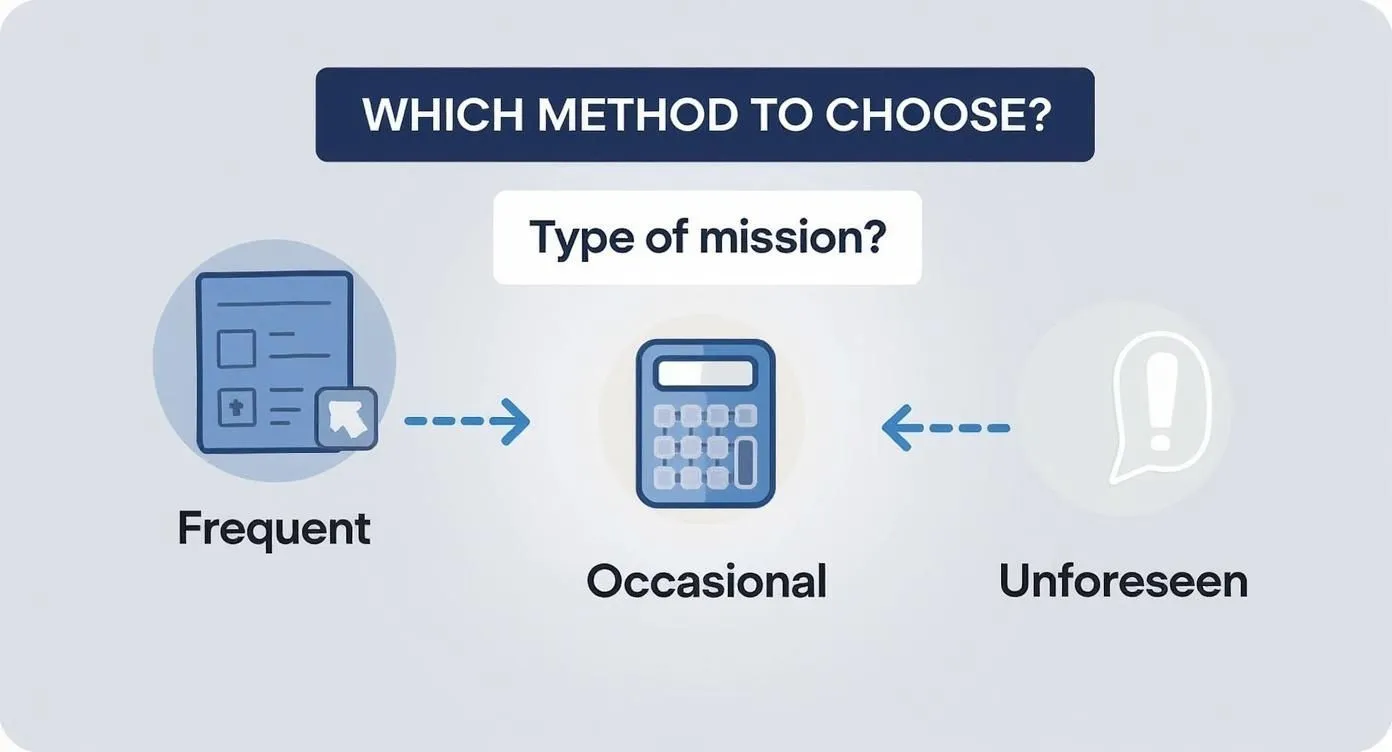
As you can see, the choice between a flat rate, actual costs or mileage allowances really depends on how regular and what kind your travel is.
Getting the wording right: clarity above all
The description you put on this line item is essential. A simple “Travel expenses” is a bit too vague and can raise questions. Be more precise — it will avoid any ambiguity.
Here are a few concrete examples you can draw inspiration from:
- For mileage allowances: “Mileage expenses - Assignment on [Date] - Trip [Departure city] / [Arrival city] (120 km round trip) x €0.636/km”
- For a flat rate: “Zone 2 travel flat rate (15-30 km) - Assignment [Assignment name]”
- For actual-cost reimbursement: “Reimbursement of travel expenses (Assignment [Assignment name]) - see receipts no. 1 to no. 4”
The idea is to give the client the keys to the calculation directly on the invoice. That way they can check it themselves, which builds trust and shows your professionalism.
Pro tip: In your invoicing software, like Bizyness, create predefined items or services for each type of expense. You’ll save a huge amount of time and be sure the wording is always spot on, without having to rewrite it every time.
The VAT puzzle: how to make sense of it
VAT on travel expenses is often where things get tricky. The rule is actually simple, but it depends on the invoicing method you’ve chosen.
If you invoice at a flat rate or on actual costs, these expenses are seen as an extension of your service. They must therefore be subject to the same VAT rate as your main service. For example, if you invoice consulting at 20%, your travel flat rate will also be subject to 20% VAT.
On the other hand, it’s different for mileage allowances based on the official tax scale. The authorities consider that this scale already includes all taxes (it is, in a sense, “tax-inclusive”) and that it amounts to a simple reimbursement. As a result: no VAT applies to a line item calculated using the official mileage scale.
To keep it simple:
- Flat-rate invoicing: subject to the VAT of your service.
- Actual-cost invoicing: subject to the VAT of your service.
- Mileage allowances (tax scale): not subject to VAT.
- Disbursements: never subject to VAT (they are not expenses you rebill, but advances).
VAT on fuel also has its own subtleties. To dig deeper, our guide on reclaiming VAT on fuel will give you all the information you need to optimize your returns.
Organizing your receipts for peace-of-mind accounting
Invoicing travel expenses to a client is one thing. Doing it fairly and professionally rests on a pillar that’s often overlooked: impeccable document management. Without properly formatted receipts, even the most precise calculation can be called into question — whether by your client or, worse, by the tax authorities.
Carefully keeping every toll receipt, fuel invoice or hotel receipt isn’t just a formality. It’s the tangible proof that legitimizes your reimbursement and guarantees your accounting stays compliant. Rigorous organization is therefore your best ally.

The essential documents to keep
For every expense you plan to rebill, you need proof. The type of document varies, but the goal is the same: to prove the reality and the amount of the expense.
Here are the records you absolutely must archive:
- For mileage expenses: there’s no direct invoice here. You therefore need to be able to justify the distance traveled. Keep a copy of your vehicle’s registration document on hand and maintain a log of your trips (date, client, departure and arrival points, distance).
- For public transport: keep train tickets, boarding passes, or taxi and ride-hailing receipts.
- For all incidental expenses: toll receipts, fuel invoices, restaurant receipts and hotel invoices are obviously essential.
It may seem tedious, but it’s absolutely crucial. A 2025 Ipsos study showed that 86% of French people continue to favor their personal car. That shows how important it is to properly document kilometers driven, since it’s often the most frequent and most scrutinized expense category.
Go digital for greater efficiency
Frankly, the days of shoeboxes overflowing with receipts are over. Digitizing your receipts is no longer optional — it’s a necessity for greater efficiency and data security. The law even recognizes the evidentiary value of digital copies, as long as certain rules are followed.
Get into the habit of using a mobile app to scan your receipts the second you receive them. It’s a small thing, but it’s a game changer. No more lost receipts, no more faded ink over time, and filing is done instantly.
My personal tip: on your cloud storage, create a simple folder structure (for example: 2024 > Expenses > [Client Name]). Scan and name each receipt clearly, like
2024-10-26_Toll-A7_Client-Dupont.pdf. It’s a small effort that will save you hours later on.
Tools like Bizyness go even further. They don’t just store your receipts securely; they let you link them directly to an expense recorded in your accounting, then associate that with the right client invoice. Everything is centralized. It radically simplifies bank reconciliation and preparing your tax returns.
The accounting treatment of your expenses
Once everything is well organized, you need to make sure the accounting treatment is correct. The entries to record aren’t the same depending on whether you opt for rebilling or disbursements.
- In the case of rebilling (flat rate or actual cost): the expense is first a cost for your business (in a class 6 account), then becomes revenue once you invoice it to the client (in a class 7 account).
- In the case of disbursements: the amounts you advance pass through a third-party account (class 4). They are neither a cost nor revenue for you.
Understanding these mechanisms is fundamental to accurate accounting. To dig deeper, feel free to take a look at our guide on accounting for expense reports, which will guide you step by step.
Ultimately, rigorous management of your receipts turns an administrative constraint into a genuine asset. It strengthens your credibility with clients, protects you in the event of an audit, and gives you a clear view of each assignment’s profitability. It’s a time investment that always pays off.
Handling special situations and edge cases
Theory is all well and good, but reality on the ground is often more complex. Every business structure, every assignment brings its own subtleties. You need to know how to juggle the rules to stay compliant without sacrificing profitability.
Navigating between legal obligations and optimizing your management takes a bit of rigor. This logic, in fact, applies to many administrative and tax matters. For example, understanding the steps to convert commercial premises into housing shows how important it is to know how to approach specific regulations to successfully carry out a project.
The case of the micro-entrepreneur: a real headache?
For a micro-entrepreneur, managing travel expenses is a strategic issue. There’s no other way to put it. The crucial point to remember is that your expenses are not deductible. They form an integral part of your declared revenue, which serves as the basis for calculating your contributions and taxes.
Rebilling your expenses the conventional way, simply adding them as a line on your invoice, is a trap. Why? Because it artificially inflates your revenue. You risk exceeding the thresholds, and you’ll pay contributions on amounts that are merely reimbursement of your own expenses.
The best solution for a micro-entrepreneur is the disbursement note (note de débours). The principle is simple: you ask for the invoices (hotel, train ticket…) to be issued directly in your client’s name. You pay them, then you ask the client for reimbursement to the euro, backed by receipts. These amounts don’t pass through your revenue. It’s simply a cash advance, completely neutral for your contributions.
Obviously, for mileage allowances, a disbursement note isn’t possible. In that case, you do need to include them on the invoice. My advice: slightly increase your mileage rate or overall price to anticipate and offset the contributions you’ll pay on it.
Assignments abroad and incidental expenses
When an assignment takes you across borders, the complexity increases. Managing currencies and intra-EU VAT requires particular attention.
- Juggling currencies: incurred expenses in dollars or pounds sterling? You need to convert them into euros on your invoice. Use the official exchange rate on the day of the expense, or the day you invoice. What matters is choosing one method and sticking to it.
- The infamous intra-EU VAT: if your client is a business based in the European Union, the reverse-charge mechanism applies. In concrete terms, you invoice tax-free (HT). Be sure to mention your intra-EU VAT number and your client’s on the invoice — it’s mandatory.
For all incidental expenses like hotels or meals, transparency is king. Rebill “at actual cost” and systematically attach the receipts to your invoice. It’s the best way to avoid disputes and build a relationship of trust.
Tips for pros who are always on the road
Whether you’re a consultant, a photographer or a tradesperson in construction, your office is often your car. Poorly managed travel expenses can quickly eat into your margins.
Here are a few strategies that have proven their worth:
- Create zone-based flat rates: for recurring travel within a defined area, set up a simple grid. For example: Zone 1 (under 20 km), Zone 2 (20 to 50 km), and so on. It’s crystal clear for the client and saves you a huge amount of time.
- Adopt a tracking tool: don’t rely on memory. A mobile app that tracks your kilometers by GPS and lets you scan receipts on the fly is a game changer. Software like Bizyness can then retrieve this data to integrate it directly into your invoices.
- Plan ahead from the quote stage: be as precise as possible upfront. Mention a detailed estimate of travel expenses, even if it needs to be refined later. A “Provision for travel expenses” line is far more professional than a bad surprise on the final invoice.
- Reassess your costs: fuel prices rise, tolls go up… take the time, every quarter, to check that your flat rates or per-kilometer rate still match the reality of your expenses.
By building these habits, you turn what looks like an administrative chore into a genuine lever for your profitability and your brand image.
Your questions, our answers on travel expense invoicing
Invoicing travel expenses can quickly become a headache. To help you see things more clearly, I’ve gathered here the questions that come up most often among freelancers and business owners.
The goal is to give you concrete answers so you can handle this calmly, without overthinking it.
Can I really invoice my travel every single time?
Yes, without hesitation. Any professional has the right to invoice the expenses they incur to travel to a client or to a job site. It’s even a perfectly normal practice for protecting your margin.
The one requirement? Transparency. Your client needs to know before committing. So remember to state it clearly on your quote, either with a dedicated line or in your general terms of sale. It’s the best way to avoid unpleasant surprises and endless discussions.
Are receipts always mandatory?
It depends on the method you choose. If you invoice at actual cost, then yes, receipts are essential. Toll receipts, restaurant bills, hotel invoices… they’re the concrete proof of the expense that you present to your client.
On the other hand, if you go with a flat rate or use the mileage allowance scale, your client doesn’t need those receipts. The amount is already set and agreed. Be careful though: this doesn’t exempt you from carefully keeping all proof of your travel for your own accounting. A tax audit can come around quickly.
The special case of micro-entrepreneurs: if you use the disbursement method, you must absolutely attach the original invoices, issued in your client’s name. That’s what proves it’s merely an expense advance and not revenue to be declared.
What should you do if expenses exceed what was planned?
A massive traffic jam, an unexpected issue on a job site forcing you to stay an extra night… the ups and downs of the job! If your actual expenses rise above the quote’s estimate, the watchword is: communication.
Whatever you do, don’t wait until you send the final invoice to break the bad news. Notify your client as early as possible. Calmly explain the situation and offer them an amendment to the quote to formalize this additional cost. By acting this way, you turn what could be a source of conflict into a simple administrative formality, and you preserve your client relationship.
Managing the invoicing of your travel expenses and all your paperwork shouldn’t take up all your time. With a tool like Bizyness, you can create flawless quotes and invoices in just a few clicks, easily incorporating all your cost lines.
Spend less time on admin and more time on what you do best. Take a look at what Bizyness can do to simplify your day-to-day.
