

 Français
 Late payment: the complete guide for businesses
Is a late payment threatening your cash flow? Discover our complete guide to handling unpaid invoices, from friendly reminders to legal action.

When a client fails to pay an invoice by the agreed date, it’s called a late payment. For a freelancer or a small business, this isn’t just a minor inconvenience. It’s a situation that can quickly become a real headache, weaken your cash flow, and generate plenty of stress.
The real impact of a late payment on your business
An unpaid invoice is much more than a line blinking red on your dashboard. It’s a genuine spanner in the works of your business. It can trigger a domino effect on your cash flow, force you to put projects on hold, and ultimately slow your growth.

Think of your cash flow as your company’s fuel tank. Every overdue invoice is a small leak. At first, it seems harmless, but if you don’t plug the hole quickly, the tank eventually runs dry. And unfortunately, this situation is far from rare.
A phenomenon with multiple consequences
This isn’t an isolated problem — it’s an issue eating away at the economy. Late payments in France have reached record highs, now affecting 86% of businesses. This trend is worsening in a tense economic climate, where the average time to get paid between professionals is nearing 50 days. If you want to dig deeper, you can look at the full data on business payment behavior.
For a small business or sole trader, the impact is direct and can really hurt:
- Strained cash flow: A lack of liquidity can leave you unable to pay your own suppliers, your contributions, or even yourself a salary.
- Wasted time: Every minute spent chasing a client by phone or email is a minute you’re not spending on finding new work or looking after your good clients.
- Mental load: Living with financial uncertainty and having to manage sometimes tense situations with bad payers takes a real toll on morale.
A late payment isn’t just a financial issue. It’s a thief of time and energy. It distracts you from what really matters: growing your business.
Summary of the impacts of a late payment
To give you a clearer picture of the risks, the table below summarizes the main negative consequences of a late payment.
| Type of impact | Direct consequence for the business | Concrete example |
|---|---|---|
| Financial | Drastic reduction in working capital | Unable to pay rent for business premises or restock inventory. |
| Operational | Time and resources spent on collections | Spending entire afternoons sending emails and making follow-up calls. |
| Relational | Tension in the business relationship | A loyal client becomes distant and less cooperative after several reminders. |
| Strategic | Postponed or cancelled investments | Giving up on new equipment or launching a marketing campaign due to lack of funds. |
Understanding these stakes is the very first step toward defending yourself effectively. The goal of this guide is to show you that you’re not powerless against this scourge, and to equip you with concrete tools and methods to protect your business over the long term.
Mastering the rules of the game: payment terms and late penalties
When a client doesn’t pay you, your cash flow takes a hit. To defend yourself effectively, you need to know your rights. Rest assured, French law is on your side, with clear rules and precise tools for taking action. You don’t need to be a legal expert to find your way around; let’s go through the essentials so you can claim what you’re owed with confidence.
Lawmakers have set strict payment terms to protect businesses, especially the smallest ones. These rules apply automatically, even if you haven’t specified anything in writing.
How do legal payment terms work?
The default payment term between professionals, if you haven’t negotiated anything specific, is 30 days. This countdown starts from the date the goods are received or the service is completed. That’s the baseline.
Of course, you can agree on different terms with your client. The deadline can be extended, but be careful — it can never exceed 60 days net from the invoice date. There’s also an alternative, “45 days end of month,” which is a bit more technical to calculate but entirely legal.
Key takeaway: These deadlines aren’t mere recommendations — they are a legal obligation. If your client fails to respect them, they risk heavy administrative fines, on top of the penalties they already owe you.
Late penalties: an automatic right
As soon as your invoice’s due date has passed, you are entitled to demand late penalties. It’s simply financial compensation for the harm this delay causes you. It’s an absolute right: penalties start accruing from the very first day of delay, without you even needing to send a reminder.
To apply them, the interest rate simply needs to be mentioned in your business documents. The most common practice is to base it on the European Central Bank’s (ECB) key rate, plus 10 points. Since this rate is often close to zero, the penalty rate applied is generally around 10%. You can set a different rate, but it can never be lower than three times the legal interest rate. For more detail, our guide on invoice payment terms covers the topic in full.
The flat-rate compensation for collection costs
On top of that, the law lets you charge a fixed amount to cover your collection costs. This amount is €40 per overdue invoice. The idea is to compensate for the time you spend following up, the cost of a registered letter, and so on.
This compensation is added automatically to the late penalties. And if your collection efforts cost you more (for example, by using a collection agency), you can request additional compensation, provided you can justify it.
Let’s take an example to make this clearer:
- Invoice total (incl. tax): €2,000
- Due date: March 1st
- Today’s date: April 30th (i.e., 60 days late)
- Penalty rate: 10%
Here’s how to calculate the penalties:
(Total amount x Penalty rate x Number of days late) / 365
Which gives: (€2,000 x 10% x 60) / 365 = €32.87
Don’t forget to add the flat-rate compensation:
€32.87 + €40 = €72.87
By April 30th, your client owes you the €2,000 invoice, plus €72.87 in compensation.
To strengthen your position, it’s really crucial to draft solid Terms and Conditions of Sale. This is the reference document where you must clearly state your payment terms and the conditions for applying penalties.
Unfortunately, on the ground, the situation is far from ideal. In France, the average payment delay stands at 13.6 days, a figure on the rise and well above the European average. Less than half of businesses pay their invoices on time, which ties up nearly €15 billion in cash flow that would otherwise be vital to our economy.
Setting up a friendly collection process
A client hasn’t paid their invoice on time? The first reaction is often annoyance. Yet before bringing out the heavy artillery, a diplomatic and well-structured approach pays off far more. That’s the whole point of friendly (amicable) collection: getting your money back while preserving your client relationship.
Think of it as a conversation that gradually escalates, but gently. There’s no question of brandishing threats from day one of the delay. The idea is to guide your client toward payment, step by step, always assuming that a simple oversight is the most likely cause.
This infographic quickly reminds you of the legal payment terms in France, which frame your entire approach.
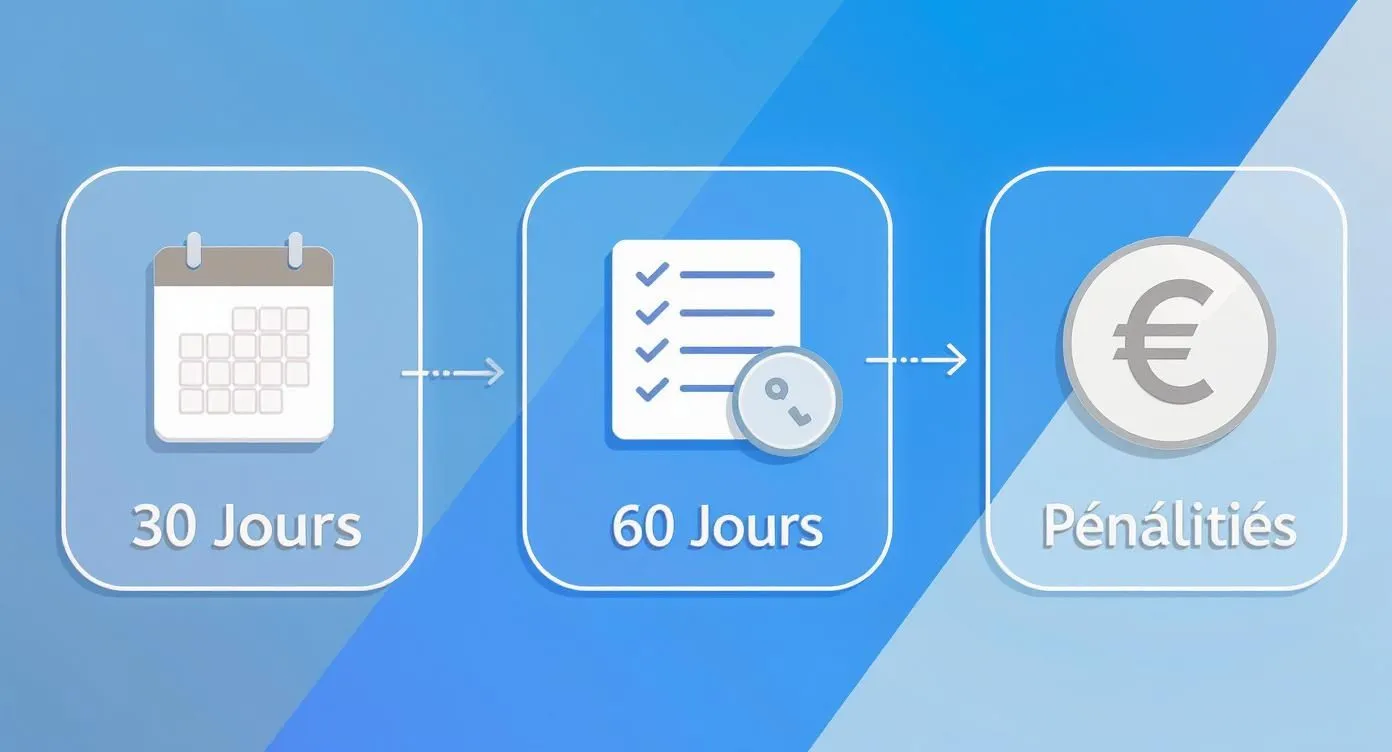
It’s clear here that time works against you, and that penalties can apply once the standard 30- or 60-day terms have passed.
Step 1: The small preventive reminder (before the due date)
The best way to handle an unpaid invoice is still to prevent it from happening. A few days before the payment deadline, a short, courteous email works wonders. It’s not an aggressive follow-up, just a friendly reminder.
The goal is twofold. First, you make sure the invoice was actually received and isn’t lost somewhere in an inbox. Second, you show that you’re professional and organized.
A simple example:
- Subject: Quick reminder regarding our invoice [Invoice number]
- Content: “Hello [Client name], just a quick note to remind you that our invoice [Invoice number] for [Amount] € is due on [Due date]. Could you just confirm that everything is in order on your end? Thanks and have a great day!”
With this simple precaution, you defuse most delays caused by a forgotten invoice or one that ended up in spam.
Step 2: The first written reminder (right after the due date)
The due date has passed and still nothing? You need to react quickly. The next day or two days later, send a first reminder by email. Keep the tone cordial, but slightly more formal.
Always assume it’s an oversight. What matters is clearly restating that payment is expected.
A late payment doesn’t mean you’re dealing with a bad payer. Clear, prompt communication resolves 90% of situations without the slightest conflict.
To be effective, don’t forget to include the essential information in your email:
- The invoice attached, to make it easy for them.
- The invoice number and amount.
- The due date, which has now passed.
This responsiveness shows that you keep a close eye on your accounts, which naturally encourages your clients to be more diligent. For more examples, our guide on reminder letters for unpaid invoices is here to help.
Step 3: The phone call
A few days have passed since your email and it’s still radio silence? Pick up the phone. Direct, human contact through a call is often far more effective at unblocking the situation.
Prepare a little beforehand. Have the invoice, its number, the amount, and the date in front of you. Your goal is to understand why it’s stuck and, ideally, to get a precise payment date.
Stay calm and professional, even if the person on the other end is a bit defensive. The idea is to find a solution together. If they mention cash flow problems, you can even propose a small payment plan. It’s a good compromise to secure your payment while preserving the relationship.
Step 4: The second written reminder (raising the tone)
The call didn’t produce results, or the promised payment wasn’t made? It’s time to send a second written reminder, and this time the tone changes.
Your email should be more direct. Recap the history of your efforts (the first reminder, your call) and clearly mention that late penalties now apply, as required by law. This shows that you know your rights and are prepared to go further.
Key points of this second reminder:
- A clear subject line: Put “Second reminder” or “Reminder #2” in the subject.
- A recap of the facts: List the invoice date, its due date, and your previous contacts.
- Mention of penalties: State that penalties are now due.
- An ultimatum: Set a very short new deadline (say, 48 or 72 hours) before moving to the next step, the formal notice.
This gradual escalation is the best way to handle a late payment. It lets you resolve the vast majority of cases amicably, saving you time and energy while preserving your business relationships. Only if this last attempt fails should you move up a gear.
The formal notice: the last warning before the storm
When friendly reminders are no longer enough and your client’s silence becomes overwhelming, it’s time to change tone. The formal notice (mise en demeure) is much more than a simple reminder. It’s a legal act that raises the pressure a notch.
Think of it as the last official warning before things get serious. This formal letter clearly signals to your client that your patience has limits and that, absent payment, you’re prepared to take the matter to court. Its psychological weight is often enough to unblock the situation, as it proves your determination. Legally, it’s also crucial: it officially starts the clock on late interest (known as “moratory interest”) and serves as a key piece of evidence if you need to go further.
What absolutely must appear in your letter
For a formal notice to have real legal value, it must be drafted with surgical precision. Miss even one of the following elements, and it could be considered invalid. It’s a bit like a contract: every detail matters.
Here’s the checklist of mandatory mentions:
- The identity of both parties: Your full details (company name, address, SIRET) and those of your client.
- The date and place: Essential for calculating the deadlines that follow.
- An unambiguous subject line: Write out in full “Formal notice to pay”. The message must be crystal clear.
- The context of the debt: Recall the number of the invoice concerned, its date, and its total amount (incl. tax), including the late penalties already calculated.
- Your demand: Clearly state your request: payment of the amount owed.
- A final deadline: Give your client one last chance by granting a reasonable period, generally between 8 and 15 days, to settle the debt.
- The threat of what follows: This is the crucial point. State that in the absence of payment within the given period, you will bring the matter before the competent court to obtain forced collection.
Think of the formal notice not as a declaration of war, but as a powerful tool to assert your rights. It’s the last formal step to try to recover your money without going to court. And more often than not, it works.
Sending it: the only method that really matters
How should you send this important letter? The answer is simple: registered letter with acknowledgment of receipt. This is non-negotiable. The acknowledgment of receipt, signed by your client (or their representative), becomes irrefutable proof. It attests to the date on which your debtor was officially notified.
This acknowledgment of receipt is your trump card if the matter ends up before a judge. It will demonstrate that you did warn your client of the consequences of their inaction. A simple email, even with a read receipt, doesn’t carry the same legal weight and can easily be disputed. Don’t take that unnecessary risk.
A ready-to-use formal notice template
To save you time, here’s a template you can adapt. Simply replace the information in brackets.
[Your Company Name]
[Your Address]
[Your Postal Code and City]
[Your SIRET Number]
[Client’s Company Name]
[Attention: …]
[Client’s Address]
[Client’s Postal Code and City]
Done at [Your City], on [Date]
Subject: Formal notice to pay
Registered letter with acknowledgment of receipt
Dear Sir or Madam,
Unless we are mistaken, we note that as of today, invoice no. [Invoice number], dated [Invoice date] and totaling [Invoice amount] € including tax, remains unpaid. We remind you that its due date was set for [Due date].
Despite our previous reminders, we have received no payment.
By this letter, we hereby give you formal notice to pay us the sum of [Total amount owed, including penalties] € within eight days of receiving this letter.
This sum breaks down as follows:
- Original invoice amount: [Amount] €
- Late penalties to date: [Penalty amount] €
- Flat-rate compensation for collection costs: €40
Absent payment within this period, we will be forced to initiate legal proceedings against you to obtain forced collection of our claim, which would generate additional costs at your expense.
Hoping it will not come to that, we await your payment without further delay.
Yours faithfully,
[Your Name]
[Your Title]
[Signature]
Moving up a gear: legal collection procedures
When the formal notice goes unanswered and your client turns a deaf ear, it’s a sign that the amicable phase is over. It’s time to turn to the courts. This idea can be daunting for a small business, but rest assured: simplified procedures have been designed specifically for you. The goal is to let you assert your rights without exhausting all your energy and money.
Starting legal proceedings isn’t declaring war. It’s simply the logical next step when dialogue has broken down. The most common method, and by far the most suited to unpaid invoices, is the injonction de payer (payment order). It’s a fast, low-cost procedure that, initially, doesn’t even require you to set foot in court.
The payment order: the most effective weapon
The payment order was designed to be accessible. The principle is simple: you ask a judge to order your client to pay you, based solely on the written evidence you provide. No hearing, no lengthy pleadings needed.
To start, you need a solid case file. Gather everything that proves you’re owed money:
- The unpaid invoice, obviously.
- The signed quote or purchase order that started it all.
- Proof that you did the work (a delivery note, a satisfaction email, etc.).
- A copy of your formal notice and, above all, its acknowledgment of receipt.
Once you have all that, you need to fill out a Cerfa form and file it with the registry of the competent court. For a debt between professionals, this will almost always be the commercial court.
The judge will then review your request based solely on the documents you sent. If they find your claim justified, they issue what’s called an “order granting a payment injunction.” This is a genuine court decision ordering your client to pay you.
Unfortunately, the economic climate is making these procedures increasingly common. In France, the average payment delay has reached 14.1 days, a sad European record putting many small businesses in difficulty. Some sectors, such as real estate or textiles, are particularly affected, contributing to a higher number of bankruptcies (68,000 in one year) than before the health crisis.
What happens after the order?
Getting this order is winning the first half. But the match isn’t over. The next step is crucial: you must have this decision formally “served” to your client by a judicial officer (the new name for a bailiff). This is mandatory — it’s what officially informs your client that a judge has ordered them to pay you.
From the moment they receive this document, your client has one month to react. Two scenarios are possible:
- They pay their debt: Victory! Your persistence has paid off.
- They file an objection: If they disagree and dispute the debt, they can object. In that case, the matter is referred back to court for a “standard” hearing where each party can explain their position.
If, after one month, your client has neither paid nor objected, you can ask the court registry to affix the “enforcement order” (formule exécutoire) to the ruling. This magic stamp turns the decision into a title that allows the judicial officer to enforce payment, for example via a seizure of your client’s bank account. For an overview of the possible strategies, feel free to check our article on client debt collection.
The référé-provision, another fast-track option
For cases where the debt is truly indisputable (a clear-cut contract, irrefutable evidence), there’s another very fast procedure: the référé-provision. It allows you to ask a judge, urgently, to grant you an advance on the amount owed, without waiting for a full ruling on the merits of the case.
Whatever procedure you’re considering, one last piece of advice before you start: check your client’s financial health. Incurring legal costs against a company that’s already in liquidation is unfortunately often a wasted effort that could end up costing you more than what you hoped to recover.
Preventing unpaid invoices: best practices to adopt
The best way to handle a late payment? Still to prevent it. Rather than suffering through it and having to chase your money in a rush, a proactive approach can literally change the health of your cash flow. A few simple habits, adopted upfront, are enough to secure your revenue and save you precious time.
Think of your sales process like building a house. You’d never start on the walls without first checking that the foundations are solid, would you? It’s exactly the same principle for your business relationships.
Building solid foundations before you even start
Preventing unpaid invoices starts well before you send the first invoice. It’s all about setting a clear framework from the very first contact. By establishing clear rules of the game, you drastically reduce the risk of misunderstandings that often end up as unpaid invoices.
Here are some fundamental actions:
- Check the creditworthiness of new clients: For a contract that represents a significant stake, take the time to check sites like Infogreffe or Pappers to get a sense of the company’s financial health. It’s a simple precaution that can save you major problems.
- Draft rock-solid quotes and Terms and Conditions of Sale: Your quotes should be clear, detailed, and formally accepted (the famous signed “approved” note). Your terms and conditions of sale, meanwhile, must clearly state payment terms, the late-penalty rate, and the €40 flat-rate compensation.
- Systematically request a deposit: For any project of a certain size, requiring a deposit (usually 30%) is more than sound practice. Not only does it secure part of your cash flow, it also commits your client much more firmly to the project.
Clarity is your best weapon against unpaid invoices. A precise quote and well-drafted terms and conditions aren’t just paperwork — they’re your company’s real shield.
These first steps set a professional tone and tend to discourage less serious clients. You show right away that tracking your invoicing is something you take very seriously.
Making payment simple and smooth
Once the work is done, the speed and simplicity of the payment process are decisive for avoiding any late payment. It’s logical: the easier it is for your client to pay you, the faster the money will land in your account.
So think about optimizing this crucial phase:
- Invoice without delay: As soon as the service is complete, send your invoice. The habit of waiting until the end of the month to send everything creates unnecessary delays and increases the risk of your invoice getting lost in the pile.
- Offer several payment methods: Don’t limit yourself to bank transfer. Offering online card payment or even direct debit can significantly smooth out payments.
Adopting these good habits is even easier with the right tools. Modern invoicing software, for example, can help you systematize all these actions so they become automatic.
This screenshot shows how a tool like Bizyness lets you centralize invoice tracking and even automate reminders. By turning manual, often stressful tasks into a clear, controlled process, you free your mind to focus on what you do best: your craft. No more wondering whether this or that invoice is overdue — the system takes care of it for you.
Your frequently asked questions about late payments
Debt collection can quickly become a headache, especially when you’re just starting out. To help you navigate these sometimes murky waters, here are clear answers to the questions you ask most often when facing a late payment.
My client isn’t paying — am I allowed to stop my work?
Yes, absolutely. This is a well-known legal principle: the exception of non-performance. Put simply, if your client doesn’t fulfill their part of the contract (paying), you have the right to suspend yours (continuing the work).
Be careful, you can’t just do this however you like. For it to be legal and beyond dispute, it’s best to have planned for a clause on this in your terms and conditions of sale. Before suspending anything, send a proper formal notice, giving your client one last reasonable deadline to pay and clearly warning them of your intention.
How much time do I have to claim an unpaid invoice?
The law gives you time, but it’s not unlimited. For a transaction between professionals, you have a limitation period of five years. This period starts running from the invoice’s due date, not its issue date.
In concrete terms, you have five years to take legal action. Once this period has elapsed, your invoice isn’t erased, but you can no longer use the courts to force your client to pay you. So it’s best not to let things drag on too long.
In commercial law, this is called extinctive prescription. If you exceed the five years, your right to take legal action expires, even though the debt technically still exists.
Are late penalties mandatory if I didn’t include them on the invoice?
Yes, absolutely. The French Commercial Code is very clear on this: late penalties are a right. They apply automatically, from the first day of delay, even if you forgot to mention them on the invoice or in your terms and conditions.
It’s a legal protection designed for all creditors. Obviously, it’s always wiser and more professional to state them on all your documents. This informs your client and prevents any attempt at dispute, putting you in a much more comfortable position should a problem arise.
Managing your invoices and protecting yourself against a late payment shouldn’t keep you up at night. With Bizyness, you can automate your reminders, keep an eye on your payments in real time, and finally focus on what really matters: your business. Discover how Bizyness can secure your cash flow today.
