

 Français
Mandatory Quote: What Amount Requires One for Professionals
Find out the threshold above which a quote becomes mandatory. A complete guide to sector-specific obligations, legal requirements and penalties.

Contrary to popular belief, there is no magic amount that triggers the obligation to issue a quote in France. The reality is more nuanced. It all depends on your sector of activity and, above all, the nature of your client: is it an individual or another business?
Is a quote always mandatory, and from what amount?
Digging into the question, you quickly realize the law doesn’t set a single universal rule. The most common mistake is looking for a universal threshold that simply doesn’t exist. The key to clarity is distinguishing between two very different commercial contexts:
- The B2C relationship (Business to Consumer): This is when you sell a product or service to an individual. Here, the law is far more protective of the consumer, so the obligations are stricter.
- The B2B relationship (Business to Business): In this case, your client is another business. The principle of contractual freedom prevails. The quote then becomes less a legal constraint and more an essential commercial tool to frame the engagement.
In practice, a plumber working for a private individual won’t face the same constraints as a marketing consultant working for a startup. The former is subject to very precise rules, while the latter relies more on sector best practices. To fully understand this key document, our complete guide explains in detail what a quote is.
Quickly identify your situation
To help you find your way at a glance, the diagram below summarizes the questions to ask yourself to know whether you must provide a quote.
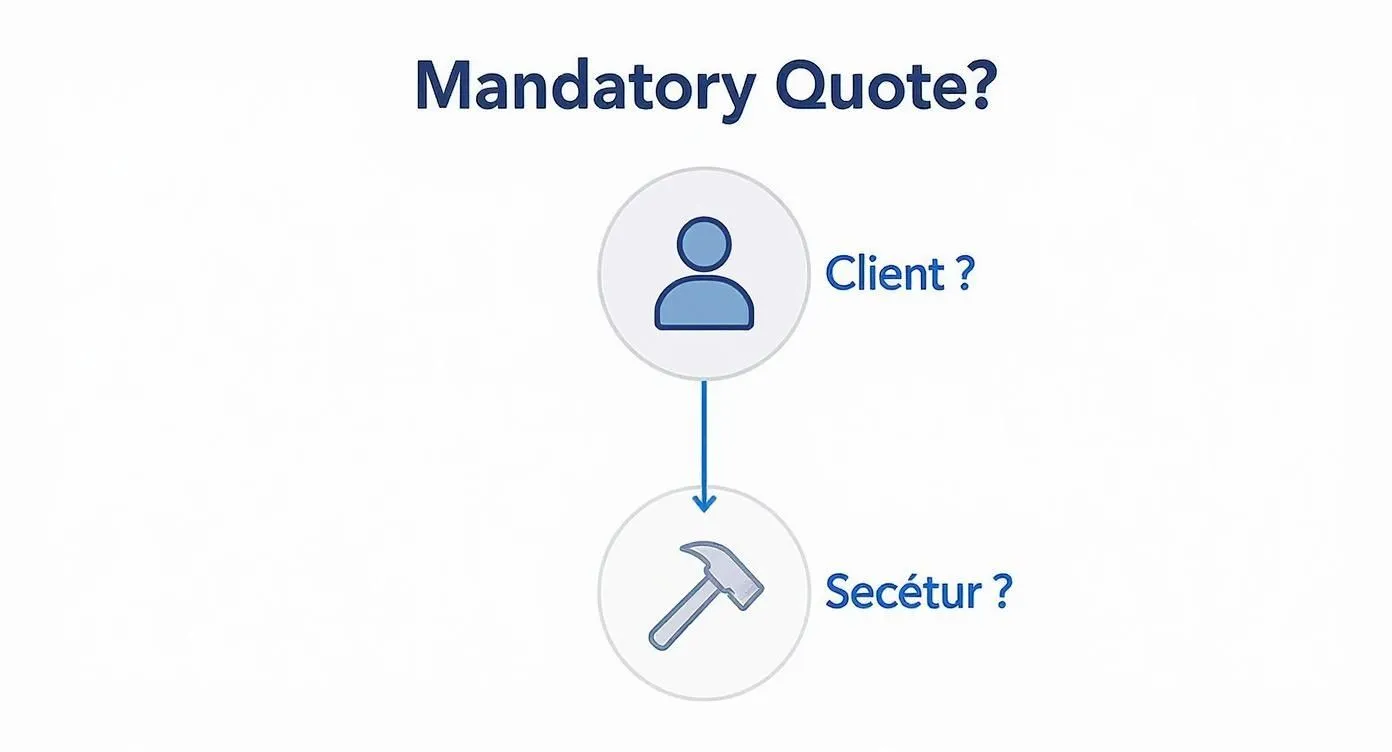
This visual makes it clear: the first reflex should be to ask who your client is. Only afterward do the sector of activity and the amount of the service come into play. Understanding this logic is the first step to being compliant and building a relationship of trust with your clients. In the following sections, we’ll detail the specific rules for each scenario.
The rules of the game for service providers
For most service providers, the big question — “from what amount is a quote mandatory?” — finds its answer in the nature of your client. The law makes a very clear distinction between an individual and a business. These are two different worlds, with two sets of rules.

This is really the starting point for everything. Knowing whether you operate in a B2C (Business to Consumer) or B2B (Business to Business) context is the first building block for running a smooth, compliant business.
With individuals (B2C): protection above all
When you work for a private individual, the law considers them the “weaker” party in the exchange. They don’t necessarily have the technical or commercial knowledge to evaluate everything, so they need protection. That’s why French legislation sets up a very strict framework to ensure they are well informed and give their consent with full knowledge of the facts.
In this context, a detailed quote becomes mandatory in quite a few situations. One important threshold to know concerns recurring services: as soon as the amount exceeds €100 including tax per month, such as a maintenance contract or a coaching subscription, a quote is required.
And then there’s a simple golden rule: if an individual client asks you for a quote, you must provide one. It’s that simple, regardless of the amount of the service.
The right reflex in B2C: See the quote as a mark of seriousness and transparency. It reassures your client, but it also protects you. By formalizing the agreement, it clears away any potential misunderstandings about what you need to do and at what price.
Between businesses (B2B): flexibility comes first
Things change completely when your client is another business. In a B2B relationship, both parties are assumed to be knowledgeable professionals, capable of negotiating and understanding the ins and outs of a contract.
The result: the law does not require a mandatory quote, even for very large sums. Contractual freedom prevails. This is a crucial distinction to understand, whether you offer marketing consulting or professional garage services.
But be careful: “not mandatory” doesn’t mean “useless.” Far from it. In practice, the quote remains an absolutely essential commercial and legal tool. Why?
- To secure the transaction: It puts in writing the scope of the engagement, deliverables, deadlines and price. No room for ambiguity.
- To avoid disputes: In case of disagreement over an invoice or the quality of the work, it’s the reference document that settles everything.
- To manage expectations properly: It ensures you and your client start on the same footing, with a shared vision of the project.
Even though the law doesn’t require it, issuing a quote is a sound practice that builds trust. To make sure you don’t forget anything, feel free to rely on a service quote template.
A special case: specific rules for construction work
If you’re a tradesperson in construction or home repair, the €100 or €1,500 thresholds don’t apply to you. Forget them. For you, the rules of the game are much stricter, and that’s no accident. The construction sector is particularly regulated for a simple reason: to protect clients in situations that are often urgent and stressful, where abuse can quickly occur.
Think of a burst pipe on a Sunday morning or a door slamming shut in the middle of the night. In these moments of panic, the client is vulnerable. It’s precisely to prevent abuse in this type of intervention that the law has tightened.
The quote is mandatory, regardless of the amount
Since a 2017 order, the rule is clear and unambiguous: for any repair, troubleshooting or maintenance service in the building and home equipment sector, you must provide a quote before starting the work. Regardless of the amount.
In practice, this means a plumber replacing a simple €20 gasket or an electrician replacing a €30 fuse must provide a detailed quote to their client. Above all, they must obtain the client’s agreement before even taking out their tools. This obligation to inform the client upfront is the cornerstone of their protection.
The goal is simple: guarantee total transparency on costs before the client commits. No more bad surprises on the final invoice.
The idea that there’s a minimum threshold for issuing a quote in construction is a persistent belief, but it’s completely false. Whether the intervention costs €50 or €5,000, the law requires a proper quote to be provided before starting anything.
This requirement covers a very wide range of trades, notably:
- Plumbing
- Electrical work
- Masonry
- Locksmithing
- Carpentry
- Painting
- Roofing work
Specific requirements you must never forget
A quote in the construction sector isn’t limited to basic information. To be fully compliant, it must include additional elements that are crucial for your client’s trust and protection.
1. Whether the quote is chargeable (or free)
If you charge for drafting the quote — for example to cover travel or a complex diagnosis — you must inform the client explicitly and in advance. If nothing is specified, the quote is automatically considered free.
2. Information about your ten-year (decennial) insurance
This point is absolutely non-negotiable. Your quote must include the contact details of your ten-year civil liability insurer as well as the geographic coverage of your contract. This insurance protects your client for 10 years against defects that could affect the structural soundness of the work.
Don’t take this obligation lightly. A missing or incomplete quote can cost you dearly. The Consumer Code provides for an administrative fine of up to €3,000 for an individual (such as a sole trader) and €15,000 for a company. To better understand the scope of this document, feel free to read resources on the legal value of a construction quote.
In short, in construction, the quote is much more than a mere formality. It’s a legal obligation that secures the relationship with your client, protects everyone, and demonstrates your professionalism. Neglecting it means taking a significant legal and financial risk, while damaging the trust that is essential to your trade.
Writing an airtight quote: legal requirements you must never forget
A quote is much more than a simple price estimate. It’s the document that lays the groundwork for your future collaboration with a client. Once signed, it becomes a genuine contract that binds both parties. Seeing it as a mere piece of paper would be a beginner’s mistake, one that can cost you dearly if something goes wrong.
For this document to be your best ally and protect you, it must be flawless. Every detail matters.
Think of your quote as the foundation of a house. If it’s solid, clear and well-built, the whole structure will hold. But if a single pillar is missing, a single crucial piece of information, the entire edifice of your client relationship risks collapsing at the first disagreement.
The information that makes your quote bulletproof
For a quote to be legally valid, it must contain a series of non-negotiable elements. It’s a bit like a recipe: if you leave out a key ingredient, the dish is ruined.
Here’s a simple checklist to go through before hitting “send.”
- The identity of both parties: On one side, yours. Name, address, SIRET number, and if you’re a sole trader, don’t forget the mention “EI” or “Entrepreneur Individuel.” On the other, your client’s: their name and address (or company name if it’s a business).
- The framework of the engagement: The date you draft the quote and, very important, its validity period. Generally, this is set between 1 and 3 months.
- Transparency above all: The precise detail of each service or product. This is the heart of the quote. Indicate the quantity and unit price excluding tax.
- The small extras (that aren’t so small): Travel or delivery costs? They must be listed separately, in black and white. No bad surprises.
- The bottom line, the price: The total amount due, clearly showing the total excluding tax, applicable VAT rates, and the final amount including tax. If you’re a micro-entrepreneur and don’t charge VAT, the mention “VAT not applicable, art. 293 B of the CGI” is mandatory.
- The financial rules of the game: The payment terms. Is there a deposit? What are the deadlines for settling the invoice? What penalties apply in case of late payment? Everything must be written down.
To go further and make sure you’re fully compliant, take a look at the legal notices that govern any commercial activity.
Complete checklist of mandatory quote information
To make your life easier, here’s a summary table. Keep it handy — it’s your safety net for 100% compliant quotes.
| Category | Required information | Concrete example or detail |
|---|---|---|
| Identification | Your full contact details | Name, address, SIRET number, “EI” mention if applicable |
| Client | Client’s contact details | Client’s name/company name and address |
| Timeframe | Date and validity period | ”Date: 01/10/2024”, “Valid until 12/31/2024” |
| Description | Detailed breakdown of services/products | Line by line: quantity, description, unit price excl. tax |
| Additional costs | Travel, delivery fees… | Dedicated line: “Travel fee: €50 excl. tax” |
| Pricing | Total amount excl. and incl. tax | Total excl. tax, VAT rate (e.g. 20%), VAT amount, total incl. tax |
| VAT (if applicable) | Specific mention for VAT exemption | ”VAT not applicable, art. 293 B of the CGI” |
| Payment | Payment terms | ”30% deposit upon signing, balance within 30 days” |
| Validation | Client’s mention and signature | ”Approved” or “Quote received before work begins” |
With this table, it’s hard to go wrong. Every line is a step toward a secure transaction for you and your client.
The details that turn a quote into a contract
Beyond the list of “technical” information, there are two elements that shift your quote from a mere proposal to a proper contract.
The first is the famous handwritten mention “Quote received before work begins” or, more simply, “Approved.” Right next to it, you need your client’s signature. This is the gesture that seals the agreement. It’s formal, irrefutable proof that they accept your terms and give you the green light to start.
Want to dig deeper? Our complete article on mandatory quote information is made for you.
An essential point to keep in mind: as long as a quote isn’t signed, it doesn’t bind you to anything. But it doesn’t protect your client either. It’s an offer, a starting point that you can modify or withdraw. The signature changes everything. It formalizes the commitment of both parties.
What are the risks and penalties for not providing a quote?
Skipping a mandatory quote is a bit like playing Russian roulette with your business. You might get away with it once, twice… but the day it goes wrong, the consequences can be very serious. These aren’t empty threats; the risks are concrete and can be very costly.
Treating the quote as a mere administrative formality is a beginner’s mistake. Its absence exposes you not only to direct financial penalties, but also to legal tangles that can slow down, or even paralyze, your business.
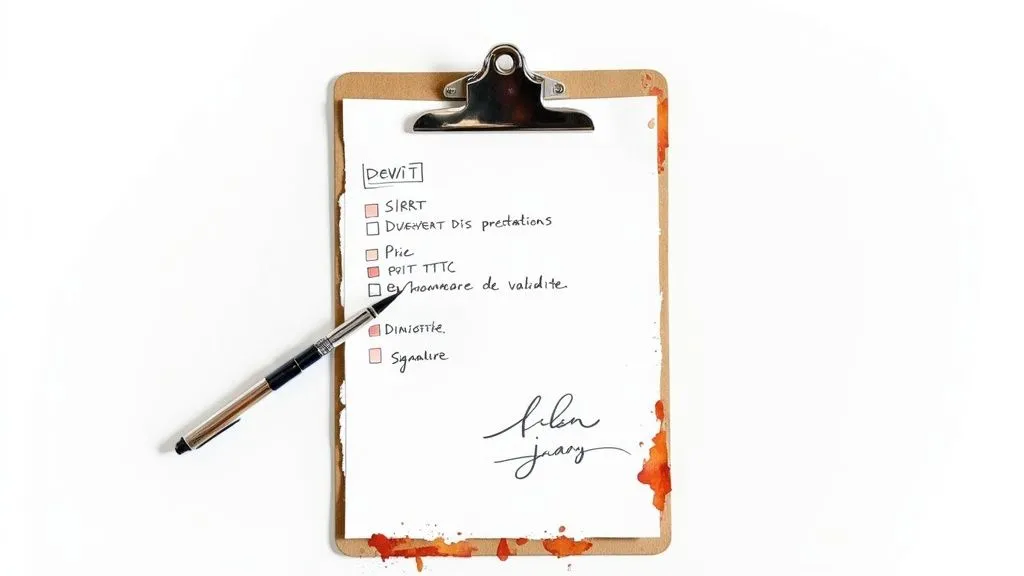
The quote isn’t a constraint, it’s a protection. It’s a shield that covers you and your client. Skipping it simply means deciding to work without a safety net.
Administrative fines: a stinging reality
The State, through the DGCCRF (the French consumer protection agency), doesn’t joke around with consumer protection. In the event of an inspection or complaint, the agents won’t cut you any slack. The law is clear.
A failure to meet the pre-contractual information obligation — which includes forgetting a mandatory quote — is punished by an administrative fine. And the amounts are designed to be a deterrent:
- Up to €3,000 for a sole trader (yes, micro-entrepreneurs are included).
- Up to €15,000 for a company (legal entity).
For a small business, such a sum can hit cash flow hard. A single careless mistake can have a huge impact.
Beyond the fine: legal risks and reputational damage
But the risk doesn’t stop there. The absence of a quote signed by the client puts you in an extremely weak position in the event of a disagreement.
No quote, no proof. No written contract locking in the client’s agreement on what you were supposed to do and at what price. In a dispute, it’s your word against theirs… and when facing an individual, judges will often tend to protect the consumer.
Imagine the situation: you finish a big job or a complex service, and the client refuses to pay, claiming the price wasn’t what was agreed verbally. Without a quote, how do you prove you’re right? Trying to recover your money in court becomes a real ordeal — long, stressful and costly.
And then there’s your reputation. A client who feels cheated won’t hesitate to say so, whether to people they know or by leaving a negative review online. A bad online reputation can cost you far more than a single unpaid invoice. Being compliant isn’t optional — it’s the foundation for running your business smoothly and making it last.
And what about public contracts, how does it work?
When working with the State or local authorities (town halls, regions, hospitals…), you enter a world with its own rules. Here, the rules aren’t the same as in the private sector. The goal is to guarantee full transparency and fair competition in the use of taxpayer money.
Contrary to what one might think, a public administration isn’t required to launch a heavy, complex tender process for every small need. For smaller contracts, there’s a much simpler procedure: the negotiated procedure without competition. In practice, this means they can place an order directly, without advertising or competitive bidding.
The well-known €40,000 excl. tax threshold
For most services and supply purchases, the figure to remember is €40,000 excluding tax. Below this amount, a public buyer has the right to choose the business that suits them directly, without launching a formal procedure.
This flexibility was designed to simplify administrative life for “small” contracts. But be careful, this doesn’t mean everything is done on a whim. In practice, it’s very common for the buyer to request several quotes to compare.
Even though the law no longer systematically requires it, most public buyers continue to request three quotes. It’s a reflex of good management, a way to prove they chose the best offer and spent public money wisely.
For you, responding to a request for a quote in this context isn’t a legal obligation, but it’s practically the only way to win the contract.
A notable exception: construction work
The construction sector, for its part, enjoys even greater flexibility. For construction contracts, the threshold has been raised: a public buyer can enter into a negotiated contract without competition as long as the estimated amount remains below €100,000 excluding tax.
If you want to dig deeper, you’ll find detailed information on the quote obligation in public procurement. This measure was put in place to streamline and speed up the completion of many projects for local authorities.
Some frequently asked questions about the quote obligation
Even knowing the theory, practice always raises its share of questions. Let’s review the most common doubts entrepreneurs face, to help you navigate day to day.
Can a quote that has already been signed be modified?
Once your client has signed the quote, it becomes a contract. It’s a firm commitment on both sides. It’s therefore impossible for you to modify it unilaterally, and your client cannot impose changes on you either.
If the project evolves along the way — an additional service is added, deadlines change — the best practice is to draft an amendment to the original quote. This supplementary document should clearly list the adjustments, their impact on the final price, and of course be dated and signed by both you and your client. This is the only way to protect yourself and make sure everyone is on the same page.
Are you allowed to charge for a quote?
The basic principle is that the quote is free. It’s seen as a commercial gesture to win a contract. However, the law allows you to charge for it, especially if it requires genuine preparatory work: an in-depth study, specific research, a long trip, etc.
The condition you must never forget: For a quote to be chargeable, you must inform your client before you even start drafting it. If this information isn’t clearly communicated in advance, the quote is automatically considered free. You won’t be able to demand payment for it after the fact.
Is a micro-entrepreneur subject to the same rules?
Yes, without any exception. The micro-entrepreneur status is a tax and social simplification, but it doesn’t place you above the commercial laws that apply to all businesses. A sole trader must therefore follow the same rules as a large company to determine from what amount a quote is mandatory.
To give a concrete example, a plumber operating as a micro-entrepreneur must provide a quote before any repair intervention, just like a large SME in the sector. The status changes nothing.
Keeping your quotes and invoices legally compliant can quickly become a headache. Bizyness is here for that: the tool automates the creation of your documents so they always meet the mandatory requirements and the rules of your sector. Simplify your admin work and focus on what really matters. Take a look at https://www.bizyness.fr.
