

 Français
The complete guide to the micro-BIC threshold for simplified taxation
Master the micro-BIC threshold and its caps. Our guide explains the rules for exceeding the limit and how to optimize your tax regime without stress.

If you’re starting out on your own, the micro-BIC regime is often your first contact with self-employed taxation in France. It’s a simplified system with two main revenue caps: €188,700 if you sell goods and €77,700 if you provide services. The idea? Replace complex bookkeeping with a flat-rate allowance that’s much simpler to manage day to day.
Diving into the micro-BIC regime to get started

Think of the micro-BIC regime as the “quick start” mode for entrepreneurs. Its main strength is its remarkable simplicity. No more headaches deducting actual expenses one by one. Instead, the tax authorities apply a flat-rate allowance directly to your revenue.
This allowance is an estimate of all your business expenses. So you don’t have to keep detailed accounts of every expense, which saves a significant amount of time and energy when you’re just starting out.
Who can benefit from it?
This tax regime is tailor-made for sole traders whose income falls under the Industrial and Commercial Profits (BIC) category. The scope is fairly broad and covers many activities:
- Traditional retailers and e-commerce sellers (selling products).
- Craftspeople, for the sales portion of their activity.
- Providers of commercial services, such as equipment rental.
- People renting out furnished accommodation on a non-professional basis (LMNP).
To learn more about the options available to you, feel free to read our guide to micro-entrepreneur taxation; it’s packed with practical advice for optimizing your situation.
What to remember: The micro-BIC regime is a pact of simplicity. The State estimates your expenses on a flat-rate basis so you can avoid heavy bookkeeping. It’s the ideal regime if your actual expenses don’t exceed the amount of the allowance.
So, are you eligible? It all comes down to revenue. To make things clear, here’s a quick summary.
Summary of micro-BIC thresholds and allowances by activity
This table summarizes the revenue caps you must not exceed and the corresponding allowance percentage for each major category of activity under micro-BIC.
| Type of activity | Annual revenue threshold | Flat-rate expense allowance |
|---|---|---|
| Sale of goods, food to take away or consume on site, provision of accommodation (hotels, classified furnished tourist rentals) | €188,700 | 71% |
| Commercial or craft services (BIC) | €77,700 | 50% |
In short, if you sell goods and your actual expenses represent less than 71% of your revenue, the micro regime is very advantageous. The same goes for services if your costs are below 50%. It’s that simple.
The revenue caps you must not exceed
To enjoy the simplicity of the micro-BIC regime, everything comes down to revenue. Your annual revenue excluding VAT must stay comfortably below certain limits. These thresholds aren’t there for show; they determine whether you can keep benefiting from the flat-rate allowance or whether you have to switch to the actual expenses regime, which is more complex.
In practice, there are two main caps, each tied to a specific type of activity. Understanding them well is key to running your business stress-free and anticipating tax turning points.
Sale of goods: the €188,700 cap
This is the highest threshold. It’s set at €188,700 in annual revenue. This cap covers all buy-to-resell activities, the sale of food to consume on site or take away, as well as accommodation services such as hotels, guesthouses or bed and breakfasts.
Take the example of an e-commerce seller specializing in handcrafted products. As long as their annual revenue doesn’t cross this €188,700 mark, they remain comfortably under micro-BIC and enjoy their 71% allowance.
Services: the €77,700 cap
Here, the threshold is much lower: €77,700 per year. This cap applies to all commercial services (BIC), such as a marketing consultant, an IT repair technician, or an equipment rental provider.
For these activities, the flat-rate allowance representing your business expenses is 50%. The regime is therefore particularly attractive if your actual expenses are well below half of your revenue.
An important point: these caps are not set in stone. The tax authorities revise them every three years to reflect economic reality. For reference, between 2017 and 2019, the limits were €170,000 and €70,000, before rising to €176,200 and €72,600 in 2020. You can find the history by consulting the BOFiP archives on the subject.
What if you have a mixed activity?
What if you juggle both types of activities? This is a very common scenario. Imagine a craftsperson who sells spare parts (sales) and also offers a home repair service (services).
In this case, a double rule applies:
- Your total revenue (sales plus services combined) must not exceed the higher cap, i.e. €188,700.
- And within that revenue, the portion coming from services must not exceed its own cap, i.e. €77,700.
Specifically, if you generate €150,000 in sales and €30,000 in services:
- Your total revenue is €180,000, which is well below €188,700.
- Your services revenue is €30,000, well below the €77,700 threshold. You therefore remain perfectly within the bounds of the micro-BIC regime.
The subtleties of the micro-BIC regime for furnished rentals (LMNP)
Non-professional furnished rental, better known by its French acronym LMNP, is a somewhat special case in the world of micro-BIC. For landlords, it’s crucial to understand that not all rental income is treated the same way by the tax authorities. The tax treatment differs entirely depending on the nature of the property you rent out.
Picture a rail switching yard. Standard furnished rental of a primary residence follows the services path. Alongside it, tourist rental splits into two branches: classified and non-classified furnished accommodation. Each of these paths has its own micro-BIC threshold and its own flat-rate allowance.
The major crackdown on tourist furnished rentals
The tax landscape for furnished rentals has recently undergone quite an upheaval. These changes are mainly aimed at regulating the seasonal rental market, often seen as more profitable and therefore more tax-advantaged than year-round rental.
The 2024 Finance Act reshuffled the deck, making the micro-BIC regime much less attractive for part of the tourist rental market. The goal is barely disguised: rebalance the rental market, especially in areas where finding housing has become a real struggle.
These new rules sent shockwaves through many landlords. Specifically, for non-classified tourist furnished rentals, the annual revenue threshold was divided by five, dropping from €77,700 to just €15,000! At the same time, the flat-rate expense allowance was cut from 50% to 30%.
Classified furnished accommodations were not spared either, with their cap dropping from €188,700 to €77,700. To grasp the full implications of this major change for furnished rentals, it’s essential to look closely at your own situation.
Which regime applies to your rental?
To make things clearer, here’s a summary of the thresholds and allowances that apply to you as an LMNP landlord:
- Long-term furnished rental (tenant’s primary residence): No change for you. You remain under the standard services threshold, i.e. €77,700 in annual income, with a comfortable 50% allowance. This is the simplest case, the one spared by the reform.
- Non-classified tourist furnished rental: This is where it gets tricky. The threshold drops to €15,000 per year, and the allowance is now only 30%. Exceeding it pushes you into the actual expenses regime much faster than before.
- Classified tourist furnished rental: The cap is now set at €77,700. However, you benefit from an enhanced allowance of 51% (the 30% allowance common to all tourist furnished rentals, plus a 21% bonus tied to classification).
This new situation makes classifying your property more strategic than ever. Switching to the actual expenses regime, while more demanding to manage, can also become a very attractive option for deducting all your actual expenses (renovations, loan interest, etc.). This mechanism is reminiscent of what we explore in our article on property deficit and its benefits.
Anticipating the consequences of exceeding the threshold
Crossing the micro-BIC caps isn’t a punishment. On the contrary, it’s often a sign that your business is doing well and growing! Think of it as a natural stage in your development, a step up to the next level with new rules of the game. In fact, the tax authorities have planned everything to make the transition smooth.
Specifically, you get a kind of “safety net” for the first year your revenue exceeds the cap. For that year, nothing changes; you remain under micro-BIC. It’s only if you exceed the threshold again the following year (N+1) that the regime change will apply, starting on January 1 of the year after that (N+2).
How does the first-year tolerance work?
Let’s take a simple example: an e-commerce seller who generates €195,000 in revenue in year N. They are therefore above the €188,700 threshold. For year N, no need to panic: they keep their micro-BIC status and their 71% allowance.
The following year (N+1) becomes crucial. They’ll need to keep a close eye on their business. If revenue falls back below the cap, their safety net is effectively “reset.” But if they exceed it a second year in a row, the switch to the actual expenses regime becomes inevitable. This flexibility is truly valuable for handling an exceptional activity spike without being penalized immediately.
This mechanism is particularly important in fast-growing sectors like non-professional furnished rental (LMNP). Micro-BIC is extremely popular there, with nearly 600,000 LMNP landlords under this status in 2021 out of a total of 1,020,000. To better understand the dynamics of this market, feel free to consult detailed analyses on the subject.
What are the concrete consequences of exceeding the threshold?
If the excess is confirmed two years in a row, you automatically switch to the actual expenses tax regime. This transition is not trivial and brings several major changes. It’s best to keep them in mind so you’re not caught off guard.
The most important change: No more flat-rate allowance. You will no longer be able to automatically deduct 71% or 50% of your revenue. Instead, you will deduct your business expenses at their exact amount, down to the cent.
This shift brings new obligations, admittedly heavier ones, but which will also give you a much clearer view of your profitability.
- Proper bookkeeping: You’ll need to keep full accounts, with a balance sheet and an income statement. A simple revenue log will no longer be enough.
- VAT management: In most cases, leaving micro-BIC also means leaving the VAT exemption threshold (franchise en base). You’ll then have to start charging VAT to your customers, declaring it, and remitting it to the State.
- A new calculation for social security contributions: Your contributions will no longer be based on your revenue, but on your actual profit. If you have a lot of expenses, this can even work out more favorably for you.
Well prepared, this transition isn’t a constraint but a genuine strategic decision. By anticipating it, you can turn this administrative obligation into an opportunity to optimize your taxes and steer your business’s growth more precisely.
Micro-BIC threshold and VAT threshold: be careful not to mix them up
This is a classic mix-up, and it can sometimes be costly: many entrepreneurs think that the micro-BIC regime automatically comes with VAT exemption. In reality, these are two entirely separate tax mechanisms, each with its own rules and, above all, its own caps.
Imagine you have two gauges on your business dashboard. The first tells you whether you can stay within the comfort of the simplified tax regime (micro-BIC). The second measures whether or not you need to charge VAT to your customers. So it’s entirely possible to still be under micro-BIC while having to collect VAT.
Caps and logics that have nothing to do with each other
The micro-BIC threshold determines your income tax regime: either you benefit from the flat-rate allowance, or you switch to the actual expenses regime. VAT thresholds, on the other hand, are tied to the VAT exemption scheme (franchise en base), a mechanism that exempts you from charging and declaring this tax as long as you don’t exceed a certain revenue level.
The trap is that these caps are not at all the same. This difference often creates somewhat hybrid situations. For example, a service provider may find themselves charging VAT well before reaching the micro-BIC regime cap.
To visualize how an overrun is handled over time, from when it’s first noticed to when it takes tax effect, here’s a very telling diagram.
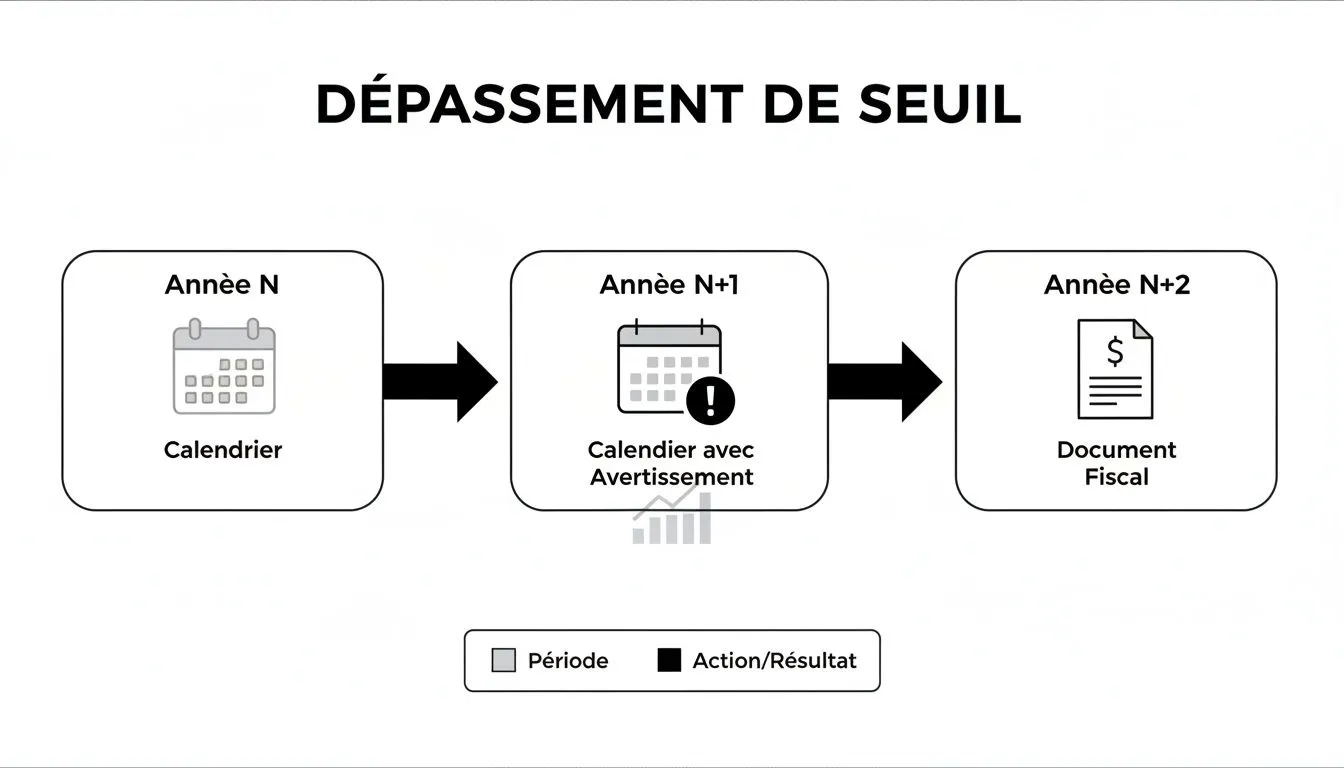
As you can see, the consequences are rarely immediate. This gives you a little room to anticipate and prepare.
Specifically, which figures should you watch?
To avoid any unpleasant surprises, you need to keep three figures in mind, specific to your activity. There’s the base VAT exemption threshold, a second so-called “increased” threshold that triggers an immediate obligation, and finally the overall micro-BIC cap.
If you exceed the base VAT exemption threshold in year N, you become liable for VAT starting January 1 of the following year (N+1). But be careful: if you blow past the increased threshold, you must apply VAT from the first day of the month in which you exceeded it.
This table summarizes the thresholds you shouldn’t confuse, to make things clearer.
Comparison of micro-BIC thresholds and VAT thresholds
| Type of activity | Micro-BIC threshold | VAT exemption threshold | Increased VAT threshold |
|---|---|---|---|
| Sale of goods, catering, accommodation | €188,700 | €91,900 | €101,000 |
| Services (BIC/BNC) & regulated professions | €77,700 | €36,800 | €39,100 |
| Mixed activities (Sales & Services) | €188,700 (total) with the services portion < €77,700 | €91,900 (total) with the services portion < €36,800 | €101,000 (total) with the services portion < €39,100 |
Keep this table handy. It highlights the significant gap between the caps, which is often the source of many mistakes.
Let’s take a practical example. A marketing consultant (service provider) generated €40,000 in revenue in year N-1. For year N, she is therefore under micro-BIC and benefits from the VAT exemption. Her business takes off and she reaches €80,000 in revenue for the year.
What are the consequences for year N+1?
- For her tax regime: She remains under micro-BIC, as her revenue stays well below the €188,700 cap.
- For VAT: Here, everything changes. She has exceeded the exemption threshold (€36,800) and even the increased threshold (€39,100). She should therefore have started charging VAT from the first day of the month in which her revenue crossed the €39,100 mark.
To master this topic inside and out, feel free to check out our full guide explaining in detail how VAT exemption works. Anticipating this shift is absolutely crucial for adjusting your prices and invoicing in time, without losing money along the way.
Managing your thresholds effortlessly with the right tools
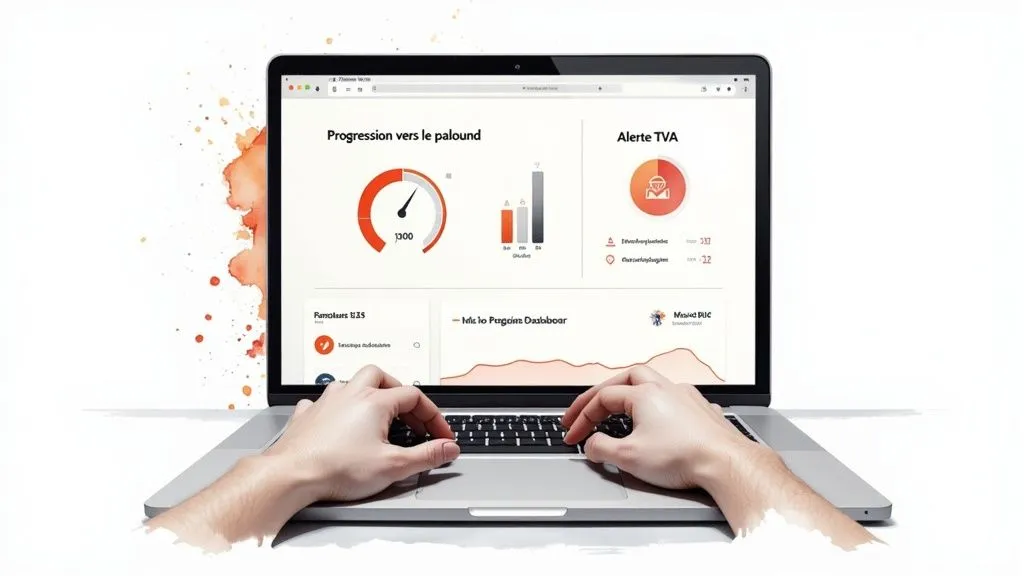
We’ve all tracked our revenue on a spreadsheet to keep an eye on the micro-BIC threshold. But let’s be honest, that’s a recipe for stress and mistakes. A simple typo, a forgotten invoice, and you find yourself exceeding a cap without even knowing it, with all the complications that follow.
Fortunately, there are much more reassuring solutions. Think of a modern management tool as a copilot constantly monitoring your financial dashboard. That’s exactly what a software like Bizyness offers, turning this tedious manual monitoring into a real advantage for managing your business.
A real-time dashboard for full visibility
To manage well, you first need to see clearly. The key is having clear information available at all times. A good tool gives you a visual dashboard where you can track your progress against the various thresholds at a single glance.
- Micro-BIC gauge: You can see exactly where you stand relative to the €77,700 or €188,700 cap.
- VAT indicator: Your progress toward the exemption thresholds (€36,800 or €91,900) and the tolerance thresholds (€39,100 or €101,000) is displayed clearly.
Having this overview lets you make good decisions, not under pressure, but by calmly anticipating the coming months.
Proactive alerts so you’re never caught off guard again
The real strength of a system like this is how proactive it is. No more checking your numbers every five minutes. The tool does it for you and warns you well before the situation becomes critical.
Approaching 80% of the VAT exemption threshold? A notification alerts you. Have you exceeded the micro-BIC threshold for the first time? The tool flags it so you can stay especially vigilant the following year.
This automation frees you from a significant mental burden. You save time and energy to focus on what matters: growing your business. You move from reactive, anxiety-inducing management to calm, controlled steering of your growth.
Frequently asked questions about micro-BIC thresholds
To wrap up, let’s go through the questions that come up most often in practice. This is a chance to clear up any remaining doubts you may have about the micro-BIC caps.
Is it possible to exceed the micro-BIC cap without changing regime?
Yes, there’s a bit of leeway. The tax authorities have built in a tolerance that allows you to exceed the threshold for a first year without anything changing for you. You remain under micro-BIC for the current year.
Be careful, this isn’t a permanent free pass. If your revenue crosses the cap again the following year (i.e. two years in a row), switching to the actual expenses regime becomes inevitable. This change will take effect on January 1 of the year following these two overruns.
How does it work for your first year of activity?
This is an essential point to watch when starting out. For your very first year, the micro-BIC threshold is calculated on a pro-rata basis, i.e. based on your start date. If you start mid-year, your cap will logically be lower.
The calculation is fairly straightforward: the annual threshold (€188,700 or €77,700) is prorated based on the number of days your business has existed during the year. It’s best to keep this figure in mind so you don’t switch to the actual expenses regime without realizing it in the first few months.
Let’s take a practical example: You start your services business on October 1. There are 92 days left before the end of the year. Your personal cap will therefore be (€77,700 / 365 days) x 92 days = €19,576.
How do I actually declare my income under micro-BIC?
This is where the beauty of the regime lies: its simplicity. You simply report the total amount of your gross annual revenue — without deducting any expenses — on your supplementary income tax return (form 2042-C Pro).
- In box 5KO for sales of goods.
- In box 5KP for services.
Above all, don’t calculate the flat-rate allowance yourself. The tax authorities take care of that to determine the amount on which you’ll actually be taxed.
Do I need to declare my activity even if I earn very little?
The answer is a resounding yes. As soon as you receive the first euro from a commercial activity, declaration is mandatory. You must register your business with the INPI’s one-stop shop to get your SIRET number. There is no minimum threshold for this step; it’s a basic rule, whether you’re under micro-BIC or not.
Juggling all these caps can quickly become a real headache. With Bizyness, this monitoring becomes simple, stress-free management. Our dashboard shows you where you stand at a glance, with alerts to calmly anticipate every stage of your growth. Rediscover your peace of mind as an entrepreneur by exploring Bizyness.
