

 Français
The NF Z 42-013 guide for your e-commerce business in 2026
Discover how the NF Z 42-013 standard secures your e-commerce archives. This guide explains evidential value and how to ensure your legal compliance.
The NF Z 42-013 standard can sound like a bit of obscure technical jargon. Yet it’s what ensures your digital documents, such as invoices or contracts, carry the same evidential value as a paper original. In practical terms, it sets the rules for keeping your electronic archives intact, traceable, and durable.
Understanding the NF Z 42-013 standard in under 2 minutes
Imagine, for a moment, that every document in your e-commerce business — invoice, purchase order, contract — is sealed inside a tamper-proof digital vault recognized by law. That’s essentially what the NF Z 42-013 standard is about. It isn’t just a technical constraint; it’s your best guarantee that your digital archives keep their legal value over the long term.
Why is this standard crucial for your e-commerce business?
As an online seller, whether you use Shopify, Amazon, or your own site, you handle a significant volume of transactions. Document management quickly becomes a critical issue. That’s where the NF Z 42-013 standard turns this administrative mountain into reliable, automatic protection. Skipping this compliance exposes you to real risks, such as a tax reassessment or the invalidation of your evidence in a customer dispute.
By choosing a compliant archiving system, you unlock several direct benefits:
- Legal security: Your invoices and business documents become solid, indisputable evidence before tax authorities or courts.
- Guaranteed longevity: Your archives stay not only secure but also readable for the entire legal retention period (often 10 years for accounting records).
- Peace of mind: Compliance is handled continuously, with no action needed on your part. You can finally focus on what really matters: growing your business.
More than a standard, a benchmark of trust
Created in 1999, the NF Z 42-013 standard has kept evolving, with its latest update in 2020 to address new cybersecurity threats. Its robustness is such that it served as the model for the international ISO 14641 standard.
Put simply, an Electronic Archiving System (EAS) certified to NF Z 42-013 acts like a digital notary: it seals each document, logs every action in a tamper-proof journal, and ensures nothing can be altered or deleted without leaving a trace.
This approach guarantees a complete chain of trust, from the document’s creation to its final archiving. For an online seller, the benefit is clear: airtight document management, ready to withstand any audit. By automating this process, a complex legal obligation becomes a simple formality that protects you effectively, effortlessly.
Making your digital documents unquestionable: evidential value explained
The term “evidential value” may sound impressive, but it hides a simple idea that’s essential for any online seller. In practical terms, it means that a digital document, such as an invoice from Stripe or Shopify, carries exactly the same legal weight as a paper original in the event of a tax audit or dispute. It’s the NF Z 42-013 standard that opens the door to this legal recognition.
Simply put, an archiving system compliant with this standard acts as a genuine digital vault for your most important documents. Its effectiveness rests on three fundamental guarantees.
The integrity pillar
Integrity is the assurance that your document is sealed once and for all. From the moment it’s archived, it becomes impossible to modify it, whether intentionally or by accident. Think of the digital fingerprint and timestamp as a tamper-proof wax seal, adapted to the digital world.
A compliant system guarantees that not a single pixel, not a single comma, can be altered without leaving an obvious trace. This guarantee is the foundation of your digital archives’ credibility. To go further on document authenticity, it’s worth understanding the legal value of the electronic signature.
The traceability pillar
Traceability, for its part, means logging every single action performed on a document in a tamper-proof event journal. Who filed the invoice? On what date? Who tried to view it? Everything is recorded.
This journal works a bit like a court clerk’s register. It creates a continuous chain of evidence that traces the document’s life from A to Z. Any challenge to its origin or history becomes virtually impossible.
This rigor is at the heart of the standard’s requirements.
The longevity pillar
Finally, longevity is the promise that your documents will remain accessible and readable throughout their entire legal retention period. For accounting records, that’s often 10 years. The system must therefore anticipate the inevitable obsolescence of technology.
- Long-term readability: The PDF/A format (for Archiving) is often preferred, designed to stay readable decades later without depending on any specific software.
- Secure migration: If a file format becomes obsolete, the system must be able to migrate the document to a new standard without ever altering its content or integrity.
- Redundant backups: To guard against any eventuality (outage, disaster), data is duplicated and stored across multiple servers, often in different geographic locations.
These three principles are not mere suggestions. The 2020 version of the NF Z 42-013 standard notably strengthened its requirements around cybersecurity and data protection to address today’s challenges.
Together, these three pillars turn a simple digital invoice into irrefutable proof, recognized by tax authorities and the courts alike. It’s also an essential mark of seriousness for meeting your obligations around retaining accounting documents.
The technical mechanisms that protect your archives
For a digital document to be truly reliable, it can’t simply be saved to a hard drive. To guarantee its value over time, an Electronic Archiving System (EAS) compliant with the NF Z 42-013 standard puts in place a whole series of technical safeguards.
Think of it a bit like a crime scene. Every invoice, every contract you archive is a piece of evidence. For it to be admissible in court years later, it must be preserved with absolute rigor. That’s where the standard’s mechanisms come into play.
The evidentiary mechanisms of the NF Z 42-013 standard
The NF Z 42-013 standard doesn’t just store files. It builds a genuine digital fortress around each document, resting on several technical pillars. Each has a specific role in guaranteeing the integrity and authenticity of archives over the long term.
This table summarizes the main technical mechanisms required by the standard and their role in protecting documents.
| Technical Mechanism | Main Role | Concrete Example for an Online Seller |
|---|---|---|
| Qualified timestamping | Attests to the exact date and time of archiving. | Proves that an invoice was issued and archived on March 15 at 10:32, and not altered afterward. |
| Digital fingerprint (hash) | Guarantees the document has undergone no alteration since it was archived. | Ensures the amount or customer name on a PDF invoice hasn’t been changed, even by a cent. |
| Electronic sealing | Binds the document, its fingerprint, and its timestamp into a secure container. | Creates a “digital wax seal” on the package containing the invoice and its proof, making it tamper-proof. |
| Event journal | Logs every action carried out on the archive (creation, viewing, etc.). | Provides a complete, tamper-proof history of the invoice’s life within the archiving system. |
Together, these four elements create an unbroken chain of evidence. That’s what turns a simple digital invoice into irrefutable proof, even 10 years after it was created.
A system compliant with the NF Z 42-013 standard doesn’t just store your files — it actively protects them. It builds a digital fortress around each document to preserve its authenticity and integrity over the long term.
These mechanisms have been the standard since the 2009 version of the norm. They require, for example, the creation of daily journals that are themselves timestamped to incorporate the evidence of archived documents. The standard even recommends mirrored storage, keeping a copy of each archive in two geographically distinct locations, to guard against any major incident.
To make the most of these technologies, a solid grasp of document management within a company is essential, particularly around security and automation. If you’d like to go further, our guide on the benefits of an electronic document management solution offers practical pointers.
Automating your compliance, from sale to archiving
Understanding the theory behind the NF Z 42-013 standard is one thing. Putting it into practice day to day without losing a huge amount of time is another, better thing. For an online seller, the goal isn’t to become a legal archiving expert, but to ensure every sale is perfectly compliant, almost invisibly. And for that, there’s no secret: automation is the only real solution.
Imagine, for a moment, that compliance is no longer a manual chore, a source of errors and stress, but simply a cog built into your business. That’s exactly the role of a tool like Bizyness, once connected to your sales ecosystem (Shopify, Stripe, etc.).
A simple customer order then turns into a smooth, transparent process that’s, above all, legally airtight.
The path of a compliant sale, in automatic mode
Concretely, what happens between your customer’s click to buy and the secure archiving of their invoice? What may seem complex is, in reality, a fully automated sequence of steps.
-
The customer buys from your Shopify store. That’s the starting point. The action triggers the entire mechanism in the background.
-
Bizyness creates the corresponding invoice instantly. The system is smart enough to apply the correct VAT rates and include all the mandatory legal notices. No more risk of forgetting or data-entry errors.
-
The invoice is immediately “locked.” Before you’ve even had time to see it, the document receives a timestamp, its digital fingerprint is calculated, and an electronic seal is applied. From that instant on, it’s tamper-proof.
This is exactly what the three pillars of digital proof illustrate:
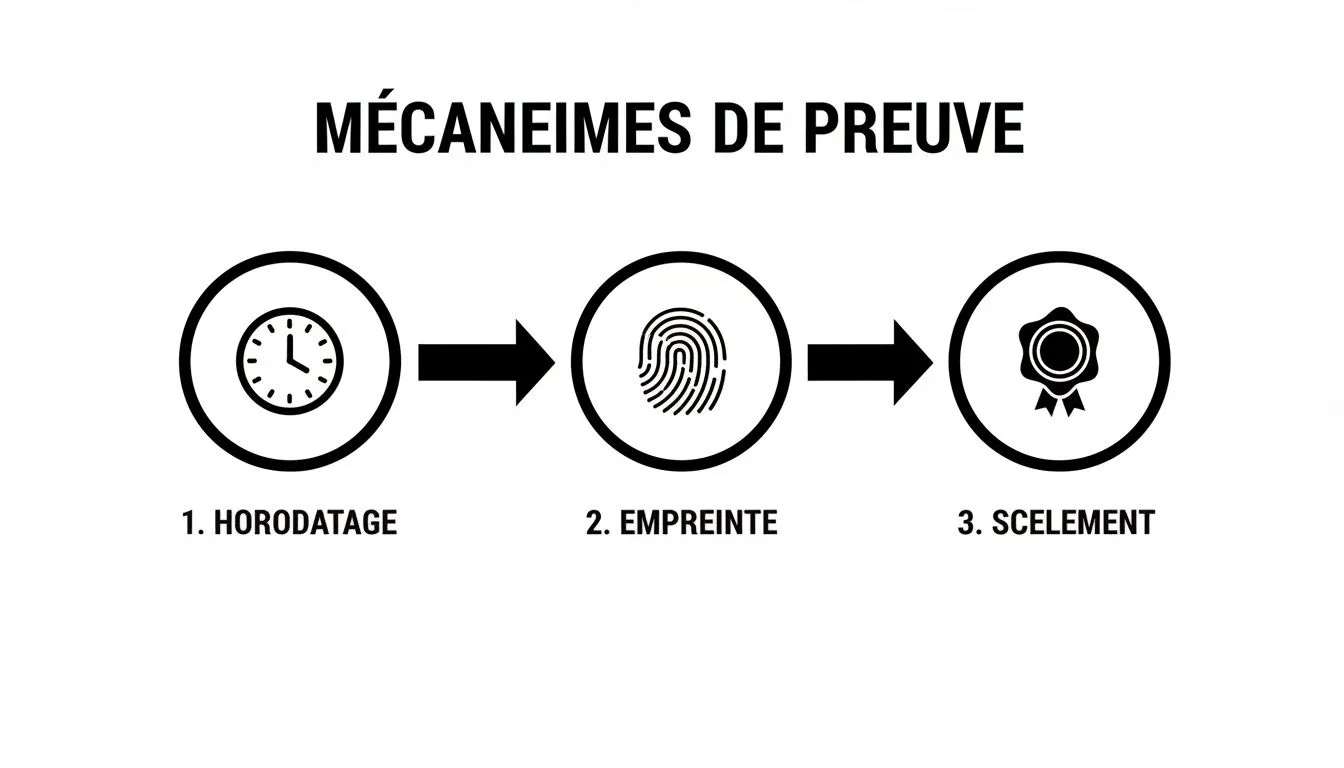
By combining these three operations, you get a chain of evidence as solid as rock. It guarantees that the document is indeed the original and that it hasn’t undergone any modification.
The digital vault: the final destination
Once the invoice is sealed, the work isn’t quite finished. To be truly compliant, this document must be stored somewhere that guarantees its integrity and readability for years to come.
Be careful — a simple folder on Google Drive or Dropbox absolutely doesn’t cut it. The NF Z 42-013 standard is very clear: you need an Electronic Archiving System (EAS) that meets very strict security and traceability rules.
This is where automation shows its full power:
-
Secure transfer: The sealed invoice is sent, encrypted, to a partner digital vault, itself certified NF Z 42-013. You have nothing to do — the system handles it.
-
Complete audit trail: Every action (invoice creation, sealing, deposit into the vault) is recorded in an evidence journal. In the event of an audit, this journal is what will prove your good faith.
-
Long-term retention: The document is carefully kept in its vault for the entire legal period, which is 10 years for invoices. The system ensures it will remain readable and accessible the whole time.
With this approach, you hand off all the technical complexity. No more headaches choosing and configuring an EAS or managing manual procedures. The process directly connects your business activity to your archiving obligations, without you having to think about it. To go further on this topic, feel free to check our guide on choosing a partner dematerialization platform.
The payoff is clear: a heavy regulatory constraint turns into an automatic process that secures your business and builds trust. NF Z 42-013 compliance is no longer a standalone project, but a simple reality, handled behind the scenes.
Here’s your practical checklist for staying compliant with the NF Z 42-013 standard
Getting compliant with the NF Z 42-013 standard can quickly feel overwhelming. To help you see things clearly, I’ve put together this checklist as a simple, straightforward diagnostic tool. Each point is a concrete question, designed for a business owner, to help you assess where you stand and set your priorities.
The goal isn’t to drown you in technical detail, but to give you a concrete roadmap. Take a few minutes to answer honestly.
1. Your archiving policy
This is the foundation, the bedrock of your entire document management. Without a clear policy, it’s like navigating blind through an administrative storm.
-
Retention period: Do you know exactly how long to keep each document? We often talk about 10 years for accounting records, such as invoices, but be careful, the period can vary for contracts or HR documents.
-
Formalization: Have you put your rules in writing? Even a simple document explaining your archiving method is essential. In the event of an audit, it proves your approach is structured and considered.
-
Destruction process: Once the legal period has passed, what do you do with the documents? Have you set up a secure process to destroy them? Keeping archives “forever” is neither useful nor even desirable.
If you answered no to any of these questions, your first mission is clear: formalize your archiving policy.
2. Integrity and traceability of your documents
Here we get to the heart of the matter: evidential value. How do you prove that a digital invoice is indeed the original and that it hasn’t been modified since?
For a digital document to be considered reliable, it must be “frozen” in time, like a photograph. The NF Z 42-013 standard requires mechanisms such as timestamping and fingerprint calculation to digitally seal each file as soon as it’s archived.
-
Sealing at the source: Are your invoices and important documents protected by a digital fingerprint and a qualified timestamp as soon as they’re created or received? A simple “Save As” into a folder on your computer is absolutely not enough.
-
Event journal: Are you able to trace every single action carried out on an archived document? Who filed it, who viewed it, and when? This audit journal is the black box of your archives.
The NF Z 42-013 standard has evolved considerably since its first version, published by AFNOR in 1999. After several revisions, the 2020 edition truly modernized the framework, with no fewer than 275 requirements and 95 recommendations. To better understand its history and nuances, this excellent summary of its evolution is well worth reading.
3. Security and longevity of the archive
A well-sealed document is good. Keeping it in an environment that guarantees its security and readability over the long term is even better.
-
Access control: Who can view your archives? Is access restricted based on each person’s role and secured with strong authentication?
-
Secure storage: Are your archives duplicated and stored across at least two geographically distant sites? This is a strong requirement of the standard, protecting you against a disaster such as a fire or flood.
-
Long-term readability: Do you use durable file formats, such as PDF/A? This format was specifically designed to ensure your documents can still be opened and read in 10 years, or even longer.
4. Retrieval capability
Ultimately, being compliant is pointless if you can’t quickly prove it when needed.
-
Search and extraction: Can you find a specific invoice, along with all its associated evidence (audit journal, proof of sealing), within just a few minutes?
-
Retrieval during an audit: Imagine a tax audit tomorrow. Would you be able to provide a complete archive, with its evidence file, in a format usable by the authorities, say in under an hour?
This checklist gives you a good sense of the work ahead. If you see a lot of red flags, don’t panic. This is exactly where a solution like Bizyness, connected to a certified digital vault, comes in. It’s designed to automate almost all of these requirements for you.
Turning compliance into a strategic advantage
If there’s just one thing to take away from this guide, it’s this: the NF Z 42-013 standard is far more than a line on an administrative checklist. It’s a powerful strategic lever. In an ecosystem where trust is king, being able to prove your rigor carries real weight.
This approach strengthens your credibility with your partners, your investors, and, of course, the tax authorities. Adopting a compliant Electronic Archiving System (EAS) is therefore not an expense, but a genuine investment in the strength and longevity of your business.
Simplifying complexity to unlock your potential
We often picture regulation as a complex maze. In reality, it can become a source of everyday simplicity. The key? Automation. By connecting a legal archiving flow directly to your sales tools, you put an end to manual tasks, eliminate the risk of error, and gain precious time.
The goal isn’t to turn you into an expert on the NF Z 42-013 standard, but to let you ignore its complexity while still benefiting from its maximum protection. Automation turns this obligation into an invisible, reliable process.
You can devote the time and energy you get back to where they truly create value: improving your products, refining your marketing, and taking care of your customers. In short, you focus on growing your e-commerce business, with total peace of mind.
Toward a European harmonization of archiving
The regulatory framework, moreover, keeps moving in this direction. The recent European eIDAS 2 regulation, published in May 2024, has just officially recognized electronic archiving as a trust service across the European Union. This is a major step forward that will standardize practices and ensure that a document qualifiedly archived in France will be recognized everywhere else in Europe.
For all online sellers trading internationally, this is excellent news. It promises to simplify procedures and reinforce the evidential value of your archives, no matter which country your customer or auditing authority is in. By already being compliant with the NF Z 42-013 standard, you’re getting ahead for this new era of European digital trust.
Your questions about the NF Z 42-013 standard and e-commerce (and our straightforward answers)
The NF Z 42-013 standard often seems technical and intimidating. As an online seller, you’re probably wondering what it actually means for your business.
Let’s untangle the most common questions together. Here are clear answers to help you see things clearly and secure your business.
Is the NF Z 42-013 standard mandatory?
No, let’s be direct: no law requires you to obtain NF Z 42-013 certification.
So why does everyone talk about it? Because it’s the only standard that offers a presumption of reliability recognized by French courts for an Electronic Archiving System (EAS). In practical terms, if you undergo a tax audit or a dispute arises, documents from a certified EAS reverse the burden of proof. It’s no longer up to you to prove your archive is reliable, but up to the tax authorities or the opposing party to prove otherwise. And believe me, that’s an almost impossible mission for them.
In short, even though it isn’t mandatory, NF Z 42-013 compliance is your best digital life insurance. It’s what gives your archives indisputable legal value and protects your business over the long term.
Are the invoices from my Shopify or Stripe account enough?
Invoices generated by platforms like Shopify, WooCommerce, or payment services like Stripe are an excellent starting point. They’re clean, well-structured, and generally include all the mandatory legal notices.
The problem is that creating the invoice is only the beginning of the story. These platforms aren’t designed for archiving with evidential value. An invoice that sits quietly in your Shopify back office or in a Google Drive folder has no guarantee of integrity, longevity, or traceability in the eyes of the law.
- What’s missing: To be valid, these invoices must be immediately “sealed” (via a timestamp and digital fingerprint) and then deposited into a certified digital vault.
- The risk: Without this process, nothing proves the invoice hasn’t been altered, even unintentionally, after it was created.
This is exactly where a solution like Bizyness comes in: it creates an automatic, invisible bridge between generating your invoice and archiving it securely.
How long do I need to archive my invoices?
It’s the law that sets the rules here, not the NF Z 42-013 standard. For anything related to accounting — including customer and supplier invoices — the legal retention period is 10 years after the close of the accounting period.
Managing this obligation manually for a decade can quickly become a nightmare. This is one of the major benefits of a compliant EAS: it manages the entire lifecycle of your documents for you.
The system is designed to:
- Keep the document secure throughout the legal retention period.
- Ensure it remains readable, even as technologies and file formats evolve.
- Manage its destruction, also carried out securely, once the retention period has passed.
What is NF 461 certification?
You’ll almost certainly hear about NF 461 certification. Don’t let the number intimidate you.
It’s simply the name of the certification, issued by AFNOR Certification, that validates that an Electronic Archiving System (EAS) fully meets the requirements of the NF Z 42-013 standard.
When a service provider tells you their solution is “NF 461 certified,” it means they’ve successfully passed a very thorough audit, conducted by an independent third-party body. It’s the highest level of assurance you can find for storing your important documents. Think of it as a trust and security label for your document management.
Achieving compliance with the NF Z 42-013 standard may seem complex, but it becomes simple and fully automatic with the right tools. Bizyness connects directly to your sales platforms to generate compliant invoices and send them to a certified digital vault — all without you having to lift a finger.
