

 Français
Paid invoice template - download and use it
Download the paid invoice template and create reliable proof of payment (Word/Excel) to secure your transactions and simplify your bookkeeping.
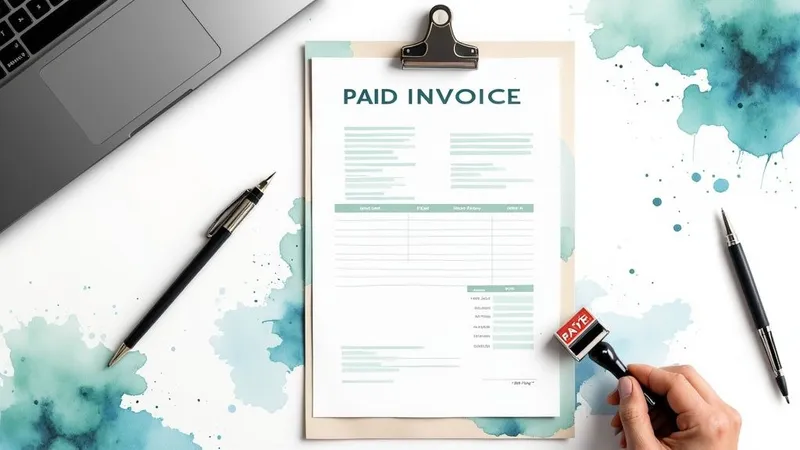
Need a reliable, ready-to-use paid invoice template? No worries, we’ve got you covered. With one click, you can download our free templates for Word and Excel. They’re designed to help you certify your payments and give a sharp, professional image of your management.
A paid invoice is much more than a simple receipt. It’s formal, undeniable proof that a debt between you and your client has been settled.
Why a paid invoice template is essential
We tend to underestimate the importance of the paid invoice, and yet it’s a genuine strategic asset. It doesn’t just confirm a transaction; it strengthens trust with your client and protects your cash flow from potential misunderstandings or disputes. Think of it as the final handshake that seals a good deal, cleanly and without ambiguity.
This document even becomes crucial in certain very concrete situations. Take a cash payment, for example: without a bank statement to prove it, the paid invoice becomes the sole proof that your client actually settled what they owed you.
The legal and accounting role
In France, the paid invoice is a key document for securing your commercial exchanges. Even though the law doesn’t require issuing it systematically, it is very commonly used as legal proof of full payment.
This document relies on Article 1353 of the French Civil Code, which is very clear: whoever claims to have settled a debt must be able to prove it. With rampant dematerialization (over 70% of B2B invoices are now electronic), traceability has greatly improved, making the use of paid invoices even more relevant.
Put simply, the paid invoice is your best ally for sound bookkeeping. It offers clear proof to your client, simplifies tracking for your accountant, and covers you in case of disagreement.
The concrete benefits for your business
Making a habit of using a paid invoice template brings several immediate benefits:
- Dispute prevention: It puts an end to any discussion about a payment that supposedly wasn’t received. No more misunderstandings.
- Increased professionalism: Providing this document shows that your management is rigorous and transparent. It builds trust.
- Simplified bookkeeping: It’s the simplest way to mark a transaction as “closed” in your books.
Rather than starting from scratch every time, a good template guarantees you won’t forget any mandatory legal mention. If you’re looking for a solid base, our article on the blank invoice template is an excellent starting point before adding the payment mention.
What are the essential elements of a properly formed paid invoice?
A paid invoice isn’t just a regular invoice with “Paid” scribbled on it. To hold up legally and serve as undeniable proof, it must include very specific elements. Think of it as transforming an accounting document into a genuine proof of payment.
Of course, it must first contain all the legal information of a standard invoice: your details, the client’s details, your SIRET number, the breakdown of services, etc. But it’s three specific additions that make all the difference and give it its evidentiary value.
The 3 key pieces of information that change everything
For an invoice to be officially considered “paid” — meaning the debt is extinguished — you must add these three pieces of information very clearly. Without them, the document could be contested.
- The payment mention: You must write, in black and white, “Invoice paid on” or simply “Paid on”. This wording carries stronger, more formal legal weight than a simple “Paid”.
- The exact payment date: Note the exact day you received the funds. It’s this date that officially closes the transaction and settles your client’s debt.
- The payment method: Specify how the invoice was settled. Bank transfer, cheque, card, cash… this information is essential for tracing the transaction.
Concretely, a perfectly worded mention would be, for example: “Invoice paid on 25/10/2024 by bank transfer”. It’s simple, direct, and leaves no room for interpretation.
Don’t forget the basics: a compliant invoice above all
It’s crucial to understand that the payment mention is added on top of an invoice that must, from the outset, be perfectly compliant.
Adding the “Paid” mention does nothing to correct any oversights or errors on the original invoice. Before marking it as paid, check that it already contains all the legally required information, since it keeps its number and its accounting value.
Make sure elements such as the invoice number, issue date, VAT details, and the full identity of both parties are present. For a full reminder of these obligations, check out our guide on mandatory mentions on an invoice.
How to handle slightly more complex situations?
In practice, things aren’t always so simple. What should you do in the case of a partial payment, for example? It’s a golden rule: the “paid” mention must never be applied until the full amount has been settled. If a client pays you a deposit, it’s much wiser to issue a deposit invoice or a specific receipt.
For cheque payments, a good practice is to add the cheque number next to the payment method to reinforce traceability. If you’re paid in cash, the paid invoice becomes your sole formal proof. Rigor is key!
This is where a pre-filled template proves its worth. It saves you from oversights and ensures that every document you issue is not only professional but, above all, legally solid.
How to turn an invoice into proof of payment
Turning a standard invoice into undeniable proof of payment is a bit like the finishing touch on a successful transaction. It’s the act that officially closes the exchange and secures both your business and your client. Depending on whether you’re working solo or handling dozens of invoices a day, two paths are open to you: the good old manual method or automation via dedicated software.
Each has its advantages, let’s be clear. What matters is choosing the solution that best fits your day-to-day organization, without ever sacrificing the compliance of your documents. Let’s look at how to go about it in both cases.
The manual method: a classic in Word or Excel
For freelancers and small businesses juggling a reasonable volume of invoices, the manual method often remains the most straightforward. No need to invest in a complex tool; your usual word processor or spreadsheet, like Word or Excel, will do the job perfectly.
The process is fairly simple. Once your client’s payment is confirmed, pull up the original invoice. The goal is to add the famous mention that certifies the payment.
- Add the magic mention: It must be clearly visible. We recommend placing it right under the total amount due, or even in the header. The most effective and legally recognized wording is “Invoice paid on DD/MM/YYYY by [payment method]”. Concretely, that gives: “Invoice paid on 15/11/2024 by bank transfer”.
- Never touch the invoice number: That’s the golden rule. A paid invoice remains a modification of the original invoice, not a new document. Its unique number must absolutely be kept so as not to break the chronology of your bookkeeping.
- Always think PDF: Once the mention is added, never send the file in an editable format (such as .docx or .xlsx). Always export it as a PDF. This locked format guarantees the integrity of the document and gives it its official stamp.
This approach, while simple, requires rigor. Every paid invoice must be processed one by one, and if your business takes off, this can quickly become repetitive and time-consuming.
Saving time with invoicing software
As a business grows, manually managing paid invoices becomes not only a waste of time but also a breeding ground for potential errors. This is exactly where invoicing tools like Bizyness change the game.
No more tinkering with each document. The process is centralized and, above all, automated. As soon as you receive a payment, you simply log into your dashboard and switch the corresponding invoice to “Paid” status.
The infographic below sums up nicely the elements that make your document valid at a glance.
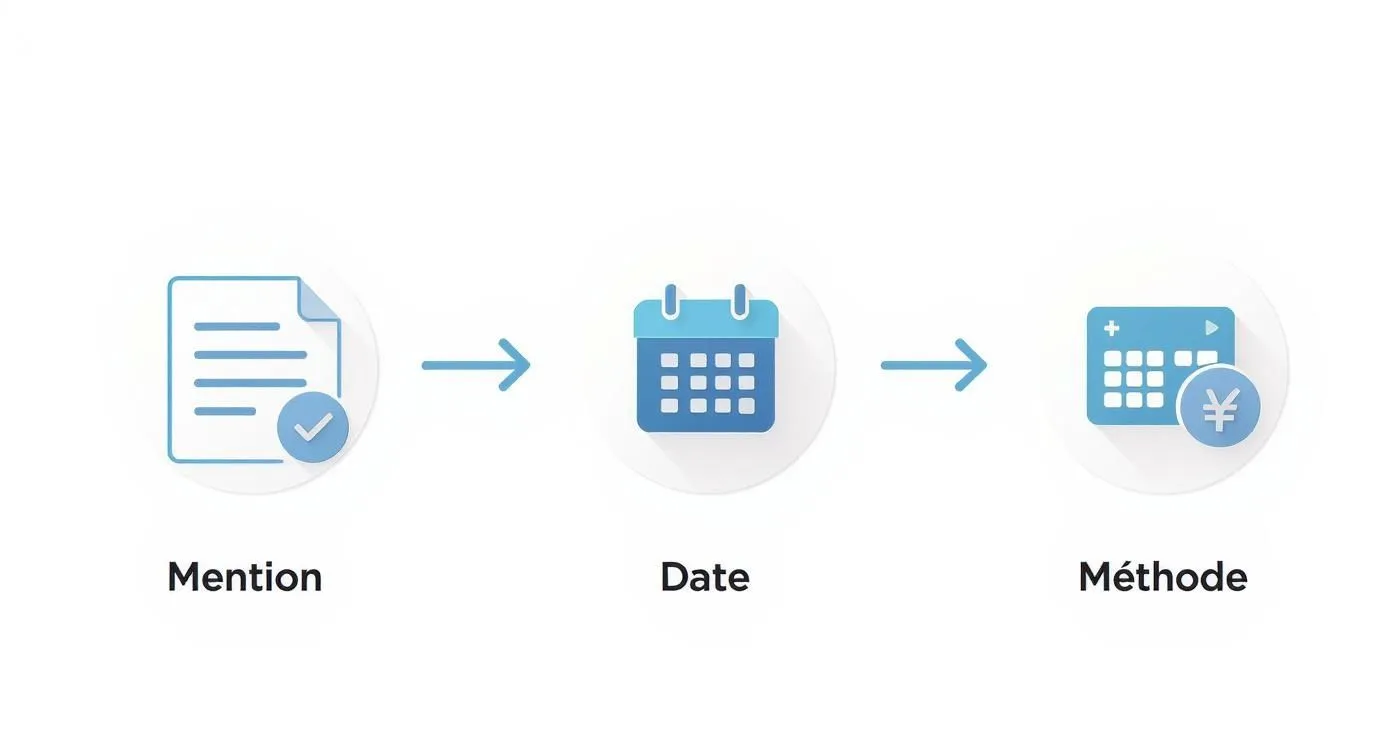
This diagram highlights the three pillars of a properly formed paid invoice: the mention, the date, and the payment method. Information that good software handles for you.
With a single click, the software adds the payment mention with the correct date and payment method, updates the invoice status in your tracking, and generates the PDF to send to the client. All of that in a few seconds.
Automation drastically reduces the risk of human error (a missed mention, a typo in the date…). And as a bonus, you get a clear, real-time view of your cash flow. It’s a huge time saver that lets you focus on what you do best: your craft.
By the way, speaking of good management, don’t forget that you need to keep these documents. To know exactly how long, feel free to check out our article on document retention periods.
The paid invoice in real life: a few practical cases
To really understand what a paid invoice template is for, the best way is to dive into concrete situations. Seeing this document in action helps grasp how it adapts to different contexts and why it’s so important for securing your transactions.
Theory is fine, but practice always speaks louder. Let’s look together at a few everyday examples to illustrate the usefulness and versatility of this document.
The case of the service provider
Take the example of a digital marketing consultant who has just wrapped up a three-month assignment. Her final invoice is detailed: SEO audit, ad campaign management, performance report… everything’s there.
Her client pays the full amount by bank transfer. As soon as the funds show up in her business account, she opens the original invoice file. She adds, clearly and legibly, the mention “Invoice paid on 10/12/2024 by bank transfer”, usually right below the total. A quick PDF export, an email, and that’s it: the assignment is officially closed, and everyone’s at ease.
Online product sales
Now imagine an online shop specializing in handmade goods. A client places a large order. The system automatically generates the invoice with the product details, quantities, prices, VAT, etc.
Payment is made by card. As soon as the transaction is confirmed by the payment platform, the invoicing software switches the order status to “Paid”. The invoice is then instantly updated with the mention “Paid on 12/12/2024 by card” and is attached to the email confirming the parcel’s shipment.
For an online seller, this is an essential automation. The client receives a clear proof of purchase and confirmation that their order is paid and on its way. It’s a mark of professionalism that reinforces trust.
Managing a payment in installments
Here’s a slightly more complex situation: a web developer builds a website for a client for €3,000. They agree on a three-installment payment plan: 30% deposit, 30% upon delivery of the mockup, and the remaining 40% at launch.
How does this play out in practice?
- First payment: He issues a deposit invoice for €900. Once the money is received, he can send a receipt, but the overall invoice is not yet settled.
- Second payment: Same for the second installment of €900.
- Final payment: Only after receiving the final transfer of €1,200 can the developer take his final invoice of €3,000 and add the mention “Invoice paid on 15/12/2024”. This is what certifies that the entire project has been paid for.
This rigor is essential to avoid misunderstandings and make sure the accounts are correct, with a zero balance.
Protecting your cash flow and client relationships
More than just a piece of paper, the paid invoice is a genuine management tool for your business. Used well, it turns a sometimes tedious administrative task into a real strategy for protecting what matters most: your cash flow and your clients’ trust.
Picture a situation every entrepreneur has already experienced. A client calls you, convinced they’ve already paid the invoice you’re chasing. Without tangible proof, the discussion can quickly turn sour, create tension, and damage a business relationship that was working well.
This is exactly where the paid invoice becomes your best ally. By sending it systematically as soon as you receive the funds, you cut this kind of misunderstanding off at the source. You provide irrefutable proof that closes the debate before it even starts, while also projecting an image of rigor and professionalism.
Preventing disputes and strengthening trust
Providing a paid invoice template for every payment isn’t just a good bookkeeping habit. It’s a clear message you’re sending your clients: you track your payments seriously, and you expect the same in return. This transparency is the foundation of a solid trust relationship, essential for any long-term collaboration.
In case of a dispute, this document is your shield. It’s no longer your word against theirs, but a fact, in black and white, dated and indisputable. A simple, professional way to defuse a conflict by relying on concrete elements rather than vague memories.
A client who receives a clear proof of payment feels respected and secure. It’s one of those small details that, added up, make a huge difference to how your service is perceived and that encourage loyalty.
A safeguard against late payments
A poorly managed invoicing cycle can quickly jeopardize the financial health of your business. To stay in control of your cash flow, it’s crucial to master your proof of payment, especially when you need to consider collection strategies.
This isn’t trivial. A report from the Banque de France revealed that 33% of the businesses audited had irregularities in payment terms, often due to loose administrative organization. Issuing a paid invoice promptly doesn’t just confirm receipt of a payment; it anchors the transaction in a sound, well-managed process.
These figures prove it: good document management isn’t optional. It’s an essential lever for securing your revenue and your business relationships.
Frequently asked questions about the paid invoice
Even with the best paid invoice template in hand, a few practical questions can quickly come up. To help you see things more clearly, we’ve compiled the questions that come up most often among entrepreneurs, with direct answers, no jargon.
Am I required to send a paid invoice?
The short answer is no, it’s not a systematic legal obligation in France. But in practice, it’s a business practice we can only recommend. Think of it as a sign of good management and a safeguard for everyone.
Your client is fully entitled to ask you for one to prove they’ve paid you. For you, it’s protection in case of a dispute. This document confirms, in black and white, that the debt is settled. It’s especially useful for payments that are harder to trace, like cash or cheques.
How do I handle a payment in installments?
Here’s a crucial point. The “paid” mention should only appear on the final invoice, and only once the full amount owed is in your bank account. Not before. For intermediate payments, the right move is to issue receipts or specific deposit invoices for each installment.
Marking an invoice as paid too early is an accounting mistake that can create real confusion. Be patient, wait for the final balance to be paid before officially closing the transaction.
Did you know? A paid invoice sent by email is entirely valid. A PDF sent by email has the same legal value as a paper document, as long as it includes all the mandatory mentions.
Sending by email has, in fact, become the norm. It’s faster, more eco-friendly, and easier to trace. One piece of advice: keep a copy of the email and the document safely archived. You can never be too careful.
How long should I keep my paid invoices?
For all your accounting records, paid invoices included, the rule is simple: 10 years. This legal retention period starts at the close of the relevant financial year. And be careful, this obligation applies just as much to you, the issuer, as to your client who receives it.
Rigorous archiving, whether on a hard drive, in the cloud, or in a good old binder, is therefore essential. It’s your best guarantee of compliance in case of a tax audit.
Stop wasting time on paperwork. With Bizyness, your invoices automatically switch to “paid” status as soon as the payment is reconciled. You gain peace of mind and can focus on your core business. Discover how Bizyness can simplify your management today.
