
Pro forma invoice: the guide for entrepreneurs
Discover what a pro forma invoice is, its legal value, and how to create one. A complete guide with examples to clarify your business transactions.
A pro forma invoice is a bit like the “official draft” of your future sale. It looks like a standard invoice, with all the details, but has no legal or accounting value. Its purpose? To let your client visualize exactly what they’re buying, at what price and under what conditions, well before committing.
Understanding the pro forma invoice beyond the definition
Imagine you’re having a house built. The architect doesn’t start digging the foundations on a whim. First, they show you a detailed 3D plan. That plan isn’t the house itself, but it shows you exactly what it will look like, from the surface area of each room to the materials chosen. The pro forma invoice plays exactly that role in a business transaction.
This document is neither a request for payment nor a legally binding contract. It’s a simulation, a kind of “sales plan” that clarifies things. The idea is to make sure you and your client are perfectly on the same page before the sale is officially sealed.
A plan to align expectations
The real power of this document is its ability to clarify an offer. It goes further than a simple quote because it adopts a structure almost identical to a final invoice. For the client, it’s much easier to picture the deal and understand the financial details of the transaction.
Think of it as the dress rehearsal before opening night. Every element — product, service, price, condition — is in its place. This makes it possible to spot and correct misunderstandings before they become real problems. This upfront transparency builds trust and gives your business a very professional image.
A pro forma invoice serves to give a definitive form to a commercial offer. It formalizes the terms of a future sale without creating any accounting or legal obligation.
A flexible tool with multiple uses
The strength of the pro forma invoice also lies in its versatility. It’s not just a negotiation tool. It becomes essential in quite a few situations, for example to:
- Obtain financing: A bank will often ask you for a pro forma invoice to assess the soundness of your project before granting a loan.
- Clear goods through customs: For imports/exports, and especially for samples with no commercial value, it’s used to declare the value of goods to customs.
- Request administrative authorization: Certain procedures, such as obtaining an import license or a grant, require formal proof of the upcoming transaction.
In short, the pro forma invoice is a strategic document that secures, clarifies and simplifies business exchanges. By mastering it, you add another tool to your belt to make your sales smoother and build solid relationships with your clients, even before sending the first official invoice. It’s the foundation of a successful transaction.
Distinguishing the pro forma invoice from the quote and the invoice
In business jargon, it’s easy to mix everything up: pro forma invoice, quote, invoice… They’re sometimes used as if interchangeable, which can create misunderstandings that cost time and clarity. Yet each of these documents has a very specific role and comes into play at a key moment in the sales cycle. Mastering their differences is the foundation of a professional, hassle-free client relationship.
To picture things clearly, imagine you’re assembling a piece of furniture. The quote would be the basic plan, with dimensions and the type of wood. The pro forma invoice would be the exploded 3D view, with every screw and every step detailed, but without being the furniture itself. The final invoice? That’s the assembled, delivered furniture, with the price tag waiting to be paid.
This infographic clearly illustrates how the pro forma invoice positions itself as a simulation tool, a kind of dress rehearsal before the big premiere.
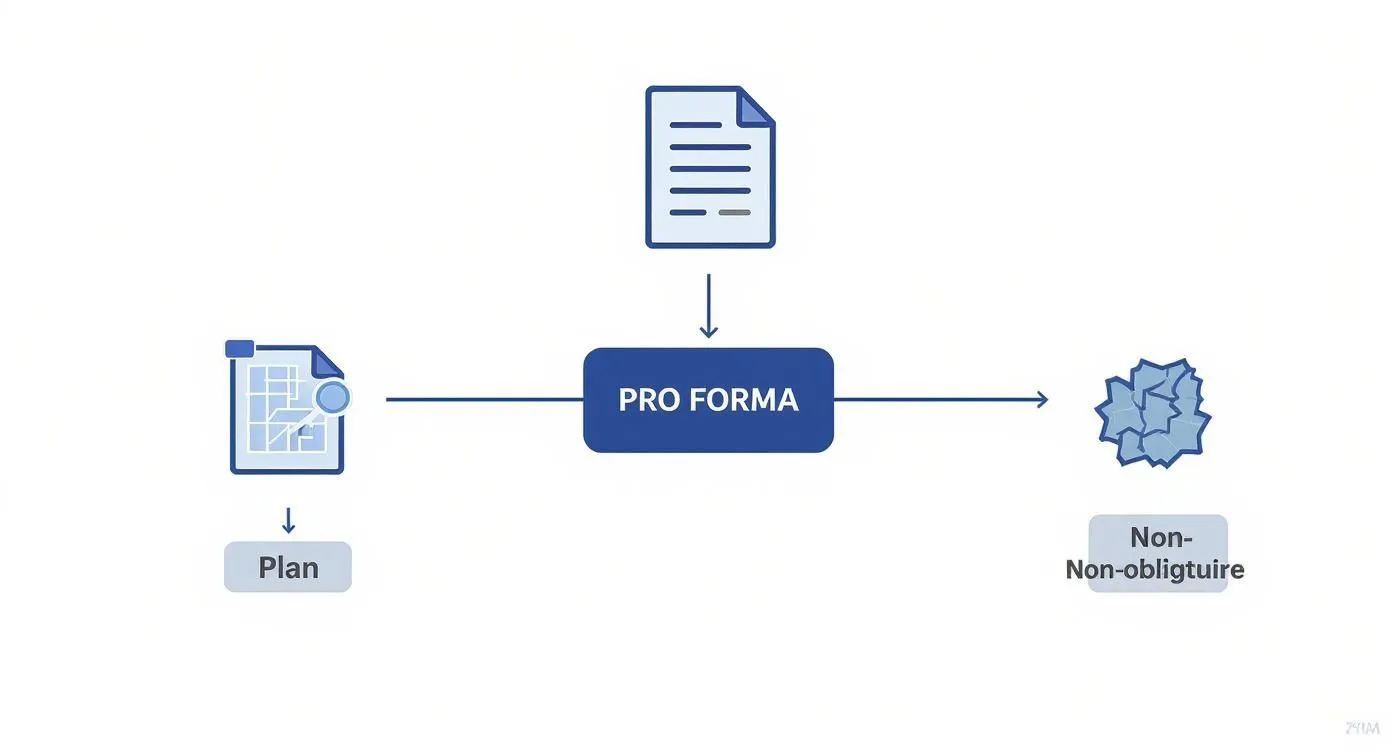
We can clearly see that the pro forma invoice is there to provide an overview, an action plan, which highlights its preparatory, non-binding nature.
The quote: a commercial commitment
The quote is the starting point of any serious negotiation. It’s a formal commercial proposal that lists your services or products, their price and the terms of sale. Be careful: once your client signs it with the famous “Approved for agreement” note, this simple piece of paper turns into a legally binding contract for both of you. On your side, you commit to delivering, and the client commits to paying.
Its primary purpose is therefore to set a clear contractual framework before work even begins. The quote secures the agreement by locking in the terms of the exchange. To go further on this topic, feel free to check out our detailed guide on invoices and quotes.
The final invoice: the call for payment
The final invoice, or commercial invoice, is the document that closes the transaction. You issue it once the product has been delivered or the service completed. And this is where the real difference lies: unlike its cousins the quote and the pro forma invoice, it carries accounting and tax value.
It formalizes a debt owed by your client to you and triggers the payment obligation. It’s an essential document for your accounting, serving as proof to record your revenue and declare VAT. Needless to say, it must comply with very strict mandatory particulars to be valid.
The real difference lies in intent: the pro forma invoice informs and prepares, while the final invoice demands payment and officially enters the company’s books.
The pro forma invoice: a simulation with no obligation
The pro forma invoice sits somewhere between the two. It looks like an invoice, but that’s where the resemblance ends. It has no legal, tax or accounting value whatsoever. Its name says it all: it’s an invoice “for the form,” a very detailed preview of what the final invoice will look like.
It binds neither the seller nor the buyer. Its usefulness is purely informational and administrative. It’s used to obtain a loan, declare the value of goods to customs, or simply to validate the details of a complex order before moving on to the official quote.
To make all this clearer, nothing beats a table.
Comparison: Pro Forma Invoice vs Quote vs Final Invoice
This table highlights the fundamental distinctions between the three business documents to avoid any confusion.
| Criterion | Pro Forma Invoice | Quote | Final Invoice |
|---|---|---|---|
| Legal value | None. It’s an informational document. | Binding once signed (“Approved for agreement”). | Binding. It proves a debt. |
| Accounting value | None. Not recorded in accounting. | None until accepted. | Yes. Essential accounting record. |
| Main purpose | Simulate, inform, prepare (customs, loan). | Propose, negotiate and formalize an offer. | Request payment and justify the transaction. |
| Triggers payment | No. | No, unless a deposit is agreed and accepted. | Yes. |
| Numbering | Often has its own, but not mandatory. | Mandatory and sequential. | Mandatory and follows a chronological sequence. |
In short, each document has its moment and its function. Using the right tool at the right time is the key to sound, professional business management.
When should you use a pro forma invoice?
Don’t think of the pro forma invoice as just another administrative paper piling up on your desk. It’s actually a genuine business Swiss Army knife, particularly useful in situations where a quote is no longer enough, but a final invoice would be premature. It’s the document that unlocks complex situations, especially when working internationally.
Its purpose is simple: to give a precise, detailed view of an upcoming transaction. That’s what makes it essential in several very concrete scenarios. Knowing when and why to use it is the key to smoothing your sales and securing your business exchanges.
Facilitating international trade and customs clearance
This is probably the most common case where the pro forma invoice comes into play. When you send goods abroad, customs officers need to know the value of what you’re shipping, even if it’s not strictly a sale.
Take a concrete example: you send free samples to a prospect in Asia. These products have a market value, even though your client isn’t paying for them. The pro forma invoice is precisely used to declare this value to customs. Thanks to it, your parcel will cross the border without a hitch. Without this document, expect delays, holds, or even a return to sender.
Conversely, for an import, it allows your buyer to anticipate the customs duties and taxes they’ll have to pay. It’s an essential document for preparing customs clearance and avoiding unpleasant financial surprises on arrival.
The pro forma invoice acts as an official declaration of value for customs authorities. It proves that the contents of the parcel match what’s declared, even in the absence of a direct financial transaction.
The use of the pro forma invoice is very widespread in the e-commerce sector, where international transactions and customs formalities are commonplace. For online stores selling across borders, it’s an everyday tool that guarantees smooth deliveries.
Obtaining financing or an administrative authorization
Here’s another very strategic use of the pro forma invoice: it can serve as proof for a third party, such as a bank or a public administration.
Imagine your client needs to take out a loan to buy your equipment. The bank won’t release the funds based on a simple discussion. It will require a formal document that precisely quantifies the investment. The pro forma invoice is perfect for this: it lays out all the details of the future transaction, without committing the client to pay immediately.
This document becomes tangible proof of the project, allowing the lending institution to assess the file and, hopefully, approve the credit. Similarly, to obtain an import license or a grant, authorities very often ask for a pro forma invoice to validate the nature and amount of the transaction.
Validating an order before launching production
In certain industries, especially when manufacturing custom products or handling high-value orders, it’s essential to make sure all details are validated before launching production. The pro forma invoice plays the role of final validation document here.
It summarizes all the key points of the order:
- The technical specifications of the products
- The exact quantities and references
- The unit prices and total amount
- The delivery terms and expected timelines
By sending this document to the client for signature, you add one last verification step. This helps “lock in” the terms of the agreement and avoid misunderstandings or last-minute changes that can be very costly in time and money. Once the pro forma invoice is validated, you can launch production with peace of mind, knowing everyone is on the same page.
In short, the pro forma invoice is much more than a mere formality. It’s a tool that builds trust, clarifies agreements and facilitates administrative procedures at many key stages of the sales cycle.
How to write a pro forma invoice the right way
Writing a pro forma invoice may seem like just a formality, but it’s a document that requires real rigor. Even though it has no accounting value, it reflects your professionalism. A clear, precise pro forma invoice builds your client’s trust and smooths all the steps that follow, whether for obtaining financing or clearing customs.
Think of it as the blueprints of a house before construction: every detail is crucial to giving an accurate picture of what the final invoice will look like. Follow this step-by-step guide to create a flawless document that secures your business exchanges.
The essential particulars for total clarity
The golden rule is to avoid any confusion with a final invoice. To achieve that, a few particulars are simply non-negotiable. They form the backbone of your document and ensure that everyone — you, your client, the bank — understands its nature and content.
Here’s the information that must absolutely appear:
- The explicit label: This is the most important point. Clearly state in the header: “Pro Forma Invoice”. There can be no mistake; the ambiguity is removed from the outset.
- Identification of the parties: Note your full details (name, address, business registration number) and those of your client. The precision should match that of a standard invoice.
- The date and number: The issue date is essential. Also remember to assign a unique number to your pro forma invoice to make tracking and discussions with your client easier.
With these basics, you already set a clear, professional framework.
Detailing the offer with precision: the heart of the matter
The real value of the pro forma invoice lies in the detailed description of your products or services. This is where you provide critical information, especially when working internationally. Every line should be as specific as possible.
For each item or service, don’t leave out any of these points:
- Clear description: Don’t just stick to the product name. Add references, dimensions, color, or any other relevant information.
- Exact quantity: State the number of units for each line.
- Unit price excluding tax: This is the cost per unit before VAT is applied.
- Applicable VAT rate: Even though VAT isn’t yet due, you must state the rate that will appear on the final invoice. This helps the client anticipate the real total cost.
- Total amount excluding and including tax: Calculate the subtotal excluding tax, the VAT amount, and the total including all taxes, of course for reference only.
A well-crafted pro forma invoice is a mark of transparency. It lets the client check that everything matches their order and avoid misunderstandings before the actual invoice is even issued.
Wrapping up with the commercial terms
Finally, a truly complete pro forma invoice should include the terms that will govern the final transaction. This information lets your client picture and understand the whole sales process.
Remember to add these elements:
- Payment terms: Specify the terms that will apply later (for example: payment within 30 days, 30% deposit, etc.).
- The transaction currency: Clearly indicate the currency used (EUR, USD…), a crucial detail for sales abroad.
- The offer’s validity period: Set a deadline. After this date, the terms, and in particular the prices, are no longer guaranteed. It’s a safeguard for you.
- Delivery terms: Mention the timeframes, mode of transport and Incoterm if relevant to your industry.
These particulars aren’t all strictly mandatory, but they demonstrate great professionalism and secure the business relationship. To make sure all your documents are compliant, take a look at our guide on the mandatory particulars of a standard invoice.
And to make your life easier, software like Bizyness can automate the creation of these documents while ensuring they’re always compliant. A real time-saver and peace of mind.
Simplify your pro forma invoices with software
Creating each pro forma invoice by hand is a bit like insisting on crossing the country by stagecoach in the age of the high-speed train. It can quickly become repetitive, and above all, it’s an open door to errors. A simple typo on a quantity, a miscalculated VAT amount, or a rough currency conversion, and your professional image takes a hit. Fortunately, there’s no need to tear your hair out over spreadsheets anymore.
Modern invoicing software, like Bizyness, is here to turn this chore into a smooth, fast, hassle-free process. Instead of juggling different templates and making risky copy-pastes, these tools centralize everything. The result? You save precious time to focus on what really matters: growing your business.
Save time through automation
The most obvious benefit of dedicated software is clear: automation. No more starting from a blank page for every new request. Smart features are designed to speed things up and drastically reduce the risk of human error.
In concrete terms, it changes everything:
- One-click conversion: Quote accepted? Turn it into a pro forma invoice, then into a final invoice in a single click. All the information carries over, with nothing to retype. Perfect consistency.
- VAT management: The software calculates the correct VAT rates for you, whether your client is in France or abroad. No more diving into the intricacies of international taxation.
- Built-in catalog: Save your products and services once and for all. Then simply pick them from your catalog to add them to the document, with the right description and price.
This image clearly shows how a clear, intuitive interface makes it possible to generate professional documents in seconds.
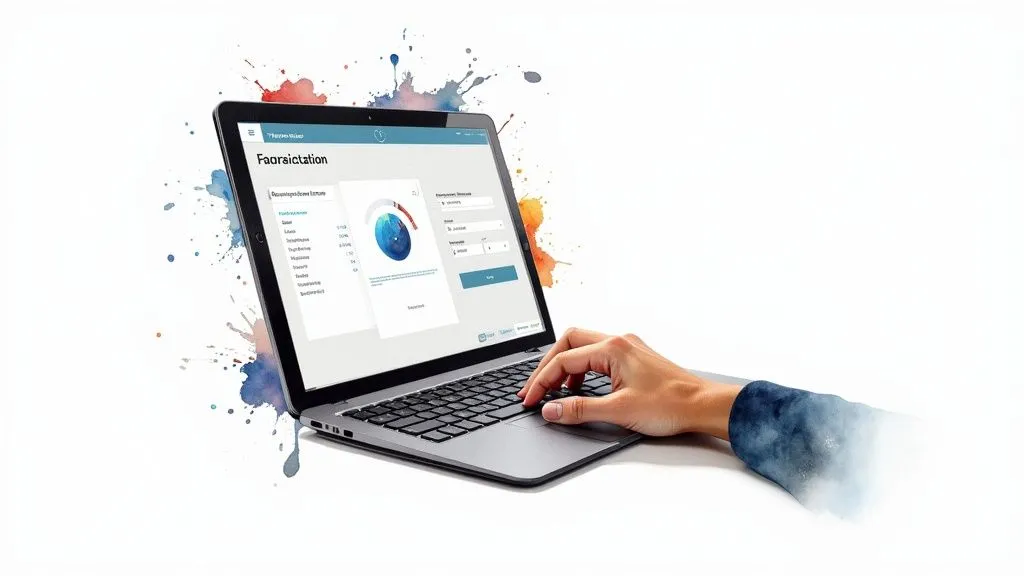
Thanks to this automation, preparing a pro forma invoice becomes a simple formality again. That’s time freed up for tasks that truly pay off.
Features designed for today’s entrepreneurs
Good invoicing software doesn’t just create documents. It becomes a true co-pilot for your day-to-day management, especially if you have specific needs or work internationally. Sole traders, for example, find tools perfectly suited to their status, radically simplifying their paperwork. If that’s your case, our guide on the best invoicing software for sole traders might interest you.
It’s estimated that small businesses save up to 10 hours a week by automating their invoicing. That’s time you can reinvest in finding clients or developing your offerings.
Here are a few other features that make all the difference:
- Multi-currency management: Invoice your clients abroad in their own currency, without the hassle. The software handles updated exchange rates and takes care of conversions.
- Professional export: Instantly generate flawless PDFs, customized with your logo and colors, ready to be sent.
- Data synchronization: All your information is updated in real time. This gives you a clear, precise view of your transactions and your business’s financial health.
In short, adopting a tool like Bizyness to manage your pro forma invoices means choosing efficiency and peace of mind. You make your administrative processes more reliable, strengthen your brand image, and, above all, give yourself the means to run your business with much greater peace of mind.
Frequently asked questions about the pro forma invoice
Even with all these explanations, a few very concrete questions often remain. That’s normal. The idea here is to clear up any last doubts so you can use the pro forma invoice with full confidence, like a true pro. Let’s get straight to clear, directly applicable answers.
Does a pro forma invoice have accounting value?
The answer is simple and categorical: no. A pro forma invoice has absolutely no accounting value whatsoever. This is truly the fundamental difference that sets it apart from a standard invoice.
Think of it as an enhanced quote or a very precise simulation. Its role is to put an offer on the table, set the terms of a future transaction, or serve as proof for certain procedures. But it creates neither a receivable for you nor a debt for your client.
Direct consequence: it must never be recorded in your books or your accounting software. Including it would amount to creating phantom revenue and would completely distort your balance sheet. Only the final invoice, issued once the work is done or the goods delivered, has any accounting or tax existence.
Can a pro forma invoice be cancelled or modified?
Absolutely, and it’s even one of its greatest strengths. Since it has no binding legal value, the pro forma invoice is an incredibly flexible document. You can modify it or simply cancel it at any time, without any consequence.
It’s designed to be a basis for negotiation. Your client receives the pro forma invoice and wants to adjust quantities, change an option or discuss delivery times? No problem. Just send them an updated version.
The pro forma invoice is a living document until the agreement is finalized. It evolves as the discussion progresses, allowing you to adjust the commercial offer with great agility before setting it in stone with a signed quote or firm order.
This flexibility is a real convenience. It spares you the administrative burden of credit notes, which would be necessary if you had to correct a final invoice already recorded in your accounts.
Is the client required to pay a pro forma invoice?
Here again, the answer is an unambiguous no. Your client has absolutely no obligation to pay based on a simple pro forma invoice. This document is in no way a request for payment.
The payment obligation only arises once the transaction is finalized and you issue a proper commercial invoice. It’s this final document that formalizes the debt and starts the payment deadline countdown.
Note that a pro forma invoice can certainly be used to request a deposit. But this condition must be clearly stated in writing and be part of the overall agreement. In that case, payment of the deposit must then be confirmed by the issuance of an official deposit invoice, which does carry accounting value.
Is it mandatory to number a pro forma invoice?
Unlike final invoices, which must follow a continuous, gap-free numerical sequence, there is no legal obligation to number a pro forma invoice. That said, it’s a practice I strongly recommend to stay well organized.
Giving each pro forma invoice a unique number (for example, PF-2024-001, PF-2024-002, etc.) will make your life much easier.
- For you: It’s the best way to find it in your files and link it to a quote or order.
- For your client: They can refer to a specific number in your exchanges, which avoids any confusion, especially if several versions have been created.
Adopting clean, logical numbering for your pro forma invoices is a simple habit that strengthens your professionalism and eases your day-to-day management.
When does a pro forma invoice become a final invoice?
A pro forma invoice doesn’t magically “turn into” a final invoice. These are two documents of a very different nature. The pro forma invoice is the draft, the plan; the final invoice is the official document that comes after.
The transition from one to the other happens in several stages:
- Commercial agreement: Your client approves the terms presented in the pro forma invoice.
- Performance of the service: You deliver the goods or perform the service.
- Issuance of the final invoice: Once your part of the contract is fulfilled, you create and send a commercial invoice complying with all mandatory legal particulars.
Fortunately, good invoicing software makes this process nearly automatic. With one click, it carries over the information from the pro forma invoice to generate a compliant final invoice, with a new number that fits seamlessly into your accounting sequence.
As an entrepreneur, beyond managing your business documents, building genuine relationships matters too; also check out this guide on personalized corporate gifts.
Juggling pro forma invoices, quotes and invoices can quickly become a headache. But with the right tool, everything becomes simple and intuitive. Bizyness lets you create professional documents in just a few clicks, convert a quote into a pro forma invoice and then into an invoice effortlessly, and ensures your management is always flawless. Focus on what you do best, we’ll take care of the rest. Discover how Bizyness can simplify your life.
